Diversification

Foreword

Real estate vs stocks, the perennial debate. Which one should you invest in?

As usual, a reminder that I am not a financial professional by training — I am a software engineer by training, and by trade. The following is based on my personal understanding, which is gained through self-study and working in finance for a few years.

If you find anything that you feel is incorrect, please feel free to leave a comment, and discuss your thoughts.

Caveats

Before we go deeper into the discussion, I’d like to address some criticisms of “Monte Carlo“. To be absolutely clear, in “Monte Carlo” and in this post, I use simplified models to represent returns from various assets. In particular, stock returns have been modeled as normal distributions, which isn’t quite correct:

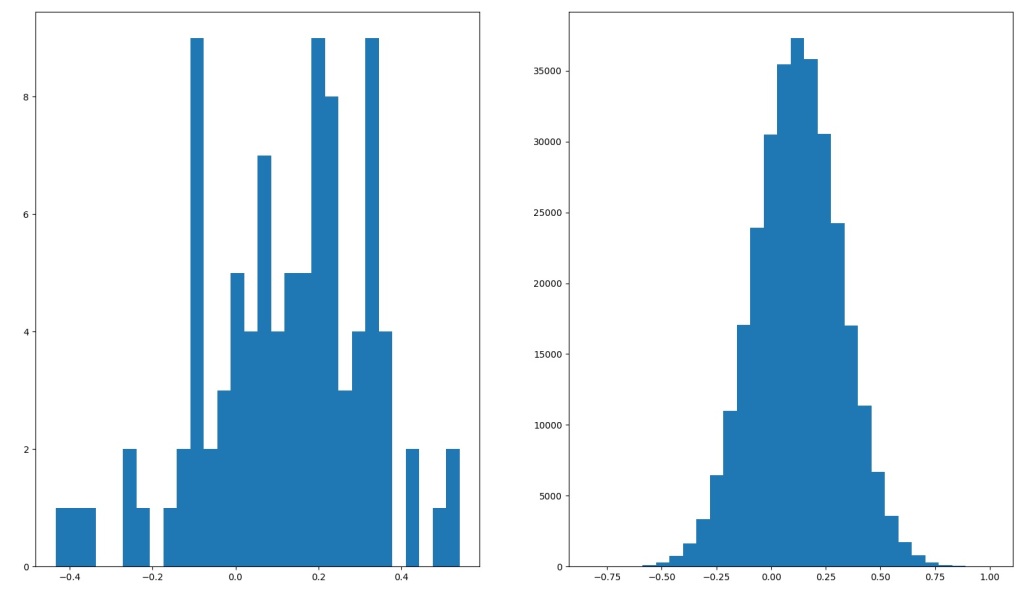
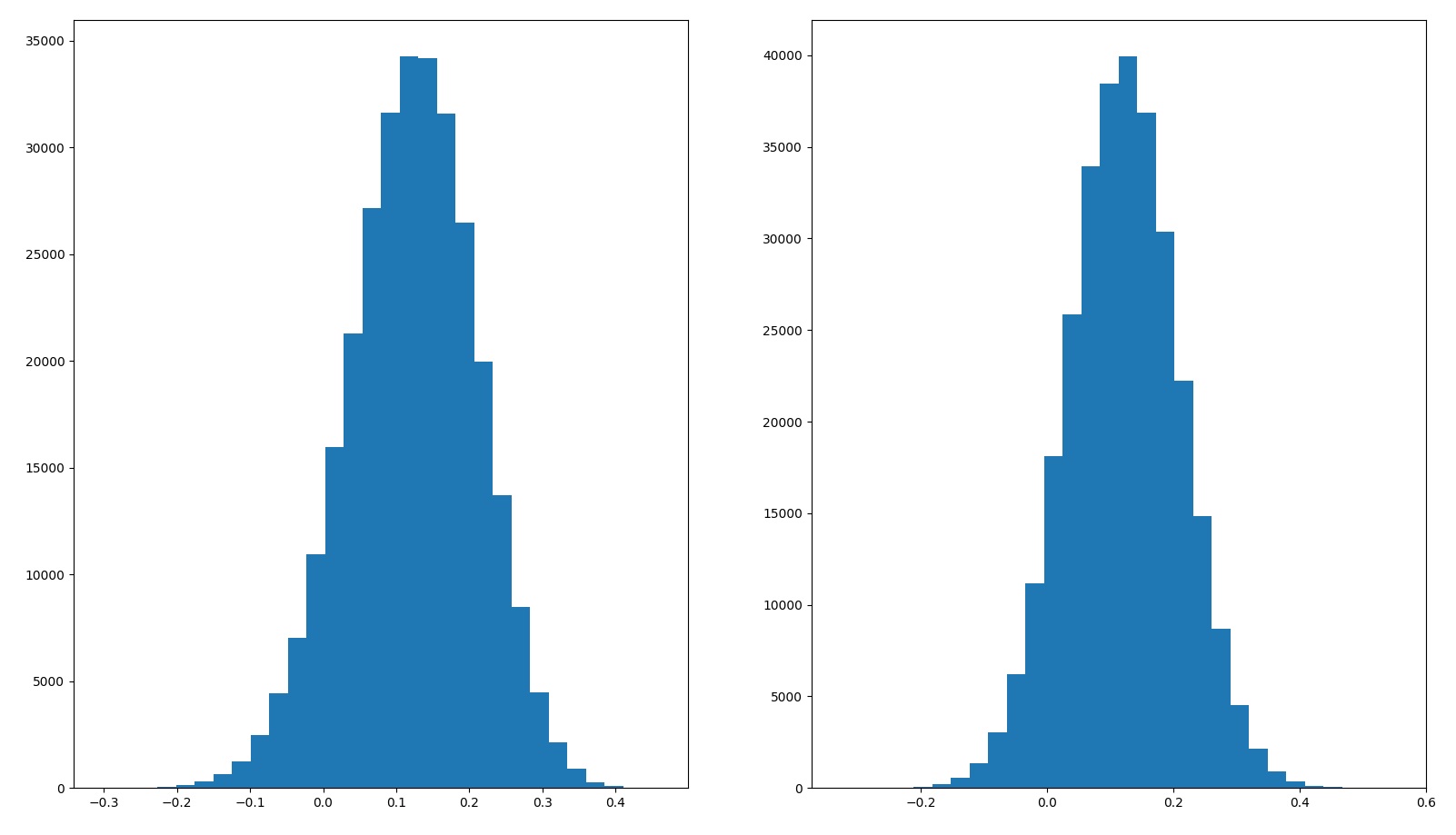
Left: Historical total returns of S&P500 from 1926 to 2020, inclusive.
Right: Normal distribution with 12.2% mean returns and 19.7% standard deviation.

As you can see from the histograms, actual stock markets total returns (left) is quite different from the stylized normal distribution with similar mean and standard deviation.

Separately, assumptions that stocks and bonds (and in this post, real estate) returns are completely uncorrelated are clearly too permissive. In reality, stocks, bonds and real estate are somewhat (negatively) correlated over short periods of time, as all of them are generally affected by politics, inflation and interest rates, amongst other things.

That said, the point of “Monte Carlo” and this post isn’t to build a perfect model for anyone’s financial planning purposes. Instead, these 2 posts are meant to explore various aspects of portfolio construction — how you should think about expected returns, CAGR, SWR, and how volatility affects these metrics. With this rather more modest goal, I believe the simplified models used are more than adequate.

My my, what low returns you have!

In “My Personal Portfolio“, I mentioned that I invest heavily in real estate, generally via private real estate syndications.

In some private discussions about real estate syndications, others have noted that the pro forma returns presented by some real estate syndications that I invest with (generally in the 10-15% range) are lower than what the stock markets have returned in the past 20 years or so.

If you pick up a calculator, you’ll find that from 2009 – 2020 stocks have returned about 15.5% on average every year, with a CAGR of about 15%. Compared to the 10-15% pro forma returns, it seems silly to even consider real estate.

Therefore, we should just invest 100% in stocks… right?

Expected returns

The first problem with the 100% stocks assertion, is that expected returns are misleading — expected returns are merely “expected” as opposed to “realized”. The future is always uncertain, and it is entirely possible that the next N years see returns dramatically below expected returns based on the past N years.

That is why in “Monte Carlo“, each test is done 10,000 times and the metrics reported are the averages of the 10,000 simulations. However, since the average person cannot live 10,000 lives and pick the best/median/average lives (1), these numbers should be taken with a pinch of salt — they are expected values, not realized nor even predicted values. In the context of a single lifetime, the law of large numbers simply does not hold.

Looking further

The next problem with the 100% stocks assertion is that only looking at the expected returns of the past ~11 years is misleading. Typically, expected returns are the arithmetic means of historical returns. In effect, they tell you “given a random year, what is the expected returns of that year”. Stock markets, however, do not always go up uninterrupted — periods of growth are punctuated with periods of declines.

In the context of historical stock markets performance, the past ~11 years have been unusually kind to stock investors, and it is currently not clear if future years will be as kind.

Since returns are multiplicative, a few years of subpar returns in the future will reduce lifetime CAGR significantly. In “Monte Carlo“, I presented historical total returns of the S&P 500, which suggests that long term CAGR is closer to 10%, with mean annual total returns of around 12.2%. Suddenly real estate is looking much better(2)!

Volatility

As we’ve discussed above and in “Monte Carlo“, volatility in the portfolio, as represented by standard deviation of annual total returns, can dramatically curtail the safe withdrawal rate from that portfolio. To illustrate this point, let’s look at some example scenarios.

In each of these, stocks are represented by both their sampled historical returns as well as their normally distributed returns (mean 12.1%, standard deviation 19.7%). The 2 alternate universes is a hypothetical scenario, where we invest 50% of our portfolio each in 2 completely independent stock markets (i.e.: each stock market in its own alternate universe). 5 alternate universes is where we invest 20% of our portfolio each in 5 completely independent stock markets. Real estate is represented by a normally distributed model with mean of 9% and standard deviation of 10% (3).

In each case, the portfolio is rebalanced annually so that the portfolio is distributed across the assets according to the description.

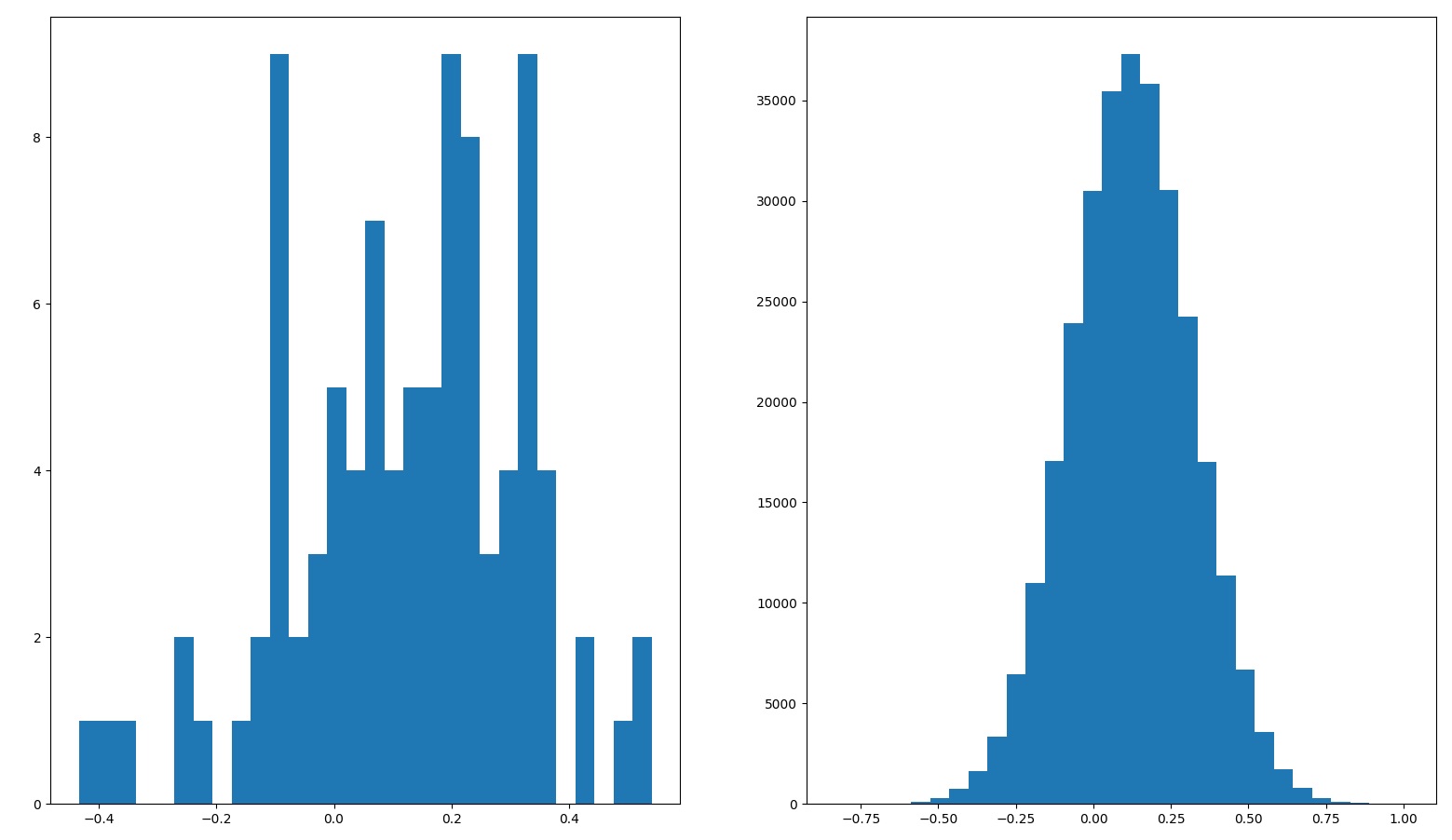
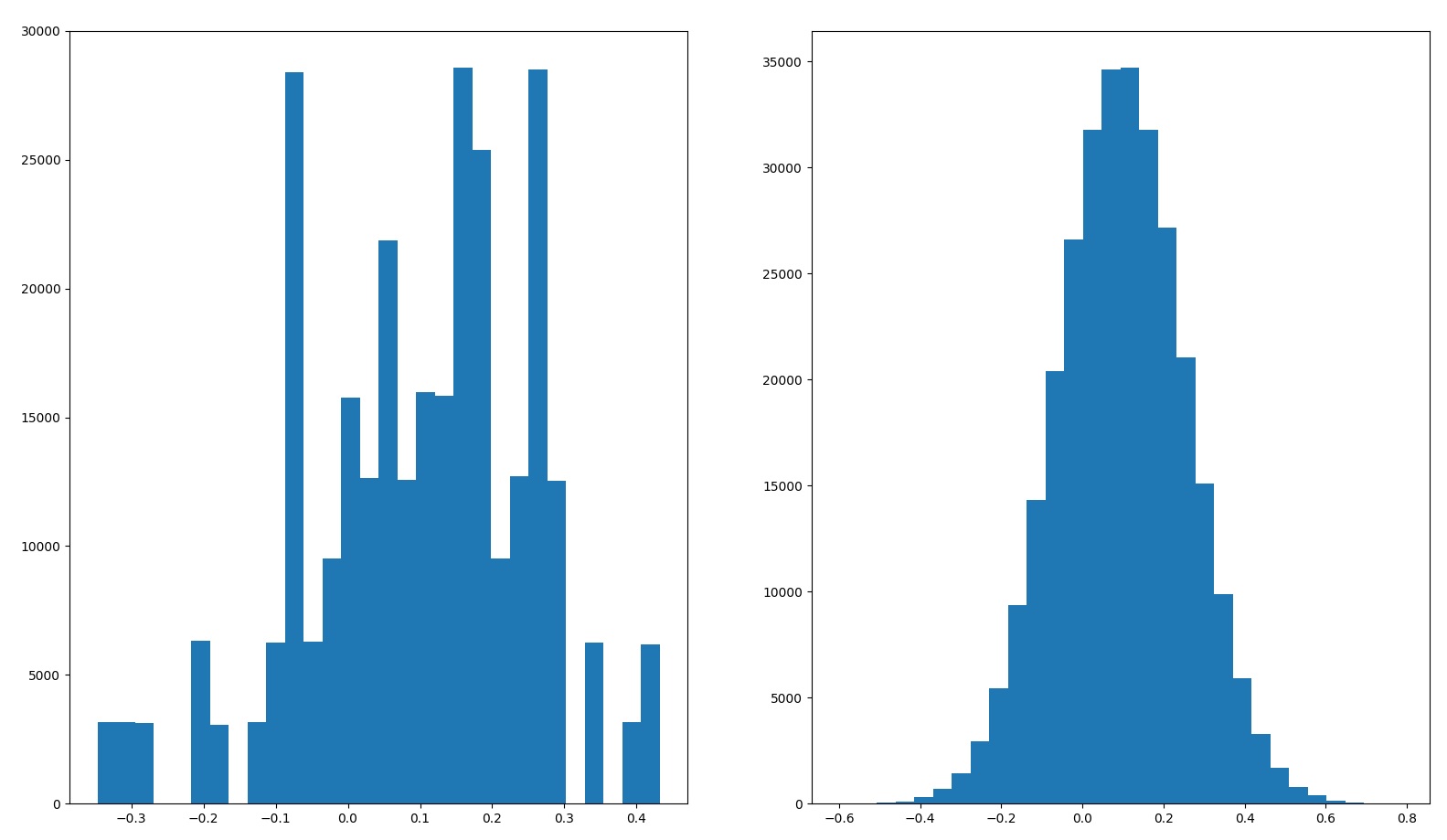
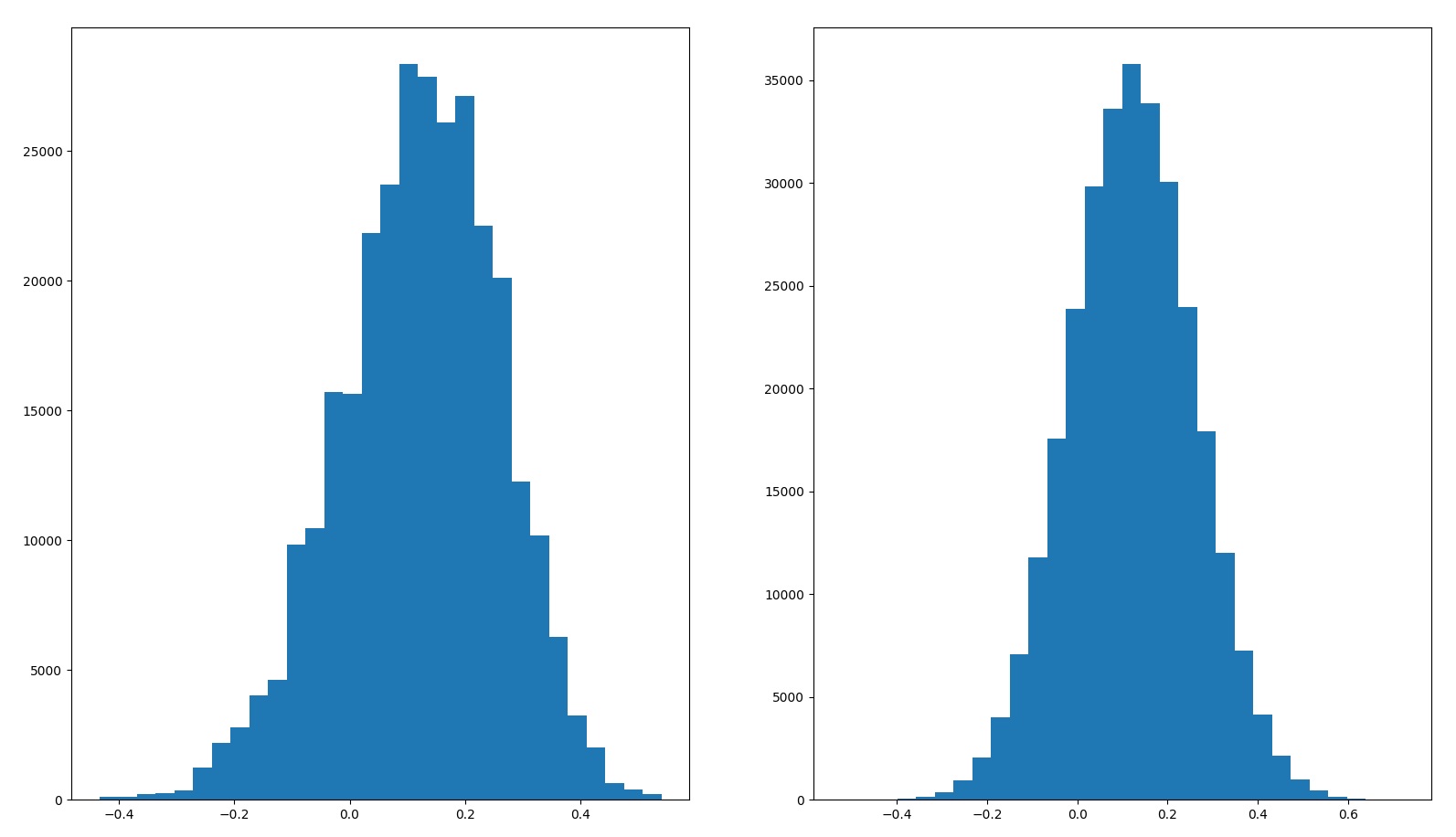
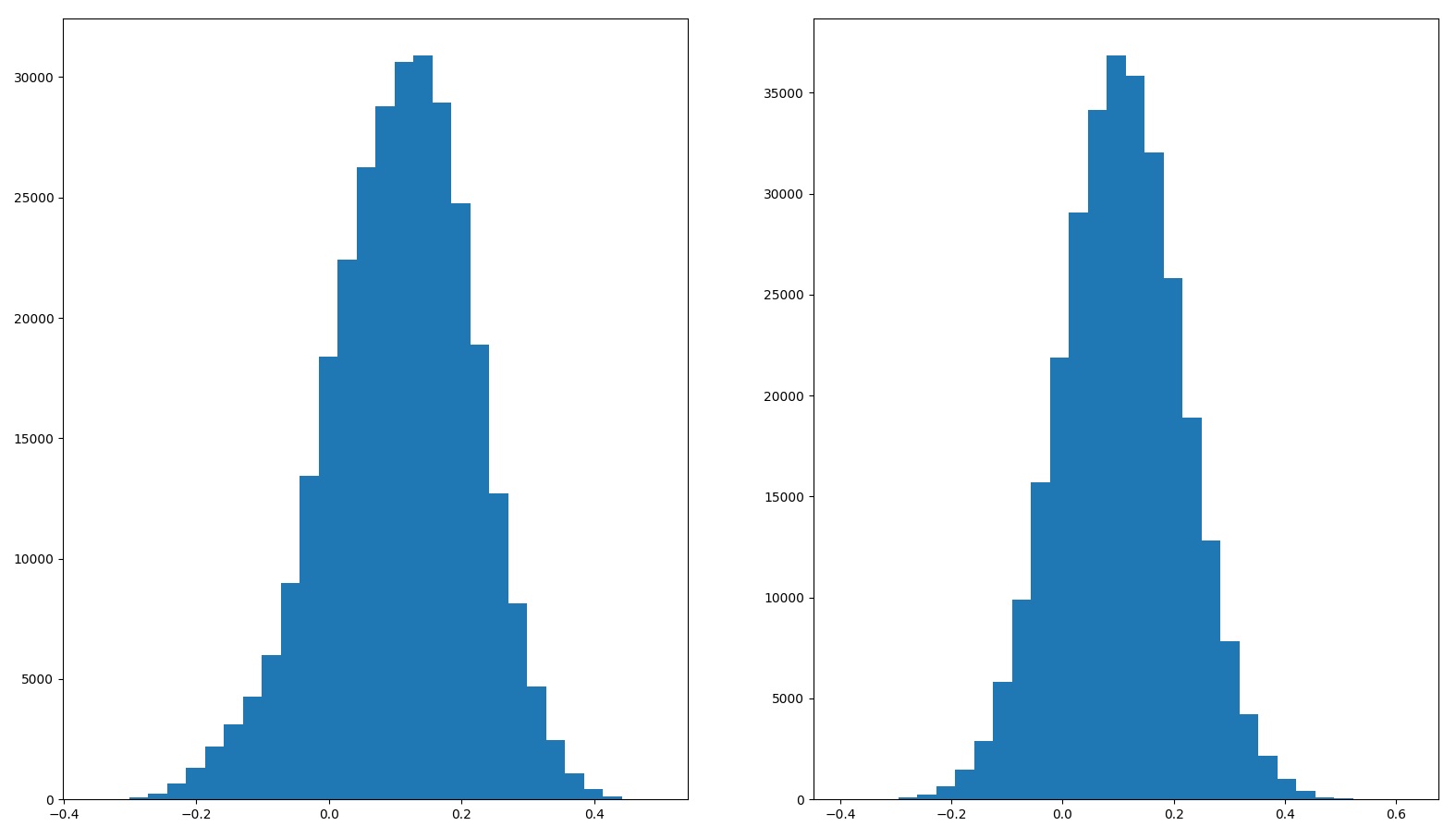
The histogram on the left is when we use sampled historical stock returns for the simulation, and the histogram on the right is when we use normalized stock returns.

PortfolioAverage returnsStandard deviation of returnsHistogram of returns
100% stocksSampled – 12.1%
Normalized – 12.1%
Sampled – 19.7%
Normalized – 19.7%
80% stocks 20% cashSampled – 9.7%
Normalized – 9.7%
Sampled – 15.6%
Normalized – 15.7%
2 alternate universesSampled – 12.2%
Normalized – 12.2%
Sampled – 13.8%
Normalized – 13.9%
5 alternate universesSampled – 12.1%
Normalized – 12.2%
Sampled – 8.75%
Normalized – 8.79%
50% stocks 50% real estateSampled – 10.6%
Normalized – 10.6%
Sampled – 11.00%
Normalized – 11.00%

And for the same 5 portfolios, we compute the CAGR and SWR over 30 years (see “Monte Carlo” for a full description of the methodology details).

PortfolioAverage returnMedian returnCAGRSWR 90%SWR 95%SWR 99%
100% stocksSampled – 12.1%
Normalized – 12.1%
Sampled – 13.9%
Normalized – 12.1%
Sampled – 10.3%
Normalized – 10.4%
Sampled – 3.78%
Normalized – 3.95%
Sampled – 3.00%
Normalized – 3.25%
Sampled – 1.87%
Normalized – 2.08%
80% stocks 20% cashSampled – 9.7%
Normalized – 9.7%
Sampled – 11.1%
Normalized – 9.8%
Sampled – 8.5%
Normalized – 8.6%
Sampled – 3.65%
Normalized – 3.78%
Sampled – 3.05%
Normalized – 3.22%
Sampled – 2.11%
Normalized – 2.32%
2 alternate universesSampled – 12.2%
Normalized – 12.2%
Sampled – 12.9%
Normalized – 12.2%
Sampled – 11.3%
Normalized – 11.3%
Sampled – 5.42%
Normalized – 5.46%
Sampled – 4.76%
Normalized – 4.82%
Sampled – 3.60%
Normalized – 3.74%
5 alternate universesSampled – 12.1%
Normalized – 12.2%
Sampled – 12.4%
Normalized – 12.1%
Sampled – 11.8%
Normalized – 11.8%
Sampled – 6.74%
Normalized – 6.78%
Sampled – 6.26%
Normalized – 6.34%
Sampled – 5.39%
Normalized – 5.46%
50% stocks 50% real estateSampled – 10.6%
Normalized – 10.6%
Sampled – 11.2%
Normalized – 10.6%
Sampled – 10.1%
Normalized – 10.0%
Sampled – 5.27%
Normalized – 5.29%
Sampled – 4.70%
Normalized – 4.81%
Sampled – 3.80%
Normalized – 3.93%

Some interesting results:

  • If we invest in 2 or more independent assets, then the sampled returns approximate the normally distributed model.
    • This is why the differences between using sampled stock returns and normally distributed model is generally small, especially when we consider a diversified portfolio.
  • If you just put 20% of your assets in cash, and 80% in stocks, your expected returns will suffer. However, somewhere in the 95-99%-ile range, your SWR will actually go up.
  • If you can invest in stock markets in 2 alternate universes, then your expected annual returns will remain roughly the same. But your CAGR and SWR will increase dramatically.
  • This is even more pronounced if you can invest in 5 alternate universes.
  • Since I am a mere mortal, the best I can do is invest 50% in stocks and 50% in real estate, which definitely helps SWR, and maybe helps with CAGR as well(3).

Diversification

The basic idea behind the magical increase in CAGR and SWR beyond 100% stocks, is simply “diversification”. When you diversify, and you rebalance your portfolio periodically (4), what you are doing is essentially selling high (the asset which outperformed) and buying low (the asset which underperformed). Buying low and selling high is, historically, the winning strategy for investing (and speculating), and will likely remaining a winning strategy in the future (5).

So, the last problem with the 100% stocks strategy, is that even if real estate has a lower expected annual returns and lower expected CAGR than stocks (3), the very fact that they are not very correlated to stocks means that an allocation to real estate can help increase your portfolio’s CAGR and SWR.

This is the same principle in use when financial advisors recommend investing in index funds (as opposed to single name stocks) — diversification helps to reduce overall volatility and regular rebalancing forces you to buy low and sell high.

Side note: taking profits

A corollary that is not immediately obvious from the above, is the act of “taking profits”. Historically, when people have asked me for advice on what to do after some speculative asset they’ve bought appreciated by a huge amount (more than 100% increase in price), my general advice is something along the lines of “sell enough so that you take a decent profit, and won’t be sad if everything else drops back to your cost basis.”

The psychological effect of doing so is that you’ve now already realized a decent profit, and everything left in that asset is essentially “house money”. While a mathematical fallacy, I have found that this has made holding on to a speculative asset that much easier.

The financial/mathematical effect of doing so, is essentially the same as diversification. Assuming the money you take out is put into another (not very correlated) asset, then you have essentially achieved the “2 alternate universes” scenario.

Code

What kind of a nerd would I be, if I didn’t also present the code for the simulations mentioned above? Note that this builds upon the code in “Monte Carlo” — you’ll need to copy the code there and save it in a file titled “montecarlo.py” for the code below to work.

#!/usr/bin/python3.8

import matplotlib.pyplot as plt
import montecarlo
import numpy


HISTORICAL_RETURNS = montecarlo.HISTORICAL_RETURNS

NormalDistribution = montecarlo.NormalDistribution
UniformSampling = montecarlo.UniformSampling
Cash = montecarlo.Cash
Composite = montecarlo.Composite

GenerateReturns = montecarlo.GenerateReturns
MonteCarlo = montecarlo.MonteCarlo


def PlotHistogram(data):
  _, axs = plt.subplots(1, len(data))
  if len(data) == 1:
    axs.hist(data, bins=30)
  else:
    for i in range(len(data)):
      axs[i].hist(data[i], bins=30)
  plt.show()


def PrintStats(label, data):
  print("{}  Mean:{:.3g}%  StdDev:{:.3g}%".format(
    label,
    numpy.mean(data) * 100,
    numpy.std(data, ddof=1) * 100))


class NormalizedDistribution(NormalDistribution):
  def __init__(self, label, data):
    NormalDistribution.__init__(self, label, numpy.mean(data), numpy.std(data, ddof=1))


def Main():
  cash = Cash("Cash")

  sampled_stocks = UniformSampling("SampledStocks", HISTORICAL_RETURNS)
  normal_stocks = NormalizedDistribution("NormalizedStocks", HISTORICAL_RETURNS)
  normal_re = NormalDistribution("NormalizedRE", 0.09, 0.1)

  data = GenerateReturns(normal_stocks).flatten()
  PrintStats("Historical S&P 500", HISTORICAL_RETURNS)
  PrintStats("Normalized S&P 500", data)
  MonteCarlo(sampled_stocks)
  MonteCarlo(normal_stocks)
  PlotHistogram([HISTORICAL_RETURNS, data])

  sampled_stocks_80 = Composite("80% sampled", (sampled_stocks, 0.8), (cash, 0.2))
  normal_stocks_80 = Composite("80% normalized", (normal_stocks, 0.8), (cash, 0.2))
  s_data = GenerateReturns(sampled_stocks_80).flatten()
  n_data = GenerateReturns(normal_stocks_80).flatten()
  PrintStats("80% sampled stocks, 20% cash", s_data)
  PrintStats("80% normalized stocks, 20% cash", n_data)
  MonteCarlo(sampled_stocks_80)
  MonteCarlo(normal_stocks_80)
  PlotHistogram([s_data, n_data])

  sampled_stocks_alt2 = Composite("Alt2 sampled", (sampled_stocks, 0.5), (sampled_stocks, 0.5))
  normal_stocks_alt2 = Composite("Alt2 normalized", (normal_stocks, 0.5), (normal_stocks, 0.5))
  s_data = GenerateReturns(sampled_stocks_alt2).flatten()
  n_data = GenerateReturns(normal_stocks_alt2).flatten()
  PrintStats("2 alternate universes, sampled stocks", s_data)
  PrintStats("2 alternate universes, normalized stocks", n_data)
  MonteCarlo(sampled_stocks_alt2)
  MonteCarlo(normal_stocks_alt2)
  PlotHistogram([s_data, n_data])

  sampled_stocks_alt5 = Composite("Alt5 sampled",
                                  (sampled_stocks, 0.2), (sampled_stocks, 0.2), (sampled_stocks, 0.2),
                                  (sampled_stocks, 0.2), (sampled_stocks, 0.2))
  normal_stocks_alt5 = Composite("Alt5 normalized",
                                 (normal_stocks, 0.2), (normal_stocks, 0.2), (normal_stocks, 0.2),
                                 (normal_stocks, 0.2), (normal_stocks, 0.2))
  s_data = GenerateReturns(sampled_stocks_alt5).flatten()
  n_data = GenerateReturns(normal_stocks_alt5).flatten()
  PrintStats("5 alternate universes, sampled stocks", s_data)
  PrintStats("5 alternate universes, normalized stocks", n_data)
  MonteCarlo(sampled_stocks_alt5)
  MonteCarlo(normal_stocks_alt5)
  PlotHistogram([s_data, n_data])

  sampled_stocks_re = Composite("Stocks+RE sampled", (sampled_stocks, 0.5), (normal_re, 0.5))
  normal_stocks_re = Composite("Stocks+RE normalized", (normal_stocks, 0.5), (normal_re, 0.5))
  s_data = GenerateReturns(sampled_stocks_re).flatten()
  n_data = GenerateReturns(normal_stocks_re).flatten()
  PrintStats("Sampled stocks + normalized real estate", s_data)
  PrintStats("Normalized stocks + normalized real estate", n_data)
  MonteCarlo(sampled_stocks_re)
  MonteCarlo(normal_stocks_re)
  PlotHistogram([s_data, n_data])


if __name__ == "__main__":
  Main()

Footnotes

  1. Not religious advice!
  2. This is an imperfect comparison. The pro forma returns from syndications are estimates and may be wrong (though in my, very limited, experience good sponsors tend to underestimate returns). Also, the pro forma returns of syndications today have very little bearings on historical total returns of real estate over long periods of time. Certainly, the Great Financial Crisis of 2008 taught us that real estate prices can go down too!
  3. Real estate returns are hard to measure, because real estate tends to illiquid and non-fungible, and the way depreciation affects accounting just confounds that matter even more. The 9% mean, 10% standard deviation modeled here is mostly out of thin air — I picked 9%/10% because it is a lower return with lower volatility than stocks. Some (unverified) data I’ve found suggests this is too pessimistic — historical real estate returns seems to be better than this.
  4. Rebalancing periodically is key here! If you do not rebalance, then most, if not all, the benefits of diversification goes away. Every time I hear someone boast about how they are both “diversified” and “passive” (so passive that they do not rebalance), I die a little bit inside. I am already old, stop trying to help me along.
  5. If you’ve managed to lose money by buying low and selling high, please let me know!

Financial planning, portfolio management and wealth management

Foreword

Financial planning, portfolio management and wealth management are often used interchangeably, but they are actually different disciplines in finance.

In this post, we look at the differences between the three, and how they should be employed.

As usual, a reminder that I am not a financial professional by training — I am a software engineer by training, and by trade. The following is based on my personal understanding, which is gained through self-study and working in finance for a few years.

If you find anything that you feel is incorrect, please feel free to leave a comment, and discuss your thoughts.

Financial planning

Financial planning, as the name implies, is a process where you plan out your finances. First, you come up with financial goals that you want to achieve, for example:

  • Save for a house down payment by age 30
  • Pay for children’s college
  • Financial independence by 45
  • Retire by 55
  • etc.

These goals should have a dollar amount attached, estimated to the best of your abilities. They should also have a deadline. In effect, all of these goals can be translated into a statement of the form:

I want to have $D by year Y.

Once you have your list of goals, you’ll effectively have a list of net worth dollar amounts that you’ll need, by certain years.

The next step is to take stock of what your assets are, right now. You should be able to then assess the viability of your financial plan, by just applying aggressive assumptions for your assets, for example, 15% annual growth year over year, every year. You should also factor in your expected annual income from a job, trust, allowance, etc., as well as your annual expenditures, again, use aggressive assumptions — your income will grow 2-4% a year, your expenditures will only grow 1.5-3% a year, etc.

If your financial plan fails even with the aggressive assumptions, i.e.: you miss one or more goals even with such aggressive assumptions, then your goals are likely unreasonable, and you should re-evaluate the goals and try and make them more reasonable. For example, maybe delaying retirement by a few years?

Finally, you need to figure out how much risk you need to take on, and how much you need to increase your income by, and how much you need to limit your expenditures by, in order to give your financial plan the highest probability of success. This is important! You are not trying to maximize the return of your assets/investments, but rather, under the set of goals, you are trying to figure out what is the least risky way for you to achieve it.

This last step is where you start making more conservative assumptions. Is 15% annual growth in investments reasonable? There certainly are stocks that grow 15% or more a year for long periods of time. But how likely are you to identify them ahead of time? Also, these stocks tend to be more risky — either small/mid caps, highly levered, etc. Also, how likely are you to get a 2-4% raise every year? How much harder will you have to work to achieve that? Are you willing to work that much harder? And how much will you have to sacrifice in terms of living standards to keep your expenditures low? Are you sure you can maintain such low expenditures for long periods of time?

These are all questions you need to ask yourself honestly, and answer honestly. Make the necessary adjustments to what kind of risks you are willing to take with your investments, how much you are willing to put into your job to try and achieve the raises you target, and how much you are willing to forsake in current standards of living in order to meet your goals.

Remember always, that you are trying to maximize the probability that your plan works! Yes, if you work 20hours a day, you may get a 6% raise every year. But is that reasonable? What are the chances that you work yourself into serious health issues, and then have to take months or even years off of work to recover? Think about all these issues, then ask yourself, is it reasonable to expect yourself to work 20hours a day for 2 years? 5 years? 10 years? Probably not!

As you are probably thinking now, this is an iterative process. As you figure out the kind of sacrifices, risks and adjustments you’ll have to make, you’ll find that perhaps you are willing to trade off some goals to reduce the amount of sacrifices, risks and adjustments you’ll need to make, which in turn will likely increase the probability of success.

After a few rounds of adjusting goals, making more conservative assumptions, you’ll have a better picture of the tradeoffs that you need to make — either reducing your goals, or increasing your risk, sacrifices and adjustments.

And once you are done, once you are happy with the final result, you’ll have a financial plan.

That’s not the end, though! Life is unpredictable and things often change without warning. After you have a financial plan, you need to re-evaluate your plan periodically — I like to do it once a year or when I have to make major financial decisions. Figure out if you are on track for your plan, and if not, go through the iterative process again, and figure out what you need to do to get yourself back on track.

Portfolio management

Portfolio management is the curation of your investment assets. For example, let’s say you have a financial plan in place, and you have devoted $100,000 to investing. What assets should you buy? In what ratio? Should you have excess cash lying around to opportunistically time market downturns? Or will you stay 100% invested at all times? Or will you even lever your position to be more than 100% invested?

These are all questions that you’ll answer when you are managing your portfolio.

In order to answer these questions, though, you’ll need to have an idea of the different asset classes. Largely they are:

  • Cash
  • Equity (stocks, or ownership of private businesses)
  • Bonds (or other types of debt(-like) instruments such as loan, preferred equity, etc.)
  • Real estate
  • Commodities (such as precious metals, agricultural products, energy commodities, or more likely derivatives of these)
  • More exotic forms such as fine wine, rare art, etc.

Each of these behave differently in different environments. For example, in inflationary environments, commodities and real estate tends to do well, equity decently, but bonds and cash tend to suffer. In reducing interest rate environments, bonds and equity tend to do well, real estate decently, commodities and cash maybe not so much, etc.

Figuring out what to invest in, and in what ratio, is non-trivial! Happily, for most people, the answer need not be very nuanced. A 60/40 portfolio of 60% equities and 40% bonds (1), with maybe a few percentage taken out of each to invest in real estate will generally be a fairly good trade off between risk undertaken and potential reward. However, if you are willing to spend more time on the topic, you may be able to eek out more return without increasing risk or reduce your risk without reducing your return. Unless you have a substantial amount of assets under you care, however, you may find that the results are simply not worth the effort.

Remember that when you are planning your portfolio, you are effectively aiming for some goal from your financial plan — say you need to get 10% returns every year. This goal may severely hamper the choice of assets that you can invest in! If you aim for 10% returns every year, for example, leaving your portfolio entirely in cash is unlikely to work.

Finally, unlikely financial planning, where the focus is mainly on trying to maximize the probability of success (i.e.: reducing risk), portfolio management takes a more balanced approach and looks more at expected returns of assets, before figuring out how to reconcile that with expected risk (i.e.: trading off risk vs return).

Wealth management

Wealth management is generally spoken of as a service provided by a professional, a wealth manager. It’s not really something someone does for themselves.

In effect, wealth management is a service which combines aspects of financial planning and portfolio management. The wealth manager will work with you to figure out what you are comfortable doing for yourself, and what you would prefer professional help with, and then work through the financial planning and portfolio management process with you. At the extreme, you may simply give the manager power of attorney over your assets, and they will then manage everything towards the goals you’ve discussed, and perhaps send you a regular stipend for living expenses.

In practice, wealth management services tend to be very expensive, as they involve a lot of risk for the manager (legal and liability risks mostly), which need to be defrayed with increased fees. Also, ongoing portfolio management and financial planning services tend to be labor intensive, while also requiring fairly specialized skills, again pointing to high fees. So, in general, wealth management services are typically only offered to those who are wealthy, and for most managers, the minimum assets a client must have is generally in the $2-10m range.

How they intertwine

Financial planning can be thought of as your “life’s goals”, finance-wise. It is the targets that you’d like to hit, if you think of your financial life as a business. Portfolio management is, then, the actual steps you’d take to achieve those targets (though focusing only on investments, while a financial plan often involves incomes and expenditures as well).

Wealth management, in our little analogy, will then be the hiring of external consultants or vendors to advice on or run part of your business for you.

Do I need a financial plan?

Probably yes! Everyone has goals they’d want to meet in the future, and unless you are so incredibly wealthy that almost any goal you can think of can be trivially met financially, you’ll probably want to develop a financial plan to figure out where you stand, and what you need to work on.

Do I need to manage my portfolio?

Probably yes, but this may not be that hard. Unlike financial planning which often involves taking stock of your current situation and trying to figure out what goals are feasible and how much effort/risk you need to take on, portfolio management can be fairly straightforward.

For most people, a passive (or mostly passive) investment portfolio may be appropriate — unless you have specialized knowledge about the financial markets, or you are personally interested in finance, or if you have a large amount of assets already where even a marginal increase in returns is a meaningful absolute number, you may find that effort spent on managing your portfolio to optimize it more, may be wasted. Instead, for most people, it may be more bang-for-the-buck if you spend more of your efforts on trying to increase your income, for example, taking on more at work to aim for a promotion, or taking on a side gig, etc., or by spending time going through your expenses to try and reduce your expenditures.

A passive investment portfolio may be as simple as figuring a ratio between stocks/bonds that you’d like to hold, and then buying the respective indices in the decided ratio. (2)

Do I need a wealth manager?

Probably not. The pre-requisite net worth for a wealth manager to be even willing to work with you is often a bar most people do not meet. And honestly, unless you are incredibly wealthy and have a very complicated financial situation, it probably isn’t worth the money hiring a wealth manager in the first place.

However, if you do happen to have the requisite $2-10m lying around (check your couch!), and you don’t happen to be interested in finance and just want to enjoy what life has to offer, then a wealth manager may indeed be just what you need.

Footnotes

  1. For those who are younger, you may want to take on more equity risk, say, 70/30, or even up to 90/10, depending on your risk tolerance. For those who are closer to retirement, you may want to reduce equity risk, say, 50/50, etc.
  2. It irks a lot of people, but I generally will not provide financial advice except to people I am close to. This is for conscience reasons (I may be wrong), legal reasons (I am not licensed to provide financial advice) and for liability reasons (you may sue me if I’m wrong). Therefore, this is about as specific as I will go.

Monte Carlo

Foreword

How much money can you spend every year, if you want your money to last 30 years?

Does this change if you invest 100% in stocks? 100% in bonds? 60/40 in stocks/bonds?

Do you even know what the historical returns of stocks are?

As usual, a reminder that I am not a financial professional by training — I am a software engineer by training, and by trade. The following is based on my personal understanding, which is gained through self-study and working in finance for a few years.

If you find anything that you feel is incorrect, please feel free to leave a comment, and discuss your thoughts.

Raw data

Here is the annual total return (1) of the S&P500 index since 1926, taken from https://www.slickcharts.com/sp500/returns. I haven’t verified the data, but a quick glance suggests it’s probably close enough for our purposes. I’ve excluded 2021 because the year hasn’t ended yet. All numbers are in percentage terms.

  18.40,  # 2020
  31.49,  # 2019
  -4.38,  # 2018
  21.83,  # 2017
  11.96,  # 2016
  1.38,  # 2015
  13.69,  # 2014
  32.39,  # 2013
  16.00,  # 2012
  2.11,  # 2011
  15.06,  # 2010
  26.46,  # 2009
  -37.00,  # 2008
  5.49,  # 2007
  15.79,  # 2006
  4.91,  # 2005
  10.88,  # 2004
  28.68,  # 2003
  -22.10,  # 2002
  -11.89,  # 2001
  -9.10,  # 2000
  21.04,  # 1999
  28.58,  # 1998
  33.36,  # 1997
  22.96,  # 1996
  37.58,  # 1995
  1.32,  # 1994
  10.08,  # 1993
  7.62,  # 1992
  30.47,  # 1991
  -3.10,  # 1990
  31.69,  # 1989
  16.61,  # 1988
  5.25,  # 1987
  18.67,  # 1986
  31.73,  # 1985
  6.27,  # 1984
  22.56,  # 1983
  21.55,  # 1982
  -4.91,  # 1981
  32.42,  # 1980
  18.44,  # 1979
  6.56,  # 1978
  -7.18,  # 1977
  23.84,  # 1976
  37.20,  # 1975
  -26.47,  # 1974
  -14.66,  # 1973
  18.98,  # 1972
  14.31,  # 1971
  4.01,  # 1970
  -8.50,  # 1969
  11.06,  # 1968
  23.98,  # 1967
  -10.06,  # 1966
  12.45,  # 1965
  16.48,  # 1964
  22.80,  # 1963
  -8.73,  # 1962
  26.89,  # 1961
  0.47,  # 1960
  11.96,  # 1959
  43.36,  # 1958
  -10.78,  # 1957
  6.56,  # 1956
  31.56,  # 1955
  52.62,  # 1954
  -0.99,  # 1953
  18.37,  # 1952
  24.02,  # 1951
  31.71,  # 1950
  18.79,  # 1949
  5.50,  # 1948
  5.71,  # 1947
  -8.07,  # 1946
  36.44,  # 1945
  19.75,  # 1944
  25.90,  # 1943
  20.34,  # 1942
  -11.59,  # 1941
  -9.78,  # 1940
  -0.41,  # 1939
  31.12,  # 1938
  -35.03,  # 1937
  33.92,  # 1936
  47.67,  # 1935
  -1.44,  # 1934
  53.99,  # 1933
  -8.19,  # 1932
  -43.34,  # 1931
  -24.90,  # 1930
  -8.42,  # 1929
  43.61,  # 1928
  37.49,  # 1927
  11.62,  # 1926

Pop quiz 1

You can refer to the numbers above, but don’t use a calculator or anything, just try to estimate the answers:

  1. What do you think is the average annual return over the period covered?
  2. What do you think is the median annual return over the period covered?
  3. What do you think is the CAGR(2) over the period covered?
  4. Which of the following 3 numbers above should you use, if you want to estimate how much returns you’ll get over the next 10 years?

The answers are:

  1. 12.2%
  2. 14.3%
  3. 10.3%
  4. CAGR, because total returns over a period of time compounds multiplicatively. Average and median are non-compounding measures.

Are those numbers surprising? Most people find it surprising that the CAGR is so much lower than the other 2 measures, because they generally hear about the average/median returns thrown around in the media, but CAGR is a number that’s less frequently used, even though it’s more important. Some people, especially those who started investing since 2010, may find it surprising that the numbers are so low, because they are used to 15+% returns, in most years since 2010. However, because returns compound multiplicatively, a down year dramatically skews the CAGR, which is why we see these numbers.

Pop quiz 2

Now, let’s say we have some amount of money, $R, to retire on, and assume inflation rate of 3% (3), which is to say, if you need $X in year one, you’ll need $(1.03 * X) in year 2, and $(1.03^2 * X) in year 3, and so on.

The ratio X/R is your withdrawal rate in the first year. The safe withdrawal rate (or SWR) is the ratio X/R, such that you have a high probability of not running out of money within your retirement — in our case, 30 years.

Assuming we used $R to buy the S&P 500 index on day 1 of our retirement, and ignoring transaction costs, taxes, etc.,

  1. What do you think is the SWR if you want a 90% probability of not running out of money in 30 years?
  2. What about if we want a 95% probability?
  3. 99% probability?

Now, if you are like most people, you’ll probably do something like take average/median/CAGR of stocks return, subtract the inflation rate, and that’s your SWR. That’ll give you a number that is either 9.2%, 11.3% or 7.3%, depending on which measure of stocks return you used.

And all 3 answers are wrong. The correct answers are:

  1. 3.8%
  2. 3.1%
  3. 1.9%

Hopefully, you are surprised (4).

Whadafuqjuzhappened!?

The reason the numbers are so small, is because of volatility. Stocks don’t go up in a straight line, they often take little detours where the annual total returns is the wrong shade of green (5). During the years where stocks are down, you are actually spending a much larger percentage of your assets to maintain your lifestyle — since your spending strictly goes up due to inflation, X/R (or your withdrawal rate) goes up if X goes up and R goes down.

So, if you want to maintain the same lifestyle over time, you’ll need to start off by just withdrawing a smaller portion of your portfolio in the first year, i.e.: a lower SWR, to compensate for these episodic underperformance of stocks.

This is sometimes called “sequencing risk”.

I am never gonna retire

Well, maybe don’t despair yet — it’s not as bad as it sounds. Recall that you don’t have to invest (just) in stocks. You can also invest in bonds! Or real estate! Or fine art! Or in this blog! I take donations! (6)

Now, as we know, bonds have, in recent history, really low yields. At the time of this writing, the 30y US Treasury is yielding only 1.93%. Can bonds really help?

Pop quiz 3

Let’s say you use your entire retirement fund of $R to buy a 30y US Treasury yielding 2% (7). So, what do you think your SWR is for

  1. 90% probability of not running out of money in 30 years?
  2. 95% probability?
  3. 99% probability?

And the answers are… 2.9%. For all 3. Note that we are assuming US Treasuries won’t default, and you’ll always get your money back, on top of all the other assumptions above.

So yea, for 90/95%, it’s not as good as stocks, but the stability of bonds help in the 99% case.

What’s going on here?

Recall that I said the main reason why SWR for stocks is so low, is because of volatility and sequencing risk — you need money every year to survive, even if the stock market is being uncooperative. But bonds, being so helpfully stable (at least in our made up model world with semi-unrealistic assumptions), means that even at 99% (and 100%!) percentile levels, we can have the same SWR of 2.9%, higher, in fact, than their CAGR (which is 2%)!

To hammer home this point, I ran simulations of various scenarios, and the results are summarized below:

PortfolioAverage returnMedian returnCAGRSWR 90%SWR 95%SWR 99%
Sampled stocks12.14%13.91%10.32%3.75%3.00%1.83%
Normalized stocks12.17%12.14%10.43%4.01%3.25%2.07%
Low vol stocks12.14%12.14%11.72%6.49%6.00%5.18%
Low vol, low return stocks6.06%6.08%5.62%3.25%2.90%2.36%
High vol, high return stocks24.34%24.42%14.30%2.77%1.17%Impossible
2% bonds2.00%2.00%2.00%2.88%2.88%2.88%
6% bonds6.00%6.00%6.00%4.90%4.90%4.90%
10% bonds10.00%10.00%10.00%7.39%7.39%7.39%
60/40 stocks, 2% bonds8.05%8.07%7.42%3.79%3.35%2.66%
55/35/10 stocks, 2% bonds, cash7.35%7.36%6.82%3.66%3.24%2.62%
60/40 stocks, 2% bonds, 1.5x 1% margin11.62%11.65%10.22%4.25%3.54%2.49%
60/40 stocks, 2% bonds, 1.5x 6% margin9.11%9.05%7.67%3.08%2.51%1.61%

“Sampled stocks” is stocks using actual historical returns, uniformly sampled for each simulation year.

“Normalized stocks” is stocks using a random returns sampled from a normal distribution with 12.16% mean and 19.66% standard deviation (which is the mean/standard deviation of our historical data above). As you can see, these numbers are fairly similar. Because it’s easier to model different scenarios using a normal distribution, all other simulations involving stocks use variations of “normalized stocks”.

“Low vol stocks” is stocks where we simply halved the standard deviation for modeling purposes. “Low vol, low return stocks” is stocks where we halved both the standard deviation and the mean. “High vol, high return stocks” is stocks where we doubled both standard deviation and mean.

“2/6/10% bonds” are bonds where the yield is 2%, 6% or 10%. (8)

The remaining rows show composite portfolios where we have some percentage of assets in stocks, bonds or cash, and where we may apply leverage (buying 50% of the portfolio’s value on margin) at different margin interest rates.

Observations

If you go through the data carefully, you’ll quickly see that:

  1. Expected returns (either via average, median or CAGR) is not a good predictor of SWR at all, especially at the higher confidences.
  2. Instead, volatility, or lack thereof, is a much better predictor of SWR, again, especially at the higher confidences.
  3. So, you can sacrifice some expected returns, and get a higher SWR 99% rate, by swapping out some stocks for bonds, or even cash!
  4. If you can get cheap leverage, then some mild application of leverage on a balanced portfolio (for example, 60/40 1.5x leverage with 1% margin) can yield even better results.
  5. But using leverage without first tamping down volatility is a recipe for disaster (not shown here, but the high vol, high return stocks scenario is a good approximate).

Wrapping up

For a very long time, people have been asking me why I’m “leaving money on the table” by not being more aggressive in stocks, or why I’m not levering 100% into stocks, etc. Some have even suggested a portfolio of 100% UPRO (which is a 3x daily balanced SPY product).

But think of it this way — when you retire, you’ll depend essentially 100% on your portfolio for cashflow to survive. And as we discussed in “net worth“, net worth is only useful if it can be used somehow to generate cash flow. Because, say it with me now, you cannot eat net worth. Therefore, “expected net worth”, based on whatever modeling of expected returns from a risky portfolio, is only useful if I can depend on it, at retirement, to generate cash flow. It doesn’t matter if the expected value of my portfolio is $1B at retirement, if there’s a 50% probability I’d go bankrupt — What? Am I supposed to eat caviar on my mega yacht off Monaco 50% of the time and then jump off a building the other 50%? (9)

What about levering up now and then selling everything at retirement to buy safer assets? Sure, if you happen to retire when the stock markets are at a high. But I’m not inclined to time my retirement based on the whims of the stock market. Also, since I don’t have a crystal ball, that means I’ll have to go with a more conservative strategy.

Which is to say, in general, as you approach retirement, it is a good idea to reduce volatility in your portfolio, so that you can smooth out market madness and thus achieve a higher level of stable cash flow (higher SWR) from your portfolio. (10)

Monte Carlo

By now, you’re probably wondering why this post is titled “Monte Carlo”. That’s simply the name of the methodology I used to run the simulation for the numbers above. The code for the simulation is attached, feel free to play with the assumptions yourself to see what comes up.

Note that for all the stocks based portfolios, the inputs are random (which is why we need Monte Carlo in the first place), so your numbers may differ slightly. But I’ve found that the differences are relatively minor, typically in the 5-10bps range.

#!/usr/bin/python3.8

import numpy


# Number of times to run each simulation.
TOTAL_ITERATIONS = 10000
# Ratio of runs where we must end up with more than $0, before we consider the test a success.
THRESHOLDS = [0.9, 0.95, 0.99, 1]

# Number of years to run for in each simulation.
NUM_YEARS = 30
# Inflation rate of cash withdrawal.
INFLATION = 0.03

# This should be mostly irrelevant.  Just use a large number.
START_CASH = 1000000

# Data from https://www.slickcharts.com/sp500/returns
HISTORICAL_RETURNS = numpy.array([
  18.40,  # 2020
  31.49,  # 2019
  -4.38,  # 2018
  21.83,  # 2017
  11.96,  # 2016
  1.38,  # 2015
  13.69,  # 2014
  32.39,  # 2013
  16.00,  # 2012
  2.11,  # 2011
  15.06,  # 2010
  26.46,  # 2009
  -37.00,  # 2008
  5.49,  # 2007
  15.79,  # 2006
  4.91,  # 2005
  10.88,  # 2004
  28.68,  # 2003
  -22.10,  # 2002
  -11.89,  # 2001
  -9.10,  # 2000
  21.04,  # 1999
  28.58,  # 1998
  33.36,  # 1997
  22.96,  # 1996
  37.58,  # 1995
  1.32,  # 1994
  10.08,  # 1993
  7.62,  # 1992
  30.47,  # 1991
  -3.10,  # 1990
  31.69,  # 1989
  16.61,  # 1988
  5.25,  # 1987
  18.67,  # 1986
  31.73,  # 1985
  6.27,  # 1984
  22.56,  # 1983
  21.55,  # 1982
  -4.91,  # 1981
  32.42,  # 1980
  18.44,  # 1979
  6.56,  # 1978
  -7.18,  # 1977
  23.84,  # 1976
  37.20,  # 1975
  -26.47,  # 1974
  -14.66,  # 1973
  18.98,  # 1972
  14.31,  # 1971
  4.01,  # 1970
  -8.50,  # 1969
  11.06,  # 1968
  23.98,  # 1967
  -10.06,  # 1966
  12.45,  # 1965
  16.48,  # 1964
  22.80,  # 1963
  -8.73,  # 1962
  26.89,  # 1961
  0.47,  # 1960
  11.96,  # 1959
  43.36,  # 1958
  -10.78,  # 1957
  6.56,  # 1956
  31.56,  # 1955
  52.62,  # 1954
  -0.99,  # 1953
  18.37,  # 1952
  24.02,  # 1951
  31.71,  # 1950
  18.79,  # 1949
  5.50,  # 1948
  5.71,  # 1947
  -8.07,  # 1946
  36.44,  # 1945
  19.75,  # 1944
  25.90,  # 1943
  20.34,  # 1942
  -11.59,  # 1941
  -9.78,  # 1940
  -0.41,  # 1939
  31.12,  # 1938
  -35.03,  # 1937
  33.92,  # 1936
  47.67,  # 1935
  -1.44,  # 1934
  53.99,  # 1933
  -8.19,  # 1932
  -43.34,  # 1931
  -24.90,  # 1930
  -8.42,  # 1929
  43.61,  # 1928
  37.49,  # 1927
  11.62,  # 1926
])
HISTORICAL_RETURNS /= 100

# Uncomment to print average, median and CAGR of HISTORICAL_RETURNS.
#print(numpy.mean(HISTORICAL_RETURNS) * 100)
#print(numpy.median(HISTORICAL_RETURNS) * 100)
#print((numpy.prod(HISTORICAL_RETURNS + 1) ** (1 / len(HISTORICAL_RETURNS)) - 1) * 100)


class Sim():
  def __init__(self, label):
    self.__label = label

  def Name(self):
    return self.__label


class FixedRate(Sim):
  def __init__(self, label, interest_rate):
    Sim.__init__(self, label)
    self.__interest_rate = interest_rate

  def Return(self):
    return self.__interest_rate


class NormalDistribution(Sim):
  def __init__(self, label, mean, std_dev):
    Sim.__init__(self, label)
    self.__mean = mean
    self.__std_dev = std_dev

  def Return(self):
    return max(-1, numpy.random.normal(self.__mean, self.__std_dev))


class UniformSampling(Sim):
  def __init__(self, label, data):
    Sim.__init__(self, label)
    self.__data = data

  def Return(self):
    return numpy.random.choice(self.__data)


class Cash(FixedRate):
  def __init__(self, label):
    FixedRate.__init__(self, label, 0)


class FullLoss(FixedRate):
  def __init__(self, label):
    FixedRate.__init__(self, label, -1)


class Composite(Sim):
  def __init__(self, label, *args):
    Sim.__init__(self, label)
    self.__args = args

  def Return(self):
    result = 0
    for asset, ratio in self.__args:
      result += asset.Return() * ratio
    return result


def RunOneIteration(model, rate, returns):
  value = START_CASH
  required_cash = START_CASH * rate
  for i in range(NUM_YEARS):
    if value < required_cash:
      return False
    value -= required_cash
    value *= 1 + returns[i]
    required_cash *= (1 + INFLATION)
  return True


def RunSim(threshold, model, rate, returns):
  num_pass_required = TOTAL_ITERATIONS * threshold
  for i in range(TOTAL_ITERATIONS):
    if RunOneIteration(model, rate, returns[i]):
      num_pass_required -= 1
      if num_pass_required <= 0:
        return True
  return False


def GenerateReturns(model):
  output = numpy.empty([TOTAL_ITERATIONS, NUM_YEARS])

  for i in range(TOTAL_ITERATIONS):
    curr_results = output[i]
    for j in range(NUM_YEARS):
      curr_results[j] = model.Return()

  return output


def Report(model, output):
  print("{}:".format(model.Name()))

  while output:
    prefix = output[:5]
    output = output[5:]
    print("  " + "  ".join(["{:>8s}: {:<7s}".format(metric, "{:.2f}%".format(result * 100)) for (metric, result) in prefix]))
  print()


def MonteCarlo(model):
  returns = GenerateReturns(model)

  highest_rate = {}
  for threshold in THRESHOLDS:
    highest_rate[threshold] = float("nan")
    min_rate = 0
    max_rate = 1
    while round(min_rate, 4) < round(max_rate, 4):
      rate = (min_rate + max_rate) / 2
      if RunSim(threshold, model, rate, returns):
        min_rate = rate
        highest_rate[threshold] = rate
      else:
        max_rate = rate

  output = [
    ("Average", numpy.mean(numpy.mean(returns, axis=1))),
    ("Median", numpy.mean(numpy.median(returns, axis=1))),
    ("CAGR", numpy.mean(numpy.prod(returns + 1, axis=1) ** (1 / NUM_YEARS) - 1)),
  ]

  for threshold, rate in highest_rate.items():
    output.append(("SWR-{}%".format(int(threshold * 100)), rate))

  Report(model, output)


def MakeLabelParams(label, *params):
  full_label = label
  first = True
  for param in params:
    if first:
      first = False
      full_label += " {:.2f}".format(param * 100)
    else:
      full_label += "/{:.2f}".format(param * 100)

  return full_label, *params


def Main():
  cash = Cash("Cash")
  margin = FullLoss("MarginCost")

  bonds2 = FixedRate("2% Bonds", 0.02)
  MonteCarlo(bonds2)

  bonds6 = FixedRate("6% Bonds", 0.06)
  MonteCarlo(bonds6)

  bonds10 = FixedRate("10% Bonds", 0.1)
  MonteCarlo(bonds10)

  sampled_stocks = UniformSampling("SampledStocks", HISTORICAL_RETURNS)
  MonteCarlo(sampled_stocks)

  stocks_mean = numpy.mean(HISTORICAL_RETURNS)
  stocks_stdev = numpy.std(HISTORICAL_RETURNS, ddof=1)
  stocks = NormalDistribution(*MakeLabelParams("Stocks", stocks_mean, stocks_stdev))
  MonteCarlo(stocks)

  low_vol = NormalDistribution(*MakeLabelParams("Stocks[LoVol]", stocks_mean, stocks_stdev * 0.5))
  MonteCarlo(low_vol)

  low_vol_mean = NormalDistribution(*MakeLabelParams("Stocks[LoVolMean]", stocks_mean * 0.5, stocks_stdev * 0.5))
  MonteCarlo(low_vol_mean)

  high_vol_mean = NormalDistribution(*MakeLabelParams("Stocks[HiVolMean]", stocks_mean * 2, stocks_stdev * 2))
  MonteCarlo(high_vol_mean)

  stocks60_bonds240 = Composite("60/40", (stocks, 0.6), (bonds2, 0.4))
  MonteCarlo(stocks60_bonds240)

  stocks55_bonds235_cash10 = Composite("55/35/10", (stocks, 0.55), (bonds2, 0.35), (cash, 0.1))
  MonteCarlo(stocks55_bonds235_cash10)

  # 50% margin loan, at 1% rate = 0.05% interest payments per year.
  stocks60_bonds240_x15 = Composite("60/40 x1.5", (stocks, 0.9), (bonds2, 0.6), (margin, 0.005))
  MonteCarlo(stocks60_bonds240_x15)

  # 50% margin loan, at 6% rate = 3% interest payments per year.
  stocks60_bonds240_x15 = Composite("60/40 x1.5", (stocks, 0.9), (bonds2, 0.6), (margin, 0.03))
  MonteCarlo(stocks60_bonds240_x15)


if __name__ == "__main__":
  Main()

Footnotes

  1. Total return is equal to dividends + gains in asset price.
  2. CAGR is “compounded annual growth rate”, which is, loosely speaking, the geometric mean of the returns, expressed in percentage terms.
  3. I’ve been using 3% for modeling inflation for a while now. People used to laugh at me for this, especially during the 2009-2019 period. After 2020, they are still laughing at me. But for very different reasons. For those who are more conservative, feel free to jack up the value to 5% (or more!) in the simulation to see how that affects the numbers.
  4. Look, buddy. I worked really hard to build up the suspense and everything. At least act surprised.
  5. Also known as “red”.
  6. I’m kidding, I don’t take donations.
  7. I’m using 2% because it’s easier to type than 1.93%. Also, US Treasuries have some tax advantages, so it’s probably not THAT crazy an assumption. Finally, there are other “safe’ish” assets that can yield as high as 5-6% “safely”.
  8. Yes, 6% and 10% bonds sound crazy in today’s low interest rates world. But there are assets (mostly for accredited investors) which can indeed yield up to 12%. They have varying degrees of risk, and certainly aren’t risk free like this modeling suggests. But they behave very similarly to bonds.
  9. Interestingly, someone made the argument to me recently that if there’s an asset with a 25% probability of 10x, and 75% probability of going to 0, the expected value is still 2.5x, which means (paraphrased) “you almost have an obligation to buy that asset”. Hopefully this post and the discussion have shown that the question (and thus answer) is not so simple, and that there are a lot of other considerations other than “expected return”.
  10. There are other withdrawal strategies that try to mitigate the sequencing risk issue. Most of them revolve around reducing your cash flow in bad market years (e.g.: keeping your withdrawal rate the same, or even reducing it). Some of them may work, but in general, I’m not really inclined to eat lobster one year and starve the next, just because the stock market decides to tank. I’d rather just have my daily, stable supply of ramen noodle.

Components of a trading strategy

Foreword

Contrary to the perception of many people, a lot of things go into a good trading strategy.

It is not simply just “a good idea”, but really, the orchestration of many different disciplines towards a common goal.

As usual, a reminder that I am not a financial professional by training — I am a software engineer by training, and by trade. The following is based on my personal understanding, which is gained through self-study and working in finance for a few years.

If you find anything that you feel is incorrect, please feel free to leave a comment, and discuss your thoughts.

Investing vs Speculating

Before we begin, let’s address the elephant in the room. Are we talking about investing or speculating?

Both. While most associate “trading” with speculation, in this particular post, I’m using the word in a more mechanical way — a “trade” is just a transaction, an exchange, in this case, of cash for some asset.

In the world of speculation, a “successful trade” is actually 2 (or more) separate trades — one or more to get into the “position”, and one or more to get out of it, sometimes also called a “roundtrip”. A speculative trade is never a success until you close out the position.

In the world of investing, most “successful trades” are also “roundtrips”. However, there is a separate class of trade which are perpetual, or near perpetual, where a “successful trade” is simply how you edge into a long term advantageous position. Recall that when investing, you are hoping to profit off the productive capacity of the asset. Therefore, a successful long term trade could simply just be getting into a long position with an asset that is productive and stable, at a good price — in such a trade, you are not looking to sell, instead, you are looking to hold the asset for an indefinite amount of time and let the productive capacity accrue profits.

There is an old trader’s adage which goes roughly, “An investment is a trade gone pear shaped”. And therein lies the difference as explained above, albeit with a tragicomedy twist.

Components of a trading strategy

So what are the components of a trading strategy? In broad terms, a good trading strategy should always have these 3 main components:

  • Base thesis
    • Why are we even considering this trade?
    • What is the catalyst, or driver for this trade to perform well?
    • Examples:
      • Inflation trade, e.g.: we believe inflation is going up/down over the next N months/years
      • Macro trade, e.g.: we believe this country/industry/sector will go up/down over the next N months/years because of <reason>
  • Execution
    • How would we translate the base thesis, from a purely analytical state, to one or more trades?
    • Embedded in this, are considerations such as:
      • Time horizon – How long are we holding the position in each roundtrip?
      • Instrument – What asset are we going to trade to express the base thesis?
      • Price – At what price are we looking to trade?
      • Trading – Are we going to edge into the position slowly? Or buy everything at once?
    • Example:
      • Base thesis: We believe that inflation will go up slightly in the next 2-3 years
      • Time horizon: 2-3 years
      • Instruments:
        • Short short/medium term Treasuries
        • Long stocks of businesses with fixed input costs and variable output prices
      • Price: At the market based on trading strategy.
      • Trading: Form a basket of the instruments with some ratio, rebalance every 3 months
  • Risk management
    • How would we know that our base thesis/execution strategy was wrong?
    • And if one (or both) was wrong, what are we going to do to salvage the situation?
    • Example (follow up on the above):
      • We’ll know our inflation thesis is wrong if inflation does not go up at least 0.1% on a year over year basis every month for the next 6 months.
      • If our thesis is wrong, immediately close out the short Treasuries leg of the position, keep the long stock leg as long as it is still performing at or near broad market performance, and slowly close it out over 2-3 quarters.
      • We’ll know our execution strategy is wrong if inflation does go up as described, but out position does not appreciate faster than broad market performance over a 1 month moving window, sampled daily.
      • If our execution strategy is wrong, immediately close out all positions and rethink.

Case study – Inflation in the 1970s

Base thesis

We are currently in 1971, we predict inflation is going to be much higher for the rest of the decade into 1980.

Execution strategy

Buy near month exchange traded gold futures, and continually roll the contracts forward until expiration of thesis. We believe market pricing is currently fair, so we’ll trade at the market.

We’ll leverage our position by 3x of equity, rebalanced yearly.

Case study result

Anyone who predicted (in 1971) that high inflation will be a problem that decade would have been absolutely correct — inflation went from around 5% in 1971 to 12% in 1975, and finally around 14% in 1980.

However, this simple summary is misleading. Inflation actually fell after 1971 to a low of around 3% in mid 1972, before its enormous rise to 12% in 1975. After that, it again fell to around 5% in 1977, before another huge surge, before ending at around 14% in 1980.

So while the base thesis was, on the whole, correct, the sampling period and how we decide we were correct or wrong (risk management) may have led to us conclude that high inflation was over in 1972 or 1977!

The execution strategy, on the other hand, likely would have given us a roller coaster ride. From 1971 to 1975, gold prices raised from around $260 per ounce to $929 in early 1975. At 3x leverage balanced yearly, we’d have suffered a devastating 91% loss in 1976, ending up with a value worse than if we had simply just bought gold outright without leverage:

YearGold price in JanAnnual % change3x leverage annual % change3x leverage value
1971261.07261.07
1972305.3417.0%50.9%393.95
1973419.4437.4%112.1%835.57
1974762.3081.7%245.3%2885.22
1975929.3821.9%65.8%4783.69
1976647.59-30.3%-91.0%430.53
1977619.89-4.3%-12.8%375.42
1978760.8322.7%68.2%631.46
1979912.9620.0%60.0%1010.34
19802390.52161.8%485.5%5915.54
Gold prices in 1971-1980 and effects of leverage

If we had closed our position then, however, we’d have lost out on a magnificent rise in value till 1980. True, it’s quite a bit less than 3x what the underlying did, but it was still pretty decent!

The astute reader will notice that in the case study, a section on risk management was left out. This is intentional, because since we are looking at the data in hindsight, any risk management strategy can be crafted to make any arbitrary point. That said, a good risk management strategy would hopefully have gotten us out of the trade either in 1972 (because the base thesis, at that point in time, looked like it might have been wrong), or in mid 1975, because gold prices and inflation were both turning down, or (albeit a very risky strategy) it could have given us the courage to held on to our convictions till 1980.

Why bother?

The reason why a good trading strategy plans out the base thesis, execution strategy and risk management way before even entering a trade, is so that these decisions can be made with a level head. Imagine if you were the portfolio manager of the strategy above. Would you have the conviction to hold in 1972, after a very decent (almost double) gain, but with inflation lower than expected? What about in 1976, after a devastating 91% drawdown? Or would you have folded, expecting gold prices to go even lower (as it did the next year by 1977, by another 12.8%)?

Laying out your strategies, and putting them to paper while you still have a clear head helps to eliminate emotional biases that creep in in the heat of the moment. This gives you a chance to at least think clearly about the issues, and decide what your risk tolerances are.

Efficient Market Hypothesis

Foreword

The Efficient Market Hypothesis (EMH) is often cited, or at least alluded to, as the reason why everyone should just buy a basket of all stocks in the market, and then hold them passively. (1)

However, while I believe that the general advice is reasonable (2), the premise is, I believe, flawed.

As usual, a reminder that I am not a financial professional by training — I am a software engineer by training, and by trade. The following is based on my personal understanding, which is gained through self-study and working in finance for a few years.

If you find anything that you feel is incorrect, please feel free to leave a comment, and discuss your thoughts.

EMH, eh?

The EMH is generally attributed to Eugene Fama, in his seminal work “Efficient Capital Markets: A Review of Theory and Empirical Work”, though as the name suggests, many of the core ideas of the EMH did not come from Fama, but from others before him.

The gist of EMH is best summarized by a quote from the very first paragraph of that paper:

A market in which prices always “fully reflect” available information is called “efficient”.

Fama, E. (1970). Efficient Capital Markets: A Review of Theory and Empirical Work. The Journal of Finance, 25(2), 383-417. doi:10.2307/2325486

Note the key words: “always”, “fully reflect”, “available information”.

In other words, the EMH proposes that any public information is instantaneously (i.e.: always + fully reflected) incorporated into the prices of any securities affected by that information.

Models, models everywhere and not a single forecast to trade on

There are 2 main reasons why I believe the EMH is wrong — one is a technical reason, and the other is based on empirical observations.

Technically speaking…

The EMH is not really a hypothesis, so much as it is a model. It is a model of how financial instruments are supposed to behave, and the idea is that using that model, you can then make reasonable deductions about financial assets (or more accurately, their prices).

By definition, a model is a simulacrum of the original — models abstract away certain details of the original, to achieve a simplified representation.

Therefore, models are, by definition, wrong — when you remove certain aspects of the original in order to achieve the model, you are, in effect, creating something that is not a perfect reflection of the original, and thus it will never predict every single nuance of the original.

However, this doesn’t mean all models are useless! Within the assumptions on the parameters used to create the model, the model could very well be very predictive. For example, a simple model of the Sun is that it rises in the East and sets in the West. This is a model of how the Sun operates, but with the implicit assumption that you are observing the Sun on Earth, in a spot a little bit removed from the absolute North and South poles. If, say, you are observing the Sun from Mars, then this may not hold true any more. So, while this model is useful, because everyone I know is on Earth and none are on Mars, it is actually wrong — it implies the Sun revolves around the Earth in a prescribed path, instead of the other way around.

Ergo, all models are wrong, but some models are selectively useful.

EMH? This. Is. Empirical!

Going back to definition of EMH, note that it explicitly states that publicly available information are instantaneously reflected in the prices of security. Well, how often do you hear market moving information about stocks? Maybe once a day? Once an hour? Every few minutes?

But how often do stock prices move? If you have access to tick level information on stock prices, you’ll notice that they literally move every few microseconds. Microseconds. Are there really “publicly available price moving news” every few microseconds? If not, then why are the stock prices moving if they supposedly “always ‘fully reflect’ available information”? (3)

At a more high level, there exists easily observed price discrepancies in the stock markets. Take, for example, the stock symbols GOOG and GOOGL. Both are stocks of Alphabet Inc., the parent company of Google. GOOG represent class C shares which have exactly the same financial/economic interests as GOOGL, the class A shares. However, GOOGL, the class A shares, have voting rights on top of the financial/economic interests, while GOOG, the class C shares, only have the financial/economic interests.

Given that GOOGL = GOOG + “voting rights”, and voting is optional — you can choose to vote or you can choose to abstain, which means voting rights have a value strictly above 0, we should arrive at the conclusions that GOOGL should always trade at least as high as GOOG, and possibly a little bit higher. Right?

GOOG vs GOOGL stock prices in the past ~5 months in 2021, courtesy of Interactive Broker’s Trader Workstation.

Well, would you look at that…

There are some who claim that prior to Q3 2021, because Alphabet Inc. does buybacks primarily via GOOG, therefore GOOG tends to trade at a higher price compared to GOOGL. I have no idea if that’s accurate, but on the face of it, it seems accurate enough — in Q3 Alphabet Inc. announced that they’ll also buyback GOOGL and the gap closed significantly.

Before the EMH crowd screams “Eureka!”… think about it. A stock buyback is essentially the company taking $N of cash and exchanging it for $N of its own stock. It is a financially and economically neutral move, i.e.: stock buybacks, according to the EMH, should not impact the company’s stock price at all.

Hypothetically speaking…

This is where I’ll admit that I was being a little misleading. If you read Fama’s paper in full, you’ll realize that he didn’t actually say that EMH is correct. In fact, he fully admits the hypothesis is wrong:

We shall conclude that, with but a few exceptions, the efficient markets model stands up well.

Fama, E. (1970). Efficient Capital Markets: A Review of Theory and Empirical Work. The Journal of Finance, 25(2), 383-417. doi:10.2307/2325486

Note that he clearly stated there are “exceptions”, and that the “model” isn’t correct, but that it “stands up well”. More importantly, he doesn’t even call it a hypothesis, but a model.

Because a hypothesis is a proposition of what reality is, and as all budding scientists know, “no amount of experimentation can ever prove me right; a single experiment can prove me wrong”, i.e.: just a single counter example, or exception, can prove a hypothesis is wrong. And we have “a few exceptions” here.

Which is to say, it appears that Fama is fully aware that EMM(odel) is a model, with all that implies about a model. It is close enough to reality that it is a useful model in some cases, but it is wrong to assume that the model is always right.

Practically speaking…

In practice, the EMH is useful essentially when you are unable or unwilling (4) to delve deeper into the data. By abstracting away a lot of the complexities of modern financial system, the EMH provides a useful simplification of what happens in the markets, and allows us to ignore those parts of the markets which we don’t care to care about.

For example, when you are developing a trading algorithm for SPY, the number of things the perfect such algorithm will need to know about is basically limitless — interest rates, consensus interest rates predictions, possible Fed initiatives, major events happening around the world, etc. The list is, quite literally, endless.

To make a perfect trading algorithm for SPY is thus impossible. But that doesn’t mean that a profitable SPY trading algorithm cannot exist! The EMH suggests that for the most part, you can assume away most of the details, and focus only on those bits that you have an edge on. For example, maybe you really understand how interest rates and SPY interact. Well, then you can build a model and an algo off that model, which assumes everything else is priced in (5), and just trade based off your simplistic model. Maybe it works, maybe it doesn’t — the point is, the EMH does not predestine it to not work.

In other words — the EMH is useful if there are some things you simply don’t care to worry about right now. Maybe v2 of your model/algo will take those into account. But right now, you have money to make.

Passive investing

Coming back to “passive investing” (1) — if you are unable or unwilling (4) to delve deeper into the data/details, and you simply want a carefree, easy way of investing your money, passive investing is a reasonable answer (2). This is a corollary of “the EMH is useful if there are some things you simply don’t care to worry about right now” — in this case, you simply don’t care to worry about any of those things.

But understand that it is reasonable, only because you are willingly looking at the problem from 10’000 feet away, and thus missing a lot of the nuances and detail that others who are more attentive may see.

Footnotes

  1. I intentionally avoided using “passive investing” in the foreword, because that term is often overloaded — some people mean “buy and hold” (i.e.: don’t trade too much), some people mean “buy baskets of stocks reflecting the total market” (i.e.: don’t do active stock selection), and some people mean both. For the sake of this article, I’m going with “both”.
  2. It is “reasonable”, in that for most people, it is pretty good advice — most people are unlikely to do much better than simply passive investing (as defined in (1) above), though this is not always true in every case. Remember that financial planning isn’t about maximizing your returns, it is the reverse — it is about finding an acceptable level of return, then figuring out the least risky way of attaining that return. Therefore, in some cases, it may be reasonable to adjust your holdings. For example, if you work in tech and your company pays much of your salary in stock, it may make sense to hedge against a general tech stocks decline by overweighting non-tech stocks in your investing portfolio.
  3. There are some who claim that the stock prices themselves are “publicly available information”, and thus, the “current” price move is just a reflection of the “prior” price move, i.e.: the stock price is moving because the stock price moved and generated new information. This is mostly circular reasoning that falls apart upon even cursory examination — as noted, the information must be “fully reflected” in the price “always”, which implies the information must be priced in instantaneously. There is simply no “prior” or “current” in an instant.
  4. Unable here means, well, unable. It doesn’t necessarily mean “too stupid to”. Similarly, unwilling here means unwilling — it doesn’t necessarily mean “too lazy to”.
  5. By the powers vested in me by the EMH, I pronounced all those factors I don’t care about “priced in”.

Analyst Reports

Foreword

Opinions are like rear ends — everyone has one, and most of them smell funny. Analyst reports are just formal versions of opinions. Draw your own conclusions.

I want to start by noting that I am not a financial professional by training — I am a software engineer by training, and by trade. The following is based on my personal understanding, via some formal classes, but mostly self-taught.

If you find anything that you feel is incorrect, please feel free to leave a comment, and discuss your thoughts.

What report now?

The definition of an “analyst report” is a little loose — people have been talking about stocks pretty much since people have been trading stocks. Anyone who claims to be able to predict the movements of stocks will always get an audience.

To keep the discussions sane, when I say “analyst report”, I mean “analyst reports, valuation models and other stuff of this nature”. Essentially, any document (or video!) that tries to decipher the threads of Fate and give you an insight on what a stock’s price would be in the future.

Types of report

Analyst reports come in 3 main flavors – sell side reports, buy side reports and independent reports.

Sell side reports are the reports that banks, brokers, dealers, etc. generate. These are entities that generally are not investing in the stocks, but provide a service to help someone else (their clients) buy or sell stocks.

Buy side reports are the reports that hedge fund managers, private equity managers, endowment fund managers, private investors, etc. generate. These are entities that are investing in the stocks themselves, or are managing money for others who are investing.

The main difference between brokers/dealers and “money managers” in this, is that “money managers” (buy side) have “skin in the game” — if their recommendation do well, they tend to profit, and if it does not, they may lose money. Brokers/dealers (sell side), on the other hand, are generally just interested in encouraging trading activity — they collect a fee based on each trade, and have no further “skin in the game”, regardless of how the stock performs.

Independent reports are generated purely for the sake of the report. For example, independent research companies which generate reports, and then try to market and sell the reports themselves.

In terms of quality, independent reports tend to be the least biased, followed by buy side, followed by sell side.

Note: Everytime the market is moving rapidly, either up or down, there will be a rush of people trying to portray themselves as “gurus” of the stock market. Some of these people are legitimate — proper research operations with a team of researchers. Others are more fly-by-night operations with a single (or maybe husband+wife/family) operator, yet others are just thinly veiled buy side operations that are just touting their own stocks. The first may or may not produce good recommendations, but the latter two almost never so.

Why write these reports?

As hinted above, sell side reports are generally created as a means to encourage clients to trade more. For example, most brokerage firms will produce reports that provide basic information about a company, and provide historical charts of how the company’s stock price and various other metrics have performed. Some buy side reports also include projections or even recommendations on what stocks to buy and when.

The goal, ultimately, is to provide as much information as needed for the client to decide that they know enough to pull the trigger — to execute a trade. Remember, sell side earns their money from collecting fees (or spreads) when a trade happens, or by collecting fees for handling your account. If you don’t trade, and you don’t put money/assets with them, they don’t get paid.

Buy side reports, on the other hand, are generally private. They are generated as proprietary work products of large financial entities, or even your average investor! Many retail trader have some form of research report that they produce while trying to decide how to manage their money. This can be as simple as “TSLA to the moon!” scribbled on a piece of toilet paper, or as detailed as a spreadsheet with line by line breakdown of a company’s quarterly reports.

The buy side reports that generally make it to the public, usually are published with a single focus — to convince the rest of the world that they are right, and that the rest of the world should follow them in that trade.

Independent reports, finally, are usually made for sale. They tend to be more neutral in tone, and often, the goal of the report is to sell the report itself. For example, Morningstar, Motley Fool, Benzinga, Seeking Alpha all provide independently sourced reports for sale. (1)

Reading an analyst report

When you read an analyst report, you should keep in mind the main objective of the research author, as well as their competencies. As this blog clearly shows, anyone with a keyboard can put together a post. Whether that post is worth reading, is an entirely different matter!

For the most part, analyst reports are fine — they may be wrong (or right!), but they are “fine”. Which is to say — analyst reports are not always right.  If you read a report in full, including all the little size 1 font wordings and maybe press the author for proper disclaimers/assumptions, you’ll quickly realize one thing:

All reports have a list of assumptions/caveats, that taken in full, will read something along the lines of, “This report is correct, assuming it is correct. It may also be wrong. Don’t sue us.”

Analyst reports are not meant to be crystal balls — they are not meant to be predictive.  For the most part, they are meant to be persuasive.  i.e: Given a set of assumptions, then one possibility is that “this” will happen, and you should believe me, because <reason>.

In many cases, the assumptions are simply “assuming what we saw in the past N months repeat in the next N months”.  Which is “fine” — it’s a reasonable prior given no additional information, but it is not “right”, nor is it “predictive”.

When you read an analyst report, don’t just skip to the last line that says “stock X is worth $Y”.  Because that line is, literally, the most useless line in the whole report.

That line bakes in the biases, prejudices and, frankly in many cases, dumb-posterior assumptions made by the author, along with whatever number/fact fudging they care to put in. Instead, read through the assumptions, and see if they make any sense.  You need some amount of critical thinking, some background on the macro and micro environments, and potentially some research of your own.

Once you’re done with the assumptions, look at the model the author is building.  There are many valuation models, but all of them have pros and cons. More importantly, not all models apply to all companies. For example, P/FCF is a very useful model for REITs, because of their tax structure, but P/E is completely useless (because a large part of “E” is reduced by depreciation, which isn’t a real cost for most real estate properties) (2).

Once you’ve done the above, there are a few ways to react to an analyst report:

  1. Read more analyst reports.
    1. Adjust their numbers that were based on wonky assumptions and/or model.
    2. Assign a probability for each report to become true, based on what you understand about the macro/micro environment.
    3. Then take a probability weighted average of all the adjusted results and use that result.
      For example, after reading 3 reports, and adjusting each for obvious errors, you get these predictions:
      Report 1: Stock @ $100
      Report 2: Stock @ $90
      Report 3: Stock @ $50
      You give these reports the following probabilities of becoming true:
      Report 1: 50%
      Report 2: 40%
      Report 3: 10%
      And so, the weighted average is (100*0.5) + (90*0.4) + (50*0.1) = $91
  2. Read more analyst reports.
    1. Filter out those that are just plain batpoop crazy.
    2. Of the rest, look at the inputs they use, and for each input, consider a reasonable conservative estimate across all reports (you can use the most conservative, or the 25%-tile or whatever, depending on how risk-averse you are).
    1. Then recompute based on these numbers.
      For example, if you filter down to 3 reports that are reasonable, and all of these have stock price models based on some estimate of future sales and future production costs, then you can either take the median (or 25%-ile, or average, or whatever) estimate for each of future sales/costs.
      Plug these blended estimates into the model, and arrive at your own estimate for the stock price.
  3. Read more analyst reports.
    1. Use the reports to get a feel of what people “on the street” are thinking, because while a single report is probably noise, a bunch of them together may show a useful trend.
    2. Build your own model.
  4. Read the report as a work of fiction, just like Harry Potter.  If you enjoy it, great.  If not, maybe try Judy Moody instead.
  5. Roll your eyes at yet-another-crazy-analyst-report, say something nice but vague so that whoever showed you the report, and is eagerly hopping up and down telling you about this “hot new opportunity” that is “sure to go to the moon”, will just leave you alone.
  6. Start a thread in an obscure forum in a private company/blog, trying to explain that analyst reports are not meant to be prophetic, nor are they the threads of the Fates.  And pray that enough will understand enough that they stop throwing money at terrible ideas based on even more terrible ideas.

Footnotes

  1. This is not a recommendation nor endorsement for any of these services, or the quality of their reports. Also, note that some research branded as “independent” may have ulterior motives, such as illegal pump and dump schemes, trying to “talk the author’s book”, etc.
  2. See the “How to value a company” series of posts for more details on valuation models:
    1. How to value a company – income statement
    2. How to value a company – balance sheet
    3. How to value a company – cash flow statement [coming soon]

How to value a company – cash flow statement

Foreword

This post discusses some common techniques on evaluating the fundamental value of a company by looking at its cash flow statement, for those who are investing, as defined in Investing vs Speculating.

There are, of course, other ways of evaluating the value of a company, which we will cover in other posts. Other posts in this series:

As usual, a reminder that I am not a financial professional by training — I am a software engineer by training, and by trade. The following is based on my personal understanding, which is gained through self-study and working in finance for a few years.

If you find anything that you feel is incorrect, please feel free to leave a comment, and discuss your thoughts.

Show me the money

If, after reading How to value a company – income statement, you come away thinking there’s way too many finance gobbledygook in there about stuff that aren’t really about cold hard cash, like depreciation, accounts payable, etc., and you’d really just want to figure out whether cash is coming in or leaving the registers. Then you may be tempted to just throw away the income statement and just scream, “Show me the money!”

And you wouldn’t be alone.

This is where the cash flow statement comes in. As the name implies, it is, literally, a statement of the cash flowing into and out of the company. Gone are the hand-wavy “assets” and “costs” like accounts receivable and depreciation. Gone are the confusing terms like “operating costs”, which for some reason, don’t include the costs of actually producing the products (what’s up with that?). Everything is broken down into 5 very simple lines, which tell you exactly how much cash is coming into (or leaving!) the company’s coffers and where they are from (or are going).

Common accounting terms

There’s really only 5 lines on the cash flow statements that are important. Yes, there are probably like 30 lines on an actual cash flow statement (we’ll get to them later), but the 5 important lines are:

Net incomeThis is always the first line in the cash flow statement, but always the last line in the income statement. In both cases, this is the same number, and mean the same thing.

Net income, defined in the earlier post, is the glue that joins a company’s income statement to the cash flow statement.
Total cash from operationsThis is the actual amount of cash, moving into, or out of, the company, due solely to its operations.

Usually, this value is derived backwards from net income by adding back (or taking out) all those line items that aren’t strictly about cash flows due to operations.

For example,
Depreciation is added back in, because it’s not an actual cash expense.
Accounts payable are added back in, because we haven’t paid our suppliers yet, and the cash is still sitting on our balance!
Similarly, accounts receivable is taken out, because we haven’t been paid yet.
Total cash from investingThis is the actual amount of cash, moving into, or out of, the company, due solely to investing activities. This includes things like buying new factories, new equipment, buying another company, etc.

For example,
If our company buys a new factory for $100,000, then this value is reduced by $100,000.
If our company sold a previously bought factory for $120,000, then that is reflected as an increase of $120,000 in this value.
If our company did both, and had no other investing activities, then the total cash from investing = -$100,000 + $120,000 = $20,000.
Total cash from financingThis is the actual amount of cash, moving into, or out of, the company, due solely to financing activities. This includes things like taking out a new loan from a bank, paying off an old loan, paying a dividend to shareholders, etc.

For example,
If our company took out a new loan of $10,000, and paid off an old loan of $9,000, then the total cash from financing = $10,000 – $9,000 = $1,000.
Net change in cashThis is the actual change in the cash balance of the company.

This is simply “cash balance before this period” + “total cash from operations” + “total cash from investing” + “total cash from financing”.

Sometimes, there’s a little line entry that adds or removes a little bit additional due to things like foreign exchange fluctuations. Just to spice things up a little bit.

Showing your work

Yes, there’s really only 5 lines that matter. But you know how things are. We can’t make life too simple — where’s the fun in that? In general, a cash flow statement will contain, oh, about 30-50 lines. The lines other than the 5 lines mentioned above, are basically just the accountants showing their work.

Like in elementary school math, where you can’t just write “5”, or even “The answer is 5”. No, you have to write:
Sally has 2 marbles. Peter has 3 marbles. Total marbles = 2 + 3 = 5.

The result is the same. But the teachers prefer the latter. It makes them feel happier. Or something.

This is good for us! Sometimes the accountants (or the company itself) get things wrong. So they show their work on the cash flow statement. And we get to decide if they know how to do basic arithmetic. (1)

One thing to note: numbers in parentheses are negative numbers — cash flowing out of our company. For example, in the “cash from financing activities” section, “(5,000)” generally means we paid off $5,000 in debt. The parentheses means cash flowing out, and numbers without parentheses mean cash coming in.

And now what?

From the cash flow statement, we can discern a few very important tidbits:
Is most of the cash coming into the company via actual operations?
Or is the company being propped up by more and increasing debt?
Or by selling off assets?

Ideally, we want “total cash from operations” to be a positive number, and much larger than “total cash from investing” and “total cash from financing”.

Even better if “total cash from financing” is a negative number (we are doing so well, we can pay down debt!). Note that a positive “total cash from financing” number isn’t necessarily a bad thing. Maybe the company is raising debt to buy out a competitor and thus expanding its businesses. Or maybe the company is developing a new product line, etc. One off debt issuance to invest into the business is usually a good thing! The red flag is when “total cash from financing” is always positive (i.e: the company is always issuing debt), and always a substantial amount compared to “total cash from operations”.

“Total cash from investing” should hopefully also be a negative number, indicating the business is likely profitable and the company is investing more money into it. However, this is more nuanced.

If “total cash from investing” is always negative, and always a large absolute number, that may indicate a business that is heavily dependent on new injections of capital. For example, if a company has $1,000,000 of “total cash from operations” every quarter, but also $(900,000) of “total cash from investing” every quarter, that suggests that perhaps the company is heavily dependent on rolling over its investments every period to generate the profits for the next period.

Companies like this are sometimes at the mercy of their customers — if they also have a large accounts receivable, if their customers fail to pay up on time, these companies may get into temporary liquidity distress.

Even without being at the mercy of their customers, these companies generally don’t tend to perform as well — the need for heavy capital reinvestment makes it hard to scale the business, because it is not always possible to find enough capital to deploy; At the same time, the need for heavy capital investment (as a ratio of operating profits) suggests lower profitability, which deters investors.

Free cash flow

Free cash flow tells us the core efficiency of a company’s businesses — It is simply the cash the operations of a company generate, without consideration for reinvestments (i.e.: capital expenditure).

Recall that “total cash from operations” is the cash a company generates ignoring depreciation and amortization (amongst other things). So, by starting with “total cash from operations”, we just need to take out “capital expenditure” to get free cash flow:

“Capital expenditure” is the amount of cash a company reinvests in its businesses. For example, to replace capital assets that were consumed as part of operations, or to scale the business. This is sometimes called out in the cash flow statement or income statement, but usually needs to be estimated or calculated — by looking at the income statement and deducing which line items are related to capital expenditure.

Free cash flow = total cash from operations - capital expenditure

Another form of free cash flow, unlevered free cash flow, is simply free cash flow assuming the company has no debt. In this case, interest expenses are added back to the value of “free cash flow”, while tax breaks for interest expenses are taken out:

Unlevered free cash flow = free cash flow + interest expenses - tax deductions due to interest expenses

Note that tax deductions due to interest expenses may not appear in the cash flow statement nor the income statement, and may have to be estimated.

Free cash flow essentially tells us “how much this company can return if we just run it ‘into the ground'”, i.e.: without replacing consumed capital assets. It is a base case of what profits the company is capable of extracting from its businesses.

Unlevered free cash flow is similar, and gives us an idea of what free cash flow would look like, if an acquirer buys out the company and pays off all its debts.

There are other variants of free cash flow that are sector specific. The most widely used is “funds from operations”, which is used commonly in real estate heavy companies (such as REITs). “Funds from operations” is just unlevered free cash flow with losses and gains from sale of properties removed, i.e.: gains are taken out, losses are added back in. The idea is similar — to try and get a number that gives us an idea how profitable this company can be, purely from its core operations.

Once we have determined the variant of free cash flow we are using, and have computed its value, the next question is, what do we do with this number?

Recall that free cash flow gives us an idea of the core efficiency of a company at its businesses. So the most common thing, is to look at free cash flow over time. Is it consistently going up? Is it growing at a suitable rate based on investments into the businesses? How much is the shareholder paying for each dollar of free cash flow?

Ideally, we want free cash flow to be increasing over time, and at a pace equal or faster than reinvestment rate — if the company is reinvesting profits equal to 20% of capital assets, then free cash flow should increase by 20% or more in subsequent periods (2). Otherwise, the company would probably be better off investing that money in other pursuits, or returning the cash to investors.

Sometimes, an unprofitable company may be a good investment, even if free cash flow is currently negative! A company that is heavily investing in its businesses may sometimes have negative free cash flow — recall that free cash flow is operating cash flow – capital expenditure. Assuming the capital expenditure is a temporary event (3), when the need to invest in scaling the business stops, free cash flow will likely quickly jump to positive. Note that such businesses are not without their risks! There is a chance that the capital expenditure does not result in future profits, for example, if the research failed to find anything useful, etc.

Finally, the price / free cash flow (P/FCF) ratio is a useful indicator of how much the investor is paying for dollar of free cash flow from the company. As with the other price ratios (P/E, P/S, etc.), the numerator is usually the market capitalization (price per share can also be used if free cash flow is also normalized to free cash flow per share).

Like the P/S ratio, the P/FCF ratio may be useful for informing whether a company is a good investment at a certain price, even if the company is currently unprofitable. Furthermore, the P/FCF ratio is also useful for companies that have strong and stable cash flows (such as some real estate related businesses) — unlike the P/E ratio, the P/FCF (or P/FFO — price per funds from operations) tends to provide a more stable value less affected by one time events that are not related to the core operations.

A company with a good P/FCF ratio, but a terrible P/E ratio may simply be affected by accounting quirks like depreciation and amortization rules, which are not strictly part of the core operations.

Footnotes

  1. I kid! Nowadays, every financial statement pushed out by a public company, especially a large, public company, is scrutinized by an army of analysts whose jobs are, in part, to make sure silly arithmetic mistakes are rooted out. The additional lines are still useful for those who are curious, and want to know the breakdown even more, though.
  2. Note that in some industries, there is a significant lag time between when investments are made, to when profits from those investments can be extracted. This should be taken into account when judging if free cash flow is growing at a rate commensurate with the investment rate.
  3. Many types of businesses are characterized by heavy capital expenditure in a few years, followed by many years of extracting profits from those capital expenditures. For example, research and development heavy industries (pharmaceuticals, some technology firms, etc.), manufacturing industries (building factories, etc.). Once the capital expenditure is done, the company may be able to enjoy many years of profits without having to do more capital expenditure.

How to value a company – balance sheet

Foreword

This post discusses some common techniques on evaluating the fundamental value of a company by looking at its balance sheet, for those who are investing, as defined in Investing vs Speculating.

There are, of course, other ways of evaluating the value of a company, which we will cover in other posts. Other posts in this series:

As usual, a reminder that I am not a financial professional by training — I am a software engineer by training, and by trade. The following is based on my personal understanding, which is gained through self-study and working in finance for a few years.

If you find anything that you feel is incorrect, please feel free to leave a comment, and discuss your thoughts.

What does a company own?

In the previous post of this series, we considered how a company operates, by looking at its income statement. In this post, we focus instead on what a company is, or more accurately, what it owns.

We have already discussed in the previous post how a model company operates, and how its earnings and sales numbers affect our decision on how much the company is worth. But sometimes, a company does not actually have operations. For example, a holding company is essentially just a legal container that “holds” other companies. The holding company itself has minimal operations — it is mostly only a corporate shell to provide some amount of bookkeeping, legal and financial services to the companies it owns, and it is those companies that have actual businesses and operations.

Trying to value a holding company using P/E ratio, P/S ratio or any metric that falls out of its income statement will necessarily lead to misleading numbers — the main value add of the entire conglomerate is not so much its corporate operations, but the operations of its individual constituent companies.

While we can passthrough the underlying metrics of all the children companies, aggregate them and then compute our valuation ratios based on that, the result is also likely confounding — the children companies may be in different sectors/industries, and at different stages of their corporate lives. Combining revenue and expense numbers across drastically different companies rarely makes a whole lot of sense.

While a holding company is an extreme example, there are certain sectors/industries where purely looking at the income statement of a company can lead to misleading answers. For example, there are companies where a lot of the company’s value is in its assets (such as intellectual property, rights to certain natural resources, actual physical assets that appreciate, etc.), and the assets generally does not depreciate in value quickly (or may even appreciate!). For these companies, even if they do not have any operations, you can make the case that they have value — their assets can be sold or leased to others to generate potential profits.

For companies in these situations, a better way of valuing the company may be to just look at what the company owns — by looking at its balance sheet — and then computing the value of each component and adding them all up.

Common accounting terms

Even in our simple model of a company above, a lot of interesting terms pop up. Understanding how to read a company’s balance sheet will require some basic understanding of these terms.

Note that balance sheets tend to be more freeform, with companies having a decent amount of leeway of defining line items. Because of this, we’ll only discuss line items that are more common across different companies. Sector/industry/company specific line items tend to be self descriptive.

Cash and cash equivalents The amount of cash, usually USD for American firms, as well as any of the company’s assets that can be converted into cash immediately. These include things like bank account balances, very short term bonds, etc.

Example:
Our wooden figurine company has $2,000 in a bank account, and $3,000 worth of 3months US Treasury bonds.

Total cash and cash equivalents = $2,000 + $3,000 = $5,000
Accounts receivableThe amount of money that a company is owed by its customers due to goods or services that were already delivered.

In business, especially international trade, it is common for goods or services to be delivered, before the invoice for payment is sent. The payment, itself, will be further delayed, often with a 30-90 days grace period after invoice was delivered.

While the payment is pending, the amount of money owed is classified as “accounts receivable”.

While it is common for businesses to, essentially, offer short term (and often interest free) loans to their customers via deferred payments for goods and services, investors should be careful to at least verify accounts receivable makes sense.

If the number keeps ballooning, to the point where it is more than 30-90 days worth of sales, then that suggests possible issues with one or more customers’ ability to pay. In these cases, such accounts may have to be labelled delinquent and written down (i.e: the company may have to realize a loss), instead of being listed at full value as “accounts receivable”.

Also, a business where a large part of the current assets (see below) are in accounts receivable is naturally more risky — they are at the mercy of their customers. History is rift with examples of companies where their opportunistic customers decided not to pay up when the company is in financial trouble — if the company does indeed go bankrupt, there is a good chance that the customer may end up not having to pay at all. The higher a company’s account receivables, the more damaging such tactics from unscrupulous customers may be.

Example:
Our company has a regional wholesaler for the Asia region. Figurines are sent to the wholesaler, who then pay for the figurines when they are actually sold (i.e: sale by consignment). The wholesaler pays our company once every quarter for the figurines that were actually sold, and the company will send out a fresh batch of figurines to replace those that did get sold.

Last quarter, the wholesaler reports sales of $6,000, which will be paid at the end of this quarter. Therefore, accounts receivable = $6,000.
InventoryThe amount of products that the company has which has not been sold yet. This is valued at cost — the cost of producing that amount of products, including cost of raw materials, as well as labor to produce the product.

Example:
Our company has 1,000 finished wooden figurines that it has not sold yet in its own warehouses. It also has another 500 figurines with the wholesaler mentioned above. Recall from our previous post that each unit costs $9 to manufacture.

Total inventory = 1,500 units.
Inventory value = 1,500 * $9 = $13,500.
Prepaid expensesThe dollar value of goods or services that the company has prepaid for.

Example:
Our company rents a factory for their woodcarvers to work in. The quarterly rent is $6,000 as noted in our previous post.

However, the lease agreement is for rent to be prepaid annually. So, our company pays $24,000 annually on the first of the year, but only gets to expense $6,000 per quarter.

Therefore, at the end of Q1, our company has prepaid expenses = $24,000 – $6,000 = $18,000.
Current assetsCurrent assets refer to all assets that a company owns, that are expected to be easy to sell or used for operating purposes.

These assets typically include cash and cash equivalents, accounts receivable, inventory and prepaid expenses.

Example:
Our company has current assets = cash and cash equivalents ($5,000) + accounts receivable ($6,000) + inventory ($13,500) + prepaid expenses ($18,000) = $42,500.
GoodwillGoodwill is an intangible asset, that is accrued when a company buys another company. It is the difference between the price paid for the acquired company and the net book value of all the assets and liabilities actually acquired.

Remember that a company is generally worth more than the sum of its assets, because there is value in the act of putting together the assets and organizing them in a way that makes them productive. The company’s brand may also be valuable — customers tend to develop sentimentality towards brands they are familiar with, so even if 2 companies produce exactly the same product, customers tend to prefer the brand they’ve used before.

The more mundane reason why goodwill is generally recorded on the balance sheet, is because accounting generally requires a balanced ledger — whatever a company pays to acquire another company, should be exactly equal to the “value” that the company gets from that purchase. The physical assets of the company acquired are easy enough to value and add to the balance sheet, but since companies almost always sell for more than the sum of their physical assets, in order to balance the ledger, the goodwill entry is created to hold the remaining “value”.

If a company overpays for another company, then the goodwill line item tends to swell up. As it becomes obvious that our acquirer has overpaid, it is eventually forced to “impair” the goodwill (i.e: write it down), by taking a loss. While the loss is an explicit acknowledgement that our acquirer has overpaid (or our acquirer has been such poor stewards of the acquired company that it has lost value), it does allow our acquirer to realize a loss, which can then be used to offset profits to reduce taxes.

Example:
Our company decides to buy another company in a merger-acquisition. The other company has total tangible assets of $30,000, and debt on its books of $10,000. Our company paid $53,000 to acquire that other company.

Goodwill = Acquisition price ($53,000) – total assets acquired ($30,000) + total debt acquired ($10,000) = $33,000.
Total assetsA company’s total assets is simply the sum of its goodwill, current assets, and any other assets that cannot be easily sold or used (i.e: non-current assets).

Example:
In the case of our company, there are no other assets other than current assets and goodwill, so total assets = current assets ($42,500) + goodwill ($33,000) = $75,500.
Accounts payableAccounts payable refers to the amount of money a company owes its suppliers for goods and services that have already been rendered.

Recall that accounts receivable refers to the money owed to a company for goods it has already sold, but has not yet received payment on. Accounts payable is simply the reverse of that — suppliers for a company may have already delivered raw materials that the company has not yet paid for. These are recorded as accounts payable.

Example:
For the upcoming quarter, our company expects to sell 1,200 wooden figurines, and thus require 1,200 blocks of wood. These raw material has already been delivered by the supplier, and our company has 60 days to pay for the wood. Recall that each block of wood costs $5.

Accounts payable = 1,200 * $5 = $6,000.
Current liabilitiesCurrent liabilities refer to all the liabilities that our company has to meet within the year, or its normal operating cycle.

This typically includes accounts payable, any interest due on debt in the calculation period, any dividends that have been announced, any taxes owed but not yet paid, etc.

Example:
Our company has long term debt with annual interest only payments of $1,000. Therefore current liabilities = accounts payable ($6,000) + interest payments ($1,000) = $7,000.
Total debtThe total debt of a company refers to all outstanding loans it has taken out.

Total debt includes account payables, all other short term loans (such as bank loans, revolving credit facilities, etc.), as well as all long term loans. In short, total debt.

Example:
Our company has long term debt with annual interest only payments of $1,000. But that’s not the actual debt amount. Let’s say that debt carries a 10% interest rate, which means the actual long term debt is $10,000.

Therefore, total debt = accounts payable ($6,000) + long term debt ($10,000) = $16,000.
Deferred taxesDeferred taxes can exist as either assets or liabilities (or both!).

In the asset form, it is simply something the company owns, that can reduce future taxable income (and thus future tax liabilities). For example, a company may choose to prepay some of its tax obligations in the future.

In the liability form, it is the opposite — it is tax due for the current period, but not yet paid. Therefore, it’ll need to be paid in the future.

The most common type of deferred tax asset is a loss carryover. For example, our company had a loss this year, it generally won’t get a payment from the IRS (reverse tax!). Instead, it’ll carry the loss on its balance sheet as a deferred tax asset, valued at the amount of the loss multiplied by the tax rate. Whenever the company starts making a profit, these deferred taxes can then be used to offset the taxes due at that time.

The most common type of deferred tax liability is depreciation, typically for real estate. As mentioned in the prior post, depreciation is an estimate that is rarely right on a year to year basis. However, it is not free money from the IRS! When an asset is depreciated for tax purposes, its cost basis is reduced. When the asset is finally disposed of (sold off, in this case), the sales price is compared to the cost basis. If the sales price is greater than the adjusted cost basis after depreciation, then the difference is taxable capital gains. In that sense, if a company estimates that accounting depreciation is likely to reduce the cost basis below the actual value of the asset, it can carry the tax benefits of that depreciation on its balance sheet as a deferred tax liability.
Minority interestMinority interest is a noncurrent liability carried on the balance sheet of companies to reflect that they may not own 100% of the businesses or child companies on their balance sheets.

Example:
Our company bought a 80% stake in a competitor for $20,000 (i.e: the competitor is valued at $25,000). Because our company is effectively the controlling interest in the competitor (a child company), all the assets of the competitor (all $25,000) appears on our company’s balance sheet.

However, our company does not own all of those $25,000 brought onto its balance sheet. Instead, $5,000 belongs to the original owner of the competitor company. This $5,000 is carried on the balance sheet of our company as minority interest.
ReservesReserves represent money set aside by a company to pay for future obligations. For example, insurance companies carry payouts to customers that are due in the future as reserves on their balance sheets; Banks carry estimated future losses from loans as reserves on their balance sheets; Companies being sued carry potential legal settlement costs on their balance sheets as reserves.

Reserves provide shareholders a view into known, or at least the estimated likely, costs of doing business in the foreseeable future.

Example:
Our company was sued for selling a defective product that caused injury to a customer. When the lawsuit was received, the company makes an estimate of how much liability it has (in dollar terms), and set that money aside as reserves for when the lawsuit is completed.

Once the results of the lawsuit are out, but before the penalties are paid, the reserves are adjusted to reflect the actual amount owed to the plaintiff.

Once the payment to the plaintiff is made, the value of the reserve is decreased to $0.
Total liabilitiesTotal liabilities is simply the sum of all liabilities of a company. This includes total debt, deferred taxes liabilities, minority interest and reserves.

Example:
Our company has total liabilities = total debt ($16,000) + interest payments ($1,000) + deferred taxes ($0) + minority interest ($5,000) + reserves ($0) = $22,000.
Preferred stockPreferred stock represents a fractional ownership of a company that has some benefits (and generally, also some downsides) over common stock.

On the balance sheet, preferred stock is generally listed as number of outstanding preferred shares, multiply by the par value of each preferred share. The par value is a made up number, usually some round number like $10 or $25, and has no bearing on what price the preferred stock actually trades at.

This is mostly an accounting entry, there’s no real point thinking too hard about it.

The par value, theoretically, represents the actual value of the share — an investor can return the share to the company and get the par value back. However, the par value is generally so low that no investor would ever do that, so it is mostly an accounting entry.
Common stockCommon stock represents a fractional ownership of a company. In general, stocks traded on the public stock markets are common stock.

On the balance sheet, common stock is generally listed as number of outstanding shares, multiply by the par value of each share. The par value is a made up number, generally less than $1, and has no bearing on what price the common stock actually trades at.

This is mostly an accounting entry, there’s no real point thinking too hard about it.

The par value, theoretically, represents the actual value of the share — an investor can return the share to the company and get the par value back. However, the par value is generally so low that no investor would ever do that, so it is mostly an accounting entry.
Additional paid-in capitalAdditional paid-in capital represents the amount investors pay above the par value of preferred or common stock, to the company when they buy shares directly from the company.

This is mostly an accounting entry, there’s no real point thinking too hard about it.

Remember the par value of shares? The par value of all shares sold + additional paid-in capital will be equal to the total dollar amount of shares that the company sold in a reporting period. It is this total value that is generally interesting, not the individual par value or additional paid-in capital.

Example:
Our company’s shares are currently trading at $100.
However, when our company first IPO’d, it sold 500 shares for $10 a share.
The total amount of money raised, which is the important thing we care about, is 500 * $10 = $5,000.

For accounting purposes, we break this $5,000 into 2 parts: the common stock value, and the additional paid-in capital.

Let’s say the par value of each share is $1 (remember, this is a totally made up number), the common stock value is $500.
And therefore, the additional paid-in capital is $5,000 – $500 = $4,500.

Notice how these two line items by themselves is mostly useless — it is the total amount of money raised ($5,000) that we generally care about.
Retained earningsRetained earnings is the amount left over, after net income is used to pay out dividends to shareholders.

This, in effect, presents additional investments all shareholders make, to continue the operations of the company.

One way to think about this is — a company generates $P in net income in a year. It then distributes all $P to all shareholders as dividends. However, to continue funding the company for the coming year, shareholders are then asked to contribute part of that $P, say $R, back to the company to fund upcoming operations. This $R is retained earnings — companies simply skip the step of asking for $R back, by just reducing dividends by $R directly.

Example:
Our company had net income of $3,200. It paid no dividends, so retained earnings = net income ($3,200) – dividends ($0) = $3,200.
Unrealized gain/lossUnrealized gain/loss refers to any gains or losses a company has on securities held for trading, that has not been sold yet.

Example:
Our company bought 100 shares of another company for $20 a share, total cost basis = $2,000.
If those shares appreciated to $30 a share, then our company has an unrealized gain of $(30 – 20) * 100 = $1,000.
Total shareholder equity

AKA book value
Total shareholder equity refers to the total equity in a company all shareholders (both preferred and common) have in the company. This is the value of the claim the owners (i.e: shareholders) of a company have, after all debts have been paid.

Total shareholder equity = total shareholder equity of previous period + unrealized gain/loss + additional cash infusion from investors + retained earnings.
Where additional cash infusion from investors = par value of common and preferred stock issued in new period + additional paid-in capital of new period.

Example:
For our company, total shareholder equity = total shareholder equity of previous period ($50,000) + unrealized gain/loss ($1,000) + additional cash infusion from investors ($0) + retained earnings ($3,200) = $54,200.

Note that total shareholder equity of previous period = $50,000 is made up for this example, and we assume that our company did not issue more shares this period.

Useful quick gauges

Quick ratioCurrent liabilities are typically paid out of current assets, which means that a healthy company should usually have current liabilities that are smaller than its current assets.

The Quick ratio is generally used as a yardstick to quickly determine how likely a company can meet its short term financial obligations:

Quick ratio = (current assets – inventory – prepaid expenses) / current liabilities
Note that the numerator is simply those current assets which can be easily sold to raise cash.

The lower the Quick ratio, the more likely our company faces a short term cash liquidity crunch.


Example:
For our company, the Quick ratio = (current assets ($42,500) – inventory ($13,500) – prepaid expenses ($18,000)) / current liabilities ($7,000) = 11,000 / 7,000 = ~1.57.


Traditionally, a Quick ratio of 2 is advised — this gives a decent margin of safety against short term issues causing a company financial stress. However, in the modern day, with the advent of “just in time” supply lines, supplier provided short term zero interest debt (via accounts payable), supply chain financing options, standing credit lines, overnight debt markets and generally more liquid debt markets, companies have been known to reduce their cash holdings to increase operating efficiency, while using short term debt to cover potential funding shortfalls.

It may sound silly to hold less cash, only to borrow money (and thus pay interest!) to cover funding needs. But, in reality, it may actually increase the profitability of a company. Consider a well run company with high operating margins (say 20%). This company can opt to produce more goods (and thus incur more expenses which draw down its cash reserves). This lets our company earn a likely 20% profit on its cash that is otherwise sitting idle, compared to maybe paying a 1-2% interest rate on overnight funding if the company happens to misjudge its short term funding needs. Since 20% > 1-2%, this is a tradeoff many companies would be happy to make!

Be careful though — while many companies are tempted to reduce their cash reserves to improve operating metrics, this should be thought of as increasing leverage — these companies are explicitly leveraging up their balance sheets to improve profits.

This is fine and well, but only up to a point. At some point, if the company is constantly running afoul of funding needs, it also then becomes more susceptible to a short term failure to collect on accounts payable, or a short term lull in sales, which may result in the company violating a debt covenant (i.e: miss a required payment) and thus be in default. That can have serious repercussions on the company’s future operations.
Current ratioThe current ratio is very similar to the Quick ratio, and is generally used for similar purposes.

The main difference is that the numerator of the Current ratio is just current assets, i.e:
Current ratio = current assets / current liabilities

Therefore, Current ratio is usually greater than Quick ratio.

Different people/sector/industries tend to prefer either Current ratio or Quick ratio over the other. This is mostly a personal preference.
Debt to capital ratioThe debt to capital ratio is a measure of how leveraged a company is. It is computed as
Debt to capital ratio = Debt / (Debt + Total shareholder equity)

Notice that the denominator is simply the total amount of assets that a company has to operate with, or the total value of everything the company owns.

This ratio is analogous to the “loan to value” ratio that most people are familiar with (if you’ve ever taken out a mortgage, the loan to value ratio is simply the amount of mortgage you are taking up, divided by the appraised value of the property).


Example:
Our company has total debt of $16,000, and total shareholder equity of $54,200.
Debt to capital ratio = $16,000 / ($16,000 + $54,200) = ~0.23 = 23%.


The higher the debt to capital ratio, the more leveraged a company is.

Note that this is an imperfect measure for determining if a company is solvent, or in financial distress! Different sectors/industries have different characteristics. For example, a sector/industry that generally has a lot of steady, positive cash flow will be able to support higher leverage (i.e: higher debt to capital ratios) — because their cash flow is positive and steady (i.e: predictable), there is less need to hold additional cash as a buffer for when cash flow is slow.

Comparatively, a company in a sector/industry with very seasonal and/or unpredictable cash flow, will have to hold a much larger cash buffer to be sure that it can pay off its creditors in a timely manner. Because of this, it will naturally be less able to support high debt levels.
Price / Book (P/B) ratioAfter we’ve gone through the balance sheet of a company, one thing falls out immediately – the total shareholder equity in the company that shareholders collectively own. If we just take this value, also called “book value”, and then divide it by the number of outstanding shares, we arrive, very neatly, at the book value per share.

The P/B ratio is then simply the price per share divided by the book value per share.

Looking at the P/B ratio is simply answering the question “how much am I paying for each $1 of net assets in this company?” — a P/B ratio of 2 means you pay $2 for every $1 of net assets on the company’s balance sheet.


Example:
For our company, the price of each share is $100. The book value is $54,200.
Book value per share is thus $54,200 / 1,050 = ~$51.62.
Therefore, P/B ratio = 100 / 51.62 = ~1.94


The book value per share of a stock is simply that — the net value of all assets and debt that the the company owns, as represented by a single share of that company. Remember that this does not factor in the usefulness of those assets — certainly a bar of gold is worth a good chunk of change, but a similarly valued piece of machinery is likely more productive(1), which is to say, the machine may be used to generate future profits, while the gold really just sits there, maybe appreciating, maybe depreciating.

In that sense, book value per share is generally used as a lower bound for how much a company’s shares are worth — if the company is completely dormant, then the company is just worth the sum of its individual components (i.e: at the lower bound, P/B = 1). However, if the company’s management manages to do something productive with its assets, then the company could be worth much more than just the sum of the components (i.e: P/B > 1).

There are, of course, rare cases where management is so inept, that a company is valued at less than book value (i.e: P/B < 1). This tends to happen in one of two cases:

When management pursues such value destructive activities, that investors believe the individual components will lose value over time, with no offsetting gain in profits. For example, if a company who’s sole assets are bars of gold, decides that the best way to use its assets is to throw one bar into the ocean every year, then it can be trivially shown that the company would be worth less over time.

When there is such uncertainties in the market, or such lack of faith in management, that investors do not believe the reported book value. For example, during the Great Financial Crisis of 2008, banks are regularly valued at below book value, because investors are concerned about potential hidden risks in the assets of banks, as well as potential fraud.

As noted, different sectors/industries can leverage their assets in different ways, so the P/B ratio is not directly comparable between sectors and industries. In particular, real estate and manufacturing companies tend to have very low P/B ratios, because they tend to be rich in tangible assets like buildings and machinery (i.e: book value per share, the denominator of the P/B ratio, is high), while software related companies tend to have very high P/B ratios, because they tend to be able to leverage their assets more to generate profits.

Generally speaking, if you see 2 companies in the same sector/industry, and they have wildly different P/B ratios, then a good question to ask is, “why is the market valuing the company with lower P/B ratio so poorly?”. Some potential answers:
– Investors have little faith in management’s ability to execute.
– Investors have little faith in the accounting of the balance sheet.
– The company with lower P/B ratio is not leveraging its assets as much as the other company (and so profits are lower per dollar of book value).

Depending on the conclusion you arrive at for the question, the difference in P/B ratio may be good (lower leverage implies potential for future profits via higher leverage), or bad (loss of faith in management, or the books).
Return on equity (ROE)Return on equity tells us how much profit a company is able to generate, with shareholder’s equity in the company.

Recall that shareholder’s equity is basically what’s left after all debts of the company is paid off, so this is a measure of financial efficiency — how much profit can this company generate based on how much shareholders have invested in it.

Return on equity can be computed using this formula — net income / total shareholder equity
Where net income is from the income statement.


Example:
For our company net income from the income statement is $3,200.
Therefore ROE = 3,200 / 54,200 = 5.9%.


ROE gives us an idea of how much profits each dollar of shareholder equity generates — in this case, 5.9% of $1, or 5.9c.

Note that ROE can be artificially inflated. For example, a loss making company which has a steadily decreasing “retained earnings” that is now negative (i.e: retained losses), will see its equity value deteriorate with time. If at some point, this company is even slightly profitable, the net income divided by the now much diminished equity value, may show a dramatically higher ROE than is reality.

Another example is when a company employs excessive debt. Recall that a company can fund itself in many ways, including equity and debt. A company that chooses to primarily fund itself with debt (i.e: higher leverage), will naturally have a higher net income compared to its equity. This gives the false impression of a healthy company, one with high ROE.

However, if the company fails to roll over those debt in the future, it’ll likely suffer a catastrophic drop in net income, or may even become insolvent, at least in the short term.

It is because of these issues, that I personally eschew ROE, and prefer using ROIC (see next) instead.
Return on invested capital (ROIC)Like ROE, ROIC gives us an idea of the profitability of a company, and how efficient it is at using the resources at its disposal. Unlike ROE, ROIC takes into account sources of funding the company’s operations other than equity, namely debt.

The formula for ROIC is NOPAT / invested capital
Where
invested capital = total debt + total shareholder equity
NOPAT = net operating profit after taxes = operating income * (1 – tax rate)

Sometimes, operating income is also called EBIT, which isn’t strictly correct. Recall that
EBIT = Earnings before interest and taxes = net income + interest paid + taxes paid
Therefore, EBIT includes non-operating expenses and income. That said, non-operating expenses and income should, generally be fairly low compared to operating expenses and income, so EBIT and operating income are generally pretty close.


Example:
For our company, NOPAT = operating income (5,000) * (1 – tax rate(20%)) = 5,000 * 0.8 = 4,000
Invested capital = total debt (16,000) + total shareholder equity (54,200) = 70,200
Therefore, ROIC = 4,000 / 70,200 = 5.7%

Notice how our ROIC is slightly below ROE. This is because there is debt on the company’s balance sheet.


ROIC shows us how much profits a company is generating, based on its funding sources, and this is useful in a number of ways:
– We can determine how much debt this company can support. Assume a theoretical company with no equity, and that is funded entirely by debt. Then, this company will be able to support debt with interest rates up to around the ROIC.

For this theoretical company, if interest rate of debt is below ROIC, then it can “arbitrage” by taking on more debt, and increasing operations — the operations will earn it a return of ROIC, which we already know is greater than the cost of the debt, which is the interest rate we pay on the debt (2).

– We can also determine how profitable this enterprise can be. Assume our company is now funded entirely by equity and has no debt. In this case, all the profits flow to the shareholders, and so the shareholders will earn exactly ROIC — if ROIC is 10%, then for every dollar invested, they’ll earn 10c per year. For a well run company, this should be the lower bound. Recall that if our company can get debt at a lower interest rate than ROIC, it can generally produce greater profits by leveraging up and increasing operations. The excess return over the interest paid for debt will then flow to shareholders as well, increasing shareholders’ returns beyond ROIC.

Reading the numbers

The numbers and ratios that we can compute based on the balance sheet generally does not translate directly into a value we should pay for a company. Remember that what a company owns, is not reflective of its potential (or lack thereof!). It is the operations that management layers on top of the company’s assets that generates profits — simply gathering a bunch of factory equipment and putting them together does exactly nothing.

Therefore, except for the special case of a company where operations are to be wound up (e.g: when management is so inept that the best use of the company’s resources is to sell them off and return the cash to shareholders), the balance sheet mostly just tells us how well run a company is, how efficient it is, how profitable is its business, and all of these in terms of the inputs (i.e: funding via equity and debt) into the company.

A well run company will generally have a respectable ROE and ROIC. Generally somewhere in the 10% range is considered pretty good. This is not a hard and fast rule! There are some businesses that are naturally welcoming of leverage, and these tend to have very low ROIC (though potentially very high ROE). For example, most forms of real estate and banking businesses tend to have rather low ROIC because they are so leveraged. In fact, some publishers of company statistics don’t even publish ROIC for banks, because the number is so misleading.

Therefore ROE and ROIC tend to be sector/industry specific — certain sectors/industries just tend to have companies with higher or lower ROE/ROIC.

At the same time, Quick, Current as well as debt to capital ratios give us an idea of how indebted a company is, how likely it is able to service its debts with cash flow, and how likely it is able to meet short term obligations. These are generally useful only on a company by company basis — they tell us how healthy the company is, and how worried we should be of losing our investments in that company.

Finally, the P/B ratio tells us how much we are paying for the company’s assets. It is meaningful only between companies in the same sector/industry, as well as maturity (recall that younger companies tend to have different operating characteristics from more mature ones).

By themselves, none of these metrics are particularly useful for valuing a company. However, they can be used to supplement what we know from the company’s income statement. For example, a company with a particularly high ROE/ROIC for its sector/industry may command a higher P/E (or P/S or whatever) ratio.

Footnotes

  1. Notice how this goes back to the investing vs speculating argument — productive assets, used to generate future investment returns vs non-productive assets, used to generate speculative returns.
  2. This mathematically true, but not practically true. In practice, whenever a company has more debt on its books, the interest rate lenders will demand will go up sharply. At the same time, every business has a natural limit to how much it can grow. If a business is selling to all the customers it can possibly sell to, then increasing operations will not increase profits. For most companies, it is generally true that as investment in the business goes up, the ROIC will fall — another way of saying this is that the marginal profit from the marginal dollar of investment is a diminishing quantity.

Leverage

Foreword

This post discusses leverage, a tool to magnify the profits (or losses!) from your portfolio. Think of leverage as a tool — you can use it to ramp up the risk you are taking in your portfolio, or tamp down the risk (by reducing leverage). In that sense, leverage provides a lot of power to the investor or speculator to fine tune their exposure to the market.

But remember — with great power, comes great responsibility.

As usual, a reminder that I am not a financial professional by training — I am a software engineer by training, and by trade. The following is based on my personal understanding, which is gained through self-study and working in finance for a few years.

If you find anything that you feel is incorrect, please feel free to leave a comment, and discuss your thoughts.

Definition

First off, let’s clarify what I mean by “leverage”.  Typically, leverage means you borrow money, or via some other means, put a multiplicative effect on your capital, such that potential gains or losses are magnified as well.  For example, borrowing $100 on top of your existing $100, to buy $200 worth of stocks, or buying options, trading futures, etc.

I generally quantity leverage as a continuum between 0 to infinity, where a leverage of 0x means you’re in 100% cash, and a leverage of Nx means for every 1% move of the asset (some people use “market”, defined as S&P 500 index), your portfolio value moves by N%. For example, if you have a portfolio of $100, of which $50 is in SPY, then your leverage ratio is $50 / $100 = 0.5x.

Next, I’d like to discuss a term I invented — “holding power”.  Essentially, think of this as a mix of psychological and financial wherewithal to hold on to a position.  If you have $100 to your name, and you need that $100 to buy food for tonight, then you have very low holding power — you desperately need that money to survive, so you are not financially capable of losing that money.  If you have $1m to your name, but you really cannot stand the thought of losing money, you too have very low holding power — even though you can afford the loss financially, you are not psychologically prepared for it.

Why is leverage important?

The term “Sharpe Ratio” gets thrown around a lot.  Implicitly, a higher “Sharpe Ratio” is generally taken to be a good thing — it means your strategy is more likely to make money.  But does it really?

The Sharpe Ratio is just the ratio of the expected returns over the standard deviation of returns (1).  The layman way of thinking about it is:
Your portfolio doesn’t return the same amount everyday.
You can think of it as, your portfolio returns R, with some “noise”, N, for a daily return of R + N(day),
where R is a constant (the expected return) and N(day) can be expressed via the standard deviation of daily returns.

Sharpe Ratio = R/N then, gives you an idea of how your expected return compares, against “random noise” in daily returns.
Higher = more signal = less noise = better.

One of the first uses of Sharpe Ratio, is for portfolio planning.  The intuition is simple — If you have a strategy that is high Sharpe, then you can put more money (i.e: more leverage) into that strategy.  Because a strategy with Sharpe >1 has a low (2) chance of losses on a daily basis (or whatever period you use to calculate your Sharpe Ratio), you can worry less about a margin call (more on this later).

In other words: higher Sharpe Ratio = more “holding power”.

In CAPM and MPT, one of the core assumptions/results is that you leverage more (i.e: put more money into) assets with higher Sharpe Ratio’s. So, if you are discussing CAPM, MPT or Sharpe Ratio, but you are steadfastly against leverage, then it’s… kinda weird?

Margin loan

A margin loan is a direct loan you take out from your broker to buy stocks.  For example, if you deposit $100 into your brokerage account, and you buy $150 worth of stocks, you have $100 in equity and $50 on margin, and your leverage ratio is ($100 + $50) / $100 = 1.5x.

Typically, brokers use Reg-T (this is the name of the SEC rule) to determine how much margin you can have.  The math is complicated and has a lot of corner cases, but essentially, you are required to have ~50% equity (i.e: 2x leverage) when you open new positions.  IIRC, maintenance margin is 25%, which means at any time, you must have at least 25% equity (i.e: 4x leverage).

If you fail either of these 2 tests, your broker will issue a margin call to demand that you put in additional equity (usually via wiring more money).  Some brokers give you 1-2days to send in the money, others give you (literally) 5-10minutes… or less.  If you fail to meet your margin call, your broker has every right to force close your positions (i.e: close your positions) until you meet the requirements.  In some cases, the broker can force close more than is absolutely necessary to meet the 2 tests, e.g: get your maintenance margin to 50% or even higher. Some brokers may even force close your positions without issuing a margin call.

In other words:

  • Margin loans lowers your financial holding power.
  • More leverage lowers your psychological holding power.

Some brokers offer what is known as “portfolio margin”.  This is a case by case basis, and each broker implements it slightly differently, but essentially allows you more leverage than the 50%/25% of Reg-T. They do this by analyzing your portfolio, and if they deem it low risk, they can extend you more leverage.

Now, consider a margin loan — you put in $100, you buy $100 worth of StockA and $100 of StockB.  Is your loan to buy StockA or StockB?
The answer is, neither, and both.

Instead of thinking about “getting a $100 loan to buy Stock?”, you should think of it this way:

  • You have assets of $200.
  • You have debt of $100 (the margin loan).
  • You thus have equity of $200 – $100 = $100.

Effectively, you are giving the broker $100 (cash) to maintain a position of $200 of assets. Whether the broker used your actual $100 to buy the stocks, or put your $100 in a little box and then used their own $200 to buy the stocks, doesn’t really matter. The $100 you put in, is the collateral for the broker.

Any losses to the $200 of assets, first comes out of that collateral.  If the collateral is depleted, then the broker may start losing money — because the asset is now worth less than the loan, unless the broker can force you to cough up the difference, they’ll have to eat the loss.

Therefore, the broker will generally force you to put in more collateral (margin call), or force reduce your position (so they cannot drop in value even further), way before your equity reaches $0.

If you think of it this way (using collateral), then it’ll be easier to reason about why you need to put money in when you are shorting stocks (and thus getting cash from selling the stocks) — you aren’t putting money in to sell stocks, you are putting collateral in to support your position of “short stocks”.

Futures

You can also get leverage by trading futures.  A future contract is essentially a standardized forward contract — Forward contracts cannot be traded on exchanges, they are just bespoke contracts any 2 entities write to each other to transact at a future time.  A future contract has standardized terms, so the contract itself can be traded.

I won’t go into details of a future contract, but the gist is:

  • To open a position (long or short) in a future contract, you need to put in collateral.
  • If you buy 1 contract of MES, you are agreeing to buy 5x<S&P500 value> at the expiry.
  • To make sure you can cover 5x<S&P500 value>, the exchange may require collateral of (I can’t remember exact value, this is completely made up) $100.
    • i.e: $100 of collateral, lets you control ~15k worth of future trade value.  Hence leverage.
  • Like margin loans, futures subject you to margin calls.
  • Unlike margin loans, futures usually allow you to get much higher leverage ratios.

Most types of leveraged ETPs (3) are actually implemented on the side of the fund provider as futures. In other words, for every share of a leveraged ETP, the fund provider just buys some futures on behalf of the ETP owner.

In effect, leveraged ETPs can be thought of as futures, but packaged in such a way that prevents you from getting margin calls. This is not always a good thing! In exchange for not getting margin called, the leveraged ETPs stand a chance of losing a large portion, including 100%, of their value very quickly. In some sense, margin calls tend to protect against a 100% loss (because the broker will usually force close your positions before you even get close).

Options

Options are the last form of leverage commonly available to retail traders.  An option contract is basically a standardized warrant contract, i.e: forward to future, is the same as warrant to option.

Buying an option contract gives you the right, but not the obligation, to buy (call) or sell (put) 1 lot (usually 100 shares) of the underlying stock at expiry, at a certain price (strike price). The seller of the option is at the mercy of the buyer — the buyer decides whether and when to exercise the option and force the trade in the underlying.

Depending on expiry date and strike price, the cost of the option contract changes.  It is possible, though rarely profitable, to get 100x or even more leverage with options.

Brokers are not allowed to let anyone buy options on margin. Therefore, if you buy an option contract, the maximum amount of money you can lose, is the amount of money you spent buying the contract.

Therefore, being long option contracts doesn’t lower your financial holding power.  However, they may still lower your holding power overall, because options are still leverage, and that can lower your psychological holding power.

Cost of leverage

Now, how much should a broker charge for a margin loan?  How much should the exchange demand in collateral for a futures contract?  How much should an option contract cost?

The answer to all these is basically dependent on 2 things:

  1. Volatility
  2. Prime rate (or risk free rate, since they are related)

Margin loans

How much margin you are allowed (the 50%/25% bits) is actually modified by the volatility of the asset you are buying.  Some assets are rated at 100% (e.g: $1 in ICSH is worth $1 of equity).  But some assets are rated at less (e.g: $1 in GME is worth less than $1 of equity in Jan 2021), because those assets are too volatile.

So, volatility affects your maximum leverage. More importantly, remember that volatility of an asset can change at any time, so your maximum leverage can change at any time.

At the same time, the actual cost of the margin loan is typically fixed at some offset from prime rate, e.g: your broker may charge you 8% over prime, which means prime rate + 8% on an annualized basis, for every dollar of margin loan.

Margin loans tend to be very expensive, regardless of volatility.

Futures

Futures pricing is complicated, but essentially takes into account prime rate — otherwise you can arbitrage by buying a future, shorting the stock, and investing the net cash in safe assets like Treasuries.

In general, futures cost more as prime rate goes up. However, because prime rate is generally low (0-1%) pretty much since 2009, the cost of leverage using futures is “cheap”.

At the same time, if the asset is volatile, the bid/ask spread of the future contracts may be larger.  So while the midpoint of the future contract may remain static, it can still cost you more to trade futures if volatility is high (via crossing the spread).

Options

Like futures, options are priced off prime rate.

However, because options are not symmetric (unlike futures, where both sides must trade, options give one side the right to decide whether to trade), the price of options tend to go up when volatility goes up.

Essentially — the more likely the stock price moves (higher volatility), the more you should expect to make money off the option contract, and thus the more the contract should cost.

In general, futures are the cheapest form of leverage, followed by options, followed by margin loans.

Why is holding power important?

The market doesn’t go up or down in a straight line.  Even if the market will definitely be higher tomorrow, from now till tomorrow, it can still go down.

Having more holding power allows you to wait through the ups and downs of your portfolio, and, assuming your thesis is correct, avoid you being forced to close your position before you can realize your profits.

In particular, remember that margin loans and futures give someone else the right to force close your position, if you are in breach of your contract (futures contract or margin loan contract).  This means that you need to build more buffer in, effectively reducing your leverage.

Why is any of this important?

Because you can potentially save money, and/or increase your holding power (and thus more likely to profit) if you structure your portfolio’s leverage properly.

For example, if you have $100, and you want to buy 100 shares of a stock worth $2 each, $200 total, it may be cheaper to do:

  1. Sell 1 put at strike $2
  2. Buy 1 call at strike $2

At expiry, if the stock is below $2, the buyer of the put will force you to buy 1 lot (100 shares) of the stock at $2 each.  If the stock is above $2, you can exercise the long call to buy the 100 shares at $2 each.

To support the short put, you need to have enough equity to support holding100 shares.  However, because you aren’t actually buying the shares, you don’t pay for the margin loan — you just need enough cash in your account to support that hypothetical position. If you have margin enabled on your account, this amount of cash can be substantially less than $2 * 100 = $200 — it’s likely around $100, reflecting 2x Reg-T margin requirements.

Also, when you sell the put, you get some money, which you can then use to offset (perhaps completely!) the cost of the call.

In the end, you need roughly the same amount of equity to support this synthetic long position.  At the same time, the pricing of both call and put will be reflective of the current spot price of the stock, adjusted for volatility and prime rate.

So you “pay” for volatility when you buy the call, but you also “sell” volatility when you sell the put, so your net price is relatively immune from volatility changes.  You do, however, pay for the leverage via prime rate (it’s complicated), i.e: your cost of leverage is roughly prime rate, which is a lot cheaper than the typical retail brokerage margin loan rates of prime + 6-10%!

Note: The short put means that you are obliged to buy the stock if it falls under $2.  This effectively means that if your equity falls too low, your broker can margin call you.  Unlike being long options, when you are short options you are subject to margin calls.

There are a lot of different ways you can structure your leverage to reduce cost of loan, and/or to increase your leverage without dramatically decreasing financial holding power (e.g: by doing it in a way that doesn’t allow your broker or the exchange to margin call you).

In practice, I very rarely use margin loans — instead, I typically use futures or options instead when I want leverage.

Footnotes

  1. Not exactly — it’s actually the expected excess returns over standard deviation of excess returns.   For simplicity, however, many people just ignore the risk free rate.  This becomes even easier to ignore after 2009, where RFR is almost 0% most of the time.
  2. I believe 5%?  I don’t know, I’m really bad at statistics.
  3. ETP stands for exchange traded products, which is a generic name for both ETF (exchange traded fund) and ETN (exchange traded note), combined.

How to value a company – income statement

Foreword

This post discusses some common techniques on evaluating the fundamental value of a company by looking at its income statement, for those who are investing, as defined in Investing vs Speculating.

There are, of course, other ways of evaluating the value of a company, which we will cover in other posts. Other posts in this series:

As usual, a reminder that I am not a financial professional by training — I am a software engineer by training, and by trade. The following is based on my personal understanding, which is gained through self-study and working in finance for a few years.

If you find anything that you feel is incorrect, please feel free to leave a comment, and discuss your thoughts.

How do companies work?

Before we tackle the topic du jour, let’s get down to brass tacks and consider what is even a company? What does a company do? How does it work?

Legally, a company is simply a legal structure where one or more people get together to perform some tasks, generally a business. The company provides a shell to ringfence the business, so that there is a clear separation of concerns between its individual owners, and the business itself. A company, then, can be thought of as a container of a business — though that business may itself be the acquisition of other companies and/or businesses. For example, Berkshire Hathaway, is a holding company, whose main business is to buy other businesses, such as See’s Candies, GEICO, etc. Another interesting example of a “container” company is the SPDR S&P 500 Trust ETF. It is an investment company structured as an exchange traded fund (ETF), with the ticker symbol SPY, and its main business is to buy and hold stocks to track the S&P500 index.

Regardless of the business(es) a company is in, there are a few common aspects shared by all of them:

  • Companies typically seek commercial profit (we are excluding charities and non-profits in this discussion).
  • Companies generally have one or more products. Products may be be tangible, like a watch, a machine, etc., or they may be intangible, like a website, an online service, movie rights, etc.
  • Companies start by taking money from investors (also called shareholders) to invest in producing the product(s).
    • Note that this refers only to the initial investors, generally before the company starts trading on the markets.
    • If you buy shares of a company with a broker, the company does not generally see a single cent of that money — instead, that money goes to pay off earlier investors, who sold you their shares.
  • They may also sell bonds or otherwise acquire debt to raise cash to invest in producing the product(s).
  • Finally, they sell the product(s), ideally at a price higher than the cost of manufacturing the product(s). If they manage to do so, they make a profit.
  • Profits can then be retained by the company to invest in producing future product(s), or they can be used to pay down debt, or returned to investors via dividends, or to reduce the number of investors/outstanding shares by buying back shares.

Common accounting terms

Even in our simple model of a company above, a lot of interesting terms pop up. Understanding how to read a company’s income statement will require some basic understanding of these terms.

Revenue

Gross sales
The total amount of money the company generates from the sales of its product(s). This is almost always the first line of a company’s income statement, so literally the “top line”.

Example:
A company that sells 1,000 wooden figurine for $20 each, will have revenue of $20,000.
Operating expensesThe expenses that the company incurs through its day to day business operations. These can include costs of customer acquisitions, payroll for its workers (not directly producing the product(s)), research and development, etc.

In economics terms, it is essentially the equivalent of “fixed costs”.

Example:
Our wooden figuring company may have to rent some factory space for its woodcarvers, at, say $6,000, which is its operating expenses.

Note that regardless of how many wooden figurines are made or sold, the rent remains at $6,000. For now, we assume the factory is large enough to accommodate any amount of production.
Cost of goods soldThe expenses that the company incurs directly in the production of its product(s). For example, the costs of the materials used to produce the product(s), the payroll for factory workers, etc.

In economics terms, it is essentially the equivalent of “marginal costs”.

Example:
Let’s say that to produce a single figurine, the company has to buy a block of wood for $5, and pay a woodcarver $4 to carve the wood into a figurine. So the cost to produce each figurine is $9. With our sales of 1,000 figurines, our cost of goods sold is $9,000.

Note that cost of goods sold is directly proportional to the amount of wooden figurines sold. The more figurines sold, the more our cost of goods will rise.
Gross income

Gross margin

Gross profit
This is the the difference between “revenue” and “cost of goods sold”.

Gross income tells you how much money the company generates simply from producing and selling its product(s).

Example:
In our example, our company will have gross income = revenue ($20,000) – cost of goods sold ($9,000) = $11,000.

Notice that gross income relates directly to our marginal profitability — if gross income is negative, no amount of additional sales will save our company from eventual bankruptcy! In fact, if gross income is negative, then the company must be selling each unit of product at a loss. So the more units the company sells, the more money the company loses!

Imagine a business that sells $1 notes for 50cents. That company has negative gross income and will go bankrupt eventually — the more “products” it sells, the faster it goes bankrupt!
Operating income

Operating profit
This is the difference between “gross income” and “operating expenses”.

Operating income tells you how much money the company generates from its operations.

Example:
Continuing with our wooden figurine company, its operating income = gross income ($11,000) – operating expenses ($6,000) = $5,000.

Since operating expenses are (mostly) independent of how many product(s) we sell, operating income is basically just what’s left over, after our gross income is used to pay for “overheads” like rent, utilities, legal fees, administrative fees, etc.

Note how a company that has negative operating income, but very high gross income, may actually be in good shape! It may simply be a new company, that needs to ramp up sales. With more sales, gross income will quickly overtake operating expenses and thus lead to high, positive operating income.
Non-operating incomeAny income that the company receives that is not due to its primary business.

Example:
Our company has a interest-bearing savings account which paid the company interest, for a total non-operating income of $1,000.

Note that for some investment companies, some types of interests and dividends from its assets may be considered revenue!
Non-operating expensesAny expense that the company incurs that is not due to its primary business.

Example:
Our company once sold a defective wooden figurine to a customer, who sued and won a judgement of $2,000, which would fall under non-operating expenses.
Income before taxThis is the total amount of profit the company makes before paying its taxes.

This is simply “operating income” + “non-operating income” – “non-operating expenses”.

Example:
Our company has an income before tax = operating income ($5,000) + non-operating income ($1,000) – non-operating expenses ($2,000) = $4,000.
Net incomeThis is the income of the company, after paying (or setting aside money for) any taxes it may owe.

Example:
Our company has a tax rate of 20%, which works out to total taxes = income ($4,000) * 20% = $800.
Therefore, its net income = income ($4,000) – taxes ($800) = $3,200.
Normalized income before taxNormalized income tries to remove the “noise” of regular income by removing one off expenses or gains.

The goal here is to smooth out fluctuations of our income statements, so that long term performance of the business(es) can be easier to discern.

Example:
Our company has some non-operating expenses and income:
Interest from its savings account of $1,000
Payment for a lawsuit it lost for $2,000

Since our company will likely continue maintaining its savings account, but will (hopefully) not be sued (and lose!) on a regular basis, the $1,000 can be considered recurring income, while the $2,000 payout can be considered a one off expense.

Therefore, our normalized income before tax = income before tax ($4,000) + one off expenses ($2,000) – one off income ($0) = $6,000.


Warning: Be careful about how companies classify “one off” expenses and income. It is easy to make the income statement look better than it is, if we classify every expense as “one off” and every source of income as “recurring”! The astute investor should recognize if the level of “one off” expenses remains stubbornly high over long periods of time. Such persistently high “one off” expenses, may really just be a real cost of business that management is misclassifying. Similarly, if certain sources of income fluctuate greatly over time, then maybe those incomes are really one off!
Normalized income after taxThis is just normalized income before tax, with the taxes due removed.

For example:
In our example, normalized income after tax = normalized income before tax ($6,000) – taxes ($800) = $5,200.

Notice how the tax rate is based on actual income before tax, and not normalized income before tax! This is another reason why one should be really careful about how some incomes and expenses should or should be classified as “one off”.
Weighted average shares outstandingOver the course of a reporting period, a company may issue shares to its employees, executives or board members as a form of compensation for their services. At the same time, a company may choose to buy back some of its outstanding shares on the open market with excess cash it may generate.

Because of these, the number of shares outstanding of a company is rarely static — it typically changes slightly over time.

The weighted average shares is just the sum of number of shares outstanding over the reporting period, weighted by the fraction of the period those shares are actually outstanding.

Example:
At the start of a reporting period, our company has 1,000 shares outstanding.
One-quarter of the way through the reporting period, our company buys back 200 shares.
Half way through the same reporting period, our company issues 400 shares to its employees.

So, for the first quarter of the period, there are 1,000 shares outstanding.
For the next quarter, there are 800 shares outstanding.
And for the remaining half, 1,200 shares outstanding.

Weighted average shares outstanding = 1,000 * 0.25 + 800 * 0.25 + 1,200 * 0.5 = 1,050 shares.
Diluted weighted average shares outstanding In addition to issuing new shares, a company may also issue warrants (or options) on its shares.

These directly issued warrants/options give the bearer the right, but not the obligation, to buy more shares directly from the company at a certain price — the strike price. If and when the bearer exercises these warrants/options, the company is obligated to create new shares out of thin air, and sell them to the bearer at that strike price.

Once these warrants/options are issued, the company has no control on when the bearer may decide to exercise them. However, until the bearer actually exercises them, these warrants/options are not actual shares — they have no voting rights and they do not partake in any financial gains of the company.

In order to show the potential effects of these warrants/options on the number of shares outstanding, we can look at diluted weighted average shares outstanding. This is simply the weighted average shares outstanding, increased by the number of shares that the company would be obligated to issue if all outstanding warrants/options directly issued by the company are exercised.

Example:
In addition to the outstanding shares, our company has issued 2 warrants, each for the purchase of 100 shares (200 shares total), to the CEO.

Diluted weighted average shares outstanding = 1,050 + 2 * 100 = 1,250 shares.
Basic earnings per share

Primary earnings per share
“Basic” and “Primary” means non-diluted in this case, so basic earnings per share simply refers to the ratio of net income, over the weighted average shares outstanding.

Example:
For our company, we have net income of $3,200, and weighted average shares outstanding of 1,050.

Therefore, the basic earnings per share = $3,200 / 1,050 = ~$3.05 / share.
Diluted earnings per shareWe can also look at earnings per share on a fully diluted basis, in which case, we’ll use the diluted weighted average shares outstanding as the denominator of the ratio.

Example:
For our company, we have net income of $3,200, and diluted weighted average shares outstanding of 1,250.

Therefore, the basic earnings per share = $3,200 / 1,250 = $2.56 / share.

Notice how the dilutive effects of the 2 warrants issued to the CEO dramatically reduced our earnings per share! While directly issued warrants/options don’t represent actual shares until they are exercised, they still represent potential claims on the future profits of the company and should not be overlooked.
Basic normalized earnings per shareWe can also consider earnings per share on normalized earnings to smooth out one off expenses and income.

Example:
For our company, we have normalized income after tax of $5,200, and weighted average shares outstanding of 1,050.

Therefore, the basic earnings per share = $5,200 / 1,050 = ~$4.95 / share.
Diluted normalized earnings per shareFinally, we can consider earnings per share with normalized earnings, on a fully diluted basis.

Example:
For our company, we have normalized income after tax of $5,200, and diluted weighted average shares outstanding of 1,250.

Therefore, the basic earnings per share = $5,200 / 1,250 = $4.16 / share.

Valuation models

When considering the income statement, there are a few natural ratios, or valuation models, that we can use. Here we discuss the more common ones, using our example company above. For reference, we’ll assume that each share of our example company is selling for $100 right now.

Price / Earnings (P/E) ratioThe most popular ratio, the P/E ratio is available on almost every major financial research platform and provides a quick and easy reference number that is reasonably comparable across multiple industries.

The P/E ratio can be computed as: Price per share / Earnings per share.

In general, “P/E ratio” refers to “basic P/E ratio”, that is, price per share divided by basic earnings per share. Be very careful though! Just as there are 4 common variations of “earnings per share”, there are also 4 common variations of P/E ratios. Even though most sources quote “basic P/E ratio”, that is not true of every source! More egregiously, some sources quote different flavors of P/E ratios across different companies they report on, taking the confusion to a whole new level.

To make things even more confusing, some sources make a distinction between “forward P/E ratio” and “trailing P/E ratio”. The former is computed using earnings projection for the future, while the latter is computed using realized, historical earnings.

Looking at the P/E ratio is simply answering the question “how much do I pay, for $1 of net income?” — A P/E ratio of 30, means you pay $30 for every $1 of net income the company generates.


Example:
For our company, the P/E ratio is simply 100 / 3.05 = ~32.8.
The diluted P/E ratio is 100 / 2.56 =~ 39.1.
The normalized P/E ratio is 100 / 4.95 = ~20.2.
The diluted normalized P/E ratio is 100 / 4.16 = ~24.0.

Notice how dilution and normalization of earnings dramatically changes our computed “P/E ratio”.


When to use P/E ratio:
P/E ratio is generally comparable across companies in the same sector/industry. For example, comparing the P/E ratios of 2 companies manufacturing the same (or similar) Widget can give you an idea of which one may be a better value to invest in.

Be careful when comparing P/E ratios of an established company and a startup! As discussed above, net income is affected more by sales and less by fixed costs when a company is more mature, while net income is affected more by fixed costs and less by sales when a company is young. At the same time, gross income tends to improve as companies ramp up their sales, due to economies of scale, which further exacerbates this issue.

When comparing across sectors/industries, caution also needs to be exercised. Due to the rules of accounting, and the nature of different businesses, P/E ratios don’t tend to be comparable across sectors/industries. For example, a high growth industry may naturally support higher P/E ratios, because investors are looking towards the future, where higher income will naturally deflate the P/E ratio. However, a low growth industry will likely have lower P/E ratios, because the future is likely very similar to the recent past.

The most egregious examples where P/E ratios don’t even work are generally due to accounting rules — Consider a real estate investment trust (REIT) that owns commercial buildings and rents them out. A cost of business would be the cost of the buildings themselves — buildings age with time and eventually need to be rebuilt/replaced.

However, the lifespan of a building depends on the weather, the type of building, seismic activities in the region, whether maintenance is properly done on the building, and a myriad of other issues. Clearly there is no easy way to quantify all of these to arrive at a reasonable “expense” line item. Yet REITs need a way to be able to deduct this very real cost from their income — no company wants to pay taxes on “profits” that it did not really earn, because that “profit” is really just a deferred “cost of goods sold”.

The accounting rules that are used to allow REITs to recognize the very real cost of building depreciation tends to be overly generous when buildings are properly taken care of — in general, buildings last longer than the rules assume, so actual amortized cost is usually lower than what the accounting rules assume. This results in income statements that look worse than they really are, because the “operating expense” of “depreciation” distorts the picture significantly.

In situations like this, another measure other than the P/E ratio can be used to evaluate the company’s worth — REITs tend to be valued using their cash flow statements instead of their income statements, a topic we’ll discuss in a future post.

For now, it is important to note that almost all major companies have some amount of factory equipment, buildings and/or other assets that depreciate over time. The accounting rules clearly is not able to quantify the actual depreciation rates in all cases.

Therefore, the take away is this — the higher the “depreciation and amortization” line items on a company’s income statement are, the more likely they are distorting the income (and thus P/E ratio) of the company.
Price / Sales (P/S) ratioAnother common ratio used to evaluate companies, the P/S ratio is generally seen as “cleaner”, because it avoids completely the distorting effects of how accounting rules affect different sectors/industries.

The P/S ratio can be computed as: Market capitalization / Revenue.

Where “market capitalization” is just price per share multiplied by weighted average shares outstanding. Notice how this metric completely bypasses “normalization” of income, because we are not considering expenses. Also, this metric is almost always used in the basic form — P/S ratio is almost never computed with diluted weighted average shares outstanding.

Looking at the P/S ratio allows us to answer the question, “how much am I paying, for each dollar of sales?” — A P/S ratio of 3, means that for every dollar of sales, the investor is paying $3.


Example:
For our company, the P/S ratio is simply (100 * 1,050) / 20,000 = 5.25.


When to use P/S ratio:
Remember our example above, about comparing a mature company’s P/E ratio against that of a startup? We said that this comparison doesn’t work, because the startup’s income is unfairly dominated by its fixed costs, which will become less of an issue once the company ramps up it sales.

The P/S ratio does not have this issue! If we are confident that, at steady state, the startup will have a similar marginal gross income (that is, gross income per unit of product sold), and that the startup will have a similar operating expense as the mature company, then one easy way to compare the operating metrics of these 2 companies right now, would be to consider their P/S ratios.

Next, let’s consider those sectors/industries that are highly cyclical, such as heavy industrial manufacturing. Companies in these sectors/industries tend to require high levels of investment in factories and equipment every few years. If you look at the net income of these companies, you’ll notice that they are highly cyclical — there will be long periods of low (or even negative) net income, which coincides with periods when the companies are building out new factories and equipment. These will then be followed by long periods of much higher net income, when the build out is at a lull.

Due to this need for cyclical investment in their businesses, the P/E ratios of these companies tend to also fluctuate significantly over time, and thus are not reliable indicators of the companies’ health. Instead, the P/S ratio may be more suitable, because it takes away the distorting effects of the cyclical costs of investing in the business.

There are some caveats to the P/S ratio, of course. Unlike the P/E ratio, P/S ratio does not take into account costs of business, which while liberating in some cases, can be highly misleading in others. For example, a software company may be able to earn a high operating margin (the ratio of its revenue that eventually translates into profits), but a retail store may not! In general, the same dollar of sales in different sectors/industries may not translate into the same profit, which dramatically curtails the use of P/S ratio comparisons across sectors/industries.

Similarly, a company that is mostly funded by debt will have much higher debt servicing costs than another company that is mostly funded by equity. In the former case, after paying the interest on the debt, the company will likely have much less profits left for shareholders compared to the latter case.

Finally, like the P/E ratio, the P/S ratio does not take into account growth of the company. A company that is rapidly growing, may command a higher P/S (and P/E) ratio, because investors are looking towards the future, where highly sales will naturally bring both ratios down.
Price / Earnings-to-Growth (PEG) ratioTo account for potential future growth, the P/E ratio is sometimes augmented by normalizing it against projected (or historical) earnings growth. This gives rise to the PEG ratio.

The PEG ratio can be computed as: (Price per share / Earnings per share) / Earnings per share growth = P/E ratio / Earnings per share growth

Where “earnings per share growth” can be either forward (i.e: projected) or trailing (i.e: from historical data), giving rise to “foward PEG ratio” and “trailing PEG ratio”. Note that in both cases, the basic (i.e: non-diluted) version of P/E and earnings per share are used.

The PEG ratio does not conform to any reasonably English question that we can ask. Instead, it is a unitless value that just gives an indication of how expensive a stock is, with regards to both earnings and growth.


Example:
Recall that the basic P/E ratio of our company is ~32.8, and it has earnings per share of $3.05.
Let’s assume that the previous year, the earnings per share of our company was $2.50, and that in the next year, the earnings per share of our company is projected to be $3.50.

Trailing earnings per share growth = (3.05 / 2.50) – 1 = 22%
Future earnings per share growth = (3.5 / 3.05) – 1 = ~15%

Trailing PEG ratio = 32.8 / 22 = ~1.49
Future PEG ratio = 32.8 / 15 = ~2.19

Clearly, our company was a better value PEG ratio-wise, last year, than this year!


When to use PEG ratio:
The PEG ratio gives an idea of how expensive a stock is, compared to its rate of growth. This may be useful as a complement to any other valuation methods which did not take into account growth of the company, such as the P/E ratio, or the P/S ratio.

The smaller the PEG ratio of a stock, the more attractive it is with regards to earnings growth. Therefore, when comparing two companies in the same sector/industry, but with dramatically different growth profiles, the PEG ratio may be a useful measure to take into consideration.
Enterprise value / Earnings before interest, taxes, depreciation and amortization (EV/EBITDA) ratio

AKA Enterprise multiple
Now, let’s take a step back, and consider a company from another view point — that of a potential acquirer, say, a competitor. What would the competitor use to quickly evaluate whether our company is worth buying?

First, let’s consider what the competitor would care about.

The competitor likely wouldn’t care very much about the interest expense that the company pays — assuming the competitor has the deep pockets to buy out our company, it may very well also have the ability to pay off the company’s debts, which will nullify the interest fees. After all, how a company finances its operations (through debt or equity) is fungible as money is fungible.

The competitor likely cares about taxes paid, but the consideration is more complex than just what our company pays in taxes. Remember that taxes is on profits, which is affected by expenses such as interest, which we’ve already discarded. Separately, combining two companies may reduce operating expense (remember that operating expenses are those expenses that tend not to scale with units of product sold — so some of these expenses can be removed when the companies merge), which then increases profits and taxes. In general, the final effect of taxes on the combined company is not as simple as just adding up their individual tax bills. So we can probably exclude taxes too, for now.

The competitor also probably doesn’t care about our company’s accounting of depreciation and amortization effects either. Accounting rules tend to reset depreciation and amortization line items every time an asset changes ownership, which then changes the buyer’s accounting of depreciation and amortization.

And finally, any cash that our company owns, is irrelevant — using cash to buy cash is just silly, so we should ignore them. If our company has $1,000 in cash, the competitor will have to pony up an additional $1,000 to buy our company, but this $1,000 on both sides of the ledger will cancel out.

So, what is the actual cost to our competitor for acquiring our company? They’ll need to pay off all existing shareholders at the current share price (share price * outstanding shares = market capitalization), they’ll need to pay off all debts, and they can ignore the cash balance on our company, because cash is just fungible. This gives us a definition of enterprise value:

Enterprise value (EV) = market capitalization + debt – cash and cash equivalents

At the same time, by paying “enterprise value”, our competitor is getting a stream of earnings that ignores interest payments, taxes, depreciation and amortization, or “earnings before interest, taxes, depreciation and amortization” (EBITDA).

So the ratio they care about is EV/EBITDA.


Example:
For our company, market capitalization = 100 * 1,050 = $105,000.
We have no debt, and $1,000 in cash, so enterprise value = $105,000 + $0 – $1,000 = $104,000.
$104,000 is how much it would cost, for a competitor to acquire our company outright.

And by paying this $104,000, our competitor would get value in the form of EBITDA, equal to = net income ($3,200) + taxes ($800) + interest payment ($0) + depreciation/amortization ($0)= $4,000.

And the enterprise multiple = 104,000 / 4,000 = 26.


When to use enterprise multiple:
Enterprise multiple is mostly only useful for considering the unlevered (i.e: no debt, fully equity funded) operations of a company, and without considering such costs as taxes, depreciation and amortization, which tend to change dramatically after a company is merged with a larger entity.

After the merger, the combined company can then decide to re-lever (i.e: get into debt) its operations, but that is a future consideration.

For the personal investor, enterprise multiple isn’t particularly interesting, except where the company may be a candidate for acquisition. For example, sectors/industries tend to consolidate as they mature, where larger companies buy out their smaller competitors. In these cases, it may be useful to consider how the larger companies may value their competitors. After all, if you can buy a company that is primed for acquisition at a good enterprise multiple, there is a good chance that one of its larger competitor will then buy the company from you in future at a higher enterprise multiple, ensuring a good profit! (1)

How much is too much?

So, now that we have a “brief” overview of the different metrics that can be used to evaluate a company, based on its income statement, the next obvious question is, what yardstick do we use?

Is a P/E ratio of 10 good? How about 30? 100? Or may be a P/S ratio of 2? 3? 5?

The short answer, is that there is no real yardstick that works across all companies. As discussed above, P/E ratios tend to mellow (come down) as companies mature. They are also affected by various other issues like accounting and the cyclical nature of some sectors/industries. P/S ratio, PEG ratio and the enterprise multiple all have their own issues as well.

For simplicity, going forward, I’ll only consider the P/E ratio, with the assumption that somehow, all the distorting non-operations related issues are ironed out and accounted for. This argument then generalizes better across the different valuation metrics, and we are considering only the raw, operational characteristics of the company. (2)

How much do we want to pay?

So, given our new “perfect P/E ratio”, what yardstick should we use? This is where price discovery comes in.

Remember that the P/E ratio is simply how much we want to pay, for each dollar of earning. Clearly, that is a decision that is dependent on the individual.

For someone who has the option of investing either in a public company on the open market or investing in a private company at a fixed valuation, then the price they would be willing to pay for the public company would be dependent on the valuation of the private company — if the private company is selling for a P/E of 20, then it makes very little sense(3) to invest in the public company at a valuation much higher than a P/E of around 20.

However, for someone else who has only the option of investing in the same public company, or putting their money in a savings account earning 1% interest (i.e: paying $100 to earn $1, or “P/E ratio” of 100), then they may be willing to pay substantially more.

The final clearing price of the company’s stock, will then be a reflection of all opportunities available to all investors, such that all capital is properly deployed across all assets (in this case, the public company, the private company, and the savings account). The final result may very well be that the first investor deploys their capital entirely into the private company, while the second investor deploys their capital into the public company at a P/E ratio of 100.

Yes, this means that the private investor, at least nominally, stands a higher chance of coming out ahead in the long run, but that is not a consideration for price discovery, but a reflection of the intrinsic inefficiencies of the markets (both public and private).

So, to put it simply, for the rational, purely financial(4) investor, and assuming a “perfect P/E ratio” can be defined, then the highest P/E ratio they should pay, should be the P/E ratio of the next best investment available to them.

How certain are you?

In a perfect world, where you can be certain of your projections of a company’s growth, where you can define a “perfect P/E ratio”, etc., choosing the “next best” P/E ratio to pay is the rational thing to do. However, the world is hardly perfect, and uncertainty abounds.

For example, how confident are you in the projections that management makes for the company’s forward progress? Is management likely to overestimate? What are their incentives? Also, even if management is perfect at estimating their own company’s operations, how good are they are estimating the operations of competitors? What about future competitors that don’t even exist right now?

In reality, companies rarely perform according to their projections, and events in the future may dramatically diverge from our projections. Because of this, we need to build some amount of “margin of safety” into our assumptions.

For example, in the case of our public investor, choosing between investing in a public company and a savings account, they need to recognize 2 important facts:

  1. The savings account is guaranteed by the FDIC, so unless they have more than the FDIC insurance limits in the account, or the FDIC itself goes bankrupt, they are very unlikely to lose money. Therefore, the “capital” “invested” in a savings account is generally considered safe.
  2. Any capital invested in the public company has no such protections. An unforeseen event, say a once-in-a-hundred-years pandemic, may occur, causing irreparable harm to the company’s business and forcing it to shutdown, leaving shareholders with nothing.

So when choosing between investments, we also need to consider the potential risks in the investments, not just of the risk of returns (i.e: the probability that returns in future will match returns in the past), but also the risk of loss (i.e: the probability that we won’t even be able to recoup our initial investments).

It is with this in mind that we define a “margin of safety” — when considering between a “safe” “investment” like a 1% yielding savings account (implicit “P/E ratio” of 100), and a public company, we may very well decide that the public company should only command, at most, a P/E ratio of 17, because of all the inherent future unknowns that we need to account for. This gives our company a nominal yield of around 6% (1 / 17 = ~0.059 = 5.9%), for a “margin of safety” of 4.9% (5.9 – 1 = 4.9%).

This “margin of safety”, is sometimes also called the “equity risk premium”. It is, roughly speaking, the additional yield that investors demand from equity investments, over risk-free investments due to the inherent riskiness of equity investments.

Obviously, different investors have different appetites for risk — some investors may demand a 5% equity risk premium (i.e: stocks should yield at least 5% more than risk free investments), while others may demand much lower or higher premiums.

The combined preferences of all investors across the whole market, for all possible investment assets will interact to settle on a clearing price for all our investments.

Footnotes

  1. Note that this is delving into speculation territory, since we are depending on someone else valuing the company higher than we do, instead of just making a profit purely on the operations of the company.
  2. Obviously, this is a departure from reality — such a measure that properly takes into account all the myriad of issues is simply not possible. The assumption here is that the reader will consider all the relevant metrics (PEG ratio for growth companies, P/S ratio for startups, etc.), and come up with a personal composite that they believe in.
  3. This assumes our investor does not care for diversification, which is obviously not traditional and generally not advised.
  4. “Purely financial” here meaning that the only consideration is financial — the investor does not care about other things like sentimentality (I just like the stock), environmental concerns (I like green stocks), etc.