October 25, 2023: Earnings season

Foreword

This is a quick note, which tends to be just off the cuff thoughts/ideas that look at current market situations, and to try to encourage some discussions.

It’s earnings season again, and if you’ve read Making moves, you should know that I’m short the market since around early August. What’s next?

As usual, a reminder that I am not a financial professional by training — I am a software engineer by training, and by trade. The following is based on my personal understanding, which is gained through self-study and working in finance for a few years.

If you find anything that you feel is incorrect, please feel free to leave a comment, and discuss your thoughts.

Update

First off, a bit of an update on the August short:

I shorted the market with a small portion of my portfolio using highly levered puts. Because much of my portfolio is flat, and because the puts were quite a bit out of the money, I ended up being net short the market slightly, with a positive gamma (i.e. the more the market falls, the more short the market I become).

If you follow me on StockClubs (1), you’ll notice that the put spread I bought expires in mid November. I have similar trades (shorting SPY, VOO, or long VIX) in other accounts, some of which have different expiry dates.

The market has since fallen quite a bit, and so far, I am up on this position — roughly 50% across all accounts.

Earnings

As earnings season rolled around, some folks on StockClubs noticed that I have opened shorts on various names (so far TSLA, NFLX, GOOG, MSFT, SNAP), and asked about those positions.

In each of these cases, the position is a short bet using put spreads that expire soon (the very next expiry in all cases), targeting a max gain of 2-3x when the stock drops around 3-5% post earnings.

The rationale for these bets is simple — if you’ve been following the earnings season so far, companies that report poor results, and even some companies that have reported decent results, have been punished severely, while companies that reported good results have generally been muted.

For example, yesterday GOOG reported overall decent results, though one segment (cloud) did poorly, and their stock was punished by a 9% drop today. MSFT, on the other hand, reported pretty good results, and their stock is only up around 4%.

I am trying to play this apparent downward bias after earnings report.

So far, I’ve been correct on TSLA and GOOG, and wrong on the rest (NFLX, MSFT, SNAP). But because the gains are so biased towards the downside (2-3x gains for a relatively small drop), I’m actually ahead quite a bit after tallying up all wins and losses.

On top of this bias towards the downside, most of the factors mentioned in Making moves still apply, which further helps with the probability of downside profits.

Discussion

For those who aren’t aware, StockClubs now feature comments on trades and discussion posts to encourage more community engagement. If you have questions about my trades, feel free to ask in the app. See you there!

Footnotes

  1. Disclaimer: I am an investor in StockClubs, and only one (out of 10+) of my brokerage accounts are shown there.
September 17, 2023: Weekend video binge – Patrick Boyle, Zeke Faux

Foreword

This is a quick note, which tends to be just off the cuff thoughts/ideas that look at current market situations, and to try to encourage some discussions.

If you’ve been reading my writing for a while, you’ll probably know that I am a big fan of Patrick Boyle, a hedge fund manager, college finance professor and youtuber. This week, he interviews Zeke Faux, a reporter who investigated and wrote a social historical book on the crypto scene of the past ~3 years.

As usual, a reminder that I am not a financial professional by training — I am a software engineer by training, and by trade. The following is based on my personal understanding, which is gained through self-study and working in finance for a few years.

If you find anything that you feel is incorrect, please feel free to leave a comment, and discuss your thoughts.

Patrick Boyle vs Zeke Faux

August 8, 2023: Making moves

Foreword

This is a quick note, which tends to be just off the cuff thoughts/ideas that look at current market situations, and to try to encourage some discussions.

It’s early August, just one month away from the seasonally weakest month of the year for stocks, September. Time to make some moves?

As usual, a reminder that I am not a financial professional by training — I am a software engineer by training, and by trade. The following is based on my personal understanding, which is gained through self-study and working in finance for a few years.

If you find anything that you feel is incorrect, please feel free to leave a comment, and discuss your thoughts.

Weakest month

September is, traditionally speaking, the weakest month of the year, followed by August. There have been various theories put forth to explain this seeming affront to the Efficient Market Hypothesis, such as the end of summer where trader starts waking up from their vacation lull, the need to sell off assets to pay for a new school year, the selling of assets for tax lost harvesting, etc.

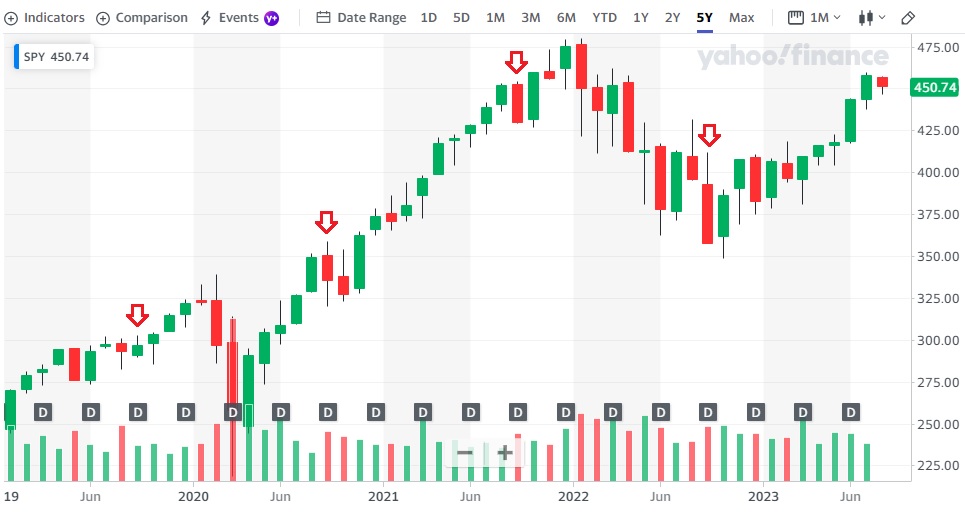
Whatever you may believe, it is undeniable that there is a fairly strong negative August/September effect for stocks:

SPY performance since 2019, monthly bars with Septembers annotated. Courtesy of Yahoo! Finance.

My portfolio

If you’ve been following me on StockClubs (1), an app that I’ve invested in, you may remember that I flattened my portfolio on September 2021, which worked out well initially with 2022 being a terrible year for stocks in general. However, at the end of 2022, I also initiated a bunch of shorts thinking the weakness will persist, but of course the market gods just laughed in my face and the market ripped higher (2).

As September 2023 rolls around, I’m getting that uneasy feeling again in the pits of my stomach, and if you’re still following me on StockClubs, you’ll note that I bought a put spread, betting that markets will be quite a bit weaker by mid November.

Why, why, tell me why

To be clear, I have a spotty track record at best at timing the markets, and unless you like losing money, it may not be prudent to follow in this fool’s quest. But here are some of the issues weighing on my mind:

Liquidity

In an earlier post, I noted that liquidity is draining from the markets. While I was waffling a bit and undecided on how that’d affect markets, I am beginning to warm to the idea that on the net, this would be market negative, especially the double whammy of student loan payments resumption and tightening monetary conditions.

Inflation

Another concern is that of inflation, the boogeyman from 2021/2022 that may be making a comeback. In 2021, inflation was an issue, but it didn’t really kick into high gear until late 2021 into early 2022, especially after the Russian invasion of Ukraine.

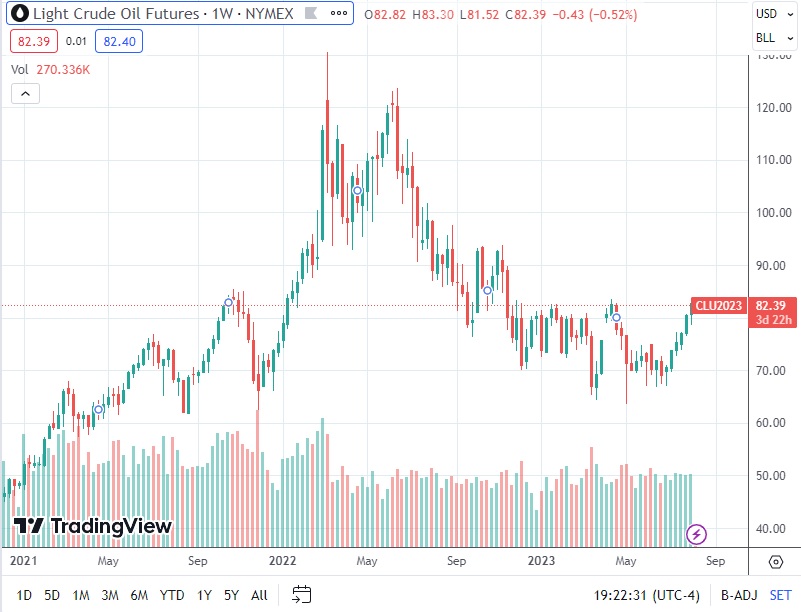
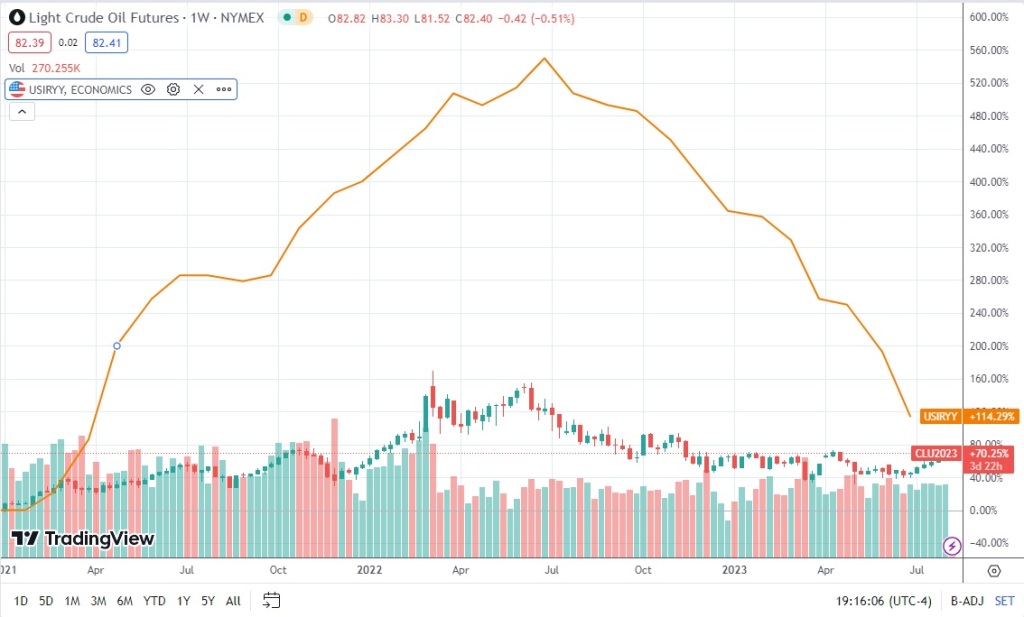
A large part of this was due to the huge spike in crude oil prices after the invasion, but which also started coming down around mid June 2022. As you can see from the graph below, inflation (orange line) looks almost like a slightly lagged, and very exaggerated version of crude oil price (candle bars):

Crude oil futures prices vs US CPI YoY inflation, weekly bars. Courtesy of TradingView.

Right now, it appears that crude oil prices is moving up again, but unlikely early 2023 when crude was around the same levels now, crude oil prices in July 2022 was much lower than crude oil prices in January to June 2022:

Crude oil futures prices, weekly bars. Courtesy of TradingView.

As a result, the drag of crude oil prices on year over year CPI is likely to be much less muted in July than for the first half of the year.

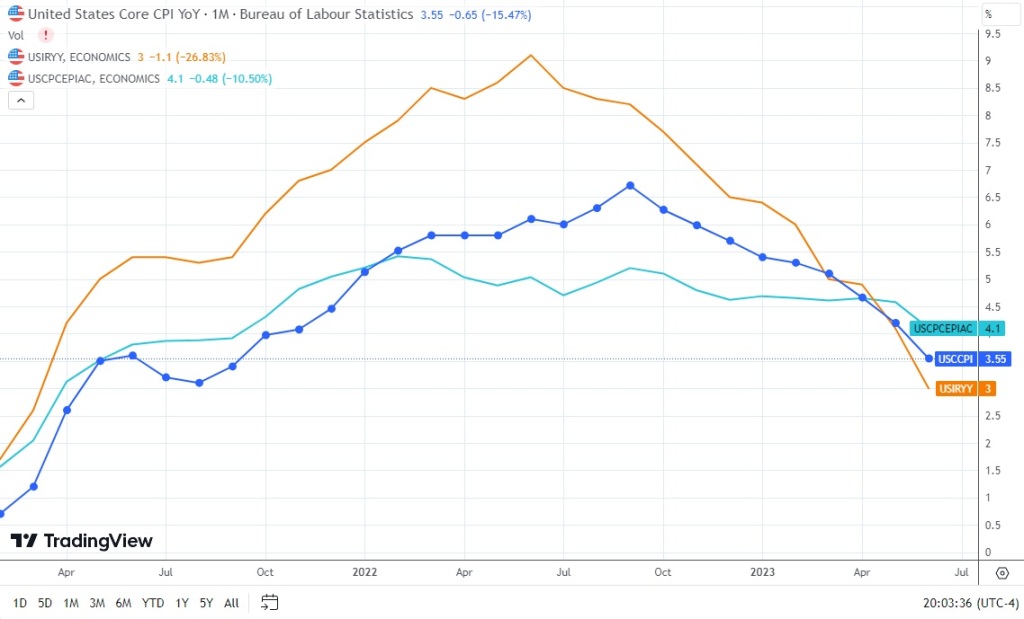
One way of visualizing crude oil prices’ impact on CPI inflation is by comparing CPI inflation (orange line) to core PCE inflation (teal line) and core CPI inflation (blue line) — core PCE inflation and core CPI inflation exclude the effects of food and energy prices:

Differences in inflation measures. Courtesy of TradingView.

As can be seen, the core inflation measures are much less affected by the spike in energy prices from February 2022 to June 2022. This in turn suggests that while the core measures may continue their down trends, headline CPI inflation may see moderate its decline, and may even inflect slightly higher for July. CPI inflation measures are due this Thursday, August 10th.

Weakening earnings

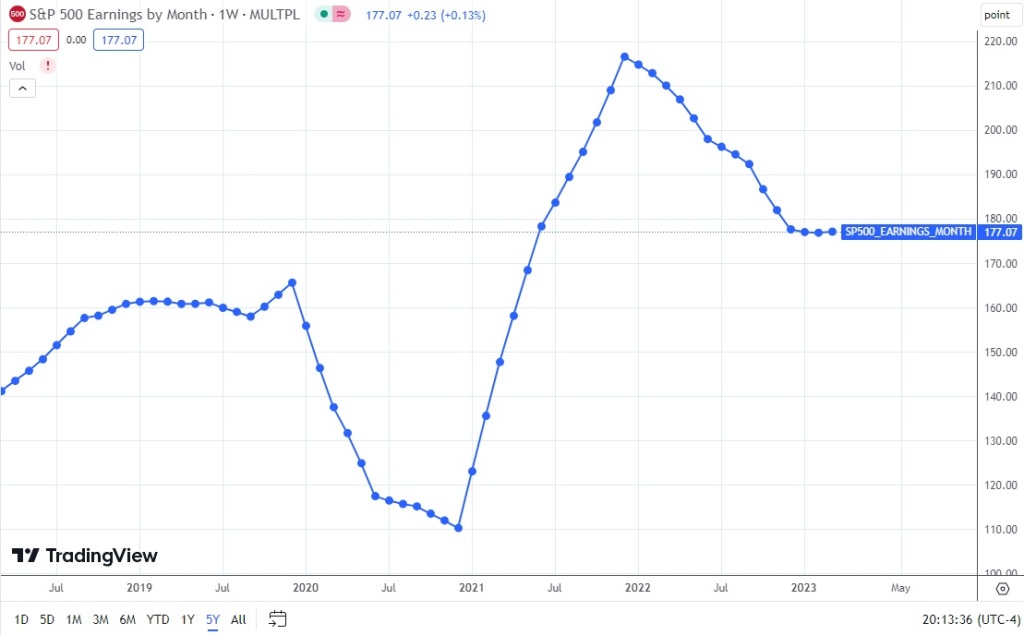
Earnings for the S&P500 has been weakening steadily since early 2022:

S&P500 earnings, monthly. Courtesy of TradingView.

While the weakening seemed to have plateaued in early 2023, recent earnings report (especially from Apple, the largest company by market cap in the USA) seems to suggest that the weakening may be reaccelerating. To be clear, earnings season for 2023Q2 isn’t over, and the weakening may just my overthinking it.

Technicals

Unless you’ve been living under a rock, you’d know that the markets have done pretty well so far this year. Some may say too well — on a short term basis, it seems like the markets may be taking a breather, with a small plateau forming. A plateau that I’m betting (hoping!) will turn into a small correction in the near term.

Final words

As always, I want to be very clear that I cannot predict the future, and that this bet that the markets will go down is a very small part of my portfolio. This is, for now, a short term trade, which I may close out or reverse at any time. Follow at your own risk.

Footnotes

  1. Disclaimer: I’m only listing 1 (out of 10+) of my brokerage accounts on StockClubs. While it is one of the largest brokerage account in terms of asset value, it is still less than 10% of my portfolio.
  2. Yes, nobody can see the future. Sadly.

July 15, 2023: Weekend video binge – Michael Cembalest

Foreword

This is a quick note, which tends to be just off the cuff thoughts/ideas that look at current market situations, and to try to encourage some discussions.

One of the other JB‘s had an interview with the chairman of Market and Investment Strategy of JPMorgan, Michael Cembalest, touching on a variety of recent themes.

As usual, a reminder that I am not a financial professional by training — I am a software engineer by training, and by trade. The following is based on my personal understanding, which is gained through self-study and working in finance for a few years.

If you find anything that you feel is incorrect, please feel free to leave a comment, and discuss your thoughts.

Michael Cembalest

Some time ago, I was given free (and apparently temporary) access to JPMorgan’s institutional research. During that time, I read eagerly the reports of Michael Cembalest, JPMorgan’s chairman of Market and Investment Strategy. Every single report put out by Michael was immaculately researched, with domain experts input, detailed deep dives and his own analysis to create a convincing narrative with actionable forecasts. It was great while it lasted.

When I lost access, I was sorely tempted to sign up for a JPMorgan private wealth account (which is not cheap!) just for continued access, but eventually decided against it. I’m a cheapskate, what I can say…

JB and Michael

One of the other JB’s (Joshua Brown in this case) had a chat with Michael, apparently his first media appearance. In this they talked about a myriad of recent themes, of note:

  1. Inflation and the most recent CPI report [5m]
  2. AI [33m 6s]
  3. SPACs [43m]
  4. Strategists are bearish [55m 24s]

The whole video is well worth a watch, here:

June 25, 2023: Weekend video binge 2 – Economics fact check

Foreword

This is a quick note, which tends to be just off the cuff thoughts/ideas that look at current market situations, and to try to encourage some discussions.

Anyone who talks to me about finance/economics, will know very quickly that I’m a stickler for definitions. It’s really annoying (to me) when people misunderstand economic/financial terms, and then applies the finding wrongly, leading to, often, ridiculous results. In that vein, this particular video hits home, and explains why over-simplifying can be dangerous.

As usual, a reminder that I am not a financial professional by training — I am a software engineer by training, and by trade. The following is based on my personal understanding, which is gained through self-study and working in finance for a few years.

If you find anything that you feel is incorrect, please feel free to leave a comment, and discuss your thoughts.

Money & Macro

To quote Joeri,

People pretending that something is simple when it’s actually complicated, giving you a solution that is really easy to understand, but also horribly wrong. And in economics, that is especially dangerous because misunderstanding concepts like inflation, recessions and unemployment could lead to decisions that actually cause inflation, recessions and higher unemployment, ruining the livelihoods of millions of people.

Joeri, https://www.youtube.com/watch?v=eyCaXPcDvng

Final words

At any point in time, I am probably involved in at least one discussion thread somewhere, where I find myself oddly defending regulators, central banks or the law to some extent. This is ironic, given that for the most part, most folks working in finance (I work at a hedge fund currently) tend to really hate legal, compliance and regulations, because they often add to our work load with bizarre requests. Frankly, I am not immune to this sentiment.

However, while we can discuss and be critical of how the central banks have, generally, been late to fight inflation this cycle, and that regulators often are unable to follow up on every shenanigan that happens in the markets, I think such criticism should also be balanced with fairness.

Ultimately, we need to recognize that regulators, law makers and central bankers are human, and they cannot see the future any more than we can, and given their very limited resources (the SEC has around 4,000 (1) employees), it is somewhat understandable, if not desirable, that things fall through the cracks, or that shortcuts are taken.

So while we must hold them accountable, we must at least be reasonable. And being reasonable, in many of these discussion threads, starts with actually understanding the details of the financial, economic or legal nuances surrounding the issue, and trying to understand why the laws/rules are as they are.

Since laws/rules tend to be formed over time based on the latest expert opinions, then having a decent understanding, a correct understanding of finance and economics becomes paramount.

For a prior take on why definitions and understanding nuances are important, please see Code Review.

Footnotes

  1. Original version said SEC had just over a thousand employees, which turns out to be false — they have around 4,000. See https://www.eeoc.gov/federal-sector/securities-and-exchange-commission-sec-0

June 24, 2023: Weekend video binge – Step-by-step fundamental analysis

Foreword

This is a quick note, which tends to be just off the cuff thoughts/ideas that look at current market situations, and to try to encourage some discussions.

Richard over at The Plain Bagel made an excellent video about how to do fundamental analysis on a stock. Highly recommended if you are having trouble falling asleep, or are just a data nerd.

As usual, a reminder that I am not a financial professional by training — I am a software engineer by training, and by trade. The following is based on my personal understanding, which is gained through self-study and working in finance for a few years.

If you find anything that you feel is incorrect, please feel free to leave a comment, and discuss your thoughts.

The Plain Bagel

One of my favorite Youtube channels, Richard is, unlike me, an actual financial advisor, though based in Canada.

Here is his excellent video on the high level steps he takes for doing fundamental analysis. It is pretty thorough (he is a professional after all!), and I have to admit that I skip some (ok, fine, many) steps when I do fundamental analysis, but this is a good list to keep in mind.

June 13, 2023: Inflation – wrap up

Foreword

This is a quick note, which tends to be just off the cuff thoughts/ideas that look at current market situations, and to try to encourage some discussions.

Almost exactly 2 years ago, I made a post about inflation at the time, with some guesses on what will happen in the 2 years hence, i.e. ending around now. Let’s see how badly I did, now that the latest inflation print is out (4% for May 2023).

As usual, a reminder that I am not a financial professional by training — I am a software engineer by training, and by trade. The following is based on my personal understanding, which is gained through self-study and working in finance for a few years.

If you find anything that you feel is incorrect, please feel free to leave a comment, and discuss your thoughts.

Background

On June 6th, 2021, I made the first in the series of inflation related notes. That was followed quickly by a clarification on August 30th, 2021, and then an update on April 30th, 2022.

Keeping score

In the three posts, I made some guesses on what would be coming next:

  • Given Janet Yellen’s press conference, at the time, I suggested that the Fed may be getting ready to hike in 2022-2023.
    • Score: 1
    • As we now know, the Fed started hiking March of 2022, 9 months after the first post.
  • I guessed that it would be unlikely for the US to get high inflation in the “next 1-3 years”, where high inflation is defined as 5-10% inflation.
    • Score: 0
    • As we now know, inflation got to a peak of ~9% since then, and it’s only been 2 years.
  • I further guessed that if it did get to high inflation, it’ll probably be transitory (1-2 quarters).
    • Score: 0
    • Inflation was above 5% for almost 2 full years — it hit 5% in May 2021, and just went below 5% in April 2023. Data here.
  • I also guessed that we’ll hit medium inflation (2.5% – 5%) and maybe stay there 4-5 quarters, up to 2 years.
    • Score: 0
    • We’ve been in medium (or higher!) inflation for 2 full years now.
  • I suggested that certain “bare necessities” stocks would perform better in this inflationary regime.
    • Score: 0.5
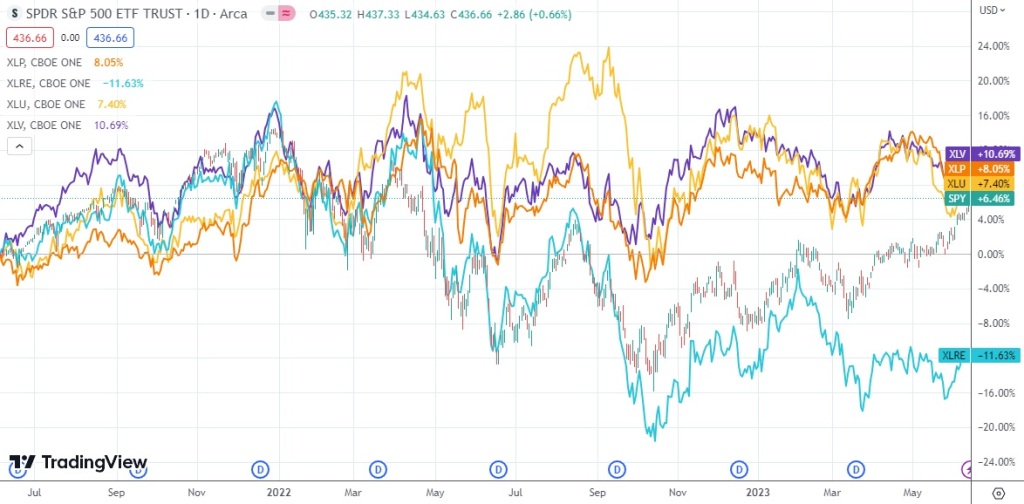
    • The performance of the 4 bare necessities proxies are below. While 3 of the 4 clearly outperformed SPY, the last one (real estate) flunked, badly. The average of the 4 also comes to around 3% returns, much below SPY’s 6.46% return.
    • That said, I wanted to point out that in the original post, I didn’t actually say real estate, but “multi-family housing”, and at least the multi-family funds that I’m holding are performing much better (they aren’t losing money for one thing…). However, I’m still giving myself a score of 0.5 because not all multi-family housing is doing well — while the funds I happen to have invested in are doing OK, multi-family housing on the west coast is doing horrendously, and quite a few of them are very likely losing money.
XLV, SLP, XLU, XLRE performance (dividend+split adjusted) from 6/6/2023 to 6/13/2023, courtesy of TradingView.

So, a score of 1.5 out of 5. Not too bad! If I saw a Yelp review of a restaurant with 1.5 stars out of 5, I’ll definitely go there… if I’m severely constipated and need help to “smooth things out”.

Excuses, excuses

Now that we’ve established I’m terrible at guessing what the future portends, let’s do my favorite part of the exercise — giving excuses for why I suck at this.

In terms of the inflation guesses, the main excuse I have is… Russia, Russia, Russia! Not predicting that Russia would invade Ukraine, and that the war would drag on for more than a year, and thus lead to chaos in supply chains, was probably the biggest miss.

In terms of stocks performance, there are 2 main misses:

  • I did not foresee the Fed ramping up so fast and so much.
    • The Fed going from 0% to 5% in around a year is a very dramatic move, essentially the fastest pace of hiking ever.
  • I did not realize how many real estate businesses were using adjustable rate mortgages.
    • I was thinking with my personal mortgage in mind, and thought that given the historically low rates, everyone would be eager to get a fixed rate mortgage.
    • Instead, a large number of real estate businesses were actually using adjustable rate mortgages, so the rate hikes hit them really hard.

Summary

While I made a mess of the guessing game, my personal portfolio has done pretty well — most of the stocks I’ve picked are doing better than the SPY (1), while my private equity multi-family real estate funds are all doing pretty OK as well.

That said, it should be noted that the private equity funds doing well is quite a bit of luck — I missed the crucial adjustable rate mortgages issue, but luckily most of the funds I’m invested in used fixed rate mortgages, or were not too terribly affected.

So, the lesson from all this is… being lucky is important for financial success. If you are not lucky, work harder at being lucky. 🙂

Footnotes

  1. If you follow me on StockClubs (disclaimer: I invested in this app, and I’m only showing 1 out of 10+ brokerage accounts on the app), you’ll realize that I had a few short bets (via puts) with varying degrees of success. I’m excluding those from the analysis, because they were mostly “for fun” bets, and the net result of all of them is around $0 (I used the winnings to buy a bunch of puts on QQQ/BITO that did not work out).

June 4, 2023: Weekend video binge

Foreword

This is a quick note, which tends to be just off the cuff thoughts/ideas that look at current market situations, and to try to encourage some discussions.

Some have read the prior note, and gone away with a distinctly bearish read. Perhaps this will disabuse you of the notion.

As usual, a reminder that I am not a financial professional by training — I am a software engineer by training, and by trade. The following is based on my personal understanding, which is gained through self-study and working in finance for a few years.

If you find anything that you feel is incorrect, please feel free to leave a comment, and discuss your thoughts.

Alf and Andreas

Alf and Andreas just had a podcast where much of it discusses some of the same liquidity issues I’ve listed in the prior note – “Liquidity worries”. In it, they discuss some of the issues in much more detail than I am able, and give thought to the nuances of each. Well worth a watch if you are sure that the markets will go down (or up) due to these issues.

TL;DR: The world is more complicated than that.

Stockclubs

As I’ve noted in “Liquidity worries” and “Synthetic bonds“, I have no clue what the markets will do next, so I’m mostly in a holding pattern right now.

To see what my portfolio looks like, you can use Stockclubs, an app which I’ve invested in, which shows 1 (out of 10+) of my brokerage accounts.

May 31, 2023: Liquidity worries

Foreword

This is a quick note, which tends to be just off the cuff thoughts/ideas that look at current market situations, and to try to encourage some discussions.

The market has been floating on a gush of liquidity since 2009, and while the economy has grown by ~60% since then, stocks have climbed ~560% since the nadir in 2009. What happens if the liquidity spigot goes away? We may be about to find out.

As usual, a reminder that I am not a financial professional by training — I am a software engineer by training, and by trade. The following is based on my personal understanding, which is gained through self-study and working in finance for a few years.

If you find anything that you feel is incorrect, please feel free to leave a comment, and discuss your thoughts.

Double, double toil and trouble

Upcoming liquidity drains:

  • Quantitative Tightening
    • Ongoing for a while now
  • Treasury General Account refilling
    • When the debt ceiling is passed, the Treasury will need to sell a bunch of bonds to refill their bank account to the tune of $200-400B (1)
  • Resumption of student loan payments
    • Currently estimated to resume end August
    • Loans on adjustable rates will also likely resume at (the now much) higher rates
  • General downturn in consumer discretionary spending
  • Potential rate hikes
    • Current estimates range from 1-2 cuts by end of year to 2-3 more hikes by end of year
    • This is generally true of all major central banks, minus Japan and China
  • Potential recession
    • Been predicted by various folks for, err.. 2 years now.
    • While some commodities and business leaders are sounding the alarm, job numbers (which tend to be lagging) are still pretty strong

Predictions

Haha, fooled you — I don’t generally do predictions. It’s not hard to make a case for stocks going up or down based on the issues above, and I’m pretty sure whatever I say, the market gods will just laugh and the complete opposite will happen anyway.

So, I guess we’ll find out.

Footnotes

  1. There are some who claim that the Treasury needs to sell over a trillion of bonds. A quick look at https://fred.stlouisfed.org/series/WTREGEN suggests that while the TGA had a peak of $1.8T during the pandemic, in recent years, the more normal amount is around $200-400B. I’m not sure if there’s something I’m missing, but $200-400B sounds more correct to me.

May 13, 2023: Weekend video binge – Howard Marks

Foreword

This is a quick note, which tends to be just off the cuff thoughts/ideas that look at current market situations, and to try to encourage some discussions.

If you read my blog often enough, you’ll realize that I spend a lot of time saying “I don’t know”, and, perhaps more disappointingly, not giving any stock tips, suggesting that more people should be wary of risky assets, and droning on about how conservative I am in my portfolio.

As usual, a reminder that I am not a financial professional by training — I am a software engineer by training, and by trade. The following is based on my personal understanding, which is gained through self-study and working in finance for a few years.

If you find anything that you feel is incorrect, please feel free to leave a comment, and discuss your thoughts.

Howard Marks

Howard Marks gave a very insightful lecture in 2019 that reveals all stock market secrets. It is long, and to be blunt, Marks is not the most enchanting orator.

But if you are willing to invest an hour listening to this legend of financial markets, I think you’ll be well rewarded for it.

Some choice quotes:

The challenge is to make money at the same time as you control risk.
And a portfolio with the opportunity to make money, but with the risk under control, is in my opinion, the mark of a professional investor.

The 3 stages of the bull market:
The first stage, when only a few exceptionally bright people understand there could be improvement.
The second stage, when most people understand, that improvement is actually taking place.
And the third stage, when everybody believes that things will get better forever.
So, if you buy in the first stage, when most people don’t see a better future, when there’s very little optimism included in asset prices, you get a bargain, and you can make a lot of money.
If you buy in the second stage, when everybody understands that improvement is taking place, you don’t get a bargain, you do OK, you follow the cycle, you buy in at a fair level.
But if you buy in the third stage, when everybody thinks things will get better forever, and when asset prices reflect a great deal of optimism, you pay high prices, which sets you up for substantial losses.

The interesting thing about investing, is it’s not what you do, it’s when you do it.
It’s not what you buy, it’s when you buy it, under what conditions, and at what prices.
So, the key to investing, is not buying good things, it’s buying things well.

Howard Marks, https://www.youtube.com/watch?v=18iIq4U4N5c