October 2nd, 2022: ERP, derp

Foreword

This is a quick note, which tends to be just off the cuff thoughts/ideas that look at current market situations, and to try to encourage some discussions.

Inflation is near its highest in ~40 years, the Fed and almost all other central banks are aggressively hiking rates at an unprecedented pace, global supply chains are shaky at best, Russia and Ukraine at effectively at war, effectively disrupting two of the largest sources of both food and fuel for the world and Europe is facing an uncertain winter due to energy shortages. Sounds like a good time to check in on equities.

As usual, a reminder that I am not a financial professional by training — I am a software engineer by training, and by trade. The following is based on my personal understanding, which is gained through self-study and working in finance for a few years.

If you find anything that you feel is incorrect, please feel free to leave a comment, and discuss your thoughts.

ERP

Equity risk premium, or ERP, is defined as the rate of return investors demand for equities over that of the risk free rate. Based on Yardeni Research, the current ERP is around 5.5%, slightly lower than the start of the year, and quite a bit lower than late 2019, early 2020 (pre-pandemic).

The lower the ERP, the more confident investors are generally said to be of equities — at the extreme, an ERP of 0% implies that investors view equities are interchangeable with risk free securities in terms of returns.

Which is to say, despite all the above, investors actually view equities more favorably than the start of the year, at least, based on the ERP.

Derp

The 3rd quarter just ended, and earnings season is upon us again, starting in earnest in about 2 weeks with the banks, followed closely by the big tech companies. By the end of October, we’ll have CPI for September as well as the Q3 earnings report from most of the largest companies in the US. Just in time for the Fed’s FOMC meeting on November 1st and 2nd.

Given that the ERP went down slightly compared to the start of the year, it seems like the market is expecting (at least with regards to the risk free rate) that the Q3 earnings reports will come in good, or at least in line with expectations.

That seems a little optimistic, given the financial situation around the world right now. In particular, it seems in my naïve view that

  • Companies that depend heavily on sales made in foreign currencies are going to suffer from the strong US dollar.
  • Companies that depend heavily on global supply chains are going to have issues with shortages.
  • Companies that don’t have pricing power relative to their input costs are likely to get their margins squeezed.

On the other hand

  • Companies that are allowed to export energy seem like they may do well.
  • Companies that are able to adjust their prices based on inflation, while keeping their costs low, are likely to do well.

Positioning

For all the reasons above, I’m thinking seriously of shorting the stocks of those companies in the first list into earnings. As usual, this will be a small position (since I don’t generally like shorting and shorting is extremely hard to get right), mostly for fun, but also for personal validation.

As always, you can see the positions in one (out of 10+) of my brokerages with StockClubs (1), with a 1 day delay.

Footnotes

  1. Disclaimer: I am an investor in the app.
September 26th, 2022: Paralysis

Foreword

This is a quick note, which tends to be just off the cuff thoughts/ideas that look at current market situations, and to try to encourage some discussions.

Markets took another drubbing today, and is now less than 20 SPX points away from year to date lows, almost 25% below the highs just a few months ago.

As usual, a reminder that I am not a financial professional by training — I am a software engineer by training, and by trade. The following is based on my personal understanding, which is gained through self-study and working in finance for a few years.

If you find anything that you feel is incorrect, please feel free to leave a comment, and discuss your thoughts.

Ouch

If you follow my blog posts, and/or if you follow me on StockClubs (1), you will know that while I’ve flattened my portfolio (i.e. reduced exposure to equities/bonds), my portfolio is not flat. As a result, the absolute drubbing in the markets, for both stocks and bonds, in the past month or so has not been fun.

As it stands, we are now less than 20 SPX points away from the lows set in June, and given the relentless selling of the past few trading days, there is a good chance that we’ll visit and maybe go below that in the coming days.

Bear market

Talking to a few friends, it seems like some are still heavily invested in stocks and bonds, and I can only imagine the pain they must be experiencing. At the same time, I get the feeling that quite a few people are essentially paralyzed with shock at the speed and magnitude of the moves so far this year — if you started investing after 2009, then you most likely have only experienced “happy times” in the markets. This year would (other than the rather brief March 2020 downturn) be the first major bear market you’ve experienced.

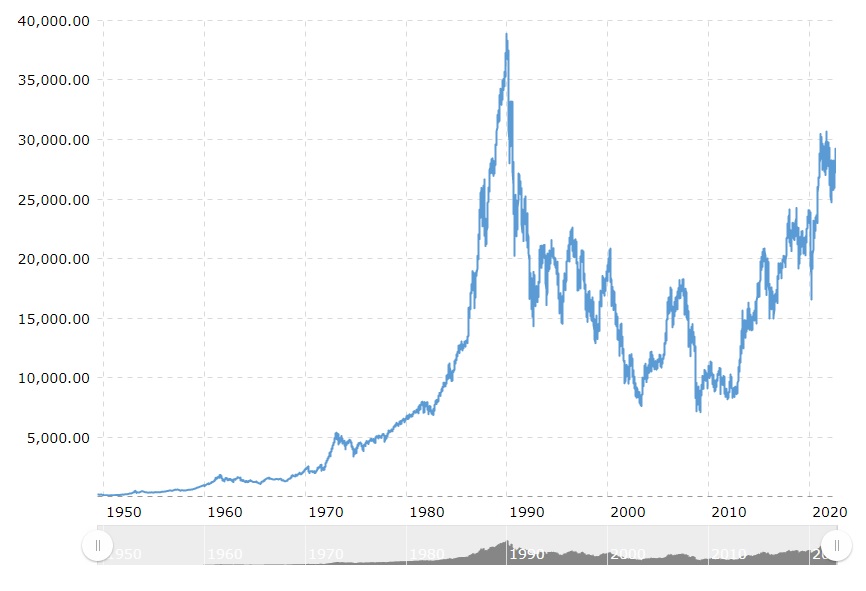
Bear markets happen, and they can last for a long time, with many, many dead cat recoveries that morph into new lows — the Nikkei 225 still has not recaptured its peak set in the late 80’s/early 90’s, about 30 years ago:

Will the SPX also take 30 odd years to not recover? I don’t know, and frankly, nobody does. It is certainly possible, though history across all the major developed markets suggests that this is unlikely — recovery to prior peaks for even fairly severe drawdowns (like the 2008 Great Financial Crisis) rarely take more than 5-10years.

As investors, all we can do is make projections, and allocate our portfolio accordingly. But as noted in Marathon, we should also make preparations for the worse/worst case scenarios, for the unknown unknowns, for when the bear awakes and takes a swipe at our portfolios.

So, if you’ve been paralyzed with indecision thus far, you need to make a decision, even if the decision is to “do nothing”. It is certainly a hard decision to make, given that you are likely sitting on a bunch of losses and realizing the losses (by selling) will make it that much more real. Sitting tight could very well see you made whole or more…, or we may drop another 25% or more.

An easier decision to make, however, is if you have immediate needs for money that cannot be deferred. If so, you should seriously consider keeping enough liquidity (i.e. cash or cash equivalents) on hand, so that your near term money needs can be met. If the market recovers, treat it as premiums for insurance against failing to meet your obligations. If the market drops more, you’ll certainly be relieved you cashed out and won’t have to worry about near term needs.

Footnotes

  1. Disclaimer: I am an investor in StockClubs, which is an app that lets you share your portfolio, or follow the portfolios of others. Note that I’m only sharing 1 (out of around 10) brokerage accounts that I maintain.

August 27th, 2022: Weekend video binge – retirement planning

Foreword

This is a quick note, which tends to be just off the cuff thoughts/ideas that look at current market situations, and to try to encourage some discussions.

Wealthion hosted a retirement planning best practices webinar this weekend, and I highly recommend it.

As usual, a reminder that I am not a financial professional by training — I am a software engineer by training, and by trade. The following is based on my personal understanding, which is gained through self-study and working in finance for a few years.

If you find anything that you feel is incorrect, please feel free to leave a comment, and discuss your thoughts.

First do no harm

As I’ve noted in “Financial planning, portfolio management and wealth management“, financial/retirement planning is very different in practice from what most people seem to think. It is rarely about maximizing your returns, but more about maximizing the probability that you’ll attain some base level of return you need to meet your needs.

As a contrived example, let’s say you have $1 and you need to retire right now. Well, if you are trying to maximize your return, you’ll probably invest in stocks or equity of some form. But if you want to maximize the probability that you’ll be able to retire on $1, then, perhaps literally, the only option you have is to buy a lottery ticket and pray for the best.

On the other hand, if you have $10m, and you need to retire right now, then again, to maximize your return, you’ll probably invest in stocks or equity of some form. But if you want to maximize the probability that you’ll be able to retire with $300k (ignoring taxes) a year to spend, then you should probably buy 30 year US Treasuries, which currently are yielding about 3% (1).

The main idea is that financial/retirement planning is a marathon, and you’re in it for the long haul, so you need to consider risks, especially those that have low probabilities, but are highly detrimental (e.g. severe stock market crash) to your plan.

Retirement plan

As noted in “My Personal Portfolio” and “Late to the party“, I tend to manage my portfolio more conservatively, trying to avoid drawdowns more than trying to achieve supernormal gains. You can learn more about this approach and why it makes sense in the long haul in this webinar that Wealthion hosted.

It’s very long (3 hours!), but very much well worth the watch.

Footnotes

  1. OK, fine. In practice, you’ll probably buy some balance of stocks/bonds, though still tilted heavily towards bonds. Because everyone is at least a little bit greedy.

August 26th, 2022: Poetry and financial commentators

Foreword

This is a quick note, which tends to be just off the cuff thoughts/ideas that look at current market situations, and to try to encourage some discussions.

So Powell spoke to the world today from Jackson Hole, Wyoming…

As usual, a reminder that I am not a financial professional by training — I am a software engineer by training, and by trade. The following is based on my personal understanding, which is gained through self-study and working in finance for a few years.

If you find anything that you feel is incorrect, please feel free to leave a comment, and discuss your thoughts.

English Literature

I used to take English Literature in middle school.  I was horrible at it — I don’t believe I’ve ever passed a single English Literature test or exam other than by being bell-curved(1).

So take this with a grain of salt.

It is my firm belief that poets intentionally write in obtuse manners, so that they can seem to be smarter than they really are.  For example, if you write “I’ll snap that legal aid’s fountain pen”, it’ll seem kind of odd, violent and petty, but if you write “I’ll mar the young clerk’s pen”, suddenly it seems like you are being all metaphorical and smart.

Finance

In that sense, poets and financial commentators are the same.  “Good” financial commentators are rarely clear and concise, because then you can be “wrong”, and “wrong” is very much the antithesis of “good”.

But if you say a bit of mumble jumble, and talk about how “we’ll continue until the job is done”, but “at some point, it’ll be time to pause/stop”, then you can’t really be “wrong”.

Poetry.

Footnotes

  1. In my school, there is the notion that exams can be set too hard or too easy, thus unfairly biasing the scores of the current batch of students. So once all the scores from every student is computed, a statistical model is applied to everyone’s scores so that the overall distribution of adjusted scores sort of resembles a normal curve, and pass/fail is then defined as some percentile into that new adjusted score.

August 19, 2022: Late to the party

Foreword

This is a quick note, which tends to be just off the cuff thoughts/ideas that look at current market situations, and to try to encourage some discussions.

I sold off a large part of my stocks portfolio in September 2021, and have been mostly flat till now, only making temporary tactical trades. The idea was that I’d get back in when things look stable again. Today, it seems this strategy received some support from empirical evidence.

As usual, a reminder that I am not a financial professional by training — I am a software engineer by training, and by trade. The following is based on my personal understanding, which is gained through self-study and working in finance for a few years.

If you find anything that you feel is incorrect, please feel free to leave a comment, and discuss your thoughts.

Flat as Nebraska

As noted in the May 12 update, I closed a large part of my stocks portfolio and went mostly flat, except for a few choice positions. As explained in My Personal Portfolio, I tend to be very risk averse and conservative. As such, whenever things look bumpy, I tend to flatten my portfolio or at least hedge a bit. When things are calmer, then I’ll slowly get back in again. I have no real reason to believe this strategy works well in practice, other than letting me sleep better at night. Until today…

Note: You see the positions and trades in one of my brokerage accounts (out of ~10) on StockClubs, an app that I’ve invested in.

Empirical data

Today, John Authers of Bloomberg posted an article in his daily column, which claims that my strategy apparently works, at least based on historical data:

Richard Bernstein Advisors LLC analyzed the returns of a hypothetical investor around major market bottoms. The returns for entering 100% into stocks “early,” meaning six months prior to a market bottom, were compared with holding nothing but cash until six months after the market bottom and then shifting to 100% stocks “late.”

“Not only does [being late] tend to improve returns while drastically reducing downside potential, but this approach also gives one more time to assess incoming fundamental data,” Dan Suzuki, the firm’s deputy chief investment officer, wrote Tuesday. “Because if it’s not based on fundamentals, it’s just guessing.”

John Authers, Bloomberg – https://www.bloomberg.com/opinion/articles/2022-08-19/-the-godfather-insight-oil-prices-have-been-driving-markets-all-along August 19th, 2022

While this doesn’t really change anything for me, it’s good to know that at least I’m not completely crazy.

July 10, 2022: Save Banks First

Foreword

This is a quick note, which tends to be just off the cuff thoughts/ideas that look at current market situations, and to try to encourage some discussions.

As volatility in the crypto space continues, it appears one man, Sam Bankman-Fried (SBF) is trying to rescue his industry by saving banks first.

As usual, a reminder that I am not a financial professional by training — I am a software engineer by training, and by trade. The following is based on my personal understanding, which is gained through self-study and working in finance for a few years.

If you find anything that you feel is incorrect, please feel free to leave a comment, and discuss your thoughts.

SBF

Before I posted the quick note on Voyager’s bankruptcy, SBF had already been in touch with various crypto banks, injecting capital so as to prevent a greater meltdown of the crypto ecosystem.

If you have money in crypto, especially if that money is tied up in one of the crypto banks that are in serious trouble and have halted transactions, and especially, especially so if your bank/broker is one of those SBF is looking to save first, then you may just be heaving a sigh of tentative relief. If SBF’s plan works, your losses will likely be dramatically reduced.

As far as I can tell, SBF’s efforts are generally held up as a shining example of the crypto community’s “community-ness”, and generally viewed as a good thing.

Irony

And that is highly ironic.

Recall the premise for the founding of crypto — that central banks were somehow evil for bailing out the financial system, especially during the 2008 Great Financial Crisis.

Nevermind that if central banks had done nothing, there was a good chance that regular folks whose money was caught up in banks stood a very high chance of taking a large financial loss. Nevermind that if the financial system were to shut down, even for just 2 months, those who would be hurt the most would likely be those who are least financially prepared. Nevermind that SBF is basically acting as a central bank for crypto, and doing exactly what a central bank would do in the event of a financial crisis — being the lender of last resort.

The crypto community (then) pointed at the rich who benefited “disproportionately” from the bailouts. Yes, a billionaire probably stood a very good chance of not losing a few hundred million dollars due to the bailouts. But for a billionaire, losing a few hundred million dollars is annoying, maybe even frustrating, but in the overall scheme of things, just a flesh wound. Consider what would happen to a family living paycheck to paycheck, if they lost access to their bank accounts for just 2 months, even if they eventually got back all their money? Would they even be able to keep a roof over their heads and food on the table in those 2 months? For our regular-joe family, even if they only stood to lose a few hundred/thousand of dollars, it would almost certainly be a financial catastrophe.

As many have pointed out over the years, the crypto community essentially seems intent on relearning every facet of financial history all over again… and mostly coming up with the same solutions.

July 9, 2022: Weekend video binge – Wealthion & Lance Roberts

Foreword

This is a quick note, which tends to be just off the cuff thoughts/ideas that look at current market situations, and to try to encourage some discussions.

Wealthion just released a great interview this weekend, that I feel is well worth watching.

As usual, a reminder that I am not a financial professional by training — I am a software engineer by training, and by trade. The following is based on my personal understanding, which is gained through self-study and working in finance for a few years.

If you find anything that you feel is incorrect, please feel free to leave a comment, and discuss your thoughts.

Lance Roberts

Wealthion interviewed Lance Roberts this weekend (this is a weekly thing — Lance and Adam are friends), which I feel should be mandatory watching for anyone managing their own money.

In this, Adam and Lance talk about recent macro economic issues, possible resolutions, and general positioning strategies with such high uncertainty in the markets. For those who haven’t read it before, I wrote on something similar to one of the topics discussed a long time ago — Death of price discovery?

Even if you don’t have the time to sit through the whole 1hour+ (protip: Watch at 1.5x speed), you should at least listen to the ~10minutes from the 56m to around the 1h 5m mark, where Adam and Lance talk about the idea of permabears. This is something particularly close to my heart, because that’s a label some people who don’t seem to be very in tuned with macro economics like to hurl around.

July 6, 2022: Voyage to bankruptcy

Foreword

This is a quick note, which tends to be just off the cuff thoughts/ideas that look at current market situations, and to try to encourage some discussions.

Voyager Digital just filed for bankruptcy. What happens next is going to be interesting.

As usual, a reminder that I am not a financial professional by training — I am a software engineer by training, and by trade. The following is based on my personal understanding, which is gained through self-study and working in finance for a few years.

If you find anything that you feel is incorrect, please feel free to leave a comment, and discuss your thoughts.

Sailing to bankruptcy

According to Bloomberg, Voyager Digital, the crypto broker, just filed for chapter 11 bankruptcy.

In the regular world …

Now, if this was a regular broker, the process is fairly well established and straightforward. Generally speaking:

  1. The regulators and SIPC will try and find a buyer for the assets of the broker.
  2. If a buyer is found, that buyer will provide customers with new login details (or in some cases, use the bankrupt broker’s existing website/apps).
    1. Most customers will basically see no real down time, except for maybe creating a new account on the new broker’s website.
    2. SIPC will work in the background with the new broker to recover assets.
  3. If a buyer is not found, then a trustee of some form is created to find assets and distribute them.
    1. Customers with accounts below the SIPC insurance limits (currently $500k, at most $250k of which can be cash) will get instructions on how to move their assets to a broker of their choice. This probably takes a few days to a few weeks.
    2. Customers with accounts above SIPC insurance limits will get assets up to the insurance limit, and anything else will be considered unsecured debt against the trust.

For the majority of customers, it should mostly just be an inconvenience.

… and then there’s crypto

Since there are no regulators in crypto, and no insurance scheme, points 1, 2.2 and 3.1 don’t apply. Basically, if a buyer is found, the buyer assumes all liabilities (i.e. customer assets), and if a buyer is not found, then all customers become unsecured creditors to the trust.

But how would it actually work?

In regular finance, the assets are typically kept at third party custodians, so the process is relatively easy — the custodian freezes the account until SIPC/regulator/trustee signs off on release of assets. But in crypto, there are rarely third party custodians — Voyager itself likely holds the keys to its crypto assets, and in many cases, the assets are backed by the broker itself, such as Voyager Tokens.

If the accounts are at a third party, a court order will force the custodian to freeze the accounts, and any missing assets from that point on must be repaid by the custodian. But if Voyager (and presumably its executives) holds the keys to the assets, how do you freeze the assets?

What’s preventing some Voyager executive from mysteriously dying after all the assets disappear?

What would Voyager Tokens be worth after chapter 11?

Are the courts able to even wrap their heads around all of these to make a reasonable ruling?

Will the entire process take so long that the price of the assets shift dramatically? And if so, are customers owed the assets, or the value at time of bankruptcy, or the value at time of distribution? This is particularly interesting because Voyager loaned out much of the assets, and with the broker now defunct, how is it going to continue servicing the loans (issuing margin calls, collecting collaterals, etc.)?

So many questions! This event has the possibility of bringing a lot of clarity to the murky world of crypto. Stay tuned!

June 11, 2022: Do you feel lucky, punk?

Foreword

This is a quick note, which tends to be just off the cuff thoughts/ideas that look at current market situations, and to try to encourage some discussions.

Yesterday, CPI reported consumer inflation at the highest level in about 40 years — since 1981. Instead of the expected flattish reading of 8.3%, inflation was reported at 8.6%, a level that must certainly be ringing some alarm bells at the Fed.

As usual, a reminder that I am not a financial professional by training — I am a software engineer by training, and by trade. The following is based on my personal understanding, which is gained through self-study and working in finance for a few years.

If you find anything that you feel is incorrect, please feel free to leave a comment, and discuss your thoughts.

Expectations

Prior to the release of CPI numbers, economists were predicting that inflation was turning, that May’s CPI print would confirm a slowdown, which could signal the start of disinflation.

Listening and reading to various financial analysts over the past month or so, almost everyone has been positioning for a gradual end to inflation. The thinking is that the Fed will eventually raise rates to around 2-2.5% (from 1% now) sometime near the end of the year or early 2023, realize that they’ve overdone it, and start the next round of QE + rate cuts.

To that end, a lot of fund managers initiated positions in TLT (long duration Treasuries ETF), thinking that with the Fed tapering the rate hikes, TLT will bottom out soon.

Instead, we had a scorcher of a print, at a level way higher than anything seen so far in this inflation cycle.

Fed

I had previously expected the Fed to start the rate hike cycle much earlier, obviously that was wrong. The thinking was that the Fed needed to shock the market into reducing liquidity conditions, so as to reduce the velocity of money and thus inflation. The sooner they did so, the less they’d need to do in actual hikes, as market expectations will do most of the work for them.

However, the Fed has, thus far, taken relatively mild steps with regards to hikes, often telegraphing their intentions well ahead of time, effectively losing the shock and awe factor which I feel is needed for the Fed to regain the narrative over inflation.

Prior to the CPI print, the Fed hinted strongly at another 50bps hike this coming FOMC meeting (next week, June 14th and 15th). With the print, the media is speculating that the Fed may have to do 75bps.

Which is to say, a hike of 50bps next week could potentially be seen as dovish, and a 75bps hike may be seen as “expected”.

If the Fed wants to shock the market, then the next alternative is a 1% hike.

For those speculating on the markets, what do you think the Fed will do? Do you feel lucky, punk?

June 3, 2022: Bubble bursting?

Foreword

This is a quick note, which tends to be just off the cuff thoughts/ideas that look at current market situations, and to try to encourage some discussions.

Recently, there has been a lot of talk about bubbles, and bubbles bursting. This is despite the fact that we are about 15% below all time highs for the SPX, and 6% above recent lows. It is getting scary out there…

As usual, a reminder that I am not a financial professional by training — I am a software engineer by training, and by trade. The following is based on my personal understanding, which is gained through self-study and working in finance for a few years.

If you find anything that you feel is incorrect, please feel free to leave a comment, and discuss your thoughts.

Sequoia

In 2008, Sequoia made the, then controversial move of publishing a slide deck titled “RIP Good Times”. Despite the events of late 2007, no major financial entity was publicly talking about dramatic economic hardships at the time, and the Fed then was still publicly optimistic.

As we now know, those slides turned out to be prescient, almost perfectly marking when the Great Financial Crisis really started in earnest, eventually resulting in the SPX dropping around 50% peak to trough.

Recently, Sequoia is out with another note, this time in a medium more fitting of the times, “Adapting To Endure”. While the title is less punchy and doomy than the deck in 2008, the contents aren’t exactly encouraging.

Wealthion

A relatively recent entrant to the financial news scene, Wealthion has grown fairly rapidly, with insightful interviews of various prominent financial scholars.

Wealthion recently published a 2-part interview with Peter Atwater, who is a fairly noted and celebrated financial observer, titled “Everything That Can Go Wrong, Will – As This Confidence Cycle Ends” and “As Bursting Asset Bubbles Vaporize Wealth, Social Blowback Will Be Inevitable”,

Clearly, the titles are less than optimistic, and the content matches the mood set.

Well then…

I would strongly encourage everyone to read Sequoia’s latest note. If nothing else, it gives some ideas for how one would prepare for potential future financial hardships.

The videos from Wealthion are also worth the time. They give a brief history of how we got to where we are, and highlights something I’ve been talking about on and off — price discovery doesn’t seem to be working well, especially since the Great Financial Crisis; With the dramatic rise in stock valuations in the past ~20 years, and despite the recent drop in stock prices and the dramatic earnings improvements of the past ~10 years, the P/E ratio of the S&P 500 is still about 30% higher than the average pre-dotcom.

Nobody really knows what the future will bring, so take the above with a pinch of a salt. They aren’t meant to be predictive, nor prescriptive. Instead, they suggest that at least in some parts of the economy, some people are starting to take note and they seem worried.