
Foreword
In “Arbitrage“, we briefly describes part of how futures are priced to argue that futures prices are, in general, not predictive. This post rounds out the discussion and talks about how futures are priced in more detail.
As usual, a reminder that I am not a financial professional by training — I am a software engineer by training. The following is based on my personal understanding, which is gained through self-study and working in finance for a few years.
If you find anything that you feel is incorrect, please feel free to leave a comment, and discuss your thoughts.
How futures work
A futures contract is a contract between a buyer and a seller, where the buyer agrees to buy from the seller some product at a future point in time (called the settlement date). The price for that futures trade will (usually, though not necessarily) be at the spot price of the product at settlement.
Futures contracts have a price attached to them — you’ve probably seen quotes for futures of various products. That is NOT the price the buyer pays when the contract is signed (nor when the trade happens in future). The futures price is a reference price — instead of paying that price when the contract is signed, the buyer only puts down a portion of that price (called the initial margin) to the exchange facilitating the trade. At the same time, the seller also puts down a similar portion of that price.
From the point when the contract is signed, to when the trade happens, if the price of that futures contract changes, money is taken out of either the buyer’s or seller’s margin, and deposited into the margin of the other side. If either side’s margin falls below some threshold (called the maintenance margin), that side needs to post more margin (i.e. they get margin called), or they risk being forced to close the position by the exchange earlier than the settlement date.
As a simple example, let’s say we are trading crude oil futures, currently priced at $100, with an initial margin requirement of 10%, and a maintenance margin of 5%.
If I buy that contract from you, I’ll need to post $10 (10% of $100) to the exchange, and you too will have to post $10 to the exchange. If the next day the price of that contract rises to $102, then $2 will be deducted from your $10 margin, and transferred into my margin account. Now I’ll have $12, and you’ll have $8.
If the contract rises again to $107 the next day, then another $5 will be transferred, and I’ll now have $17, while you’ll have $3. Notice that $3 is less than 5% of 107 ($5.35), so the exchange will demand that you post another $2.35 at least into your margin account, or your position will be force closed.
This daily margining continues until the settlement date. Since the trade happens at spot prices, at settlement, the futures price will be exactly equal to the spot price. Let’s say the spot price at that point in time is $107. So, at settlement:
Spot price = futures price = $107
My margin = $10 + $7 (my initial margin + transfers from you) = $17
Your margin = $10 – $7 + $2.35 (your initial margin – transfers to me + your margin call) = $5.35
Now, all the exchange has to do is refund us our margin accounts, so I’ll end up with $17, which is a profit of $7 for me, and you’ll end up with $5.35, which is a loss of $7 for you.
Notice that the futures price when we opened the contract was $100, and the futures prices when we closed the contract was $107, so I should have made $7, while you should have lost $7. Indeed, the buyer (me) made a $17 – $10 = $7 profit, while the seller (you) lost $10 + $2.35 – $5.35 = $7.
This daily margining is how the exchange protects itself against the potential that either side is unable to pony up the amount that they lost from contract open to settlement. In general, the more volatile the product’s prices are, the higher the margin requirements will be.
Terms
Before we continue, let’s get some terms out of the way.
| Term | Definition |
| Spot price | This is the price at which a product trades right now. i.e. if I want to buy a barrel of crude oil and have it delivered right now, I’ll be paying the spot price. |
| Futures price | This is the price attached to a futures contract. |
| Settlement date | This is the date when a futures contract matures, and the trade in the actual product happens. |
| Front month | This is generally the futures contract that is next in line for settlement. Futures contracts are created periodically at fixed dates in the future (depends on the product, but usually at least one settlement date per quarter). When a futures contract is very near settlement, it goes into the “roll period” during which it is ineligible to be the front month, and the next futures contract becomes the front month. Usually, when people talk about the “futures price”, they are talking about the futures price of the front month contract. |
| Roll | This is the act of selling (or buying) the current front month contract, and buying (or selling) the next front month contract. In effect, this allows the buyer (or seller) to close out a contract that is expiring soon, and then opening a new, similar position in the next contract to continue their exposure to the product, without actually trading the product. |
Futures prices
Now, let’s say the spot price of crude oil is $100 right now. What should the price be for a futures contract that settles in 30 days from now? Should it be higher or lower than $100?
When the futures prices are higher than spot prices, we call the situation “contango”, which is generally considered to be the “normal” way futures prices should be.
On the other hand, if futures prices are lower than spot prices, we call the situation “backwardation”.
Contango
Let’s first consider contango. As noted above, this is when futures prices are higher than current spot prices.
Why might this be? Well, think about it — if someone wants me to deliver a barrel of oil to them in the future, I can buy a barrel of oil from the spot market now, keep it in storage until the settlement date, and then deliver that barrel to them. In doing so, the costs I’ll incur are:
spot price + cost of storage + interest lost due to having to put money down now
Since cost of storage and interest rates are generally positive, in order for me to at least breakeven, the futures price must be greater than the spot price.
Hence contango is generally considered the “normal” case.
Now, the question then becomes, how much higher than spot prices should the futures price be?
Well, we know the price it needs to be for me to breakeven. What about for the buyer?
For the buyer, the reverse consideration is in place — they can also buy at spot right now, store the barrel themselves, then consume the barrel in the future. So they would be unwilling to pay very much more than my breakeven price.
Which is to say, futures prices generally trade very close to that breakeven price when we are in contango.
If everyone expects prices to be a lot lower in the future, sellers will eagerly sell at the current spot prices to avoid the lower prices in the future. As a result, spot prices will drop until the breakeven equation holds. i.e. if prices are expected to be lower in the future, spot prices will drop, and futures prices will just be priced off the new, lower, spot prices.
If everyone expects prices to be a lot higher in the future, arbitragers will simply buy from spot markets right now, store the barrels until the settlement date, and then sell it for the higher price. In so doing, they’ll push up the spot prices until the breakeven equilibrium is reached. i.e. if prices are expected to be higher in the future, spot prices will rise, and futures prices will again be priced off the new, higher, spot prices.
Which is to say, in a properly functioning market under contango, futures prices are entirely NOT predictive — they do not indicate what the markets think the product will trade at in the future, but rather they reflect the cost of carry for that product (i.e. the cost to store, as well as the interest foregone with having to put money down now).
This can break in a few ways:
- If the product is perishable, then “buy now and sell in the future” may not always work. In those cases, futures prices will be based off more complex considerations, and in some cases may in fact be predictive of future spot prices.
- If there are restrictions to the market, e.g. lack of storage capacity, then the equation may not hold, because arbitragers cannot buy at spot and sell in the future.
Backwardation
Backwardation happens when futures prices are lower than spot prices. This generally happens when there is a higher demand for the product now, than in the future, i.e. buyers are willing to pay a higher price now to get the product immediately, than wait until settlement and get the product for a cheaper price.
Usually, this indicates tightness in the market — buyers are worried that if they wait, they may not be able to get the product in the future, or if a systematic glut of the product is expected in the future.
In general, the market cannot bring forward products from future production, there is no real way for arbitragers to sell at the higher spot prices now by buying in the future, so backwardation generally cannot be arbitraged away.
In some sense then, during backwardation, futures prices sort of indicate the market’s expectations that spot prices in the future will be lower than spot prices now.
Pull to spot
Recall that at settlement, a futures contract always trade exactly at the spot price. This is intuitive — at settlement, the futures contract is a contract to transact the product “now”, so it MUST trade at the spot price.
As a result, whether in contango or backwardation, the gap between the futures price and the spot price must close as we approach the settlement date.
This is somewhat unintuitive, because this means that in contango, futures prices fall as the contract matures, while in backwardation, futures prices rise as the contract matures (in both cases, relative to spot prices). So, the higher futures prices are relative to spot prices (in contango), the faster it will drop as maturity approaches and vice versa.
In effect, assuming nothing changes outside of prices, backwardation generally results in rising futures prices, despite the fact that backwardation usually indicates the market is expecting future spot prices to be lower. Remember, lower future spot prices are an expectation of the market due to some external condition changing, e.g. a reduction in demand in the future, or more supply of the product in the future. If that expectation is not met (because of “nothing changes outside of prices”), then future prices must rise to meet current spot prices.
Roll
Traders speculating purely on the product (as opposed to hedging their future demand or supply of the product) generally do not want to take delivery of the product, i.e. they don’t want to actually hit settlement and trade the product.
As a result, when a futures contract is nearing settlement, they will usually close out their position before the actual settlement. If the trader wishes to maintain their exposure to the product, they will do what is called a “roll” — as they close the current expiring contract, they’ll simultaneously open the same position in the next front month contract, this extending (and avoiding) settlement.
As we’ve discussed above, as contracts mature, futures prices will converge on to spot prices. At the same time, when you close out a futures contract that is expiring and open a futures contract that is further out in the future, you’ll be effectively be trading a smaller futures to spot gap for a larger futures to spot gap.
As an example, let’s say we are in contango. If f1 is the price of the current front month contract, and f2 is the price of the next front month contract and s is the spot price, we know that f1 – s < f2 – s. If I were a buyer of the contract, this means that when I sell the front month and buy the next front month, I’ll lose money — because I’ll be buying a further out (and thus more expensive) contract, and selling a nearer contract.
The reverse is true when we are in backwardation — a buyer rolling a futures contract will make money. This is called the roll yield. This effect is very observable when you compare, for example, spot Brent crude prices, vs BNO, an ETF that holds (and rolls) Brent crude futures when Brent crude is trading in backwardation:
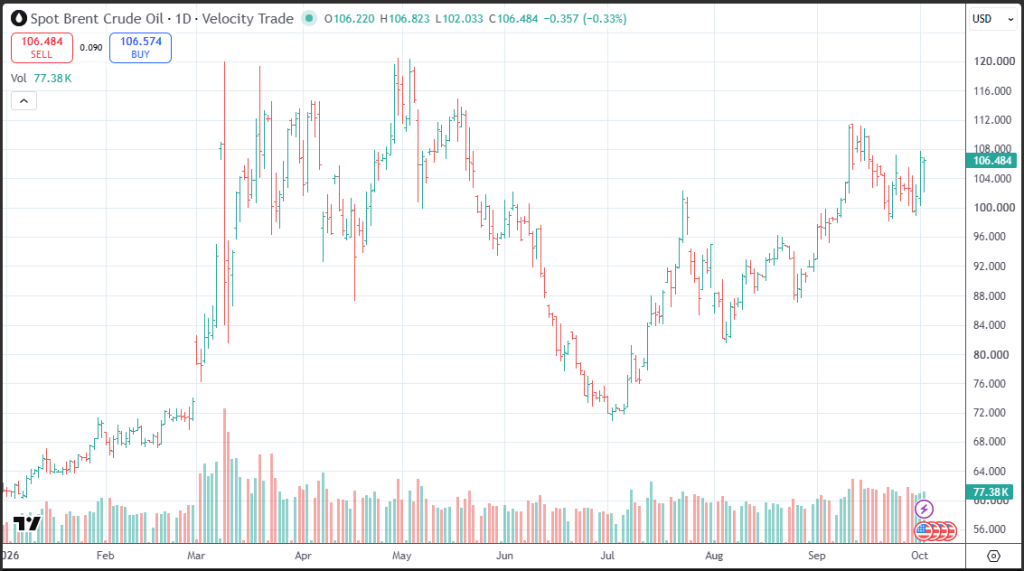
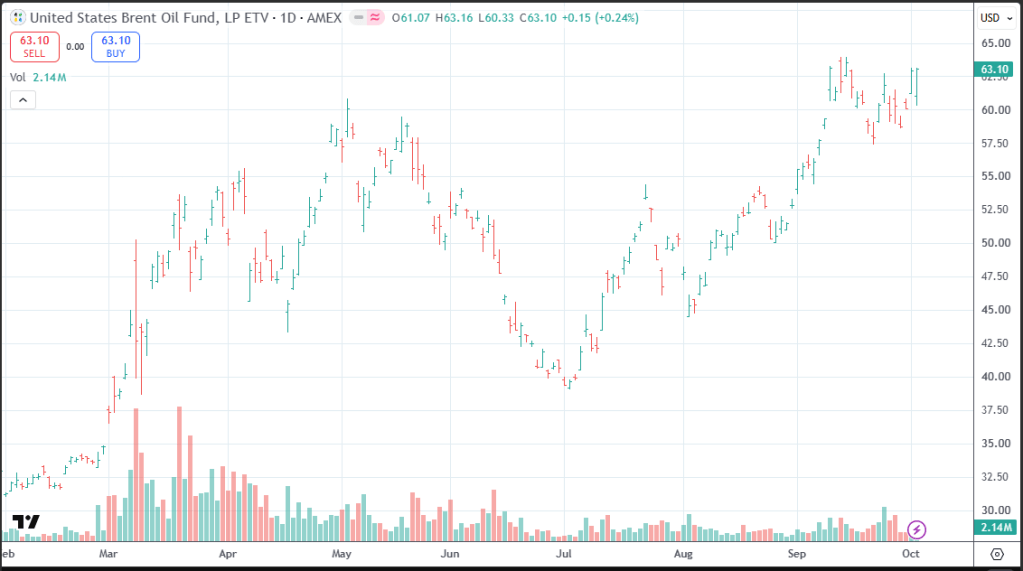
Notice that while spot Brent prices never hit the highs set in May, BNO prices exceeded those May highs in September. This difference is due to the fact that BNO, being a rolling futures product, accrues the roll yield as Brent crude is currently trading in backwardation.
In more normal times, when crude oil is trading in contango, the reverse will be true — BNO will slowly leak lower even if spot Brent prices are largely unchanged.

