August 8, 2023: Making moves

Foreword

This is a quick note, which tends to be just off the cuff thoughts/ideas that look at current market situations, and to try to encourage some discussions.

It’s early August, just one month away from the seasonally weakest month of the year for stocks, September. Time to make some moves?

As usual, a reminder that I am not a financial professional by training — I am a software engineer by training, and by trade. The following is based on my personal understanding, which is gained through self-study and working in finance for a few years.

If you find anything that you feel is incorrect, please feel free to leave a comment, and discuss your thoughts.

Weakest month

September is, traditionally speaking, the weakest month of the year, followed by August. There have been various theories put forth to explain this seeming affront to the Efficient Market Hypothesis, such as the end of summer where trader starts waking up from their vacation lull, the need to sell off assets to pay for a new school year, the selling of assets for tax lost harvesting, etc.

Whatever you may believe, it is undeniable that there is a fairly strong negative August/September effect for stocks:
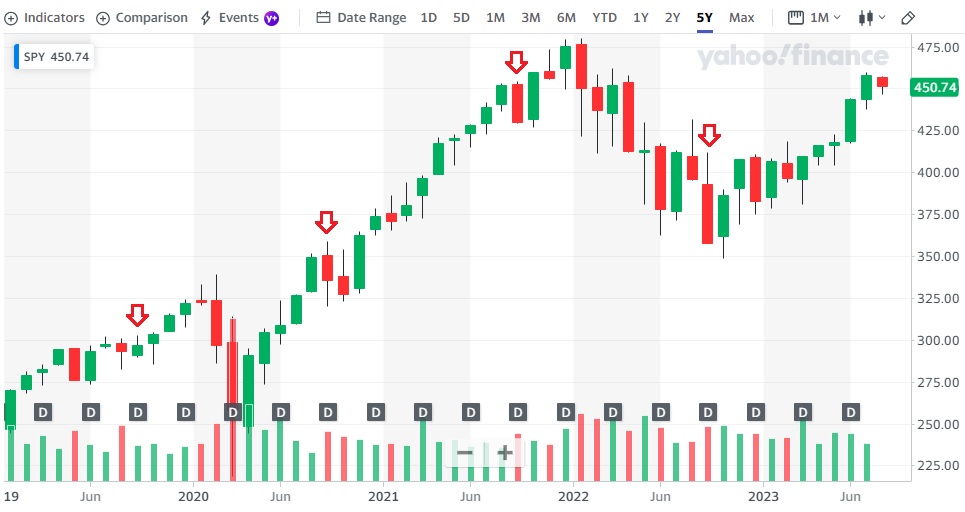
SPY performance since 2019, monthly bars with Septembers annotated. Courtesy of Yahoo! Finance.

My portfolio

If you’ve been following me on StockClubs (1), an app that I’ve invested in, you may remember that I flattened my portfolio on September 2021, which worked out well initially with 2022 being a terrible year for stocks in general. However, at the end of 2022, I also initiated a bunch of shorts thinking the weakness will persist, but of course the market gods just laughed in my face and the market ripped higher (2).

As September 2023 rolls around, I’m getting that uneasy feeling again in the pits of my stomach, and if you’re still following me on StockClubs, you’ll note that I bought a put spread, betting that markets will be quite a bit weaker by mid November.

Why, why, tell me why

To be clear, I have a spotty track record at best at timing the markets, and unless you like losing money, it may not be prudent to follow in this fool’s quest. But here are some of the issues weighing on my mind:

Liquidity

In an earlier post, I noted that liquidity is draining from the markets. While I was waffling a bit and undecided on how that’d affect markets, I am beginning to warm to the idea that on the net, this would be market negative, especially the double whammy of student loan payments resumption and tightening monetary conditions.

Inflation

Another concern is that of inflation, the boogeyman from 2021/2022 that may be making a comeback. In 2021, inflation was an issue, but it didn’t really kick into high gear until late 2021 into early 2022, especially after the Russian invasion of Ukraine.

A large part of this was due to the huge spike in crude oil prices after the invasion, but which also started coming down around mid June 2022. As you can see from the graph below, inflation (orange line) looks almost like a slightly lagged, and very exaggerated version of crude oil price (candle bars):
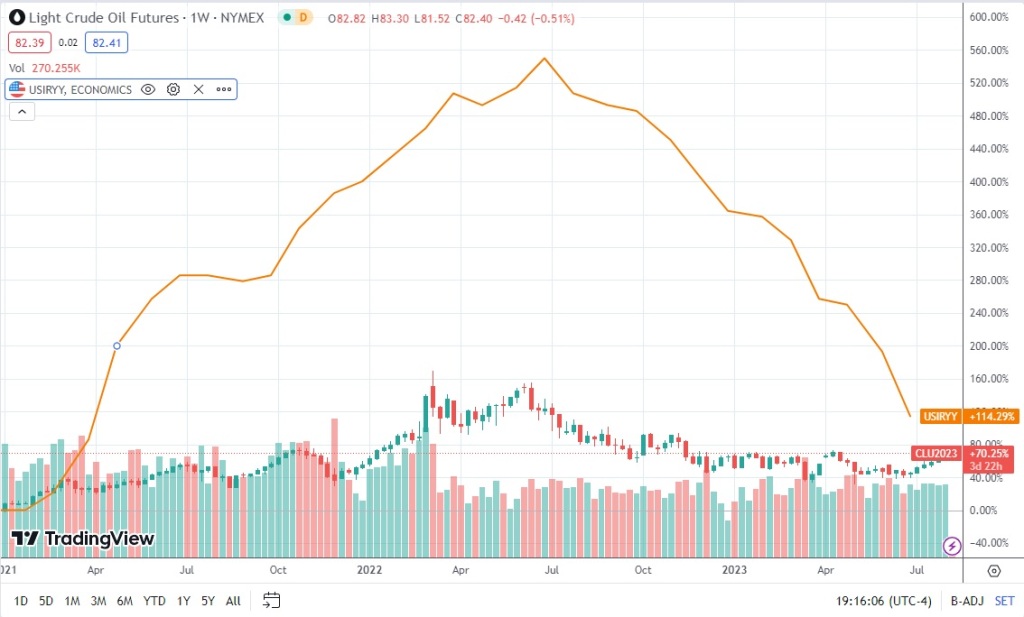
Crude oil futures prices vs US CPI YoY inflation, weekly bars. Courtesy of TradingView.

Right now, it appears that crude oil prices is moving up again, but unlikely early 2023 when crude was around the same levels now, crude oil prices in July 2022 was much lower than crude oil prices in January to June 2022:
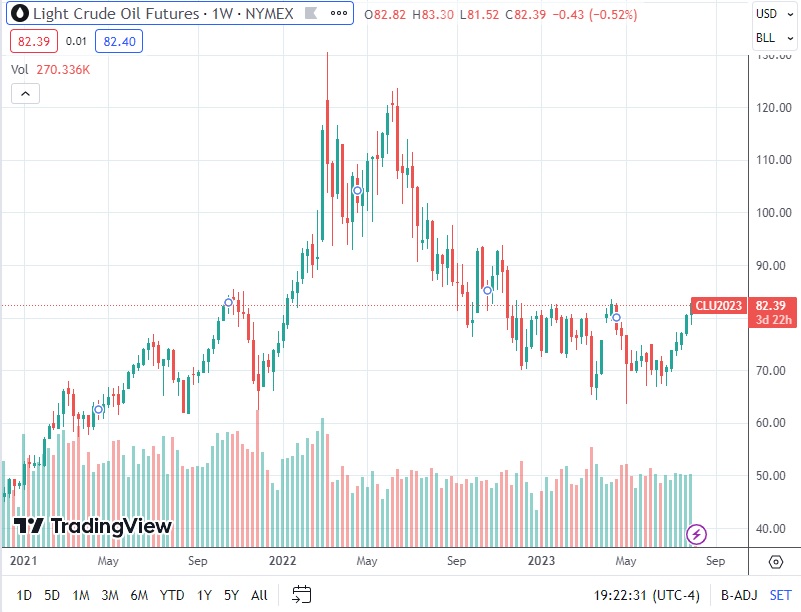
Crude oil futures prices, weekly bars. Courtesy of TradingView.

As a result, the drag of crude oil prices on year over year CPI is likely to be much less muted in July than for the first half of the year.

One way of visualizing crude oil prices’ impact on CPI inflation is by comparing CPI inflation (orange line) to core PCE inflation (teal line) and core CPI inflation (blue line) — core PCE inflation and core CPI inflation exclude the effects of food and energy prices:
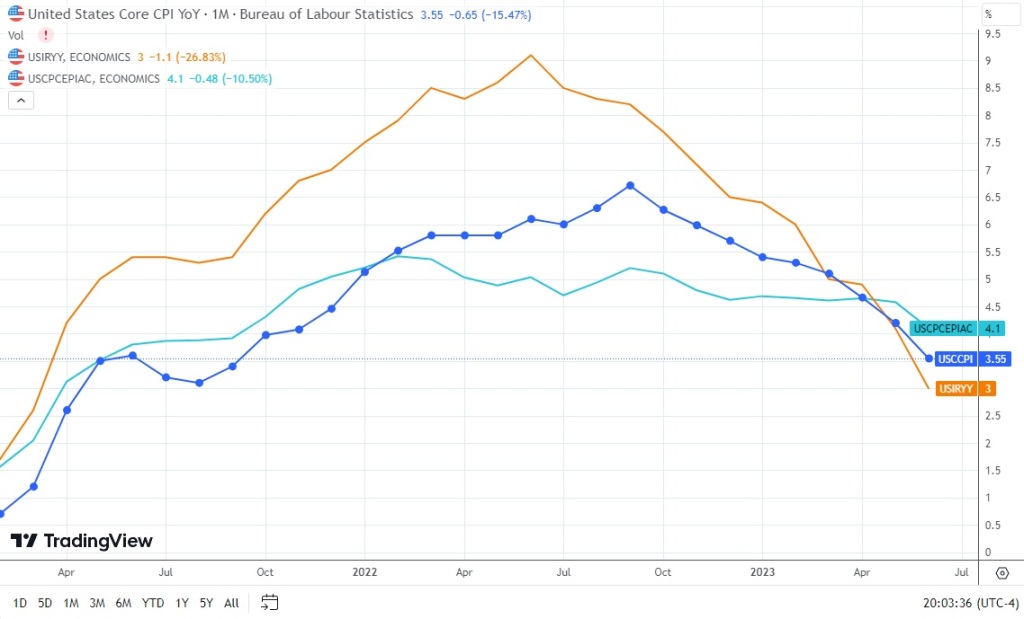
Differences in inflation measures. Courtesy of TradingView.

As can be seen, the core inflation measures are much less affected by the spike in energy prices from February 2022 to June 2022. This in turn suggests that while the core measures may continue their down trends, headline CPI inflation may see moderate its decline, and may even inflect slightly higher for July. CPI inflation measures are due this Thursday, August 10th.

Weakening earnings

Earnings for the S&P500 has been weakening steadily since early 2022:
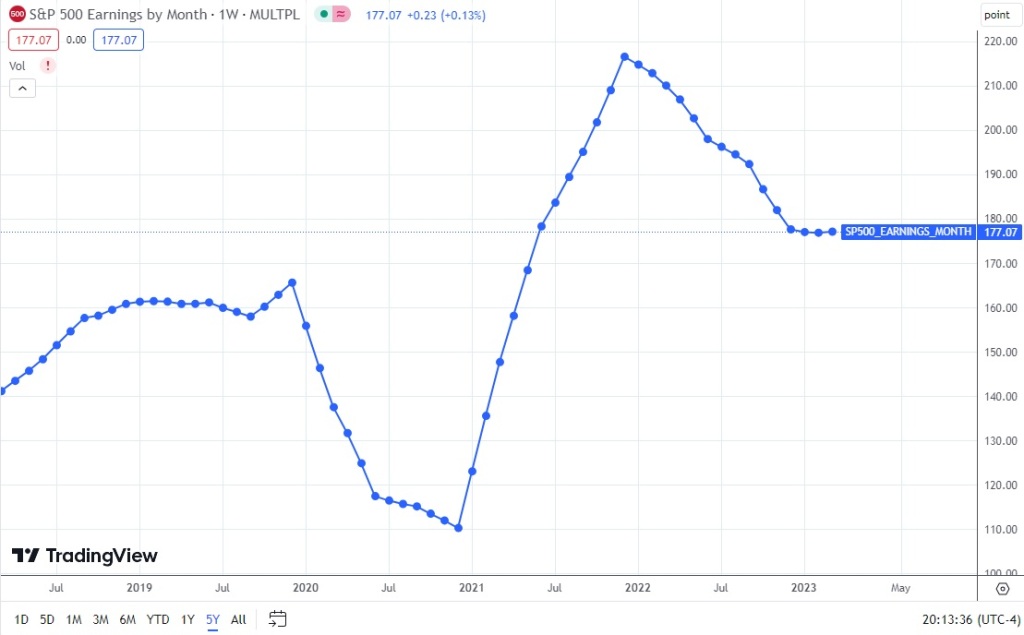
S&P500 earnings, monthly. Courtesy of TradingView.

While the weakening seemed to have plateaued in early 2023, recent earnings report (especially from Apple, the largest company by market cap in the USA) seems to suggest that the weakening may be reaccelerating. To be clear, earnings season for 2023Q2 isn’t over, and the weakening may just my overthinking it.

Technicals

Unless you’ve been living under a rock, you’d know that the markets have done pretty well so far this year. Some may say too well — on a short term basis, it seems like the markets may be taking a breather, with a small plateau forming. A plateau that I’m betting (hoping!) will turn into a small correction in the near term.

Final words

As always, I want to be very clear that I cannot predict the future, and that this bet that the markets will go down is a very small part of my portfolio. This is, for now, a short term trade, which I may close out or reverse at any time. Follow at your own risk.

Footnotes

  1. Disclaimer: I’m only listing 1 (out of 10+) of my brokerage accounts on StockClubs. While it is one of the largest brokerage account in terms of asset value, it is still less than 10% of my portfolio.
  2. Yes, nobody can see the future. Sadly.
July 15, 2023: Weekend video binge – Michael Cembalest

Foreword

This is a quick note, which tends to be just off the cuff thoughts/ideas that look at current market situations, and to try to encourage some discussions.

One of the other JB‘s had an interview with the chairman of Market and Investment Strategy of JPMorgan, Michael Cembalest, touching on a variety of recent themes.

As usual, a reminder that I am not a financial professional by training — I am a software engineer by training, and by trade. The following is based on my personal understanding, which is gained through self-study and working in finance for a few years.

If you find anything that you feel is incorrect, please feel free to leave a comment, and discuss your thoughts.

Michael Cembalest

Some time ago, I was given free (and apparently temporary) access to JPMorgan’s institutional research. During that time, I read eagerly the reports of Michael Cembalest, JPMorgan’s chairman of Market and Investment Strategy. Every single report put out by Michael was immaculately researched, with domain experts input, detailed deep dives and his own analysis to create a convincing narrative with actionable forecasts. It was great while it lasted.

When I lost access, I was sorely tempted to sign up for a JPMorgan private wealth account (which is not cheap!) just for continued access, but eventually decided against it. I’m a cheapskate, what I can say…

JB and Michael

One of the other JB’s (Joshua Brown in this case) had a chat with Michael, apparently his first media appearance. In this they talked about a myriad of recent themes, of note:

  1. Inflation and the most recent CPI report [5m]
  2. AI [33m 6s]
  3. SPACs [43m]
  4. Strategists are bearish [55m 24s]

The whole video is well worth a watch, here:

Hedging

Foreword

While hedging is mentioned in finance a lot, it is, surprisingly, not very well defined. Despite its frequent use in finance literature, it seems that most people have a rather hazy mental model of what hedging is, or how it works.

As usual, a reminder that I am not a financial professional by training — I am a software engineer by training, and by trade. The following is based on my personal understanding, which is gained through self-study and working in finance for a few years.

If you find anything that you feel is incorrect, please feel free to leave a comment, and discuss your thoughts.

What is hedging

To try and make the discussion more concrete, I’m going to provide my own mental model of what hedging is. To put it simply, a hedge is simply an auxiliary position that reduces the risk of your main position, where “risk” is defined as the variability (i.e. variance) of the combined positions performance.

Types of hedging

In my framework, there are 2 main types of hedging:

Mechanical hedges

Mechanical hedges are positions which “mechanically” go down (or up) in value as your main position goes up (or down) in value. For example, buying a put to hedge your stock exposure is a mechanical hedge — the value of the put mechanically goes up or down as the value of the stock goes down or up.

Similarly, TIPS are a form of mechanical inflation hedge — as inflation (as measured by the CPI) goes up or down, the value of the bond mechanically goes up or down.

The key thing to note, is that the value of the hedge moves inversely to the main position, regardless of market conditions. This generally happens because there is arbitrage between the main position and the hedge, such that any spreads will be swiftly closed by market makers, and/or there is an authority (such as a regulator, a government, an exchange, etc.) that enforces that the hedge moves inversely with the main position.

Statistical hedges

Statistical hedges are positions which are known to generally go down (or up) in value as the main position goes up (or down) in value, though there is no guarantee for them to always do so.

For example, in the classic 60/40 portfolio, the 40% of the portfolio in bonds can be thought of as a hedge for the 60% of the portfolio in stocks. Over the short/medium term, the value of bonds tend to move inversely with the value of stocks.

Other types of statistical hedges generally involve what is colloquially known as “pair trades”. For example, the value of the Australian dollar tends to move with high correlation to the value of the Canadian dollar, as both countries are commodities exporters with fairly similar exports, so changes in commodity prices tend to affect both. Thus, AUDUSD (Australian dollar valued in US dollars) and USDCAD (US dollar valued in Canadian dollars) tend to move inversely with each other — it used to be profitable to trade these 2 in a pair trade that bets that any gaps in performance will eventually close.

Observations

  • Assuming you do not rebalance, your total position (main position + hedge position) cannot perform better or worse than your main position. The performance of your total position, absent rebalancing, is always of a smaller amplitude of your main position.
    • If you find that your total position actually went up in value despite your main position going down in value (i.e. your hedge position went up in value more than your main position went down), then you’ve made a mistake — your main position is actually the hedge and vice versa.
  • If you rebalance smartly, then it is possible for your total position to perform better than your main position, and with lesser risk (i.e. smaller variance).
    • This is a result of the Modern Portfolio Theory. In simple terms, when your main position goes down in value (and your hedge goes up in value), you’ll sell some of the hedge position to buy the main position, and vice versa. Assuming the main position generally increases in value over time (i.e. your main thesis is correct), then this essentially forces you to buy low and sell high, and over time, should outperform the main position, but with smaller variance.
  • If the value of the hedge consistently or generally goes down when the value of the main position goes down, then you’ve made a mistake — the “hedge” is simply not a hedge for the main position.
  • If the value of the hedge moves essentially randomly with regards to the value of the main position, then it can still be used as a hedge, but only if you rebalance diligently and size the positions properly.
    • This is a result of the Modern Portfolio Theory.

My personal hedging

If you follow my positions on StockClubs (Disclaimer: I am an investor in the app, and only show 1 [of 10+] brokerage accounts in that app), then you’ll see that I very often sell calls against my stock positions. In a hand-wavy kind of way, these can be considered as hedges as well — the short call goes up in value (less negative) if the stock goes down in value.

One way of thinking about this, is that I’m giving up some upside for the stock position, to reduce some downside (if the stock goes down in value, the premium from selling the calls “absorbs” some of that loss).

June 25, 2023: Weekend video binge 2 – Economics fact check

Foreword

This is a quick note, which tends to be just off the cuff thoughts/ideas that look at current market situations, and to try to encourage some discussions.

Anyone who talks to me about finance/economics, will know very quickly that I’m a stickler for definitions. It’s really annoying (to me) when people misunderstand economic/financial terms, and then applies the finding wrongly, leading to, often, ridiculous results. In that vein, this particular video hits home, and explains why over-simplifying can be dangerous.

As usual, a reminder that I am not a financial professional by training — I am a software engineer by training, and by trade. The following is based on my personal understanding, which is gained through self-study and working in finance for a few years.

If you find anything that you feel is incorrect, please feel free to leave a comment, and discuss your thoughts.

Money & Macro

To quote Joeri,

People pretending that something is simple when it’s actually complicated, giving you a solution that is really easy to understand, but also horribly wrong. And in economics, that is especially dangerous because misunderstanding concepts like inflation, recessions and unemployment could lead to decisions that actually cause inflation, recessions and higher unemployment, ruining the livelihoods of millions of people.

Joeri, https://www.youtube.com/watch?v=eyCaXPcDvng

Final words

At any point in time, I am probably involved in at least one discussion thread somewhere, where I find myself oddly defending regulators, central banks or the law to some extent. This is ironic, given that for the most part, most folks working in finance (I work at a hedge fund currently) tend to really hate legal, compliance and regulations, because they often add to our work load with bizarre requests. Frankly, I am not immune to this sentiment.

However, while we can discuss and be critical of how the central banks have, generally, been late to fight inflation this cycle, and that regulators often are unable to follow up on every shenanigan that happens in the markets, I think such criticism should also be balanced with fairness.

Ultimately, we need to recognize that regulators, law makers and central bankers are human, and they cannot see the future any more than we can, and given their very limited resources (the SEC has around 4,000 (1) employees), it is somewhat understandable, if not desirable, that things fall through the cracks, or that shortcuts are taken.

So while we must hold them accountable, we must at least be reasonable. And being reasonable, in many of these discussion threads, starts with actually understanding the details of the financial, economic or legal nuances surrounding the issue, and trying to understand why the laws/rules are as they are.

Since laws/rules tend to be formed over time based on the latest expert opinions, then having a decent understanding, a correct understanding of finance and economics becomes paramount.

For a prior take on why definitions and understanding nuances are important, please see Code Review.

Footnotes

  1. Original version said SEC had just over a thousand employees, which turns out to be false — they have around 4,000. See https://www.eeoc.gov/federal-sector/securities-and-exchange-commission-sec-0

June 24, 2023: Weekend video binge – Step-by-step fundamental analysis

Foreword

This is a quick note, which tends to be just off the cuff thoughts/ideas that look at current market situations, and to try to encourage some discussions.

Richard over at The Plain Bagel made an excellent video about how to do fundamental analysis on a stock. Highly recommended if you are having trouble falling asleep, or are just a data nerd.

As usual, a reminder that I am not a financial professional by training — I am a software engineer by training, and by trade. The following is based on my personal understanding, which is gained through self-study and working in finance for a few years.

If you find anything that you feel is incorrect, please feel free to leave a comment, and discuss your thoughts.

The Plain Bagel

One of my favorite Youtube channels, Richard is, unlike me, an actual financial advisor, though based in Canada.

Here is his excellent video on the high level steps he takes for doing fundamental analysis. It is pretty thorough (he is a professional after all!), and I have to admit that I skip some (ok, fine, many) steps when I do fundamental analysis, but this is a good list to keep in mind.

June 13, 2023: Inflation – wrap up

Foreword

This is a quick note, which tends to be just off the cuff thoughts/ideas that look at current market situations, and to try to encourage some discussions.

Almost exactly 2 years ago, I made a post about inflation at the time, with some guesses on what will happen in the 2 years hence, i.e. ending around now. Let’s see how badly I did, now that the latest inflation print is out (4% for May 2023).

As usual, a reminder that I am not a financial professional by training — I am a software engineer by training, and by trade. The following is based on my personal understanding, which is gained through self-study and working in finance for a few years.

If you find anything that you feel is incorrect, please feel free to leave a comment, and discuss your thoughts.

Background

On June 6th, 2021, I made the first in the series of inflation related notes. That was followed quickly by a clarification on August 30th, 2021, and then an update on April 30th, 2022.

Keeping score

In the three posts, I made some guesses on what would be coming next:

  • Given Janet Yellen’s press conference, at the time, I suggested that the Fed may be getting ready to hike in 2022-2023.
    • Score: 1
    • As we now know, the Fed started hiking March of 2022, 9 months after the first post.
  • I guessed that it would be unlikely for the US to get high inflation in the “next 1-3 years”, where high inflation is defined as 5-10% inflation.
    • Score: 0
    • As we now know, inflation got to a peak of ~9% since then, and it’s only been 2 years.
  • I further guessed that if it did get to high inflation, it’ll probably be transitory (1-2 quarters).
    • Score: 0
    • Inflation was above 5% for almost 2 full years — it hit 5% in May 2021, and just went below 5% in April 2023. Data here.
  • I also guessed that we’ll hit medium inflation (2.5% – 5%) and maybe stay there 4-5 quarters, up to 2 years.
    • Score: 0
    • We’ve been in medium (or higher!) inflation for 2 full years now.
  • I suggested that certain “bare necessities” stocks would perform better in this inflationary regime.
    • Score: 0.5
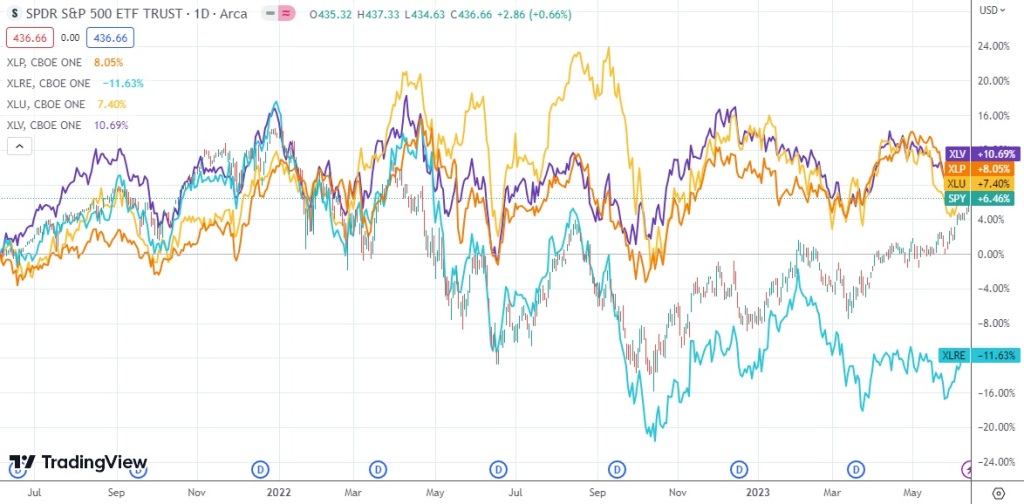
    • The performance of the 4 bare necessities proxies are below. While 3 of the 4 clearly outperformed SPY, the last one (real estate) flunked, badly. The average of the 4 also comes to around 3% returns, much below SPY’s 6.46% return.
    • That said, I wanted to point out that in the original post, I didn’t actually say real estate, but “multi-family housing”, and at least the multi-family funds that I’m holding are performing much better (they aren’t losing money for one thing…). However, I’m still giving myself a score of 0.5 because not all multi-family housing is doing well — while the funds I happen to have invested in are doing OK, multi-family housing on the west coast is doing horrendously, and quite a few of them are very likely losing money.
XLV, SLP, XLU, XLRE performance (dividend+split adjusted) from 6/6/2023 to 6/13/2023, courtesy of TradingView.

So, a score of 1.5 out of 5. Not too bad! If I saw a Yelp review of a restaurant with 1.5 stars out of 5, I’ll definitely go there… if I’m severely constipated and need help to “smooth things out”.

Excuses, excuses

Now that we’ve established I’m terrible at guessing what the future portends, let’s do my favorite part of the exercise — giving excuses for why I suck at this.

In terms of the inflation guesses, the main excuse I have is… Russia, Russia, Russia! Not predicting that Russia would invade Ukraine, and that the war would drag on for more than a year, and thus lead to chaos in supply chains, was probably the biggest miss.

In terms of stocks performance, there are 2 main misses:

  • I did not foresee the Fed ramping up so fast and so much.
    • The Fed going from 0% to 5% in around a year is a very dramatic move, essentially the fastest pace of hiking ever.
  • I did not realize how many real estate businesses were using adjustable rate mortgages.
    • I was thinking with my personal mortgage in mind, and thought that given the historically low rates, everyone would be eager to get a fixed rate mortgage.
    • Instead, a large number of real estate businesses were actually using adjustable rate mortgages, so the rate hikes hit them really hard.

Summary

While I made a mess of the guessing game, my personal portfolio has done pretty well — most of the stocks I’ve picked are doing better than the SPY (1), while my private equity multi-family real estate funds are all doing pretty OK as well.

That said, it should be noted that the private equity funds doing well is quite a bit of luck — I missed the crucial adjustable rate mortgages issue, but luckily most of the funds I’m invested in used fixed rate mortgages, or were not too terribly affected.

So, the lesson from all this is… being lucky is important for financial success. If you are not lucky, work harder at being lucky. 🙂

Footnotes

  1. If you follow me on StockClubs (disclaimer: I invested in this app, and I’m only showing 1 out of 10+ brokerage accounts on the app), you’ll realize that I had a few short bets (via puts) with varying degrees of success. I’m excluding those from the analysis, because they were mostly “for fun” bets, and the net result of all of them is around $0 (I used the winnings to buy a bunch of puts on QQQ/BITO that did not work out).

June 4, 2023: Weekend video binge

Foreword

This is a quick note, which tends to be just off the cuff thoughts/ideas that look at current market situations, and to try to encourage some discussions.

Some have read the prior note, and gone away with a distinctly bearish read. Perhaps this will disabuse you of the notion.

As usual, a reminder that I am not a financial professional by training — I am a software engineer by training, and by trade. The following is based on my personal understanding, which is gained through self-study and working in finance for a few years.

If you find anything that you feel is incorrect, please feel free to leave a comment, and discuss your thoughts.

Alf and Andreas

Alf and Andreas just had a podcast where much of it discusses some of the same liquidity issues I’ve listed in the prior note – “Liquidity worries”. In it, they discuss some of the issues in much more detail than I am able, and give thought to the nuances of each. Well worth a watch if you are sure that the markets will go down (or up) due to these issues.

TL;DR: The world is more complicated than that.

Stockclubs

As I’ve noted in “Liquidity worries” and “Synthetic bonds“, I have no clue what the markets will do next, so I’m mostly in a holding pattern right now.

To see what my portfolio looks like, you can use Stockclubs, an app which I’ve invested in, which shows 1 (out of 10+) of my brokerage accounts.

May 31, 2023: Liquidity worries

Foreword

This is a quick note, which tends to be just off the cuff thoughts/ideas that look at current market situations, and to try to encourage some discussions.

The market has been floating on a gush of liquidity since 2009, and while the economy has grown by ~60% since then, stocks have climbed ~560% since the nadir in 2009. What happens if the liquidity spigot goes away? We may be about to find out.

As usual, a reminder that I am not a financial professional by training — I am a software engineer by training, and by trade. The following is based on my personal understanding, which is gained through self-study and working in finance for a few years.

If you find anything that you feel is incorrect, please feel free to leave a comment, and discuss your thoughts.

Double, double toil and trouble

Upcoming liquidity drains:

  • Quantitative Tightening
    • Ongoing for a while now
  • Treasury General Account refilling
    • When the debt ceiling is passed, the Treasury will need to sell a bunch of bonds to refill their bank account to the tune of $200-400B (1)
  • Resumption of student loan payments
    • Currently estimated to resume end August
    • Loans on adjustable rates will also likely resume at (the now much) higher rates
  • General downturn in consumer discretionary spending
  • Potential rate hikes
    • Current estimates range from 1-2 cuts by end of year to 2-3 more hikes by end of year
    • This is generally true of all major central banks, minus Japan and China
  • Potential recession
    • Been predicted by various folks for, err.. 2 years now.
    • While some commodities and business leaders are sounding the alarm, job numbers (which tend to be lagging) are still pretty strong

Predictions

Haha, fooled you — I don’t generally do predictions. It’s not hard to make a case for stocks going up or down based on the issues above, and I’m pretty sure whatever I say, the market gods will just laugh and the complete opposite will happen anyway.

So, I guess we’ll find out.

Footnotes

  1. There are some who claim that the Treasury needs to sell over a trillion of bonds. A quick look at https://fred.stlouisfed.org/series/WTREGEN suggests that while the TGA had a peak of $1.8T during the pandemic, in recent years, the more normal amount is around $200-400B. I’m not sure if there’s something I’m missing, but $200-400B sounds more correct to me.

May 13, 2023: Weekend video binge – Howard Marks

Foreword

This is a quick note, which tends to be just off the cuff thoughts/ideas that look at current market situations, and to try to encourage some discussions.

If you read my blog often enough, you’ll realize that I spend a lot of time saying “I don’t know”, and, perhaps more disappointingly, not giving any stock tips, suggesting that more people should be wary of risky assets, and droning on about how conservative I am in my portfolio.

As usual, a reminder that I am not a financial professional by training — I am a software engineer by training, and by trade. The following is based on my personal understanding, which is gained through self-study and working in finance for a few years.

If you find anything that you feel is incorrect, please feel free to leave a comment, and discuss your thoughts.

Howard Marks

Howard Marks gave a very insightful lecture in 2019 that reveals all stock market secrets. It is long, and to be blunt, Marks is not the most enchanting orator.

But if you are willing to invest an hour listening to this legend of financial markets, I think you’ll be well rewarded for it.

Some choice quotes:

The challenge is to make money at the same time as you control risk.
And a portfolio with the opportunity to make money, but with the risk under control, is in my opinion, the mark of a professional investor.

The 3 stages of the bull market:
The first stage, when only a few exceptionally bright people understand there could be improvement.
The second stage, when most people understand, that improvement is actually taking place.
And the third stage, when everybody believes that things will get better forever.
So, if you buy in the first stage, when most people don’t see a better future, when there’s very little optimism included in asset prices, you get a bargain, and you can make a lot of money.
If you buy in the second stage, when everybody understands that improvement is taking place, you don’t get a bargain, you do OK, you follow the cycle, you buy in at a fair level.
But if you buy in the third stage, when everybody thinks things will get better forever, and when asset prices reflect a great deal of optimism, you pay high prices, which sets you up for substantial losses.

The interesting thing about investing, is it’s not what you do, it’s when you do it.
It’s not what you buy, it’s when you buy it, under what conditions, and at what prices.
So, the key to investing, is not buying good things, it’s buying things well.

Howard Marks, https://www.youtube.com/watch?v=18iIq4U4N5c

Clear as mud

Foreword

If you haven’t been hiding under a rock for the past ~5 months, you’ll know that there has been a bit of a kerfuffle in the regional banks, leading to 3 very dramatic bank failures, and a lot of uncertainty in regional bank stocks. What gives?

As usual, a reminder that I am not a financial professional by training — I am a software engineer by training, and by trade. The following is based on my personal understanding, which is gained through self-study and working in finance for a few years.

If you find anything that you feel is incorrect, please feel free to leave a comment, and discuss your thoughts.

Banks, why’d it have to be banks?

If you follow me on StockClubs (1), you’ll know that I basically never buy bank stocks. There is a fairly straight-forward reason for this — banks are weird. Everything about them is weird.

Because of the nature of their business, they have very different accounting rules compared to regular companies. They are also allowed ridiculous amounts of leverage. And finally, because banks are run by, well, bankers, and bankers are really good at finance, it sometimes (frequently?) occurs that the financial statements put forth by banks are, shall we say, less than transparent.

Which is to say, a bank’s books and financial statements are clear… as mud.

And because I don’t like buying things I don’t understand (2), I generally don’t buy bank stocks.

Drama

Which brings us to the happenings since the start of the year. Or really, since around the middle of last year. As discussed in “Safest Money“, essentially all banks have been taking it on the chin on their portfolio of bonds and loans, due to the rapidly increasing interest rates. This is particularly true for regional banks, because they tend to hold the loans on their books.

Holding loans with 2-3% interest rates on your books are good when you are a bank and can get capital (via deposits or via borrowing from the Fed) for 0-1%. You pay out 0-1%, you take in 2-3%, and the difference you pocket.

Holding those loans when interest rates are at 4-5%, however, is not quite as good, as Silicon Valley Bank, then Signature Bank and, more recently, First Republic Bank found out to their detriment.

At the same time, the news outlets have been having a blast, blaring out scary headlines about the blow by blow of which banks are having trouble, what the Fed/FDIC officials are talking about behind the scene, and which banks may be next. Accordingly, the stock prices of essentially all regional banks have been behaving like the electrocardiogram of someone having multiple heart attacks, at the same time. All very not-pretty.

Banking

Throughout all this drama, it’s natural to ask — are banks safe?

My personal opinion is that, as a whole, the banking industry should be fine. Most people simply do not pull money out of banks and stuff them in their mattresses. Instead, most of the money withdrawn are, almost immediately, shoved into another bank — there simply isn’t enough physical cash in circulation for everyone to withdraw.

What about those folks who take their money to buy assets like stocks, bonds or money market funds, you ask?

Well, every transaction has a buyer and a seller. The buyer gets the asset, and gives the money to the seller. And the seller (generally) promptly puts the money into… a bank.

So, collectively, it is very hard for money to escape the banking system (3).

That said, while banks, as a whole, should be fine (4), individual banks may drop like flies as we’ve witnessed in the past few months, because…

Irrational

… the situation really isn’t about rationality anymore. If you have under $250k in a bank account, the probability of you losing money is essentially 0. Even if you have more than that, the FDIC has shown that they are willing to go to extraordinary lengths to prevent depositors from losing even $1. While that guarantee is not set in stone and they may relent at any time, it seems that providing the safety net, at least in the short term, may be the only way to prevent contagion, so short of some really dramatic changes to the circumstances, I don’t think the implicit guarantee is going away anytime soon.

Which is to say, most of the action in terms of bank deposit flight, seems to be mostly due to irrational fear.

As for banks’ stock prices, the past few days have been a whirlwind of crazy — it simply doesn’t make sense for (at least on paper) profitable banks’ stocks to drop 60% and rebound 100% in the span of 24hours; Either the sellers are wrong, or the buyers are wrong. They can’t both be right.

So, while depositors should mostly be OK (4), shareholders may find their shares of various regional banks turning into donuts overnight, and often with very little fundamental reasons.

Systemic?

The thing to watch out for, is if the situation becomes systemic. As some may remember, the 2008 Great Financial Crisis was essentially a banking crisis, and it was not pretty.

That said, be very careful about the scary headlines. It is true that the 3 banks that just went down were the 2nd, 3rd and 4th largest banking failures ever in US history. But that fact sounds more ominous than it really is. The fact of the matter is that the US banking system is dominated by 4 very, very large banks, and thousands of, well, not very large banks. According to Bankrate, Wells Fargo, the 4th largest bank is more than 3 times larger than the 3 failed banks combined, and JPMorgan Chase, the largest bank in the US, is almost twice the size of Wells Fargo.

To put it simply, while it certainly isn’t good that medium size banks are failing, the situation isn’t quite as dire as some are making it out to be.

Even more importantly, the underlying problems in 2008 were bad loans — back then, many banks made loans to folks who simply could not possibly pay back the loans. As a result, there was a serious solvency crisis, as well as a serious confidence crisis — nobody knew which loans were good or bad, so nobody knew who was going to take massive losses, and thus nobody trusted anybody, resulting in a deep freeze of the financial system.

This time around, the problematic loans in question are mostly Treasury bonds, literally the safest security on Earth. The issue isn’t one of solvency, nor one of confidence — every bank’s holding of Treasury bonds are reasonably well documented and nobody is really worried of a Treasury hard default. The issue is one of liquidity — the affected banks simply do not have enough cash on hand if there is a severe bank run.

Given that the underlying assets backing the banking system are mostly safe, the installation of new federal backstop via the BTFP, and the willingness of larger banks to scoop up rivals at a huge discount (5), the chances of a systemic crisis seems slim. Though, again, shareholders of some banks may find a lump of coal in their stockings in the next few months.

Footnotes

  1. Disclaimer: I am an investor in StockClubs. Also, as of publication time, only 1 (out of 10+) of my brokerage accounts are linked to the app.
  2. They make me feel inadequate.
  3. There are some exceptions, for example reverse repo operations with the Fed, etc. But those are generally not available directly to retail investors. Also, according to the Fed, the amount of money parked in reverse repos hasn’t really moved that much since the start of the year.
  4. To be clear — banks (collectively) should be fine as long as the current situation remains a liquidity and duration mismatch crisis borne of interest rate risks. If this morphs into a insolvency crisis because of bad loans, then things will be very different.
  5. JPMorgan Chase’s CEO, Jamie Dimon, was noted to be bragging about the sweetheart deal to his shareholders.