September 26th, 2022: Paralysis

Foreword

This is a quick note, which tends to be just off the cuff thoughts/ideas that look at current market situations, and to try to encourage some discussions.

Markets took another drubbing today, and is now less than 20 SPX points away from year to date lows, almost 25% below the highs just a few months ago.

As usual, a reminder that I am not a financial professional by training — I am a software engineer by training, and by trade. The following is based on my personal understanding, which is gained through self-study and working in finance for a few years.

If you find anything that you feel is incorrect, please feel free to leave a comment, and discuss your thoughts.

Ouch

If you follow my blog posts, and/or if you follow me on StockClubs (1), you will know that while I’ve flattened my portfolio (i.e. reduced exposure to equities/bonds), my portfolio is not flat. As a result, the absolute drubbing in the markets, for both stocks and bonds, in the past month or so has not been fun.

As it stands, we are now less than 20 SPX points away from the lows set in June, and given the relentless selling of the past few trading days, there is a good chance that we’ll visit and maybe go below that in the coming days.

Bear market

Talking to a few friends, it seems like some are still heavily invested in stocks and bonds, and I can only imagine the pain they must be experiencing. At the same time, I get the feeling that quite a few people are essentially paralyzed with shock at the speed and magnitude of the moves so far this year — if you started investing after 2009, then you most likely have only experienced “happy times” in the markets. This year would (other than the rather brief March 2020 downturn) be the first major bear market you’ve experienced.

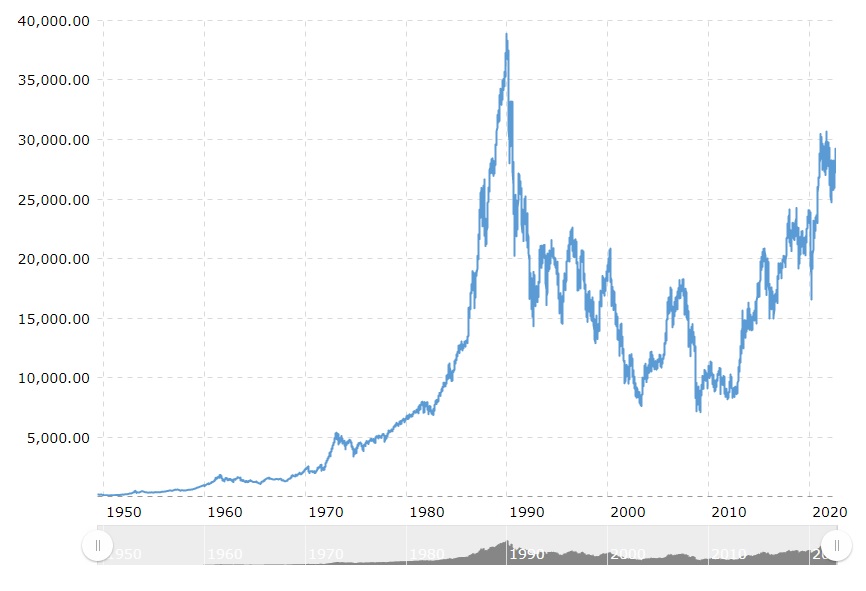
Bear markets happen, and they can last for a long time, with many, many dead cat recoveries that morph into new lows — the Nikkei 225 still has not recaptured its peak set in the late 80’s/early 90’s, about 30 years ago:

Will the SPX also take 30 odd years to not recover? I don’t know, and frankly, nobody does. It is certainly possible, though history across all the major developed markets suggests that this is unlikely — recovery to prior peaks for even fairly severe drawdowns (like the 2008 Great Financial Crisis) rarely take more than 5-10years.

As investors, all we can do is make projections, and allocate our portfolio accordingly. But as noted in Marathon, we should also make preparations for the worse/worst case scenarios, for the unknown unknowns, for when the bear awakes and takes a swipe at our portfolios.

So, if you’ve been paralyzed with indecision thus far, you need to make a decision, even if the decision is to “do nothing”. It is certainly a hard decision to make, given that you are likely sitting on a bunch of losses and realizing the losses (by selling) will make it that much more real. Sitting tight could very well see you made whole or more…, or we may drop another 25% or more.

An easier decision to make, however, is if you have immediate needs for money that cannot be deferred. If so, you should seriously consider keeping enough liquidity (i.e. cash or cash equivalents) on hand, so that your near term money needs can be met. If the market recovers, treat it as premiums for insurance against failing to meet your obligations. If the market drops more, you’ll certainly be relieved you cashed out and won’t have to worry about near term needs.

Footnotes

  1. Disclaimer: I am an investor in StockClubs, which is an app that lets you share your portfolio, or follow the portfolios of others. Note that I’m only sharing 1 (out of around 10) brokerage accounts that I maintain.

Recursive convergence model

Foreword

There are many models of how stocks are priced, dealing with different aspects of pricing, and different pricing models. Intuitively, if 2 things are the same, then they should trade with the same price. But empirically, we know that they don’t always do that (see here and here). Why not?

As usual, a reminder that I am not a financial professional by training — I am a software engineer by training, and by trade. The following is based on my personal understanding, which is gained through self-study and working in finance for a few years.

If you find anything that you feel is incorrect, please feel free to leave a comment, and discuss your thoughts.

A = B = C

Let’s say we have 3 different securities, which may be stocks, futures, options, or whatever, A, B and C, which are essentially the same thing, modulo some constants (such as interest rates, trading fees, etc.). For example, SPY, ES, VOO, IVV, etc. The conventional wisdom is that the price of A, B and C should be the same — again, modulo some constants — since these are constants, we can model them out and just assume each of A, B and C are trading sans these conditions.

In practice, we know that SPY, ES, VOO and IVV don’t trade exactly in lockstep. Yes, they trade pretty closely, and divergences don’t last for very long. But in some short-ish timeframe (which may be on the order of seconds or even milliseconds), their prices can diverge.

Arbitrage

Assuming A, B and C are convertible, i.e. we can convert any of A, B or C into any of A, B or C, then there is arbitrage — if the price of A and B, say, get out of sync, someone can short the more expensive one, buy the cheaper one, and convert from the cheaper one to the more expensive one to close the short, thus making a “risk free” arbitrage profit.

The Efficient Market Hypothesis likes to assume that all these happen instantly, so there are no risk free profits to be made. But Wall St’s legions of market makers, liquidity providers and ETF arbitragers say otherwise. The fact that these companies are massively profitable suggests then that price dislocations can happen, and these companies close the price dislocations, getting us closer to (but never really reaching!) a perfectly efficient market, while making a profit for their troubles.

Not so perfect information

Now, in the perfect world, everyone knows all publicly available information at all times (i.e. information dissemination is instantaneous). In practice, that is clearly not true and can never be true — physics teaches us that nothing can move faster than the speed of light, including information. Since light moves at a finite speed, entities further from the source of information need necessarily get the information at a later time than entities closer to the source of information.

So, let’s take that a bit further, and assume that not everybody knows about the fact that A = B = C. Let’s say some segment of the market knows that A = B, another segment know that B = C and a third segment knows about A = C. Now these segments can overlap, but they are not the same, i.e. some people may know more than one of the 3 sub-equations, but not everyone knows all the sub-equations. Further, we use “know” here loosely — it’s possible that an entity actually does understand the 3 sub-equations, but for whatever reasons, decide that they only want to trade one or two of the 3 sub-equations. For example, an entity may only be a market maker in A and B. So while they can easily trade the A = B equation, they may not be able to trade the B = C or A = C equations as effectively, and so they don’t.

A moment in time

Let’s say some large entity, E, decides, for whatever reasons, they want to buy our security, and in large quantity. E can choose to buy A, B or C, and they fully understand the A = B = C relationship. However, E is a practical, real world entity, and they are not a market maker — they are a regular investor, and more interested in the productive earnings of the security, than the temporary price dislocations. So, for practical purposes, E will only buy one of the 3 of A, B or C, as it makes bookkeeping easier.

Now, even if E does the smart thing, and buy the cheapest of the 3 right now (and for the sake of argument, let’s say that’s A), if E decides at some future date to add on their position, and in order to maintain the “only one symbol on my books” rule, they will, at that future time, continue buying A. This may be true, even if A is not be the cheapest of the 3 at that point in time. In effect, at some arbitrary point in time, E may, for perfectly rational, though not financial, reasons, decide to buy A, even if A is not the cheapest.

Next, let’s say E is expecting to deploy large sums of money. We know that a trade is always between a buyer and a seller. We have a seller in E, but who’s selling? Unless there is another entity (or set of entities) that are willing to sell at least as much as E is buying at the current market price of A, E‘s buying will necessarily push the price of A up, at least in the short term. And since at any particular point of time, it is impossible to guarantee that you can always trade such that someone else is always willing to take the other side of the trade from you at the current market price, especially if you are trading in large sizes, we come to the conclusion that at least in the short term, E‘s trades will necessarily push the price of A up.

As the price of A increases, arbitragers will start to do their work by shorting A and buying B or C to convert into A to close their short. This will push the price of A down, while simultaneously pulling the prices of B and C up. However, since it’s generally not possible that the number of entities in the segments arbitraging A = B and A = C to be exactly the same, one of B or C will move up faster than the other. Let’s say for our discussion that B moves up faster than C, so we arrive at A > B > C, again, in the short term.

Since B and C diverged, our last segment of arbitragers will step in, shorting B and buying C. This has the effect of pushing C up faster, but notice how it work against the efforts of the A = B arbitragers!

Big picture

Stepping away from the instantaneous snapshots of the prices of A, B and C caused by E‘s trades, we arrive at a well known scenario described in mathematics as a “converging recurrence relation”. E‘s trades immediately pushes up the price of A, and the efforts of the arbitragers, over time, tries to spread that “information” (here the price of the security represented by A, B and C), so that all of A, B and C all reflect the same price.

Notice that we did not talk about fundamentals! It maybe that E is too optimistic, and pushes the price of A (and eventually B and C) up too high. But that doesn’t matter to the arbitragers — they are simply making risk free profits by arbitraging the equation A = B = C. So, in the short term, it’s perfectly possible that the prices of A, B and C are dislocated from fundamentals.

More interestingly, for the prices of A, B and C to converge to a final single, identical value, will require many rounds of arbitragers shorting/buying different pairs of the 3, but since the relationship is convergent, we can assume that over time, the absolute magnitude of dislocations will reduce, and the prices will eventually settle down (assuming no one else is trading these symbols other than the arbitragers).

Most interestingly, it should be noted that we cannot actually predict the final stable price of A, B and C! Without knowing the relative numbers of arbitragers in each of the 3 sub-equations, and without knowing their relative trading speeds and aggressiveness, it’s generally not possible to figure out whether the A = B arbitragers will be more successful pulling up the price of B to meet the price of A, or that the B = C arbitragers will be more successful pushing DOWN the value of B, which eventually results in A and C catching down to B.

Liquidity

One thing to note, though, is the need for liquidity. For the arbitragers to work, there needs to be external sellers and buyers in each of A, B and C. Given that we know A = B = C, then objectively, even if not everyone knows the full equation, we can generally expect that the number of arbitrage buyers in A will be less than the number of arbitrage sellers in A, whenever A is overvalued compared to B and C.

For securities which are very liquid, such as the SPY, ES, VOO, IVV, etc., the arbitragers have a deep pool of external traders to trade against, so the convergence of the prices can be fairly quick, sometimes in the order of milliseconds.

But for securities which are very illiquid, such as certain ETFs, the arbitragers may not be able to find willing buyers/sellers to take the other side of their operations, and in those cases, the convergence can take a much longer time. In some cases, illiquid ETFs have been known to diverge from their underlying for days or even weeks at a time.

Final words

Clearly, the above does not perfectly describe every security. In fact, it does not perfectly describe any security (or set of securities). It is a model to think about how prices move, out of many, many different models that try to explain subtle nuances of different parts of the market.

While it is sort of true in practice, there are a number of assumptions made which are not realistic in practice — such as no external buyer/seller willing to move prices other than E.

However, hopefully a discussion of the model, even in our made up world, is a useful exercise in thinking about how prices move in practice.

Real Estate Syndication

Foreword

I’ve received, over time, numerous requests from various people inquiring about real estate syndication. Here is a quick summary of the space, and the things I look out for when evaluating a new deal.

As usual, a reminder that I am not a financial professional by training — I am a software engineer by training, and by trade. The following is based on my personal understanding, which is gained through self-study and working in finance for a few years.

If you find anything that you feel is incorrect, please feel free to leave a comment, and discuss your thoughts.

Real Estate Syndication

As way of a quick introduction, real estate syndication is a fancy way of saying a “real estate fund”, or, in some cases, “real estate private equity fund”. The former (real estate fund) is more general, and encompasses various real estate strategies (explained below), while “real estate private equity fund” refers specifically to funds which buy properties, improve them somehow, and then sell them again — Similar to how generic private equity funds buy companies, improve their operations, and then sell the companies again either on the private or public markets.

Terminologies

Before we dive in, here are some common terms which will come up over and over again in this space.

Sponsor, General Partner, GPThe people who found the deal and are marketing it are generally called the sponsor. The people who actually run the day to day operations as well as make major decisions on behalf of all the other investors are called the general partner (or GP for short). In general, the sponsor will usually be the GP, so the terms are used interchangeably in most cases.
BrokerThe people/entity which is purely marketing the deal on behalf of the sponsor. The broker typically takes a cut of the profits, either in the form of a front load (a fee up front as a percentage of committed dollars they bring in) and/or an equity stake (usually a percentage of the profits).

While brokers are common for really large deals (hundreds of millions to billions of dollars), they are uncommon for smaller deals (under $100m). Personally, if a smaller deal has a broker (or worse, many brokers), I would consider it a sign that the sponsor is new to the game and simply doesn’t have a large enough rolodex of investors to call upon.

Some common brokers are FundRise, CrowdStreet, YieldStreet, etc.
Investor, limited partner, LPThe people who actually put money into the deal. While the GP earns their profits from sweat labor, the LP earns their profits from equity labor, i.e. actual return on actual cash put into the deal.

In particular, the LP is also limited in that they have no say in the day to day running of the deal. This is important! A key determination of who has limited liability (and thus can walk away from a failed deal by “only” losing their investment) vs who has unlimited liability (and thus may be personally liable for any losses/debts) is who is responsible for making decisions and who actually made decisions.

Before you take part in any deal, make sure that you are joining as an LP, unless you are comfortable making decisions for the deal, and taking responsibilities for the consequences of your decisions.
Capitalization rate, cap rateThe capitalization rate of the deal. At the start of the deal, this is obviously estimated, but when a deal exits (sells of its assets), the “exit cap rate” is also of interest and is typically actual (instead of estimated).

Cap rate is simply the “net operating income” divided by the value of the asset. In a hand-wavy sort of way, you can think of it as the inverse of the P/E ratio that is so common for stocks.
Internal rate of return, IRRThe imputed return of the deal (either estimated or actual, depending on context) over a period of time, annualized to one year.

The IRR is more complicated than simply the return of the deal divided by the amount invested — the timing of the return of capital and profits is important!

A deal that takes in $100, and then immediately returns $100 the next day, while also returning another $100 over the next year, is a much better deal than one that takes in $100 and returns $200 at the end of the next year. Both deals return $200 over a one year period, but the former returns your capital almost immediately, letting you put that capital to further use.

Think of it this way — assuming you can and do put all cash thrown off by the deal back into the deal and compounding at the same rate, then 2 deals with the same IRR and same period of compounding will return exactly the same amount of money at the end of both deals.
Levered returns, levered IRRAlmost all real estate funds use leverage, because without leverage (and the associated risks!), most real estate deals simply do not make sense — you can get much better returns with much lower risks by just investing in the stock markets passively.

Levered returns or levered IRR is simply the actual (or estimated, depending on context) return or IRR after including the multiplicative effects of leverage and taking out the costs of leverage (i.e. interest fees).
Gross return, gross IRR, fund level return, fund level IRR“Gross” basically just means “fund level” in this context, which means whatever number listed, is for the fund before the GP takes their cut, but after all other applicable fees, such as property management, expenses reimbursements, legal fees, etc.

While these numbers are interesting, the more important numbers are the “net” ones. Always be sure to ask the GP for the net numbers, and if you have both net and gross numbers, then you can get a sense of how much the GP is getting paid.
Net return, net IRR, investor level return, LP level return, investor level IRR, LP level IRR“Net” basically just means “LP level” in this context, so the number listed is the actual (or estimated, depending on the context) return that you, as the LP, will get.

These are the numbers you want to use when comparing two otherwise equal deals.

Strategies

There are 4 main strategies for real estate funds:

DevelopmentThis is where the fund takes in capital to build a new property.

There are two exits:
a) The property is sold to buy/hold investors.
b) The property is converted into a buy/hold investment for long term holding.

In some cases, a fund may even opt for both — the property is sold to an affiliated buy/hold fund, and existing investors can opt to collect cash of the proceeds, or to roll over their investment into the new buy/hold fund. If too many investors opt to collect cash, then investors rolling over may be given the opportunity of putting in more cash, or the GP may find new investors or even put in their own money to make up the shortfall.

In general, development funds are the most risky, as a lot of things can go wrong during construction, and delays, additional costs, etc. are common. Also, during the period of construction, there is no cash flow — the property is not in a rentable state! As a result, a successful development deal tends to have the highest returns.
BRRR(R)R – Buy, Rehab, Rent, (Refinance), RepeatThis is a strategy popularized by some influencers, such as the founder of BiggerPockets.com. The basic idea is to
a) Buy a piece of property that is somehow mismanaged, either because management has let it fall into disrepair, the property isn’t positioning it properly for the local market, etc.,
b) Rehab the property by fixing the issues identified, either by fixing whatever’s broken, or renovating the property to position it as more upscale, etc.,
c) Rent out the property with the fixes in place for higher than what it was previously rented for,
d) (Optionally) Refinance the property at the new, higher, valuation to take cash out of the deal,
e) Repeat the entire process.

Generally speaking, if the goal is to sell off the property to recapture capital invested, then the refinance step may be skipped and instead the property is sold off. This is the “real estate private equity” strategy.

If the goal is to keep the property as a long term profit generating asset, then refinancing may be a good way to get some (or in some cases all) of the invested capital back so that it can be put to use in a new deal.

In general, this strategy is less risky than development, but more risky than buy/hold. As a result, it tends to have returns in between the other 2 strategies.
Buy/holdThis is the simplest strategy where the deal is to simply buy some property at some perceived fair price, and the GP is in charge of handling the day to day operations of the property, while returning a portion of the rental income to LPs as dividends.

In general, this strategy is the least risky of the 3, but as a result, also has the lowest returns.
OpportunisticThis is a catch all phrase for “everything else”. In these types of funds, the sponsor has a lot more leeway to do whatever they deem is appropriate, which can be good (if the sponsor is good) or bad (if the sponsor is not).

Be sure to read the incorporation documents to know exactly what the sponsor is allowed or not allowed to do, and make sure you are comfortable with everything listed before you sign your name!

Evaluating a deal

When I evaluate a deal, I look at 2 main things:

  • The sponsor
  • The deal itself

Sponsor

In the case of the sponsor, the things I look out for are:

Is the sponsor trustworthy?

Anyone can put up a website and ask for money. Anyone can claim 10, 20, 30% IRR.

Doesn’t mean they mean it or that they can do it.

There are lots of unscrupulous sponsors who put up misleading and/or outright faked information to get investors, and I’m not particularly interested in investing with them.

Does the sponsor have the experience to bring the deal full cycle?

Even if the sponsor is acting in good faith, they may simply be too inexperienced to handle the deal and the stresses involved. If everything goes well, this may not matter, but if something breaks, I’d like to know that the sponsor has seen similar situations before, and/or at least have a vague idea how to handle the setback, instead of just throwing their hands up in the air and possibly sobbing in the corner.

Evaluating the sponsor

One of the best ways to evaluate if the sponsor meets both criteria, is to see what their track record is — if they have been running the company behind the fund for at least 8-10 years (roughly the time it takes to bring a fund full cycle, or at least 4-5 individual deals), and they’ve done so without changing their name (personal and company), then that’s a good sign that:

  • They have been successful enough that they aren’t sleeping on the streets.
  • They have built up enough of a reputation/goodwill that they are unlikely to throw it all away just to scam lil’ ol’ me.
  • They have been doing this for a while, so they are at least somewhat experienced and are not flying in the dark.

Now, this isn’t a hard and fast rule — some sponsors worked for other funds, and are just starting out on their own.  If they were reasonably successful before, and they are just starting out because of ambitions (as opposed to, say, embezzling from the prior fund), then that’s a good sign too — while the fund itself doesn’t carry much reputation/goodwill, the sponsor themselves might.

I’m also not entirely opposed to working with new teams, as long as they show they know what they are doing — I’ll have to talk to them more.  But the point is that new teams tend to make mistakes, and I’m not particularly inclined to foot their tuition bill.

The absolute worst case is the “serial founder”, who creates new companies (not deals) every 5-6 years, and completely leaving out mentions of their prior endeavors.  This suggests that their prior attempts were less than stellar, and I’m not a fan of the deception, even if by omission.

There are other ways for sponsors to prove their mettle, such as being able to conduct a Q&A with ease and confidence, having a large social media presence for a long time (reputational risk if they mess up, also, if they did mess up, someone would have probably pointed it out, so you should look for those bad reviews), etc.

Another thing about sponsors — it’s usually about the team.  The more things that the sponsor does inhouse, the more likely they have control over their own destinies (and thus your investment).

If a sponsor is just a broker (i.e.: they seek investors, put the money in the fund, take a cut, then give the rest to another sponsor to do the actual deal), then understand that you are paying fees twice.  Once to the broker, and another time to the actual sponsor doing the work, whom you may never meet — because if you’ve met them, you may get the crazy idea that maybe, just maybe, you should cut out the middleman and make more for yourself.

Now, there are benefits to this arrangement — if you are deploying huge sums of money (say O($10m+)), then maybe it’s too much work to find all the deals yourself, and a broker is useful.  But if not…

BTW, and I may be wrong on this, but I believe that all such brokers need to be licensed (For example, https://dos.ny.gov/real-estate-broker for single deals. For funds, see SEC/FINRA rules).  If someone is clearly brokering a deal, and does not clearly list their licenses, then you should worry.

Deal

As for the fund, usually just understanding what the fund is doing will give you a good idea of what to expect. As discussed above there are generally a few types of funds:

  • Buy/hold, sometimes called core/core+
  • Buy and flip, sometimes called value add, or BRRR(R)R
  • Build new, sometimes called development
  • Whatever crazy scheme the sponsor can dream of, sometimes called opportunistic

Note: All numbers below are approximate for the period just before Covid19. For the 2 years after Covid19, real estate generally returned significantly higher numbers (a few multiples of the below in some cases) due to all the upheaval as people moved around. We’ll have to wait and see what post-Covid19 brings…

Now, if a fund is a buy/hold, then you’d expect levered net IRR to be in the 6-10% range, with cash flow generally steady from day 1.

For a buy/flip, you should generally see net IRR in the 12-15% range, though I’ve seen as high as 20-25% when the fund gets lucky. Cash flow in the first year is probably close to 0.  Cash flow in the 2nd year may be half of preferred (~4%), and then 8% in 3rd year, before 8-12% in the next 2-3 years.

Development funds can see net levered IRR be as high as 15-20%. Cash flow in the first 2-3 years will be 0.  No renter’s gonna pay you rent for an apartment that does not exist yet. So, if you come across a development fund, that promises 6% cash flow starting from the first year, you’ve gotta ask yourself this:

Where the hell are they getting the money in the first 1-3 years, while the property is being built, to pay me?

And the answer is, probably, they just took in more money than they really need, and are paying you with your own money. Which generally means:

  • It’s a marketing gimmick.
  • Actual net IRR is likely to suffer, since this additional money is non-productive, and just a paperwork transfer.

Location, location, location

Finally, for a deal to make sense, the strategy must fit the location.

  • It doesn’t make sense to build class A+ buildings in a depressed neighborhood with median income in the $30k’s.
  • It doesn’t make sense to do heavy renovations on a fund with many single family homes.
  • It doesn’t make sense to build large apartment complexes in a city with heavy net outflow of households.
  • It doesn’t make sense to value add a property that just recently underwent renovations.
  • Etc.

Also, note that there are some states which are just extremely hostile for real estate investments, and a fund that tries too hard to make it work there, probably can make substantially more returns by just focusing their attention elsewhere. These states tend to have laws which make it hard to turn a profit on an investment, by severely restricting the landlord’s abilities to manage their property the way they see fit. For a discussion on this, see Affordable Housing.

August 27th, 2022: Weekend video binge – retirement planning

Foreword

This is a quick note, which tends to be just off the cuff thoughts/ideas that look at current market situations, and to try to encourage some discussions.

Wealthion hosted a retirement planning best practices webinar this weekend, and I highly recommend it.

As usual, a reminder that I am not a financial professional by training — I am a software engineer by training, and by trade. The following is based on my personal understanding, which is gained through self-study and working in finance for a few years.

If you find anything that you feel is incorrect, please feel free to leave a comment, and discuss your thoughts.

First do no harm

As I’ve noted in “Financial planning, portfolio management and wealth management“, financial/retirement planning is very different in practice from what most people seem to think. It is rarely about maximizing your returns, but more about maximizing the probability that you’ll attain some base level of return you need to meet your needs.

As a contrived example, let’s say you have $1 and you need to retire right now. Well, if you are trying to maximize your return, you’ll probably invest in stocks or equity of some form. But if you want to maximize the probability that you’ll be able to retire on $1, then, perhaps literally, the only option you have is to buy a lottery ticket and pray for the best.

On the other hand, if you have $10m, and you need to retire right now, then again, to maximize your return, you’ll probably invest in stocks or equity of some form. But if you want to maximize the probability that you’ll be able to retire with $300k (ignoring taxes) a year to spend, then you should probably buy 30 year US Treasuries, which currently are yielding about 3% (1).

The main idea is that financial/retirement planning is a marathon, and you’re in it for the long haul, so you need to consider risks, especially those that have low probabilities, but are highly detrimental (e.g. severe stock market crash) to your plan.

Retirement plan

As noted in “My Personal Portfolio” and “Late to the party“, I tend to manage my portfolio more conservatively, trying to avoid drawdowns more than trying to achieve supernormal gains. You can learn more about this approach and why it makes sense in the long haul in this webinar that Wealthion hosted.

It’s very long (3 hours!), but very much well worth the watch.

Footnotes

  1. OK, fine. In practice, you’ll probably buy some balance of stocks/bonds, though still tilted heavily towards bonds. Because everyone is at least a little bit greedy.

August 26th, 2022: Poetry and financial commentators

Foreword

This is a quick note, which tends to be just off the cuff thoughts/ideas that look at current market situations, and to try to encourage some discussions.

So Powell spoke to the world today from Jackson Hole, Wyoming…

As usual, a reminder that I am not a financial professional by training — I am a software engineer by training, and by trade. The following is based on my personal understanding, which is gained through self-study and working in finance for a few years.

If you find anything that you feel is incorrect, please feel free to leave a comment, and discuss your thoughts.

English Literature

I used to take English Literature in middle school.  I was horrible at it — I don’t believe I’ve ever passed a single English Literature test or exam other than by being bell-curved(1).

So take this with a grain of salt.

It is my firm belief that poets intentionally write in obtuse manners, so that they can seem to be smarter than they really are.  For example, if you write “I’ll snap that legal aid’s fountain pen”, it’ll seem kind of odd, violent and petty, but if you write “I’ll mar the young clerk’s pen”, suddenly it seems like you are being all metaphorical and smart.

Finance

In that sense, poets and financial commentators are the same.  “Good” financial commentators are rarely clear and concise, because then you can be “wrong”, and “wrong” is very much the antithesis of “good”.

But if you say a bit of mumble jumble, and talk about how “we’ll continue until the job is done”, but “at some point, it’ll be time to pause/stop”, then you can’t really be “wrong”.

Poetry.

Footnotes

  1. In my school, there is the notion that exams can be set too hard or too easy, thus unfairly biasing the scores of the current batch of students. So once all the scores from every student is computed, a statistical model is applied to everyone’s scores so that the overall distribution of adjusted scores sort of resembles a normal curve, and pass/fail is then defined as some percentile into that new adjusted score.

August 19, 2022: Late to the party

Foreword

This is a quick note, which tends to be just off the cuff thoughts/ideas that look at current market situations, and to try to encourage some discussions.

I sold off a large part of my stocks portfolio in September 2021, and have been mostly flat till now, only making temporary tactical trades. The idea was that I’d get back in when things look stable again. Today, it seems this strategy received some support from empirical evidence.

As usual, a reminder that I am not a financial professional by training — I am a software engineer by training, and by trade. The following is based on my personal understanding, which is gained through self-study and working in finance for a few years.

If you find anything that you feel is incorrect, please feel free to leave a comment, and discuss your thoughts.

Flat as Nebraska

As noted in the May 12 update, I closed a large part of my stocks portfolio and went mostly flat, except for a few choice positions. As explained in My Personal Portfolio, I tend to be very risk averse and conservative. As such, whenever things look bumpy, I tend to flatten my portfolio or at least hedge a bit. When things are calmer, then I’ll slowly get back in again. I have no real reason to believe this strategy works well in practice, other than letting me sleep better at night. Until today…

Note: You see the positions and trades in one of my brokerage accounts (out of ~10) on StockClubs, an app that I’ve invested in.

Empirical data

Today, John Authers of Bloomberg posted an article in his daily column, which claims that my strategy apparently works, at least based on historical data:

Richard Bernstein Advisors LLC analyzed the returns of a hypothetical investor around major market bottoms. The returns for entering 100% into stocks “early,” meaning six months prior to a market bottom, were compared with holding nothing but cash until six months after the market bottom and then shifting to 100% stocks “late.”

“Not only does [being late] tend to improve returns while drastically reducing downside potential, but this approach also gives one more time to assess incoming fundamental data,” Dan Suzuki, the firm’s deputy chief investment officer, wrote Tuesday. “Because if it’s not based on fundamentals, it’s just guessing.”

John Authers, Bloomberg – https://www.bloomberg.com/opinion/articles/2022-08-19/-the-godfather-insight-oil-prices-have-been-driving-markets-all-along August 19th, 2022

While this doesn’t really change anything for me, it’s good to know that at least I’m not completely crazy.

Rethinking Financial Planning

Foreword

For most people, retirement/financial planning (1) is often thought of as simply how you deal with excess money (disposable income) after paying for living expenses, taxes, etc.

In my opinion, that is a very limited and limiting way of thinking about some of the most consequential decisions you would have to make in your lifetime.

As usual, a reminder that I am not a financial professional by training — I am a software engineer by training, and by trade. The following is based on my personal understanding, which is gained through self-study and working in finance for a few years.

If you find anything that you feel is incorrect, please feel free to leave a comment, and discuss your thoughts.

Human net worth

As I’ve discussed in “Net Worth“, net worth and cash flow are related topics, and in general, outside of less common cases like illiquid non-cash flowing assets, they can be thought of as the same thing.

Now, if you subscribe to that view, then it may seem odd that when people talk about net worth, they very rarely talk about their incomes from their jobs. In a hand-wavy, abstract sense, you can think of your knowledge, health and age as assets, and your knowledge + health + age enable you to generate cash flow via using your labor to create value for others, i.e. performing a job and getting paid for it.

So, in that sense, your knowledge + health + age should have some implied “worth”. In a more crude sense, you can imagine (a) someone who’s 26, but terminally ill and bed-bound, (b) someone who’s 80 but healthy for their age and (c) someone who’s 26 and healthy for their age. Clearly, in most cases, (c) will be able to generate much more income from their labor than (a) or (b).

Now, and again, being crude, if we were to put a number on it, how much would we value our knowledge + health + age?

Job incomes tend to be fairly stable and dependable in the short/medium terms(2), but health and age deteriorates with time, while knowledge improves with time, though deteriorate beyond some point due to old age. Unlike most financial assets like bonds, stocks, etc., the value of knowledge + health + age is extremely hard to compute, as there are other factors that muck things up — e.g. you may be a natural genius in the medical field, but were never afforded the chance to attend medical school and thus your genius is entirely trapped as “potential”.

Without going too much into theoretical modeling, I’m just going to use something simple — take your expected retirement age, subtract your current age. This is your number of working years left. Multiple that number by your current pretax salary, and we’ll call it your “human net worth”. This simplistic model assumes your salary increases at the rate of inflation, and doesn’t change other than that. It also assumes that the rate of discount is just the rate of inflation, so we can use current nominal values in place of imputed future discounted values. Feel free to nerd out and use more complex models.

If you’ve done the exercise above, you’ll quickly notice that your “human net worth” is probably pretty significant. If you are below the age of 35, I’m guessing your “human net worth” is probably quite a bit higher than your “financial net worth” (3).

Think like a business person

The one thing that most successful business people know, is how to maximize the value of their assets by focusing on what’s important. For example, it simply doesn’t make sense spending a lot of time trying to save a few thousand dollars by being draconian on office supplies if you are a multi-billion (or even trillion!) dollar software company. The same amount of effort, if directed towards more productive endeavors like improving employee productivity, would yield far greater results.

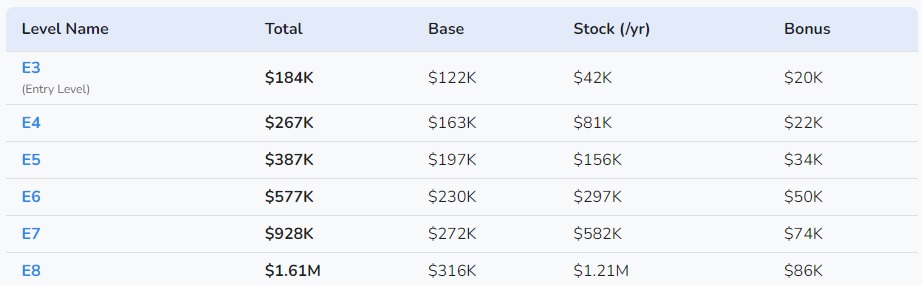
In a similar vein, if you are a software engineer with a portfolio of, say, $300k, and an annual salary of $184k, it simply doesn’t make sense spending a lot of time trying to optimize your portfolio. Even if you manage to outperform the market by 10% (assuming market returns is 10%, this would be a 20% return) (4), you will only make about $30k more. If you spend your effort concentrating on your career, getting promoted just once can easily yield more than double the benefits:

Facebook software engineer compensation, source: https://www.levels.fyi/companies/facebook/salaries/software-engineer (5)

Clearly, the exact numbers depend a lot on your personal situation, but the point is that in many cases, especially for those who are below the age of ~40, where you simply haven’t had enough time to accumulate a significant portfolio, your best financial/retirement planning move is very likely to just be throw your money into something simple to manage and not too risky, and then concentrate your efforts on developing your career.

Always do the math

Many people dive headlong into finance and investing, others take up side hustles, thinking that they can supplement their main sources of incomes. In many cases, they completely ignore the one thing that is most likely to benefit their financial situations the most profoundly — simply doing better at their day job (and getting recognized for it via higher commissions or promotions), or finding another line of work with more advancement opportunities.

Before diving headlong into any new endeavor, it probably makes sense to just spend a week or two figuring out if the effort is even worth it, or if you could get more out of your efforts if you just redirect your focus elsewhere.

Personal experience

Some random notes based on personal experience and talking to people:

  • Many people think real estate investments are passive (6). They are not.
    • If you are owning the property outright, then you have to deal with managing the property (or paying someone to manage it, and then managing the property manager). If you only have 1 or 2 properties, this is probably not a big deal, but does take quite a bit of time. If you have more than 5 or 6 properties, this easily becomes a full time job.
    • If you are investing via a fund or syndication, then you’ll have to spend a lot of time sourcing deals and vetting sponsors, reading their periodic reports to make sure everything is on track and deciding how to deploy your future dollars. In some ways, this is very similar to the pros/cons of investing in stocks.
    • In both cases, you’ll have to understand the economics/finance of real estate investing, and how macroeconomics affect it and thus you. Keeping up with these generally involve a lot of reading, attending conferences/webinars/seminars, etc., which again take up a lot of time.
  • Many people think trading stocks can be passive — once you’ve figured out a winning strategy, just make a bot and watch the money roll in. It doesn’t work this way.
    • As someone who has written and ran multiple trading bots before for personal trading, and who has worked in a quant hedge fund, I can assure you that it is not so simple.
    • All strategies eventually lose their edge. It may be 1 week after you find the strategy, or it may be 1 year. But it eventually happens. And the tricky part is trying to figure out if your current losses are due to a change in the regime (i.e. your strategy losing its edge) or just an expected drawdown. Deciding wrongly will be punishingly expensive.
    • The trading space is unbelievably crowded. Outside of large funds, millions of personal traders trade either as a full time job or with bots. Thus, you’ll need to be nimble, and be able to change and adapt depending on financial/economic forces, so that you can stay one step ahead of the competition.
    • Again, all the above means that a long term successful trading operation is almost always a full time job.
  • If you are a software engineer (7), then unless you have $10m+ in your portfolio, your best path to financial security is almost definitely to improve yourself so that you can perform your day job better, and get to your “terminal level” (8) as quickly as possible. As shown by surveyed salaries of Facebook software engineers (5), each promotion comes with a pretty hefty and permanent (9) salary increase, each of which would easily equal a double digits return on most common portfolio sizes for people of those income levels.
    • Of course, if you are personally interested in finance, and are doing it as a hobby, then by all means go ahead. All work and no play makes Jordan a dull kid. But be sure to understand the limitations of this, and do not fool yourself into thinking it is something beyond what it really is.

Footnotes

  1. Many people treat retirement planning and financial planning as different things. They aren’t really — it’s probably more accurate to think of retirement planning as a facet of financial planning, the goal of which is to, naturally, retire by some age.
  2. This isn’t true for everyone, but generally true for most people under most economic circumstances.
  3. “Financial net worth” is a made up term, here meaning the traditional “net worth” definition — the net value of your assets.
  4. It’s pretty damn hard to consistently beat the market by 10%. Many hedge funds get paid millions/billions of dollars just to beat the market by 2-3% every now and then.
  5. I am not endorsing the numbers on levels.fyi for Facebook. I do not know if these numbers are accurate at all, though I assume they are close enough to be a reasonable comparison in this case.
  6. Here, “real estate investments” mean private real estate investments, not buying publicly traded REITs, etc. Buying publicly traded REITs have all the usual pros and cons of trading stocks, which are touched on later.
  7. I’m specifically calling out software engineers here, because I am one, and understand the economics here better. Other professionals may have similar dynamics, I simply do not know.
  8. Due to luck, experience, knowledge, life commitments and other factors, most people have a “terminal level” beyond which they find it hard to impossible to get promoted beyond. At Facebook/Google/Uber and most tech companies with a similar level structure, this is generally around levels 5 – 7.
  9. OK, fine, it’s technically not permanent. But it’s pretty rare (outside of sign on bonuses and dramatic market events) to see annual total compensation drop at one of the big tech companies.

Affordable housing

Foreword

Housing is a touchy subject. On the one hand, nobody likes to hear about homeless children, or elderly retirees forced out of their homes. On the other hand, nobody seems particularly obliged to go out of their way to help those in need obtain and retain housing. So what then?

For full disclosure, I have a fairly large portfolio of real estate investments, of which a majority are residential. Obviously, I am not an impartial observer. At the same time, having been both a tenant and an (indirect) landlord for multiple years and in many different locales, while also keeping constant tabs on the managers who oversee my investments, I feel I can provide a perspective that is often lacking in the media.

As usual, a reminder that I am not a financial professional by training — I am a software engineer by training, and by trade. The following is based on my personal understanding, which is gained through self-study and working in finance for a few years.

If you find anything that you feel is incorrect, please feel free to leave a comment, and discuss your thoughts.

Costs of building a home

According to RocketMortgage, the average cost to build a home is about $282,299 in 2022. Granted that a portion of those homes are larger, luxury homes, so the actual cost of building a “starter home” for someone of more modest means is probably lower. On the same article, the average cost to build a 1 bedroom is about $80,000 on the low end — much better!

But let’s dig a little more — according to BusinessInsider, the median American family has a net worth of around $121,700. Suddenly, that $80,000 looks a lot tighter. Also, recall that the $80,000 figure is at the low end of the scale — in most parts of the country, it may not even be a feasible number. At the same time, the $80,000 cost doesn’t even include the cost of the land which, depending on location and size, can easily cost $100,000 or more.

Next, building a home takes time, from a few months to a year or more, depending on the location and scope of the project. During this time, the new owners will need a place to live, likely rented which means monthly rent payments.

Finally, home insurers and mortgage lenders typically do not service new builds. A new build is much more risky for the insurer, as there is active work being done and thus more chances for accidents. At the same time, if the borrower defaults on their mortgage, the lender has no real collateral (i.e. the house) to foreclose on to recoup their money. As a result, both insurance premiums and mortgage rates for a new build tend to be much, much higher than for a regular home.

Why is building so expensive?

A large part of the reason why building new housing is so expensive is because of existing rules and laws. Modern day housing units must fulfil a myriad of rules and laws built over decades of experience. Unfortunately, these necessarily add to the costs of building.

For example, in practically everywhere in the USA, all homes must have proper heating and cooling depending on the local climate, bedrooms must have an exterior wall and have exterior facing windows for safety reasons, wall paint must be lead free for health reasons, bathrooms must have proper plumbing, etc.

For the most part, I personally believe these to be sensible and reasonable — no one should be poisoned by lead paint just because of their financial situation.

Separately, the craftspeople who build our homes deserve to be compensated fairly — theirs is a job involving manual labor and, often, very real risks to their bodies and health. They should also be protected by adequate insurance policies so that them and their families are taken care of if the worst were to happen.

Finally, to ensure that all the proper building rules were adhered to, and that nobody made a mistake that might lead to potential disaster, most counties in the USA have enforced inspections by local engineers and experts, to ensure that buildings are “up to code”. While overall a good thing, these inspections do add to the overhead both in terms of costs (inspections typically are not free) and time (and they take a while to schedule, while any issues found need to be remedied).

And remember, we’ve just discussed the cost of building the home. Maintaining a home incurs another set of expenses such as property taxes, utility bills, etc.

Grim reality

When you put together all the requirements a modern home needs, and the costs of building that home, you arrive at a very grim conclusion — for a very large portion of the country, buying a home is simply an expense they cannot afford.

Renting

Given that so many people cannot afford to buy a home, yet still require a roof over their heads, it’s no wonder that many people choose the next option, which is to rent a home from a landlord.

Unfortunately, the facts that renters tend to be less affluent, housing costs are high, and investors (landlords) need to make profits result in some very contentious relationships. In particular, landlords tend to be portrayed in the media as unscrupulous capitalists, out to suck up every last cent from their hapless tenants.

While clearly not every landlord is a saint, it seems unduly combative to assume every landlord is the devil. While there are certain valid criticisms, there’s also a lot of just simple misunderstandings and well poisoning.

Houses are for living, not for investing

On the surface, this seems like a valid complaint, but is it really?

For better or for worse, in the USA, the government has decided that it is incapable of providing housing for the people. As such, this critical role has been outsourced to the private sector, with incentives such as tax advantages for real estate investments, etc. to encourage development.

The private sector, being capitalistic in nature, is incentivized by profits — private individuals and entities simply do not, in general, offer up their resources for free.

Given that the country has a general lack of housing, in order to correct that imbalance, housing prices need to rise, essentially increasing profit margins and incentivizing investment, so that enough housing will be built for everyone who needs it.

Until the government’s stance on the matter is changed (see below), the only real way to ensure enough housing units being built annually to accommodate new household formation is, unfortunately, higher home prices.

Investors push up the price of homes, forcing others to rent

There is some truth to this — real estate investors are driven by the profit motive, and as long as the numbers work, they will willingly bid up the price of homes, sometimes beyond the means of Regular Joe’s.

But that’s just one side of the equation. The investors clearly needed to buy the homes from someone else (in order to push up the prices) — someone who benefitted from the increase in home prices. Someone who, too, maybe a Regular Joe. What then? Are real estate investors now Santa Clauses handing out bags of money?

The fact is that this is a more nuanced issue — investors benefit existing homeowners, while hurting new ones. In more concrete terms, baby boomers and Gen X’ers tend to benefit from real estate investors, while millennials and Gen Z’ers tend to suffer.

Whether this is desirable, then, likely depends a lot on whether you already own your home.

Landlords raising rent is predatory

Tenants tend to complain that landlords seem to raise rents every year, and at rates that tenants generally feel are unfair. So let’s break it down.

As we’ve discussed before, housing is expensive, and maintaining them is also expensive. At the same time, landlords (investors) are capitalists and out to make a profit. Which means that whatever costs the landlord bear, must eventually be passed on to the renter, along with a markup for profits.

Yes, that means renters tend to pay more in rent than the landlord pays in costs. And as we’ve discussed earlier in order for the supply of housing to meet the demands of new households, this must necessarily remain true.

Given that the landlord’s costs increase every year due to inflation, so too must the rent. At the same time, in order to stimulate more housing to be built, areas with a severe lack of housing must necessarily see rents rise faster than inflation — the temporary supernormal profits incentivizes new housing to be built, which then will increase competition amongst landlords, which in turn reduce future rents.

But if renters are paying for the cost of the homes to begin with, what are landlords for? As it turns out, a lot.

Recall that renters tend to be less affluent. As a result, they tend to have trouble getting the necessary financing for building or buying homes. Landlords step in here, as an intermediary between the banks and the renters — the landlord puts up their reputation and assets as collateral to the bank to obtain the financing needed, and they then charge the renter for the “lease” of their balance sheet.

If you’ve worked in finance, you’ll know that while financing rates for the first ~75% of a project is relatively cheap, rates jump dramatically as the loan to value increases — the lender naturally assumes more risk as the equity cushion is reduced.

Similarly, the cost of borrowing 100% of the cost of a home needs to be much higher than borrowing 80% of the cost of the same home — the higher rates compensate for the higher risk assumed by the lender + landlord.

Secondly, landlords tend to manage more than 1 home. This often translates into savings in terms of maintenance costs via economies of scale — it is fairly common for landlords to build relationships with local craftspeople in a win-win relationship — the landlord provides the craftsperson a steady stream of jobs and income, while the craftsperson gives the landlord a discount for their services. This discount can then be passed on to the tenant.

Next, the landlord, by virtue of having to deal with constant maintenance issues across their tenants, will naturally build up a rolodex of known and trustworthy craftspeople, saving the tenant time and potential costs of engaging a less skilled or even outright fraudulent contractor.

Finally, the landlord also provides a service — essentially a 24 hours contact for maintenance issues, as well as aggregation of various expenses into a single, tidy monthly rent payment.

Solutions

Personally, I believe strongly that everyone benefits if everyone has proper housing — homelessness tends to bring with it many social problems.

However, and I say this as a beneficiary of the current system (being a real estate investor), the private sector is simply not equipped nor incentivized to achieve that goal. The most profits can be extracted when relative demand is high, since as supply increases marginal profits fall. So given a free market, supply will likely never ever rise enough for everyone to be suitably accommodated.

Given that the benefits of 100% housing is a benefit shared by all, basic economics then suggest that affordable housing, as opposed to luxury housing for those more affluent, should really be provided or subsidized by the government in some way. Forcing the private sector to subsidize housing for the less affluent such as the use of rent control, rent stabilization or other coercive means will just lead to less investment and thus even worse problems in the future.

Section 8 housing

As a start, section 8 housing, I feel, is a pretty good program. Its main issues are 2 fold. First of all, the program is severely underfunded, and really needs to be a much bigger priority of the government’s budget, so that everyone those in need can reliably qualify and get the assistance they need.

Secondly, the stigma associated with it must be eliminated. That can likely be achieved with a bigger budget, so that more graduated assistance can be provided to more people — those who are living in poverty may get, say, 99% of their rents covered, while those much above the poverty line but are still struggling can get, say, 10% of their rents covered.

With an expanded program aimed at everyone from those in dire need up to those in, say, the lower 85 percentile in terms of income, the program can conceivably be seen as just as social benefit, and not “aid for the poor”, and hopefully that will remove the stigma, allowing more people to benefit.

Along with the above, enforcement of the rules to prevent abuse should also be strengthened. Those receiving aid should be required to show actual need, while landlords should be on the hook for providing quality housing at a reasonable price, and not just taking advantage of desperate people who don’t have much of a choice.

Government built housing

Section 8 housing works by engaging with the private sector via subsidies. It is, however, not the only way, and to be honest, the fact that the private sector is involved necessarily means that the overall costs are higher to account for private profits.

As an alternative to section 8 housing, the government can also opt to just do-it-itself so as to save on costs. As we know from examples around the world, large scale public housing programs can work, though like section 8 housing, it needs to be properly funded and managed, while also at a scale large enough to overcome the stigma of receiving government aid.

Not that long ago, the US government used to build and sell subsidized housing to those in need. Technically, remnants of this program and its offshoots still exist around the country, though the scale is at a level that’s much too small to really address actual needs. A dramatic expansion of that program, with adequate funding, proper oversight and management may revitalize the program enough to help address the housing issues faced by those most financially vulnerable.

Altruism?

Ultimately, I think it is important to acknowledge a few basic facts:

  • A lot of people, with their own means, simply cannot afford to own a home. Some may not even be able to afford to rent.
  • Homelessness is a social problem which affects everyone, even those who are not homeless. As such, everyone benefits if homelessness is reduced or eliminated.
  • To a lesser extent, giving everyone a stake in society, via home ownership, has benefits too. People who feel that they have a stake tend to behave better, leading to less social issues.
  • To bootstrap these programs will likely involve large public programs and associated large public spending. Yes, that means those who are financially better off necessarily must take on some temporary discomfort. But if we can get it right, the future benefits should outweigh the current costs.

System design interview

Foreword

As a fairly senior software engineer in a large tech company, I get asked to do interviews of new candidates very often. For some reason, most of the time, I get asked to do the dreaded “system design” question. For those who are not in the industry, a “system design” question is one where the candidate is asked to design an entire system, as opposed to an algorithm, or just part (or even the crux) of the issue. The candidate has to consider all relevant parameters, and then come up with a solution that addresses everything.

There’s going to be a bit of rambling in this post, but I promise, there is a financial point to it all.

As usual, a reminder that I am not a financial professional by training — I am a software engineer by training, and by trade. The following is based on my personal understanding, which is gained through self-study and working in finance for a few years.

If you find anything that you feel is incorrect, please feel free to leave a comment, and discuss your thoughts.

Google

Let’s say we are doing a system design interview right now, and the question is:

We know that Google search sometimes returns wrong results. For example, sometimes the results are not personalized enough, returning results that are only relevant to people living on the other side of the world. Other times, it is too personalized, returning results that are just creepy. Describe a potential solution to address this.

As with all system design questions, it is generic, vague and requires the candidate to think a bit out of the box — there are generally no preset, “optimal” answer, and the solution is an exploration of the space with the interviewer.

Now, let’s say the candidate says something like this:

The problem is that Google cannot possibly understand the nuances of the user’s intent, and so the only solution, is to just create a new search engine. Let’s say we have a hypothetical search engine, where the entire repository is on every user’s machine. Then each user can simply run a grep (simple text search) to find the documents with the keywords. Each user can then write a small snippet of code that looks at each document, and determine which is preferable.

To which I’ll say

That’s an interesting idea. But for this idea to work, we’ll need to download the entire repository, which is a representation of the entire web, to every user’s machine. That alone will take decades per machine. Then we need to figure out how to store that much data in a single machine — no single machine on Earth currently has the disk space for this. We then need to address the issue of how grep can even search through the entire repository fast enough that user requests can be answered promptly, and finally, most people don’t know how to write code, how do you propose we fix that?

Now, a rational candidate (read: someone who isn’t definitely going to fail the interview) will realize the premise of their solution “download the web and have every user’s machine become a search engine” is flawed, and simply unworkable, even if it technically can solve the asked problem of search results personalization. They will then rethink, and hopefully come up with something better.

But let’s say our candidate says this:

First of all, we need to devote about 10% of humanity to researching better compression methods. If we can, say, compress data at a 1,000,000,000:1 ratio (that is, every piece of data can be compressed to 1 billionth its size on average), then we’ll significantly reduce the number of bytes we need to transfer and store.

Next, we’ll devote another 10% of humanity to researching better network transmission protocols. Currently, the fastest network link is on the order of 200 Tbps. We need to increase that to, say, 200 Zbps (1 Zetta = 1,000,000,000 Tera). This will let us transfer the repository 1 billion times faster.

Then, we’ll need to devote another 10% of humanity to research permanent storage. The current largest harddrive is about 20 TB, we’ll need to increase that to say, 2 ZB. This will let us store a few copies of the entire web on a single harddrive multiple times over, so that we can keep multiple copies for redundancy.

Next, we’ll devote another 10% of humanity to improving and optimizing grep, so that it can work in compressed space, as well as being a few orders of magnitude faster.

Finally, we’ll need to negotiate with every government on Earth, so that every human being is given a undergraduate level course in computer science, so that they can write their own search engine filtering code snippet.

The good news is, the transmission protocol of our repository is a solved problem. We’ll just put it on the blockchain.

Real world

One constant refrain from blockchain/crypto advocates, is that “blockchain can do X better”. Where “X” is some random facet of the financial system.

For example, corporate actions such as stock splits can take a day or two to sort out, and often, some broker will forget to update their database, and customers will be confused for a day or two more.

Now, a naive view is that “blockchain can do stock splits better” — just create a new token for the post split stock, and enforce an exchange of X old tokens for Y new tokens. The change is atomic (for each user), etc. All that good stuff.

Which is great… if the entire world of finance was invented simply to do stock splits. In that case, you have a winner!

But what if, just what if, we need the financial system to do… other things? Like, say, transact a few billion trades a second? Or being able to handle mutations because, you know, humans make mistakes and typos sometimes need to be fixed? Or provide privacy for the portfolios of private citizens? While providing transparency for the portfolios of certain public entities? Or provide regulators and other deputies a chance to veto/correct certain transactions? Or…

It’s still early days

And then you’ll get the “it’s still early days” argument (1). Fine. You have an idea, it’s still in its infancy, great.

But, you know, maybe don’t keep annoying the rest of us with it until you have it all figured out? Or, you know, at least know the parameters your solution must address.

BTW, I have this great idea for solving global warming. First, we need everyone to poop in their pants instead of bathrooms. There’s still some kinks, but it’s still early days. Trust me, though, it’ll definitely work.

Footnotes

  1. Bitcoin was invented in 2009, 13 years ago. Blockchain (or Merkle trees) was first invented in 1979, 43 years ago. Cryptography was invented centuries ago. Etc. It’s still early days.

July 10, 2022: Save Banks First

Foreword

This is a quick note, which tends to be just off the cuff thoughts/ideas that look at current market situations, and to try to encourage some discussions.

As volatility in the crypto space continues, it appears one man, Sam Bankman-Fried (SBF) is trying to rescue his industry by saving banks first.

As usual, a reminder that I am not a financial professional by training — I am a software engineer by training, and by trade. The following is based on my personal understanding, which is gained through self-study and working in finance for a few years.

If you find anything that you feel is incorrect, please feel free to leave a comment, and discuss your thoughts.

SBF

Before I posted the quick note on Voyager’s bankruptcy, SBF had already been in touch with various crypto banks, injecting capital so as to prevent a greater meltdown of the crypto ecosystem.

If you have money in crypto, especially if that money is tied up in one of the crypto banks that are in serious trouble and have halted transactions, and especially, especially so if your bank/broker is one of those SBF is looking to save first, then you may just be heaving a sigh of tentative relief. If SBF’s plan works, your losses will likely be dramatically reduced.

As far as I can tell, SBF’s efforts are generally held up as a shining example of the crypto community’s “community-ness”, and generally viewed as a good thing.

Irony

And that is highly ironic.

Recall the premise for the founding of crypto — that central banks were somehow evil for bailing out the financial system, especially during the 2008 Great Financial Crisis.

Nevermind that if central banks had done nothing, there was a good chance that regular folks whose money was caught up in banks stood a very high chance of taking a large financial loss. Nevermind that if the financial system were to shut down, even for just 2 months, those who would be hurt the most would likely be those who are least financially prepared. Nevermind that SBF is basically acting as a central bank for crypto, and doing exactly what a central bank would do in the event of a financial crisis — being the lender of last resort.

The crypto community (then) pointed at the rich who benefited “disproportionately” from the bailouts. Yes, a billionaire probably stood a very good chance of not losing a few hundred million dollars due to the bailouts. But for a billionaire, losing a few hundred million dollars is annoying, maybe even frustrating, but in the overall scheme of things, just a flesh wound. Consider what would happen to a family living paycheck to paycheck, if they lost access to their bank accounts for just 2 months, even if they eventually got back all their money? Would they even be able to keep a roof over their heads and food on the table in those 2 months? For our regular-joe family, even if they only stood to lose a few hundred/thousand of dollars, it would almost certainly be a financial catastrophe.

As many have pointed out over the years, the crypto community essentially seems intent on relearning every facet of financial history all over again… and mostly coming up with the same solutions.