November 9, 2022: Well, there you go…

Foreword

This is a quick note, which tends to be just off the cuff thoughts/ideas that look at current market situations, and to try to encourage some discussions.

About a year and a half ago, I noted that leverage in crypto and interlinkages via institutional and retail players could cause a minor contagion. I was, of course, soundly mocked for being an idiot. Well then, let me tell you about Celsius, Voyager, Three Arrows Capital and FTX…

As usual, a reminder that I am not a financial professional by training — I am a software engineer by training, and by trade. The following is based on my personal understanding, which is gained through self-study and working in finance for a few years.

If you find anything that you feel is incorrect, please feel free to leave a comment, and discuss your thoughts.

Mini-tagion?

Well, the foreword kind of already said everything (1). But the last few rounds of crypto drawdowns due to some sort of “stablecoin”(2)/leverage issue saw massive dumps in the entire crypto space, accompanied by less severe stocks drawdown.

And that happened, again, today. As FTX circled the drain due to its liquidity (and solvency) issues, stocks took a small beating (SPX down ~2%) on basically no other news (3) — apparently FTX committed the rookie mistake of using their own token as collateral, resulting in a giant #REF! in Excel spreadsheets worldwide.

Thankfully the volume in cryptoverse is relatively small compared to stocks, and the collateral damage was manageable.

SEC/CFTC investigations

While the current issue is said to only affect FTX.com, the SEC and CFTC are actively looking into the issue and potential contagion risks for FTX.us. Unfortunately for banks (4), sometimes even the whiff of impropriety can be extremely damaging (5). We will have to see if FTX.us manages to survive this crisis of faith.

Edit: It appears the DoJ is now also involved in investigations.

Related news

Footnotes

  1. Yes, this is sort of a “I told you so” moment, Mr M.
  2. Can we still call them “stablecoins”?
  3. Technically, there was news — midterm election results are mostly out, but given what looks like a gridlocked Congress, that should be positive for stocks.
  4. Here, I’m using the word “bank” more symbolically — basically any entity that takes money from others for safekeeping, while using part of the money for its own investment purposes.
  5. This is often cited as the reason why the Fed forced all banks to take bailouts during the 2008 Great Financial Crisis, and forbid any bank from disclosing whether they actually needed the bailout.

October 30th, 2022: Fed watch party

Foreword

This is a quick note, which tends to be just off the cuff thoughts/ideas that look at current market situations, and to try to encourage some discussions.

The Federal Open Market Committee (FOMC) is meeting next week, with a decision due on Wednesday. With all that’s going on, the Fed’s actions is quickly becoming one of the only things that matter in the markets.

As usual, a reminder that I am not a financial professional by training — I am a software engineer by training, and by trade. The following is based on my personal understanding, which is gained through self-study and working in finance for a few years.

If you find anything that you feel is incorrect, please feel free to leave a comment, and discuss your thoughts.

What next?

Everyone is, of course, concerned about where the Fed is heading with regards to interest rates. While inflation is still extremely high, there are mixed signs that it may be coming down, so in the past week or so, despite horrendous earnings by some of the country’s largest companies, stocks have been generally going upwards.

Bull case

The bull case for stocks right now seems to be some mix of the following:

  • At the margins, some of the leading causes of inflation (used car prices, housing prices, etc.) have started to come down, and in some cases, dramatically so, hinting that the Fed’s policies may be working, and they may be tempted to ease up.
  • Quite a few companies have been warning about their profits, as well as near term profit forecasts, suggesting an economic recession may be in our near future. To head that off, the Fed may want to ease up on the hikes or even outright ease policies.
  • The Fed has said many times that the goal is to hike to a suitable rate, and then hold rates there for a while. Maybe they are at that rate already and can stop hiking?
  • The dollar is extremely strong right now, causing much consternation to the rest of the world and notably many of America’s allies. Going slower on hikes will alleviate that somewhat and make lives easier for America’s friends.
  • The strong dollar is also causing export oriented American companies to face strong headwinds in their businesses, leading to several rounds of layoffs already in some large companies.

Bear case

And the bear case for stocks right now seems to be some mixed of the following:

  • While the initial causes of high inflation have somewhat abated, inflation seems to have spread to other parts of the economy. More worryingly, “sticky inflation” (1) seems to be going up, suggesting more effort to combat inflation may be needed.
  • The Fed, through Powell, has said many times that they wish to avoid the mistakes of the 70’s where rates were lowered only to see inflation return with gusto, leading to even more future hikes.
  • Powell has also been, of late, using words and verbal imagery, sometimes even outright invoking Volcker’s name. As we know, Volcker is famous for breaking inflation in the 70’s by raising rates relentlessly, arguably to the point where he went slightly overboard.
  • Compared to inflation, Fed funds rate is still extremely low, and despite everything, inflation is still extremely high.
  • Inflation is, first and foremost, a sentiment issue. Preventing the seed of higher expected future inflation from taking root is critical to containing inflation. The Fed has said many times that they are concerned with that seed being planted in people’s minds, and the recent calls for higher wages suggest the self-reinforcing cycle of higher inflation may be getting started.

Which is it?

There’s a lot riding on the Fed’s decision on Wednesday, and possibly even more on Powell’s press conference right after. How much the Fed rises rates by, what their dot plot hints they are thinking for the future, and what Powell says and even the tone he uses to say it — all these will be put under the microscope and analyzed to a degree that probably borders on crazy.

Getting the Fed’s nuances, and more importantly the market’s reactions to those nuances, right and doing so consistently this year will have almost guaranteed stellar portfolio performance. Since I’ve yet to retire, you can assume that I haven’t done so. 😉

Footnotes

  1. Sticky inflation is inflation of goods that tend to have more sticky prices, as in their prices don’t tend to move as much, but when they do move, they tend to stay at the new price level for longer.

October 28th, 2022: Can’t grow to the sky

Foreword

This is a quick note, which tends to be just off the cuff thoughts/ideas that look at current market situations, and to try to encourage some discussions.

The major cap growth stocks just took a long walk off a short cliff, and even with the rally today, most of them are still underperforming the SPY, something that has been a fairly rare sight in the past decade and a half.

As usual, a reminder that I am not a financial professional by training — I am a software engineer by training, and by trade. The following is based on my personal understanding, which is gained through self-study and working in finance for a few years.

If you find anything that you feel is incorrect, please feel free to leave a comment, and discuss your thoughts.

Value value stocks

If there is a theme to outperformance so far this year, it is to take a long hard look at value stocks. And then buy the good ones.

Mind you, not just any value stocks, only the good ones — There are two main definitions of value stocks, one popularized by Benjamin Graham in his genre defining book “The Intelligent Investor”, and one popularized by Fama and French in their, also genre defining, quantitative three-factor model.

The former talks about understanding the fundamentals of a company, and trying to figure out whether it is underpriced for its earnings potential, while the latter talks about metrics which hint at the potential underpricing of select stocks. The differentiation seems minor but is important — Graham’s model suggests that investors should thoroughly understand their investments and with that understanding, gain confidence to concentrate their portfolios. Fama and French’s model is the direct opposite, and relies on diversifying across many stocks with certain characteristics (such as low P/B ratios), and trying to profit off the aggregate average outperformance.

Here, I’m talking about Graham’s model.

Negative growth

Over the past 15 years or so, large cap growth stocks like Google, Microsoft, Apple and Facebook have collectively (and independently) outperform the SPY by dramatic amounts. At their peaks, these companies were commanding P/E ratios of more than 30, with many investors treating them as safe havens. Cathie Woods even famously talked about moving excess cash in her funds into these stocks temporarily while she looks for better opportunities.

Today, after a series of mistake starting late last year, most of these stocks have been beaten down severely, as investors rediscover their goals of actually making money; John Authers says it best:

This is all a tad reminiscent of the period of a few weeks in early 2000 when dot-com investors suddenly moved from metrics like “clicks per eyeball” to “burn rate” — an old metric with a new name, referring to how quickly startup companies were burning through their cash flow. Meta has become a vastly more substantial and tangible concern than the entities that evaporated 22 years ago, but the sudden and swift realization that it had been valued far too generously still rings those bells.

John Authers, Bloomberg 10/28/2022 – https://www.bloomberg.com/opinion/articles/2022-10-28/tech-s-fangs-plummet-in-wile-e-coyote-moment-on-earnings

Investing vs Speculating

As folks grapple with their buyers’ remorse, it is important to remember the fundamental difference between an investor and a speculator: If you are investing, you are looking to profit from the productivity of the asset, while if you are speculating, you are looking to sell that assert at a higher price to someone who values it more.

If you are comfortable with a 3% (assuming no growth) rate of return from your investments, then buying at 30P/E make sense — 30P/E implies a return of 3.33% (assuming no growth).

If you need your investments to return quite a bit more than 3.33%, then either you have to consider potential, realistic growth — nothing grows to the sky, so projecting 30years of 30% growth is almost definitely wishful thinking, or you’ll need to find stocks that are trading for less than 30P/E. Simple as.

October 2nd, 2022: ERP, derp

Foreword

This is a quick note, which tends to be just off the cuff thoughts/ideas that look at current market situations, and to try to encourage some discussions.

Inflation is near its highest in ~40 years, the Fed and almost all other central banks are aggressively hiking rates at an unprecedented pace, global supply chains are shaky at best, Russia and Ukraine at effectively at war, effectively disrupting two of the largest sources of both food and fuel for the world and Europe is facing an uncertain winter due to energy shortages. Sounds like a good time to check in on equities.

As usual, a reminder that I am not a financial professional by training — I am a software engineer by training, and by trade. The following is based on my personal understanding, which is gained through self-study and working in finance for a few years.

If you find anything that you feel is incorrect, please feel free to leave a comment, and discuss your thoughts.

ERP

Equity risk premium, or ERP, is defined as the rate of return investors demand for equities over that of the risk free rate. Based on Yardeni Research, the current ERP is around 5.5%, slightly lower than the start of the year, and quite a bit lower than late 2019, early 2020 (pre-pandemic).

The lower the ERP, the more confident investors are generally said to be of equities — at the extreme, an ERP of 0% implies that investors view equities are interchangeable with risk free securities in terms of returns.

Which is to say, despite all the above, investors actually view equities more favorably than the start of the year, at least, based on the ERP.

Derp

The 3rd quarter just ended, and earnings season is upon us again, starting in earnest in about 2 weeks with the banks, followed closely by the big tech companies. By the end of October, we’ll have CPI for September as well as the Q3 earnings report from most of the largest companies in the US. Just in time for the Fed’s FOMC meeting on November 1st and 2nd.

Given that the ERP went down slightly compared to the start of the year, it seems like the market is expecting (at least with regards to the risk free rate) that the Q3 earnings reports will come in good, or at least in line with expectations.

That seems a little optimistic, given the financial situation around the world right now. In particular, it seems in my naïve view that

  • Companies that depend heavily on sales made in foreign currencies are going to suffer from the strong US dollar.
  • Companies that depend heavily on global supply chains are going to have issues with shortages.
  • Companies that don’t have pricing power relative to their input costs are likely to get their margins squeezed.

On the other hand

  • Companies that are allowed to export energy seem like they may do well.
  • Companies that are able to adjust their prices based on inflation, while keeping their costs low, are likely to do well.

Positioning

For all the reasons above, I’m thinking seriously of shorting the stocks of those companies in the first list into earnings. As usual, this will be a small position (since I don’t generally like shorting and shorting is extremely hard to get right), mostly for fun, but also for personal validation.

As always, you can see the positions in one (out of 10+) of my brokerages with StockClubs (1), with a 1 day delay.

Footnotes

  1. Disclaimer: I am an investor in the app.

September 26th, 2022: Paralysis

Foreword

This is a quick note, which tends to be just off the cuff thoughts/ideas that look at current market situations, and to try to encourage some discussions.

Markets took another drubbing today, and is now less than 20 SPX points away from year to date lows, almost 25% below the highs just a few months ago.

As usual, a reminder that I am not a financial professional by training — I am a software engineer by training, and by trade. The following is based on my personal understanding, which is gained through self-study and working in finance for a few years.

If you find anything that you feel is incorrect, please feel free to leave a comment, and discuss your thoughts.

Ouch

If you follow my blog posts, and/or if you follow me on StockClubs (1), you will know that while I’ve flattened my portfolio (i.e. reduced exposure to equities/bonds), my portfolio is not flat. As a result, the absolute drubbing in the markets, for both stocks and bonds, in the past month or so has not been fun.

As it stands, we are now less than 20 SPX points away from the lows set in June, and given the relentless selling of the past few trading days, there is a good chance that we’ll visit and maybe go below that in the coming days.

Bear market

Talking to a few friends, it seems like some are still heavily invested in stocks and bonds, and I can only imagine the pain they must be experiencing. At the same time, I get the feeling that quite a few people are essentially paralyzed with shock at the speed and magnitude of the moves so far this year — if you started investing after 2009, then you most likely have only experienced “happy times” in the markets. This year would (other than the rather brief March 2020 downturn) be the first major bear market you’ve experienced.

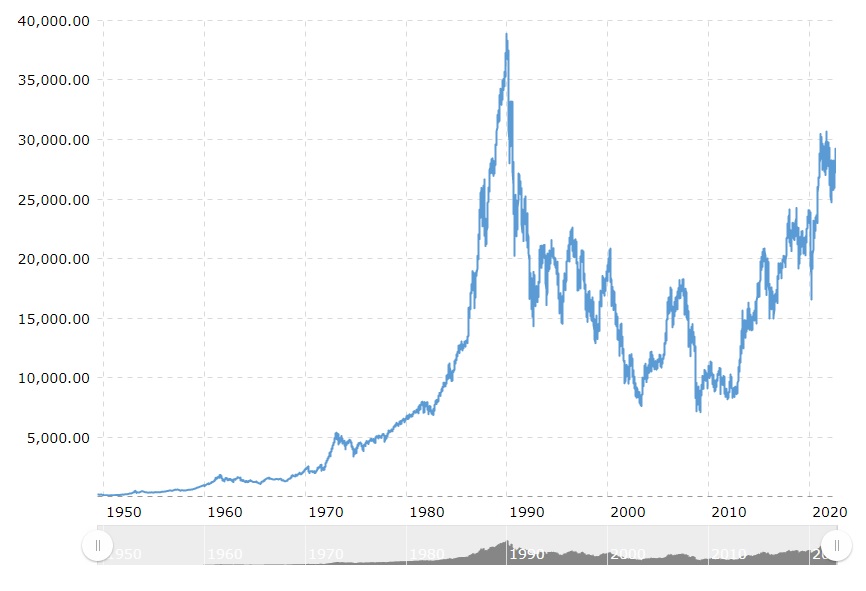
Bear markets happen, and they can last for a long time, with many, many dead cat recoveries that morph into new lows — the Nikkei 225 still has not recaptured its peak set in the late 80’s/early 90’s, about 30 years ago:

Will the SPX also take 30 odd years to not recover? I don’t know, and frankly, nobody does. It is certainly possible, though history across all the major developed markets suggests that this is unlikely — recovery to prior peaks for even fairly severe drawdowns (like the 2008 Great Financial Crisis) rarely take more than 5-10years.

As investors, all we can do is make projections, and allocate our portfolio accordingly. But as noted in Marathon, we should also make preparations for the worse/worst case scenarios, for the unknown unknowns, for when the bear awakes and takes a swipe at our portfolios.

So, if you’ve been paralyzed with indecision thus far, you need to make a decision, even if the decision is to “do nothing”. It is certainly a hard decision to make, given that you are likely sitting on a bunch of losses and realizing the losses (by selling) will make it that much more real. Sitting tight could very well see you made whole or more…, or we may drop another 25% or more.

An easier decision to make, however, is if you have immediate needs for money that cannot be deferred. If so, you should seriously consider keeping enough liquidity (i.e. cash or cash equivalents) on hand, so that your near term money needs can be met. If the market recovers, treat it as premiums for insurance against failing to meet your obligations. If the market drops more, you’ll certainly be relieved you cashed out and won’t have to worry about near term needs.

Footnotes

  1. Disclaimer: I am an investor in StockClubs, which is an app that lets you share your portfolio, or follow the portfolios of others. Note that I’m only sharing 1 (out of around 10) brokerage accounts that I maintain.

Recursive convergence model

Foreword

There are many models of how stocks are priced, dealing with different aspects of pricing, and different pricing models. Intuitively, if 2 things are the same, then they should trade with the same price. But empirically, we know that they don’t always do that (see here and here). Why not?

As usual, a reminder that I am not a financial professional by training — I am a software engineer by training, and by trade. The following is based on my personal understanding, which is gained through self-study and working in finance for a few years.

If you find anything that you feel is incorrect, please feel free to leave a comment, and discuss your thoughts.

A = B = C

Let’s say we have 3 different securities, which may be stocks, futures, options, or whatever, A, B and C, which are essentially the same thing, modulo some constants (such as interest rates, trading fees, etc.). For example, SPY, ES, VOO, IVV, etc. The conventional wisdom is that the price of A, B and C should be the same — again, modulo some constants — since these are constants, we can model them out and just assume each of A, B and C are trading sans these conditions.

In practice, we know that SPY, ES, VOO and IVV don’t trade exactly in lockstep. Yes, they trade pretty closely, and divergences don’t last for very long. But in some short-ish timeframe (which may be on the order of seconds or even milliseconds), their prices can diverge.

Arbitrage

Assuming A, B and C are convertible, i.e. we can convert any of A, B or C into any of A, B or C, then there is arbitrage — if the price of A and B, say, get out of sync, someone can short the more expensive one, buy the cheaper one, and convert from the cheaper one to the more expensive one to close the short, thus making a “risk free” arbitrage profit.

The Efficient Market Hypothesis likes to assume that all these happen instantly, so there are no risk free profits to be made. But Wall St’s legions of market makers, liquidity providers and ETF arbitragers say otherwise. The fact that these companies are massively profitable suggests then that price dislocations can happen, and these companies close the price dislocations, getting us closer to (but never really reaching!) a perfectly efficient market, while making a profit for their troubles.

Not so perfect information

Now, in the perfect world, everyone knows all publicly available information at all times (i.e. information dissemination is instantaneous). In practice, that is clearly not true and can never be true — physics teaches us that nothing can move faster than the speed of light, including information. Since light moves at a finite speed, entities further from the source of information need necessarily get the information at a later time than entities closer to the source of information.

So, let’s take that a bit further, and assume that not everybody knows about the fact that A = B = C. Let’s say some segment of the market knows that A = B, another segment know that B = C and a third segment knows about A = C. Now these segments can overlap, but they are not the same, i.e. some people may know more than one of the 3 sub-equations, but not everyone knows all the sub-equations. Further, we use “know” here loosely — it’s possible that an entity actually does understand the 3 sub-equations, but for whatever reasons, decide that they only want to trade one or two of the 3 sub-equations. For example, an entity may only be a market maker in A and B. So while they can easily trade the A = B equation, they may not be able to trade the B = C or A = C equations as effectively, and so they don’t.

A moment in time

Let’s say some large entity, E, decides, for whatever reasons, they want to buy our security, and in large quantity. E can choose to buy A, B or C, and they fully understand the A = B = C relationship. However, E is a practical, real world entity, and they are not a market maker — they are a regular investor, and more interested in the productive earnings of the security, than the temporary price dislocations. So, for practical purposes, E will only buy one of the 3 of A, B or C, as it makes bookkeeping easier.

Now, even if E does the smart thing, and buy the cheapest of the 3 right now (and for the sake of argument, let’s say that’s A), if E decides at some future date to add on their position, and in order to maintain the “only one symbol on my books” rule, they will, at that future time, continue buying A. This may be true, even if A is not be the cheapest of the 3 at that point in time. In effect, at some arbitrary point in time, E may, for perfectly rational, though not financial, reasons, decide to buy A, even if A is not the cheapest.

Next, let’s say E is expecting to deploy large sums of money. We know that a trade is always between a buyer and a seller. We have a seller in E, but who’s selling? Unless there is another entity (or set of entities) that are willing to sell at least as much as E is buying at the current market price of A, E‘s buying will necessarily push the price of A up, at least in the short term. And since at any particular point of time, it is impossible to guarantee that you can always trade such that someone else is always willing to take the other side of the trade from you at the current market price, especially if you are trading in large sizes, we come to the conclusion that at least in the short term, E‘s trades will necessarily push the price of A up.

As the price of A increases, arbitragers will start to do their work by shorting A and buying B or C to convert into A to close their short. This will push the price of A down, while simultaneously pulling the prices of B and C up. However, since it’s generally not possible that the number of entities in the segments arbitraging A = B and A = C to be exactly the same, one of B or C will move up faster than the other. Let’s say for our discussion that B moves up faster than C, so we arrive at A > B > C, again, in the short term.

Since B and C diverged, our last segment of arbitragers will step in, shorting B and buying C. This has the effect of pushing C up faster, but notice how it work against the efforts of the A = B arbitragers!

Big picture

Stepping away from the instantaneous snapshots of the prices of A, B and C caused by E‘s trades, we arrive at a well known scenario described in mathematics as a “converging recurrence relation”. E‘s trades immediately pushes up the price of A, and the efforts of the arbitragers, over time, tries to spread that “information” (here the price of the security represented by A, B and C), so that all of A, B and C all reflect the same price.

Notice that we did not talk about fundamentals! It maybe that E is too optimistic, and pushes the price of A (and eventually B and C) up too high. But that doesn’t matter to the arbitragers — they are simply making risk free profits by arbitraging the equation A = B = C. So, in the short term, it’s perfectly possible that the prices of A, B and C are dislocated from fundamentals.

More interestingly, for the prices of A, B and C to converge to a final single, identical value, will require many rounds of arbitragers shorting/buying different pairs of the 3, but since the relationship is convergent, we can assume that over time, the absolute magnitude of dislocations will reduce, and the prices will eventually settle down (assuming no one else is trading these symbols other than the arbitragers).

Most interestingly, it should be noted that we cannot actually predict the final stable price of A, B and C! Without knowing the relative numbers of arbitragers in each of the 3 sub-equations, and without knowing their relative trading speeds and aggressiveness, it’s generally not possible to figure out whether the A = B arbitragers will be more successful pulling up the price of B to meet the price of A, or that the B = C arbitragers will be more successful pushing DOWN the value of B, which eventually results in A and C catching down to B.

Liquidity

One thing to note, though, is the need for liquidity. For the arbitragers to work, there needs to be external sellers and buyers in each of A, B and C. Given that we know A = B = C, then objectively, even if not everyone knows the full equation, we can generally expect that the number of arbitrage buyers in A will be less than the number of arbitrage sellers in A, whenever A is overvalued compared to B and C.

For securities which are very liquid, such as the SPY, ES, VOO, IVV, etc., the arbitragers have a deep pool of external traders to trade against, so the convergence of the prices can be fairly quick, sometimes in the order of milliseconds.

But for securities which are very illiquid, such as certain ETFs, the arbitragers may not be able to find willing buyers/sellers to take the other side of their operations, and in those cases, the convergence can take a much longer time. In some cases, illiquid ETFs have been known to diverge from their underlying for days or even weeks at a time.

Final words

Clearly, the above does not perfectly describe every security. In fact, it does not perfectly describe any security (or set of securities). It is a model to think about how prices move, out of many, many different models that try to explain subtle nuances of different parts of the market.

While it is sort of true in practice, there are a number of assumptions made which are not realistic in practice — such as no external buyer/seller willing to move prices other than E.

However, hopefully a discussion of the model, even in our made up world, is a useful exercise in thinking about how prices move in practice.

Real Estate Syndication

Foreword

I’ve received, over time, numerous requests from various people inquiring about real estate syndication. Here is a quick summary of the space, and the things I look out for when evaluating a new deal.

As usual, a reminder that I am not a financial professional by training — I am a software engineer by training, and by trade. The following is based on my personal understanding, which is gained through self-study and working in finance for a few years.

If you find anything that you feel is incorrect, please feel free to leave a comment, and discuss your thoughts.

Real Estate Syndication

As way of a quick introduction, real estate syndication is a fancy way of saying a “real estate fund”, or, in some cases, “real estate private equity fund”. The former (real estate fund) is more general, and encompasses various real estate strategies (explained below), while “real estate private equity fund” refers specifically to funds which buy properties, improve them somehow, and then sell them again — Similar to how generic private equity funds buy companies, improve their operations, and then sell the companies again either on the private or public markets.

Terminologies

Before we dive in, here are some common terms which will come up over and over again in this space.

Sponsor, General Partner, GPThe people who found the deal and are marketing it are generally called the sponsor. The people who actually run the day to day operations as well as make major decisions on behalf of all the other investors are called the general partner (or GP for short). In general, the sponsor will usually be the GP, so the terms are used interchangeably in most cases.
BrokerThe people/entity which is purely marketing the deal on behalf of the sponsor. The broker typically takes a cut of the profits, either in the form of a front load (a fee up front as a percentage of committed dollars they bring in) and/or an equity stake (usually a percentage of the profits).

While brokers are common for really large deals (hundreds of millions to billions of dollars), they are uncommon for smaller deals (under $100m). Personally, if a smaller deal has a broker (or worse, many brokers), I would consider it a sign that the sponsor is new to the game and simply doesn’t have a large enough rolodex of investors to call upon.

Some common brokers are FundRise, CrowdStreet, YieldStreet, etc.
Investor, limited partner, LPThe people who actually put money into the deal. While the GP earns their profits from sweat labor, the LP earns their profits from equity labor, i.e. actual return on actual cash put into the deal.

In particular, the LP is also limited in that they have no say in the day to day running of the deal. This is important! A key determination of who has limited liability (and thus can walk away from a failed deal by “only” losing their investment) vs who has unlimited liability (and thus may be personally liable for any losses/debts) is who is responsible for making decisions and who actually made decisions.

Before you take part in any deal, make sure that you are joining as an LP, unless you are comfortable making decisions for the deal, and taking responsibilities for the consequences of your decisions.
Capitalization rate, cap rateThe capitalization rate of the deal. At the start of the deal, this is obviously estimated, but when a deal exits (sells of its assets), the “exit cap rate” is also of interest and is typically actual (instead of estimated).

Cap rate is simply the “net operating income” divided by the value of the asset. In a hand-wavy sort of way, you can think of it as the inverse of the P/E ratio that is so common for stocks.
Internal rate of return, IRRThe imputed return of the deal (either estimated or actual, depending on context) over a period of time, annualized to one year.

The IRR is more complicated than simply the return of the deal divided by the amount invested — the timing of the return of capital and profits is important!

A deal that takes in $100, and then immediately returns $100 the next day, while also returning another $100 over the next year, is a much better deal than one that takes in $100 and returns $200 at the end of the next year. Both deals return $200 over a one year period, but the former returns your capital almost immediately, letting you put that capital to further use.

Think of it this way — assuming you can and do put all cash thrown off by the deal back into the deal and compounding at the same rate, then 2 deals with the same IRR and same period of compounding will return exactly the same amount of money at the end of both deals.
Levered returns, levered IRRAlmost all real estate funds use leverage, because without leverage (and the associated risks!), most real estate deals simply do not make sense — you can get much better returns with much lower risks by just investing in the stock markets passively.

Levered returns or levered IRR is simply the actual (or estimated, depending on context) return or IRR after including the multiplicative effects of leverage and taking out the costs of leverage (i.e. interest fees).
Gross return, gross IRR, fund level return, fund level IRR“Gross” basically just means “fund level” in this context, which means whatever number listed, is for the fund before the GP takes their cut, but after all other applicable fees, such as property management, expenses reimbursements, legal fees, etc.

While these numbers are interesting, the more important numbers are the “net” ones. Always be sure to ask the GP for the net numbers, and if you have both net and gross numbers, then you can get a sense of how much the GP is getting paid.
Net return, net IRR, investor level return, LP level return, investor level IRR, LP level IRR“Net” basically just means “LP level” in this context, so the number listed is the actual (or estimated, depending on the context) return that you, as the LP, will get.

These are the numbers you want to use when comparing two otherwise equal deals.

Strategies

There are 4 main strategies for real estate funds:

DevelopmentThis is where the fund takes in capital to build a new property.

There are two exits:
a) The property is sold to buy/hold investors.
b) The property is converted into a buy/hold investment for long term holding.

In some cases, a fund may even opt for both — the property is sold to an affiliated buy/hold fund, and existing investors can opt to collect cash of the proceeds, or to roll over their investment into the new buy/hold fund. If too many investors opt to collect cash, then investors rolling over may be given the opportunity of putting in more cash, or the GP may find new investors or even put in their own money to make up the shortfall.

In general, development funds are the most risky, as a lot of things can go wrong during construction, and delays, additional costs, etc. are common. Also, during the period of construction, there is no cash flow — the property is not in a rentable state! As a result, a successful development deal tends to have the highest returns.
BRRR(R)R – Buy, Rehab, Rent, (Refinance), RepeatThis is a strategy popularized by some influencers, such as the founder of BiggerPockets.com. The basic idea is to
a) Buy a piece of property that is somehow mismanaged, either because management has let it fall into disrepair, the property isn’t positioning it properly for the local market, etc.,
b) Rehab the property by fixing the issues identified, either by fixing whatever’s broken, or renovating the property to position it as more upscale, etc.,
c) Rent out the property with the fixes in place for higher than what it was previously rented for,
d) (Optionally) Refinance the property at the new, higher, valuation to take cash out of the deal,
e) Repeat the entire process.

Generally speaking, if the goal is to sell off the property to recapture capital invested, then the refinance step may be skipped and instead the property is sold off. This is the “real estate private equity” strategy.

If the goal is to keep the property as a long term profit generating asset, then refinancing may be a good way to get some (or in some cases all) of the invested capital back so that it can be put to use in a new deal.

In general, this strategy is less risky than development, but more risky than buy/hold. As a result, it tends to have returns in between the other 2 strategies.
Buy/holdThis is the simplest strategy where the deal is to simply buy some property at some perceived fair price, and the GP is in charge of handling the day to day operations of the property, while returning a portion of the rental income to LPs as dividends.

In general, this strategy is the least risky of the 3, but as a result, also has the lowest returns.
OpportunisticThis is a catch all phrase for “everything else”. In these types of funds, the sponsor has a lot more leeway to do whatever they deem is appropriate, which can be good (if the sponsor is good) or bad (if the sponsor is not).

Be sure to read the incorporation documents to know exactly what the sponsor is allowed or not allowed to do, and make sure you are comfortable with everything listed before you sign your name!

Evaluating a deal

When I evaluate a deal, I look at 2 main things:

  • The sponsor
  • The deal itself

Sponsor

In the case of the sponsor, the things I look out for are:

Is the sponsor trustworthy?

Anyone can put up a website and ask for money. Anyone can claim 10, 20, 30% IRR.

Doesn’t mean they mean it or that they can do it.

There are lots of unscrupulous sponsors who put up misleading and/or outright faked information to get investors, and I’m not particularly interested in investing with them.

Does the sponsor have the experience to bring the deal full cycle?

Even if the sponsor is acting in good faith, they may simply be too inexperienced to handle the deal and the stresses involved. If everything goes well, this may not matter, but if something breaks, I’d like to know that the sponsor has seen similar situations before, and/or at least have a vague idea how to handle the setback, instead of just throwing their hands up in the air and possibly sobbing in the corner.

Evaluating the sponsor

One of the best ways to evaluate if the sponsor meets both criteria, is to see what their track record is — if they have been running the company behind the fund for at least 8-10 years (roughly the time it takes to bring a fund full cycle, or at least 4-5 individual deals), and they’ve done so without changing their name (personal and company), then that’s a good sign that:

  • They have been successful enough that they aren’t sleeping on the streets.
  • They have built up enough of a reputation/goodwill that they are unlikely to throw it all away just to scam lil’ ol’ me.
  • They have been doing this for a while, so they are at least somewhat experienced and are not flying in the dark.

Now, this isn’t a hard and fast rule — some sponsors worked for other funds, and are just starting out on their own.  If they were reasonably successful before, and they are just starting out because of ambitions (as opposed to, say, embezzling from the prior fund), then that’s a good sign too — while the fund itself doesn’t carry much reputation/goodwill, the sponsor themselves might.

I’m also not entirely opposed to working with new teams, as long as they show they know what they are doing — I’ll have to talk to them more.  But the point is that new teams tend to make mistakes, and I’m not particularly inclined to foot their tuition bill.

The absolute worst case is the “serial founder”, who creates new companies (not deals) every 5-6 years, and completely leaving out mentions of their prior endeavors.  This suggests that their prior attempts were less than stellar, and I’m not a fan of the deception, even if by omission.

There are other ways for sponsors to prove their mettle, such as being able to conduct a Q&A with ease and confidence, having a large social media presence for a long time (reputational risk if they mess up, also, if they did mess up, someone would have probably pointed it out, so you should look for those bad reviews), etc.

Another thing about sponsors — it’s usually about the team.  The more things that the sponsor does inhouse, the more likely they have control over their own destinies (and thus your investment).

If a sponsor is just a broker (i.e.: they seek investors, put the money in the fund, take a cut, then give the rest to another sponsor to do the actual deal), then understand that you are paying fees twice.  Once to the broker, and another time to the actual sponsor doing the work, whom you may never meet — because if you’ve met them, you may get the crazy idea that maybe, just maybe, you should cut out the middleman and make more for yourself.

Now, there are benefits to this arrangement — if you are deploying huge sums of money (say O($10m+)), then maybe it’s too much work to find all the deals yourself, and a broker is useful.  But if not…

BTW, and I may be wrong on this, but I believe that all such brokers need to be licensed (For example, https://dos.ny.gov/real-estate-broker for single deals. For funds, see SEC/FINRA rules).  If someone is clearly brokering a deal, and does not clearly list their licenses, then you should worry.

Deal

As for the fund, usually just understanding what the fund is doing will give you a good idea of what to expect. As discussed above there are generally a few types of funds:

  • Buy/hold, sometimes called core/core+
  • Buy and flip, sometimes called value add, or BRRR(R)R
  • Build new, sometimes called development
  • Whatever crazy scheme the sponsor can dream of, sometimes called opportunistic

Note: All numbers below are approximate for the period just before Covid19. For the 2 years after Covid19, real estate generally returned significantly higher numbers (a few multiples of the below in some cases) due to all the upheaval as people moved around. We’ll have to wait and see what post-Covid19 brings…

Now, if a fund is a buy/hold, then you’d expect levered net IRR to be in the 6-10% range, with cash flow generally steady from day 1.

For a buy/flip, you should generally see net IRR in the 12-15% range, though I’ve seen as high as 20-25% when the fund gets lucky. Cash flow in the first year is probably close to 0.  Cash flow in the 2nd year may be half of preferred (~4%), and then 8% in 3rd year, before 8-12% in the next 2-3 years.

Development funds can see net levered IRR be as high as 15-20%. Cash flow in the first 2-3 years will be 0.  No renter’s gonna pay you rent for an apartment that does not exist yet. So, if you come across a development fund, that promises 6% cash flow starting from the first year, you’ve gotta ask yourself this:

Where the hell are they getting the money in the first 1-3 years, while the property is being built, to pay me?

And the answer is, probably, they just took in more money than they really need, and are paying you with your own money. Which generally means:

  • It’s a marketing gimmick.
  • Actual net IRR is likely to suffer, since this additional money is non-productive, and just a paperwork transfer.

Location, location, location

Finally, for a deal to make sense, the strategy must fit the location.

  • It doesn’t make sense to build class A+ buildings in a depressed neighborhood with median income in the $30k’s.
  • It doesn’t make sense to do heavy renovations on a fund with many single family homes.
  • It doesn’t make sense to build large apartment complexes in a city with heavy net outflow of households.
  • It doesn’t make sense to value add a property that just recently underwent renovations.
  • Etc.

Also, note that there are some states which are just extremely hostile for real estate investments, and a fund that tries too hard to make it work there, probably can make substantially more returns by just focusing their attention elsewhere. These states tend to have laws which make it hard to turn a profit on an investment, by severely restricting the landlord’s abilities to manage their property the way they see fit. For a discussion on this, see Affordable Housing.

August 27th, 2022: Weekend video binge – retirement planning

Foreword

This is a quick note, which tends to be just off the cuff thoughts/ideas that look at current market situations, and to try to encourage some discussions.

Wealthion hosted a retirement planning best practices webinar this weekend, and I highly recommend it.

As usual, a reminder that I am not a financial professional by training — I am a software engineer by training, and by trade. The following is based on my personal understanding, which is gained through self-study and working in finance for a few years.

If you find anything that you feel is incorrect, please feel free to leave a comment, and discuss your thoughts.

First do no harm

As I’ve noted in “Financial planning, portfolio management and wealth management“, financial/retirement planning is very different in practice from what most people seem to think. It is rarely about maximizing your returns, but more about maximizing the probability that you’ll attain some base level of return you need to meet your needs.

As a contrived example, let’s say you have $1 and you need to retire right now. Well, if you are trying to maximize your return, you’ll probably invest in stocks or equity of some form. But if you want to maximize the probability that you’ll be able to retire on $1, then, perhaps literally, the only option you have is to buy a lottery ticket and pray for the best.

On the other hand, if you have $10m, and you need to retire right now, then again, to maximize your return, you’ll probably invest in stocks or equity of some form. But if you want to maximize the probability that you’ll be able to retire with $300k (ignoring taxes) a year to spend, then you should probably buy 30 year US Treasuries, which currently are yielding about 3% (1).

The main idea is that financial/retirement planning is a marathon, and you’re in it for the long haul, so you need to consider risks, especially those that have low probabilities, but are highly detrimental (e.g. severe stock market crash) to your plan.

Retirement plan

As noted in “My Personal Portfolio” and “Late to the party“, I tend to manage my portfolio more conservatively, trying to avoid drawdowns more than trying to achieve supernormal gains. You can learn more about this approach and why it makes sense in the long haul in this webinar that Wealthion hosted.

It’s very long (3 hours!), but very much well worth the watch.

Footnotes

  1. OK, fine. In practice, you’ll probably buy some balance of stocks/bonds, though still tilted heavily towards bonds. Because everyone is at least a little bit greedy.

August 26th, 2022: Poetry and financial commentators

Foreword

This is a quick note, which tends to be just off the cuff thoughts/ideas that look at current market situations, and to try to encourage some discussions.

So Powell spoke to the world today from Jackson Hole, Wyoming…

As usual, a reminder that I am not a financial professional by training — I am a software engineer by training, and by trade. The following is based on my personal understanding, which is gained through self-study and working in finance for a few years.

If you find anything that you feel is incorrect, please feel free to leave a comment, and discuss your thoughts.

English Literature

I used to take English Literature in middle school.  I was horrible at it — I don’t believe I’ve ever passed a single English Literature test or exam other than by being bell-curved(1).

So take this with a grain of salt.

It is my firm belief that poets intentionally write in obtuse manners, so that they can seem to be smarter than they really are.  For example, if you write “I’ll snap that legal aid’s fountain pen”, it’ll seem kind of odd, violent and petty, but if you write “I’ll mar the young clerk’s pen”, suddenly it seems like you are being all metaphorical and smart.

Finance

In that sense, poets and financial commentators are the same.  “Good” financial commentators are rarely clear and concise, because then you can be “wrong”, and “wrong” is very much the antithesis of “good”.

But if you say a bit of mumble jumble, and talk about how “we’ll continue until the job is done”, but “at some point, it’ll be time to pause/stop”, then you can’t really be “wrong”.

Poetry.

Footnotes

  1. In my school, there is the notion that exams can be set too hard or too easy, thus unfairly biasing the scores of the current batch of students. So once all the scores from every student is computed, a statistical model is applied to everyone’s scores so that the overall distribution of adjusted scores sort of resembles a normal curve, and pass/fail is then defined as some percentile into that new adjusted score.

August 19, 2022: Late to the party

Foreword

This is a quick note, which tends to be just off the cuff thoughts/ideas that look at current market situations, and to try to encourage some discussions.

I sold off a large part of my stocks portfolio in September 2021, and have been mostly flat till now, only making temporary tactical trades. The idea was that I’d get back in when things look stable again. Today, it seems this strategy received some support from empirical evidence.

As usual, a reminder that I am not a financial professional by training — I am a software engineer by training, and by trade. The following is based on my personal understanding, which is gained through self-study and working in finance for a few years.

If you find anything that you feel is incorrect, please feel free to leave a comment, and discuss your thoughts.

Flat as Nebraska

As noted in the May 12 update, I closed a large part of my stocks portfolio and went mostly flat, except for a few choice positions. As explained in My Personal Portfolio, I tend to be very risk averse and conservative. As such, whenever things look bumpy, I tend to flatten my portfolio or at least hedge a bit. When things are calmer, then I’ll slowly get back in again. I have no real reason to believe this strategy works well in practice, other than letting me sleep better at night. Until today…

Note: You see the positions and trades in one of my brokerage accounts (out of ~10) on StockClubs, an app that I’ve invested in.

Empirical data

Today, John Authers of Bloomberg posted an article in his daily column, which claims that my strategy apparently works, at least based on historical data:

Richard Bernstein Advisors LLC analyzed the returns of a hypothetical investor around major market bottoms. The returns for entering 100% into stocks “early,” meaning six months prior to a market bottom, were compared with holding nothing but cash until six months after the market bottom and then shifting to 100% stocks “late.”

“Not only does [being late] tend to improve returns while drastically reducing downside potential, but this approach also gives one more time to assess incoming fundamental data,” Dan Suzuki, the firm’s deputy chief investment officer, wrote Tuesday. “Because if it’s not based on fundamentals, it’s just guessing.”

John Authers, Bloomberg – https://www.bloomberg.com/opinion/articles/2022-08-19/-the-godfather-insight-oil-prices-have-been-driving-markets-all-along August 19th, 2022

While this doesn’t really change anything for me, it’s good to know that at least I’m not completely crazy.