April 11, 2023: Money, as explained by an ex Fed official

Foreword

This is a quick note, which tends to be just off the cuff thoughts/ideas that look at current market situations, and to try to encourage some discussions.

We’ve discussed various aspects of money before — what is money, money “printing”, safest money, etc. Here is an ex Fed official, explaining what money is in his words.

As usual, a reminder that I am not a financial professional by training — I am a software engineer by training, and by trade. The following is based on my personal understanding, which is gained through self-study and working in finance for a few years.

If you find anything that you feel is incorrect, please feel free to leave a comment, and discuss your thoughts.

Money, money, money, money!

For those who prefer a more authoritative perspective than lil’ ol’ me.

January 1, 2023: New Year’s video binge – The Global Everything Crisis

Foreword

This is a quick note, which tends to be just off the cuff thoughts/ideas that look at current market situations, and to try to encourage some discussions.

Money & Macro Talks interviewed one of my favorite YouTubers (Patrick Boyle) about a variety of financial topics that I’ve touched on in the past. Certainly worth a listen if you are interested in finance.

As usual, a reminder that I am not a financial professional by training — I am a software engineer by training, and by trade. The following is based on my personal understanding, which is gained through self-study and working in finance for a few years.

If you find anything that you feel is incorrect, please feel free to leave a comment, and discuss your thoughts.

Boyle, oh Boyle!

Related posts I’ve made in the past on topics discussed (in the order they are discussed in the video):

Efficient Market Hypothesis

Save Banks First

Genius level stock trader

All Money is Debt

Regulations

Price vs Value

Stock Clubs

In the vein of crises in the financial markets, I’ve recently picked up some puts on various assets for the new year. You can see part of my portfolio (1 out of 10+ brokerage accounts) with Stock Clubs, an app I’ve invested in.

December 10, 2022: Weekend video binge – Josh Brown’s End of the Year Chartapalooza!

Foreword

This is a quick note, which tends to be just off the cuff thoughts/ideas that look at current market situations, and to try to encourage some discussions.

Just watched (really just listened) a great video summing up the year, and how investors should really think about their portfolios.

As usual, a reminder that I am not a financial professional by training — I am a software engineer by training, and by trade. The following is based on my personal understanding, which is gained through self-study and working in finance for a few years.

If you find anything that you feel is incorrect, please feel free to leave a comment, and discuss your thoughts.

Watch this

Josh Brown’s End of the Year Chartapalooza!

For this who are too busy/lazy to watch the whole thing, here’s a little glimpse which starts at 38m 38s (direct link):

So I think there was like this widespread mental illness amongst people who were like 16 years old, men, young men, who were like 16 years old and 35 years old, where in the last couple of years, they like discovered the markets and they followed a lot of people who were unqualified to be followed, and they did a lot of things that were inadvisable, and some of those things in the early going were like working, so they kept going, or they used margin, or they graduated from buying a stock to buying a stock on margin to buying options, like the, all of that stuff had to get wiped away. Like it, it had to, it was very unhealthy, it was like this young male, toxic energy of like, you know, I don’t need to learn anything, I don’t need to listen to you, I don’t need a job, I just need to wake up and trade shit on my phone.

And it hasn’t been replaced by anything, there’s like a vaccum now. What are these people doing? We know they are not trading. Look at Robinhood, common stock, look at Coinbase, we know they are not trading, that’s the one thing we know for sure. We don’t know how many of them started reading books, god forbid, and like actually learning about investing and actually, like, came to the ephiphany that like people have done this before?

So, it’s fine, it’s fine though, like because nobody comes into this smart, and you have to lose money to learn how to not lose money, like, it’s, it’s a progression. So we don’t know what’s gonna take its place, I don’t think, erm, that somebody’s gonna go from crypto to 60/40 indexing, it’s probably going to be a step in between and maybe that’s like the value stock rally now. Maybe that’s like people realizing like oh you mean you can buy like an oil stock, and they don’t make semiconductors, and it, stuff actually goes up?

It’s not a smart vs dumb thing, it’s like you have to do this for a while, to understand how it works, and what the stakes are. So, er, I don’t know where the puck goes next, but we’ll see if we get a wizened class of investors out of this.

https://www.youtube.com/watch?v=L6fC1r_QsLE&t=2318s

December 6, 2022: Stocks are cheap?

Foreword

This is a quick note, which tends to be just off the cuff thoughts/ideas that look at current market situations, and to try to encourage some discussions.

I keep hearing people say that stocks are cheap, because they are 10, 20 (or in some cases 90)% below their peaks. Are they though?

As usual, a reminder that I am not a financial professional by training — I am a software engineer by training, and by trade. The following is based on my personal understanding, which is gained through self-study and working in finance for a few years.

If you find anything that you feel is incorrect, please feel free to leave a comment, and discuss your thoughts.

Bovine Stool

For the sake of decorum, let’s say I have a pile of, ahem, bovine stool. Let’s just call it BS for short.

OK, I have a pile of BS. It’s a pretty big pile. Are you willing to pay me $1m for it?

No?

What about $500k! It’s 50% off from peak!

Would you buy my BS for $500k?

Last offer, $100k, 90% off! Yes?

EMH

One criticism I hear of the example above, is some form of EMH style argument — Markets are efficient/smart/sortof-efficient/whatever, so if you buy at this temporary dip, you’ll make a lot of money.

Cool, if markets are efficient/whatever, what makes you think it was efficient then, and not efficient now?

Or, maybe, it will be efficient after your favorite stock drops another 50%?

Summary

Just because something is selling for X% less than it used to, doesn’t mean it’s on discount for X%.

It could very well mean that it’s still overvalued by Y% (Y > 0), and waiting a bit will get you a better price. If your entire thesis is that “Stock Z has dropped X%”, so it must be cheap, then I suspect over the long run, you’ll be very disappointed in your portfolio performance.

To be clear, I’m not saying stocks are overvalued (or undervalued) right now. I’m just pointing out that comparing a stock’s current price vs its prior price at some point in time, and ignoring everything else, makes no logical sense.

November 9, 2022: Well, there you go…

Foreword

This is a quick note, which tends to be just off the cuff thoughts/ideas that look at current market situations, and to try to encourage some discussions.

About a year and a half ago, I noted that leverage in crypto and interlinkages via institutional and retail players could cause a minor contagion. I was, of course, soundly mocked for being an idiot. Well then, let me tell you about Celsius, Voyager, Three Arrows Capital and FTX…

As usual, a reminder that I am not a financial professional by training — I am a software engineer by training, and by trade. The following is based on my personal understanding, which is gained through self-study and working in finance for a few years.

If you find anything that you feel is incorrect, please feel free to leave a comment, and discuss your thoughts.

Mini-tagion?

Well, the foreword kind of already said everything (1). But the last few rounds of crypto drawdowns due to some sort of “stablecoin”(2)/leverage issue saw massive dumps in the entire crypto space, accompanied by less severe stocks drawdown.

And that happened, again, today. As FTX circled the drain due to its liquidity (and solvency) issues, stocks took a small beating (SPX down ~2%) on basically no other news (3) — apparently FTX committed the rookie mistake of using their own token as collateral, resulting in a giant #REF! in Excel spreadsheets worldwide.

Thankfully the volume in cryptoverse is relatively small compared to stocks, and the collateral damage was manageable.

SEC/CFTC investigations

While the current issue is said to only affect FTX.com, the SEC and CFTC are actively looking into the issue and potential contagion risks for FTX.us. Unfortunately for banks (4), sometimes even the whiff of impropriety can be extremely damaging (5). We will have to see if FTX.us manages to survive this crisis of faith.

Edit: It appears the DoJ is now also involved in investigations.

Related news

Footnotes

  1. Yes, this is sort of a “I told you so” moment, Mr M.
  2. Can we still call them “stablecoins”?
  3. Technically, there was news — midterm election results are mostly out, but given what looks like a gridlocked Congress, that should be positive for stocks.
  4. Here, I’m using the word “bank” more symbolically — basically any entity that takes money from others for safekeeping, while using part of the money for its own investment purposes.
  5. This is often cited as the reason why the Fed forced all banks to take bailouts during the 2008 Great Financial Crisis, and forbid any bank from disclosing whether they actually needed the bailout.

October 30th, 2022: Fed watch party

Foreword

This is a quick note, which tends to be just off the cuff thoughts/ideas that look at current market situations, and to try to encourage some discussions.

The Federal Open Market Committee (FOMC) is meeting next week, with a decision due on Wednesday. With all that’s going on, the Fed’s actions is quickly becoming one of the only things that matter in the markets.

As usual, a reminder that I am not a financial professional by training — I am a software engineer by training, and by trade. The following is based on my personal understanding, which is gained through self-study and working in finance for a few years.

If you find anything that you feel is incorrect, please feel free to leave a comment, and discuss your thoughts.

What next?

Everyone is, of course, concerned about where the Fed is heading with regards to interest rates. While inflation is still extremely high, there are mixed signs that it may be coming down, so in the past week or so, despite horrendous earnings by some of the country’s largest companies, stocks have been generally going upwards.

Bull case

The bull case for stocks right now seems to be some mix of the following:

  • At the margins, some of the leading causes of inflation (used car prices, housing prices, etc.) have started to come down, and in some cases, dramatically so, hinting that the Fed’s policies may be working, and they may be tempted to ease up.
  • Quite a few companies have been warning about their profits, as well as near term profit forecasts, suggesting an economic recession may be in our near future. To head that off, the Fed may want to ease up on the hikes or even outright ease policies.
  • The Fed has said many times that the goal is to hike to a suitable rate, and then hold rates there for a while. Maybe they are at that rate already and can stop hiking?
  • The dollar is extremely strong right now, causing much consternation to the rest of the world and notably many of America’s allies. Going slower on hikes will alleviate that somewhat and make lives easier for America’s friends.
  • The strong dollar is also causing export oriented American companies to face strong headwinds in their businesses, leading to several rounds of layoffs already in some large companies.

Bear case

And the bear case for stocks right now seems to be some mixed of the following:

  • While the initial causes of high inflation have somewhat abated, inflation seems to have spread to other parts of the economy. More worryingly, “sticky inflation” (1) seems to be going up, suggesting more effort to combat inflation may be needed.
  • The Fed, through Powell, has said many times that they wish to avoid the mistakes of the 70’s where rates were lowered only to see inflation return with gusto, leading to even more future hikes.
  • Powell has also been, of late, using words and verbal imagery, sometimes even outright invoking Volcker’s name. As we know, Volcker is famous for breaking inflation in the 70’s by raising rates relentlessly, arguably to the point where he went slightly overboard.
  • Compared to inflation, Fed funds rate is still extremely low, and despite everything, inflation is still extremely high.
  • Inflation is, first and foremost, a sentiment issue. Preventing the seed of higher expected future inflation from taking root is critical to containing inflation. The Fed has said many times that they are concerned with that seed being planted in people’s minds, and the recent calls for higher wages suggest the self-reinforcing cycle of higher inflation may be getting started.

Which is it?

There’s a lot riding on the Fed’s decision on Wednesday, and possibly even more on Powell’s press conference right after. How much the Fed rises rates by, what their dot plot hints they are thinking for the future, and what Powell says and even the tone he uses to say it — all these will be put under the microscope and analyzed to a degree that probably borders on crazy.

Getting the Fed’s nuances, and more importantly the market’s reactions to those nuances, right and doing so consistently this year will have almost guaranteed stellar portfolio performance. Since I’ve yet to retire, you can assume that I haven’t done so. 😉

Footnotes

  1. Sticky inflation is inflation of goods that tend to have more sticky prices, as in their prices don’t tend to move as much, but when they do move, they tend to stay at the new price level for longer.

October 28th, 2022: Can’t grow to the sky

Foreword

This is a quick note, which tends to be just off the cuff thoughts/ideas that look at current market situations, and to try to encourage some discussions.

The major cap growth stocks just took a long walk off a short cliff, and even with the rally today, most of them are still underperforming the SPY, something that has been a fairly rare sight in the past decade and a half.

As usual, a reminder that I am not a financial professional by training — I am a software engineer by training, and by trade. The following is based on my personal understanding, which is gained through self-study and working in finance for a few years.

If you find anything that you feel is incorrect, please feel free to leave a comment, and discuss your thoughts.

Value value stocks

If there is a theme to outperformance so far this year, it is to take a long hard look at value stocks. And then buy the good ones.

Mind you, not just any value stocks, only the good ones — There are two main definitions of value stocks, one popularized by Benjamin Graham in his genre defining book “The Intelligent Investor”, and one popularized by Fama and French in their, also genre defining, quantitative three-factor model.

The former talks about understanding the fundamentals of a company, and trying to figure out whether it is underpriced for its earnings potential, while the latter talks about metrics which hint at the potential underpricing of select stocks. The differentiation seems minor but is important — Graham’s model suggests that investors should thoroughly understand their investments and with that understanding, gain confidence to concentrate their portfolios. Fama and French’s model is the direct opposite, and relies on diversifying across many stocks with certain characteristics (such as low P/B ratios), and trying to profit off the aggregate average outperformance.

Here, I’m talking about Graham’s model.

Negative growth

Over the past 15 years or so, large cap growth stocks like Google, Microsoft, Apple and Facebook have collectively (and independently) outperform the SPY by dramatic amounts. At their peaks, these companies were commanding P/E ratios of more than 30, with many investors treating them as safe havens. Cathie Woods even famously talked about moving excess cash in her funds into these stocks temporarily while she looks for better opportunities.

Today, after a series of mistake starting late last year, most of these stocks have been beaten down severely, as investors rediscover their goals of actually making money; John Authers says it best:

This is all a tad reminiscent of the period of a few weeks in early 2000 when dot-com investors suddenly moved from metrics like “clicks per eyeball” to “burn rate” — an old metric with a new name, referring to how quickly startup companies were burning through their cash flow. Meta has become a vastly more substantial and tangible concern than the entities that evaporated 22 years ago, but the sudden and swift realization that it had been valued far too generously still rings those bells.

John Authers, Bloomberg 10/28/2022 – https://www.bloomberg.com/opinion/articles/2022-10-28/tech-s-fangs-plummet-in-wile-e-coyote-moment-on-earnings

Investing vs Speculating

As folks grapple with their buyers’ remorse, it is important to remember the fundamental difference between an investor and a speculator: If you are investing, you are looking to profit from the productivity of the asset, while if you are speculating, you are looking to sell that assert at a higher price to someone who values it more.

If you are comfortable with a 3% (assuming no growth) rate of return from your investments, then buying at 30P/E make sense — 30P/E implies a return of 3.33% (assuming no growth).

If you need your investments to return quite a bit more than 3.33%, then either you have to consider potential, realistic growth — nothing grows to the sky, so projecting 30years of 30% growth is almost definitely wishful thinking, or you’ll need to find stocks that are trading for less than 30P/E. Simple as.

October 2nd, 2022: ERP, derp

Foreword

This is a quick note, which tends to be just off the cuff thoughts/ideas that look at current market situations, and to try to encourage some discussions.

Inflation is near its highest in ~40 years, the Fed and almost all other central banks are aggressively hiking rates at an unprecedented pace, global supply chains are shaky at best, Russia and Ukraine at effectively at war, effectively disrupting two of the largest sources of both food and fuel for the world and Europe is facing an uncertain winter due to energy shortages. Sounds like a good time to check in on equities.

As usual, a reminder that I am not a financial professional by training — I am a software engineer by training, and by trade. The following is based on my personal understanding, which is gained through self-study and working in finance for a few years.

If you find anything that you feel is incorrect, please feel free to leave a comment, and discuss your thoughts.

ERP

Equity risk premium, or ERP, is defined as the rate of return investors demand for equities over that of the risk free rate. Based on Yardeni Research, the current ERP is around 5.5%, slightly lower than the start of the year, and quite a bit lower than late 2019, early 2020 (pre-pandemic).

The lower the ERP, the more confident investors are generally said to be of equities — at the extreme, an ERP of 0% implies that investors view equities are interchangeable with risk free securities in terms of returns.

Which is to say, despite all the above, investors actually view equities more favorably than the start of the year, at least, based on the ERP.

Derp

The 3rd quarter just ended, and earnings season is upon us again, starting in earnest in about 2 weeks with the banks, followed closely by the big tech companies. By the end of October, we’ll have CPI for September as well as the Q3 earnings report from most of the largest companies in the US. Just in time for the Fed’s FOMC meeting on November 1st and 2nd.

Given that the ERP went down slightly compared to the start of the year, it seems like the market is expecting (at least with regards to the risk free rate) that the Q3 earnings reports will come in good, or at least in line with expectations.

That seems a little optimistic, given the financial situation around the world right now. In particular, it seems in my naïve view that

  • Companies that depend heavily on sales made in foreign currencies are going to suffer from the strong US dollar.
  • Companies that depend heavily on global supply chains are going to have issues with shortages.
  • Companies that don’t have pricing power relative to their input costs are likely to get their margins squeezed.

On the other hand

  • Companies that are allowed to export energy seem like they may do well.
  • Companies that are able to adjust their prices based on inflation, while keeping their costs low, are likely to do well.

Positioning

For all the reasons above, I’m thinking seriously of shorting the stocks of those companies in the first list into earnings. As usual, this will be a small position (since I don’t generally like shorting and shorting is extremely hard to get right), mostly for fun, but also for personal validation.

As always, you can see the positions in one (out of 10+) of my brokerages with StockClubs (1), with a 1 day delay.

Footnotes

  1. Disclaimer: I am an investor in the app.

September 26th, 2022: Paralysis

Foreword

This is a quick note, which tends to be just off the cuff thoughts/ideas that look at current market situations, and to try to encourage some discussions.

Markets took another drubbing today, and is now less than 20 SPX points away from year to date lows, almost 25% below the highs just a few months ago.

As usual, a reminder that I am not a financial professional by training — I am a software engineer by training, and by trade. The following is based on my personal understanding, which is gained through self-study and working in finance for a few years.

If you find anything that you feel is incorrect, please feel free to leave a comment, and discuss your thoughts.

Ouch

If you follow my blog posts, and/or if you follow me on StockClubs (1), you will know that while I’ve flattened my portfolio (i.e. reduced exposure to equities/bonds), my portfolio is not flat. As a result, the absolute drubbing in the markets, for both stocks and bonds, in the past month or so has not been fun.

As it stands, we are now less than 20 SPX points away from the lows set in June, and given the relentless selling of the past few trading days, there is a good chance that we’ll visit and maybe go below that in the coming days.

Bear market

Talking to a few friends, it seems like some are still heavily invested in stocks and bonds, and I can only imagine the pain they must be experiencing. At the same time, I get the feeling that quite a few people are essentially paralyzed with shock at the speed and magnitude of the moves so far this year — if you started investing after 2009, then you most likely have only experienced “happy times” in the markets. This year would (other than the rather brief March 2020 downturn) be the first major bear market you’ve experienced.

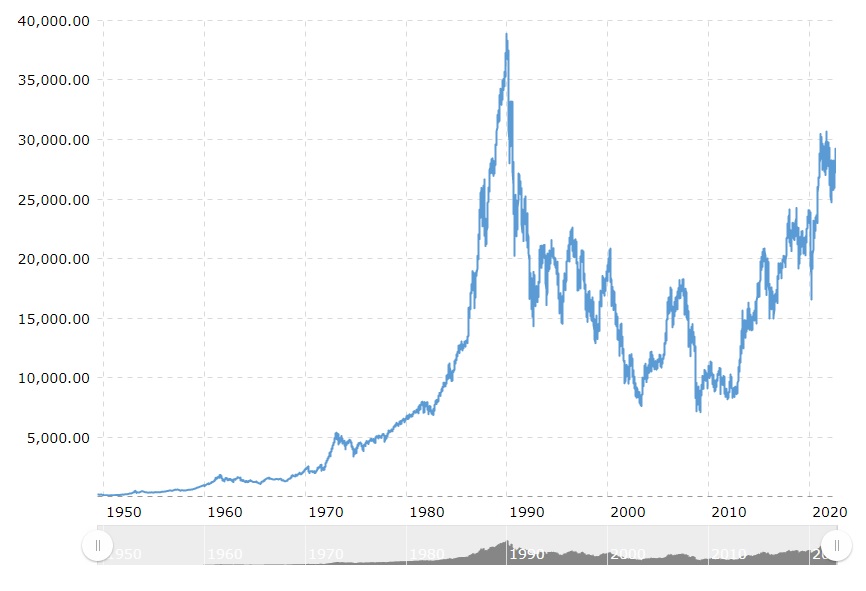
Bear markets happen, and they can last for a long time, with many, many dead cat recoveries that morph into new lows — the Nikkei 225 still has not recaptured its peak set in the late 80’s/early 90’s, about 30 years ago:

Will the SPX also take 30 odd years to not recover? I don’t know, and frankly, nobody does. It is certainly possible, though history across all the major developed markets suggests that this is unlikely — recovery to prior peaks for even fairly severe drawdowns (like the 2008 Great Financial Crisis) rarely take more than 5-10years.

As investors, all we can do is make projections, and allocate our portfolio accordingly. But as noted in Marathon, we should also make preparations for the worse/worst case scenarios, for the unknown unknowns, for when the bear awakes and takes a swipe at our portfolios.

So, if you’ve been paralyzed with indecision thus far, you need to make a decision, even if the decision is to “do nothing”. It is certainly a hard decision to make, given that you are likely sitting on a bunch of losses and realizing the losses (by selling) will make it that much more real. Sitting tight could very well see you made whole or more…, or we may drop another 25% or more.

An easier decision to make, however, is if you have immediate needs for money that cannot be deferred. If so, you should seriously consider keeping enough liquidity (i.e. cash or cash equivalents) on hand, so that your near term money needs can be met. If the market recovers, treat it as premiums for insurance against failing to meet your obligations. If the market drops more, you’ll certainly be relieved you cashed out and won’t have to worry about near term needs.

Footnotes

  1. Disclaimer: I am an investor in StockClubs, which is an app that lets you share your portfolio, or follow the portfolios of others. Note that I’m only sharing 1 (out of around 10) brokerage accounts that I maintain.

August 27th, 2022: Weekend video binge – retirement planning

Foreword

This is a quick note, which tends to be just off the cuff thoughts/ideas that look at current market situations, and to try to encourage some discussions.

Wealthion hosted a retirement planning best practices webinar this weekend, and I highly recommend it.

As usual, a reminder that I am not a financial professional by training — I am a software engineer by training, and by trade. The following is based on my personal understanding, which is gained through self-study and working in finance for a few years.

If you find anything that you feel is incorrect, please feel free to leave a comment, and discuss your thoughts.

First do no harm

As I’ve noted in “Financial planning, portfolio management and wealth management“, financial/retirement planning is very different in practice from what most people seem to think. It is rarely about maximizing your returns, but more about maximizing the probability that you’ll attain some base level of return you need to meet your needs.

As a contrived example, let’s say you have $1 and you need to retire right now. Well, if you are trying to maximize your return, you’ll probably invest in stocks or equity of some form. But if you want to maximize the probability that you’ll be able to retire on $1, then, perhaps literally, the only option you have is to buy a lottery ticket and pray for the best.

On the other hand, if you have $10m, and you need to retire right now, then again, to maximize your return, you’ll probably invest in stocks or equity of some form. But if you want to maximize the probability that you’ll be able to retire with $300k (ignoring taxes) a year to spend, then you should probably buy 30 year US Treasuries, which currently are yielding about 3% (1).

The main idea is that financial/retirement planning is a marathon, and you’re in it for the long haul, so you need to consider risks, especially those that have low probabilities, but are highly detrimental (e.g. severe stock market crash) to your plan.

Retirement plan

As noted in “My Personal Portfolio” and “Late to the party“, I tend to manage my portfolio more conservatively, trying to avoid drawdowns more than trying to achieve supernormal gains. You can learn more about this approach and why it makes sense in the long haul in this webinar that Wealthion hosted.

It’s very long (3 hours!), but very much well worth the watch.

Footnotes

  1. OK, fine. In practice, you’ll probably buy some balance of stocks/bonds, though still tilted heavily towards bonds. Because everyone is at least a little bit greedy.