September 30, 2021: Slow down show down

Foreword

This is a quick note, which tends to be just off the cuff thoughts/ideas that look at current market situations, and to try to encourage some discussions.

As usual, a reminder that I am not a financial professional by training — I am a software engineer by training, and by trade. The following is based on my personal understanding, which is gained through self-study and working in finance for a few years.

If you find anything that you feel is incorrect, please feel free to leave a comment, and discuss your thoughts.

China

The recent news out of China have been mostly pretty terrible:

United Kingdom

Not to be outdone, the UK has its own troubles:

United States

And of course, the USA cannot possibly be left out:

Globally

And all of these, during one of the worst global supply chain problem ever.

Where to from here?

Normally, the days just before the end of a quarter will see some rather dramatic fireworks in the stock markets because large funds sometimes need to rebalance their portfolios, and/or window dress their holdings for the quarterly reports. At the same time, certain systemic strategies need to buy (or sell) in large quantities based on how different assets have performed over the quarter.

All these are compounded by the expiry of the quarterly options on September 30th, as well as the quad expiry (index futures, index options, single name options and single name futures) on September 17th, which too tend to drive volatility up.

Also usually, the volatility tends to mellow out a bit once the new month/quarter starts — there is only so much excitement traders can take!

But as I sit here, at around 10pm Eastern looking at the futures market, the price action doesn’t strike me as “mellowing” — around 8.45pm, it appears someone important sneezed, because S&P 500 futures just took a ~80bps nosedive in about 30minutes. Yea, yea, overnight futures markets have low volume, sometimes little things make big noises, this could be nothing, etc.

Let’s hope tomorrow’s markets won’t be the wrong shade of green…. again.

September 24, 2021: Crypto regulation

Foreword

This is a quick note, which tends to be just off the cuff thoughts/ideas that look at current market situations, and to try to encourage some discussions.

As usual, a reminder that I am not a financial professional by training — I am a software engineer by training, and by trade. The following is based on my personal understanding, which is gained through self-study and working in finance for a few years.

If you find anything that you feel is incorrect, please feel free to leave a comment, and discuss your thoughts.

USA

Yesterday, an article came out of the New York Times, discussing potentially upcoming regulations in the USA. The article highlighted the facts that

  • Regulators in the USA have mostly ignored cryptocurrencies before as they were mostly little threat to the financial system
  • But as cryptocurrencies grew in value and popularity, they are now becoming impossible to ignore
  • Both the Treasury and the SEC have come out rather strongly for bringing cryptocurrencies under the existing regulatory fold
  • With a particular focus on stablecoins, as they appear to fall pretty clearly within the bounds of what a security means — they look and smell almost identically to “money market funds”, which have clearly been ruled as securities by the Supreme Court

It is currently unclear to what extent the Treasury and the SEC will pursue this. Fully complying with securities rules mean providing a bunch of disclosures and statements that are somewhere between “damn bloody hard” to “impossible” — just as an example, how would most coins, nominally marketed as semi-anonymous, be able to do KYC checks? Yes, various brokers might be able to do KYC checks at the broker level, but KYC checks at the coin level seems daunting — who would even be responsible for such a task?

China

I hadn’t really wanted to write about this topic, since the USA side of the story is still developing and not really concrete. But today, China drop a bombshell, by declaring all activities related to digital coins as “illegal”.

Prior to the crackdown on mining in China, a large fraction of cryptocurrency holders are Chinese nationals. After the crackdown on mining, since the coins were themselves legal still, I’m guessing a majority of Chinese holders did not divest. And now, it appears they might not be able to, at least not legally.

Currently there are many crypto exchanges based in China, naming just the big/famous ones:

  • OKCoin
  • BTCC
  • Huobi
  • FTX

It’s not clear what’s going to happen to them, though likely those with a substantial presence still in China will be forced to close down, essentially a much more dramatic action compared to techedu a while back.

More importantly, and more interestingly there is the question of Binance (and by extension, those other crypto exchanges started/based nominally in China but have since moved out a majority of their operations). Binance is the largest crypto exchange in the world, by a very long shot. While it is technically operating out of the Cayman Islands, and its CEO is adamant that Binance is a “global company” with no real national ties, that has never really been tested.

So what’s going to happen, when the Unstoppable Force of China hits the Immovable Object of Binance?

Some potentials, in increasing order of “bad”:

  • Binance moves all operations completely out of China, and continues to operate normally. Chinese citizens use Binance to skirt the local laws. Nothing really changes.
  • Binance moves all operations completely out of China, loses a large market, but not much else.
  • China somehow gets a hold of a key person of Binance, and forces the company to shut off all Chinese operations and pay a huge fine. Maybe some employees are jailed.
  • China somehow gets a hold of a key person of Binance, and leverages that into obtaining control over the company and forces it to shutdown completely.

It is the last possibility, albeit currently remote, that is concerning. What happens to the assets on a crypto exchange’s balance sheet if it is deemed illegal?

Precedence generally has been that the assets of illegal companies are confiscated and then become state property. But Binance doesn’t really own its assets — Binance has matching liabilities for most of its assets because it is holding those assets for clients. Again, precedence suggests that counterparties of liabilities on illegal companies’ balance sheets are just out of luck. Would China really do that, though? A large number of Binance’s clients are outside of China, both in terms of citizenship, as well as physically, and technically outside of its jurisdiction.

If nothing else, this seems like it’s going to be an interesting space for that much longer.

August 30, 2021: Inflation update

Foreword

This is a quick note, which tends to be just off the cuff thoughts/ideas that look at current market situations, and to try to encourage some discussions.

As usual, a reminder that I am not a financial professional by training — I am a software engineer by training, and by trade. The following is based on my personal understanding, which is gained through self-study and working in finance for a few years.

If you find anything that you feel is incorrect, please feel free to leave a comment, and discuss your thoughts.

Burry

About 2 quarters ago, Michael Burry (of “Big Short” fame) started shorting long term Treasuries quite aggressively. Basically, it seems like he was betting that long term interest rates would be going up in the nearish future — it didn’t (and hasn’t). That didn’t seem to deter him — he modified his bets somewhat, but he is still, essentially, short long term Treasuries.

Over the weekend, Youtube recommended this video to me, which does a reasonably good job of discussing Burry’s bets, and what they really mean. Essentially, it seems like Burry is betting that inflation will rise, and the Fed will raise rates to counter that inflation.

If you look at Burry’s portfolio, you’ll also notice that he’s very heavily in things that I suggested in the June 6 inflation post may be good inflation hedges — consumer staples, real estate (housing), healthcare, utilities(-like) companies that have fixed costs and floating prices.

So, it seems like Burry’s betting heavily on inflation.

Fed

Last Friday, on August 27, Jerome Powell, the current head of the Federal Reserve, gave a speech at Jackson Hole which can simply be summed up as, “Inflation is high, but probably transitory; QE is probably ending soon; Rates may not rise quite as soon”.

Which is to say, Burry’s bet on interest rates rising are probably not doing well right now, and Powell appears to disagree with his inflation bets as well.

Clarifications

And finally, some clarifications on the June 6 inflation post. In various forums which discussed that post, some people brought up some points which seem to misunderstand the post. So to clarify:

  • I believe the Fed will do something to counter high inflation, if it happens. In particular (and as noted in the prior post), I’m expecting the first rate hike to happen sometime in the 2022 – 2023 period.
  • I had previously thought the Fed would act earlier (in 2021), but Yellen’s speech (see prior post for link) made me change my mind to the new 2022 – 2023 time frame.
  • I expect the Fed will be able to counter inflation. It may require drastic actions (see 1970’s and Volcker’s policies), but it seems like they have the necessary tools. Which is also why I don’t expect elevated inflation (i.e.: more than 2.5%) to last more than ~2 years (starting from the June post).
  • Inflation is the rate of change of prices — not actual prices. And no, I do not expect deflation in the near/medium term (say 2-5 years). Which is to say, I expect the increase in (average consumer) prices to remain. But the higher rate of increase of prices (i.e.: higher inflation) to be transitory.
  • So yes, this “up to 2 years of elevated inflation” would be painful, especially for those who are most financially vulnerable.

July 20, 2021: Return of the Vol

Foreword

This is a quick note, which tends to be just off the cuff thoughts/ideas that look at current market situations, and to try to encourage some discussions.

As usual, a reminder that I am not a financial professional by training — I am a software engineer by training, and by trade. The following is based on my personal understanding, which is gained through self-study and working in finance for a few years.

If you find anything that you feel is incorrect, please feel free to leave a comment, and discuss your thoughts.

Covid-19 strikes back

Since around early July, stocks have been trading mostly sideways with a slight downward bias in the previous week. Yesterday (7/19), stocks took a ~1.5% dive, while volatility, as measured by the VIX, peaked at over 24 from a sleepy sub-18 print last Friday. This decidedly reddish hue of green caused a bit of a stir, especially since it is hitting in the middle of summer, a period traditionally marked by quiet markets as traders are busy with their vacations.

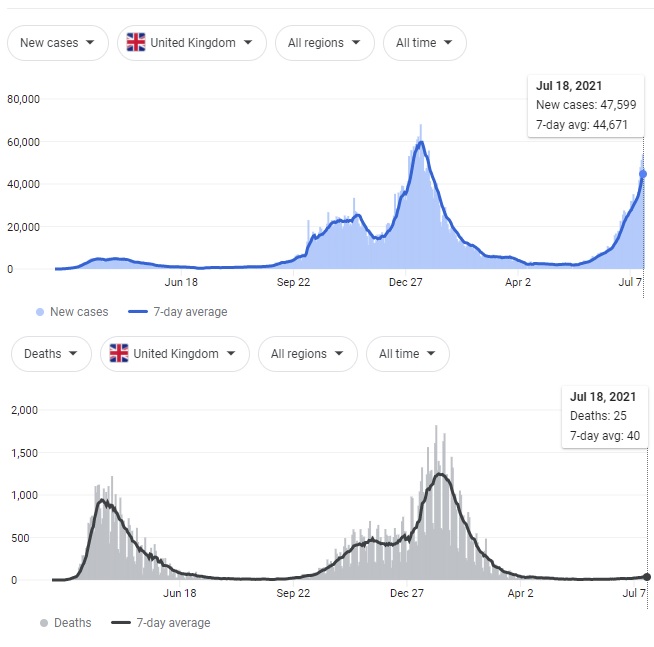
The financial news media is abuzz with suggestions that a rise in Covid-19 cases, this time by the delta variant, is to blame. Multiple countries are seeing an uptick in Covid-19 cases, with the UK especially apparent — cases in the UK are at 70% of all time highs (around 48k cases/day, compared to around 68k/day at the highs), and appears on track to take out the highs in a week or two. UK health officials and media are flirting with the idea of lockdown again, though Boris Johnson did not relent, with Freedom Day finally arriving yesterday.

The rise of the vaccinated

Despite the seemingly grim news, there is a ray of hope. While cases have been rising, death toll from Covid-19 has been surprisingly muted:

UK daily Covid-19 cases and deaths, courtesy of Google.

Some have speculated that this is due to the high rate of vaccination in the UK (at 70% of the population having at least one dose, it’s one of the highest in the world), while others have suggested that better treatments available, now that doctors and researchers have had more time and experience. Regardless, based only on the UK’s numbers in the past 7 days, the current death rate (1) for Covid-19 is lower than that for the flu (2).

A few random countries I picked show similar trends (cases up but deaths down) or better (cases and deaths both down). None of the 10 or so countries I randomly tried saw increasing death rate (as a ratio of case count).

So, unless that death rate suddenly spikes dramatically (3), it seems like the market may be overreacting slightly, assuming their only concern is the rise of Covid-19.

The cyber menace

If only that was the only thing we need to worry about. Over the weekend, a report came out suggesting that some of the major cyber attacks on US soil (4) in recent memory had links to China. President Biden made it official yesterday in an official White House press release, and the statement was backed by a few American allies.

Perhaps I’m still suffering from PTSD (5) due to the trade war of 2018, but this has undertones of a time when I’d rather not revisit, especially in light of the recent tensions due to big tech regulations, human rights, etc.

Hopefully a peaceful diplomatic solution can be found, but at least in the short term, it’s another thing to think about.

The last meme

Something that I’ve prognosticated on since last July (6), was the return of normalcy. The thesis being that with everyone cooped up at home, there is a natural draw towards more retail trading, but with reopening (7), “other stuff” will naturally take up our time, which should reduce retail trading volumes. And if retail traders were mainly the culprits bidding up markets (specifically meme stocks), then a lack thereof of such may portend dark tidings.

So far, this is sort of happening — meme stocks hit a crescendo in February/March and have been mostly leaking lower ever since.

Finally, with the end of fiscal support, especially the eviction/foreclosure moratorium, around the end of July, the impetus is there for more folks to hunt just a little bit harder for their next job, and recent joblessness numbers are reflecting that.

And well, it’s just harder to day trade meme stock options when you’re working, y’know?

Attack of the karma

Of course, now that I’ve typed this all out (despite the tone and date of the post, I’m actually typing this on the evening of July 19), you can bet that the markets will open (7/20) green and make new all time highs before lunch (8).

Because. Just because.

Footnotes

  1. This is not a perfect measure — deaths are strictly a “lagging” indicator, while a non-trivial number of people are probably misclassified either way (died from Covid-19 labelled as died from other causes and vice versa). At the same time, there’s probably a good number of people who are infected but are not captured by official statistics for various reasons.
  2. According to https://www.goodrx.com/blog/flu-vs-coronavirus-mortality-and-death-rates-by-year/, death rate for flu is around 61k/45m = 0.14%. Based on the UK’s last 7 days average numbers, death rate for Covid-19 in the UK, in the past 7 days, is around 40/44671 = 0.1%.
  3. It might! Again, deaths necessarily lag infections.
  4. Can you actually say a cyber attack is on “US soil”? Seems kinda weird?
  5. I happen to be trading FX algorithmically in 2018, and well, you always trade FX with leverage. Huge amounts of leverage. Makes for very unpleasant blood pressure graphs whenever ex-President Trump tweets anything about the trade war.
  6. If your predictions don’t come true, try, try again. Eventually they will come true. Or everyone will have died of old age and nobody will remember anyway.
  7. Remember folks predicting that we’d be reopening in July… 2020?
  8. Absolutely not investment advice. Though if you do bet on it and made money, you’re welcome. 🙂

June 26, 2021: Tethered at the hips

Foreword

This is a quick note, which tends to be just off the cuff thoughts/ideas that look at current market situations, and to try to encourage some discussions.

As usual, a reminder that I am not a financial professional by training — I am a software engineer by training, and by trade. The following is based on my personal understanding, which is gained through self-study and working in finance for a few years.

If you find anything that you feel is incorrect, please feel free to leave a comment, and discuss your thoughts.

Tethered

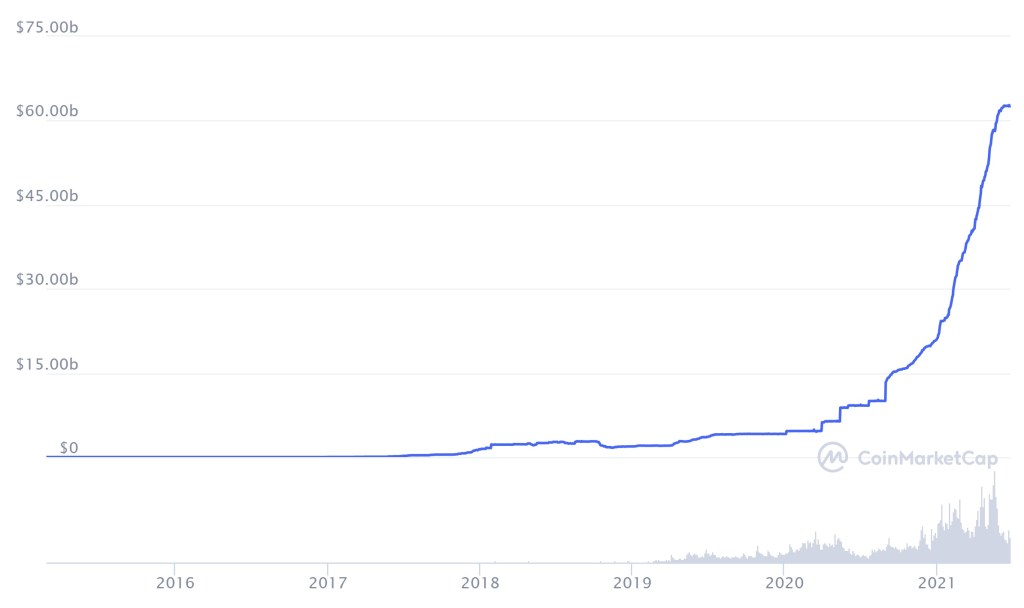
Around the start of 2021, the “market cap” (1) of Tether (2) started increasing at a phenomenal rate. In the first month of 2021, it grew by about 25%, then 35% in February, but “only” 14% in March. April saw another 25% spurt of growth, but May and June, together, saw “only” a 22% growth, with most of the growth in May and June mostly flat, with even a slight dip in late June.

Tethers marketcap, courtesy of CoinMarketCap – https://coinmarketcap.com/currencies/tether/

Prior to around late 2020, the crypto space was mostly the playground of more libertarian minded folks, and for the most part, ignored by most large institutional entities.

However, around late 2020, and especially in early 2021, a few large institutional players started taking note of crypto, and initiated positions in the space. The reverse is also true — the provider of Tether claims that the majority of its assets were held in more traditional financial instruments, such as commercial paper (i.e.: short term corporate debt), corporate bonds (i.e.: longer term corporate debt), funds, etc.

So — Tether is “backed” (3) by corporate debt, while some (possibly same, possibly different) corporations have crypto on their balance sheets, and finally, Tether is part of many conversion pathways between many crypto coins and fiat currencies (4).

Leverage

There is anecdotal evidence to suggest that Tether is involved in a bunch of highly leveraged (5) crypto trades, and the increased use of Tether may be a symptom of the increase in leverage in crypto in general. Note that Tether is hardly the only stablecoin — there are a ton of these currently operating, mostly tied to the US dollar, though some are tied to other fiat currencies.

Other than the explosion of stablecoins, there are also anecdotal evidence that some firms are speculating on crypto coins with leverage. For example, MicroStrategy recent issued a bunch of junk bonds in order to buy bitcoin.

Linked

So what we have, is:

  • Some firms issuing bonds (i.e.: debt) to buy crypto coins.
  • At the same time, some crypto coins (not necessarily the same coins as the ones above) are backed by corporate bonds (again, not necessarily the same as the bonds above).

Even though the coins/bonds in both those statements need not be the same coins/bonds, there will likely be some form of linkage, albeit potentially tenuous. For example, bond funds and algorithmic trading firms (i.e.: quant hedge funds) tend to lump individual corporate bonds into groups, and then trade everything in the same group as basically interchangeable.

Thirty thousand dollars under the C(oin)

Currently, Bitcoin is trading at around 31 thousand dollars, having repeatedly tested the 30-31 thousand range recently, and more broadly (since mid April) grinding downwards. Given that Bitcoin started the year just below 30 thousand dollars, almost everyone who bought bitcoin in 2021 is underwater on their 2021 purchases.

Get to the damn point

All the above is basically just a “quick” introduction to the space, and to make the following points:

  • Many institutions initiated crypto positions in 2021.
  • Bitcoin, by far the most popular crypto coin (6), is basically flat on the year. (7)
  • There is a lot of leverage in crypto.
  • There are non-trivial and often non-obvious linkages between cryptos and more traditional financial assets.

Given the above, it seems to me, that if bitcoin were to fall decisively below around the 29 thousand dollars mark (a drop of around 7%), and stay there for more than a few days, there is a decent chance that a few of the institutions may sell (or be forced to sell, due to being overly leveraged), resulting in a cascade of selling between the linked assets, as over levered players are forced to unwind.

Which is the nice way of saying “contagion”.

It probably won’t be terrible. Despite the large numbers involved in crypto, which dwarves the numbers we saw during the Great Financial Crisis of 2008, many players in the crypto space are relatively price insensitive, and many bought in before the 2020/2021 run up in crypto prices, so they may not even be underwater.

So while there may be pain (and very intense pain at that) in the linked assets during the unwinding of leverage, it probably (hopefully!) won’t result in financial armageddon like in 2008, i.e.: the pain will probably (really, really hopefully) be contained to the linked assets.

That said, it’s not clear to me that if (and that’s a very big if) such an unwind were to occur, whether the prices will quickly return to their pre-unwind values, or if they’d languish around or even go down more.

I guess we’ll just have to wait and see.

Footnotes

  1. More accurately, the spot value of all outstanding Tether coins.
  2. Tether is a stablecoin, a type of crypto coin whose value is supposed to be tied to fiat currencies like the US dollar.
  3. More than a few financial analysts have questioned the Tether disclosures, since those numbers would make Tether one of the largest holders of corporate debt instruments. Yet prior to these disclosures, almost no large bank/analyst firm had Tether on their radar, which is rare. It’s possible, but unlikely.
  4. Many crypto brokerages actually do not trade in fiat — they may not have the proper licenses with the relevant regulators. Instead, they trade only in stablecoins (i.e.: you are buying a stablecoin when you sell another crypto, and selling a stablecoin to buy another crypto). This isn’t always obvious to the end user, because these brokerages sometimes represent the trading as being against fiat currencies. One recent example is El Salvador’s law making bitcoin legal tender — users put in US dollars, which are then immediately converted into Tether, which is then used to buy the bitcoins.
  5. I guess “highly leveraged” is a matter of perspectives. Traditional stock trading only allows 2x leverage, but crypto trading tends to allow for much more, e.g.: Kraken, Binance, etc.
  6. Almost all institutions speculating in crypto coins are only in bitcoin, since it has the most liquidity, and is the most recognized.
  7. In the crypto space, anything less than a 10% move over a few months is basically “flat”.

June 6, 2021: Inflation

Foreword

This is a quick note, which tends to be just off the cuff thoughts/ideas that look at current market situations, and to try to encourage some discussions.

As usual, a reminder that I am not a financial professional by training — I am a software engineer by training, and by trade. The following is based on my personal understanding, which is gained through self-study and working in finance for a few years.

If you find anything that you feel is incorrect, please feel free to leave a comment, and discuss your thoughts.

Disclaimer

My usual stance is to not write about anything that can be construed as “investment advice”, because I’m simply not qualified to provide that to anyone. This post diverges slightly from that.

In this post, I talk a little bit about my thoughts on inflation, and how I would (and currently am) hedge for inflation. This is entirely my personal belief, and what I’m doing for my own portfolio. More importantly, I may change my mind at anytime, and I may or may not write about it, and may or may not otherwise notify you when I change my mind.

Please do your own research, and consider carefully what is right for your own personal situation. What is right for me, may not be right for you.

Janet Yellin’

Janet Yellen, the previous Federal Reserve Chair and current Treasury Secretary, just had a very interesting press conference. As opposed to the Federal Reserve, which has been steadfastly saying “inflation is transitory”, Yellen gave a much more nuanced take, and suggests that higher inflation, as high as 3%, may be acceptable to the government. Given that officially reported inflation in the US is somewhere between 0 and 2% for the past decade or so, that’s pretty big news — even a 1% increase in inflation can result in significantly higher prices over long periods of time — 0% compounded for 10 years results in prices that are exactly the same, 1% compounded for 10 years leads to a ~10% increase, 2% leads to ~22% increase, and 3% leads to ~34%.

There has already been considerable consternation in the markets about higher inflation, with a scare earlier this year leading to a ~12% sell off in QQQ, and some more risky stocks dropping as much as 50-60%. So yeah, everyone’s talking about inflation. Yellen making it official, doesn’t seem like it’s going to help sentiments.

How high is high

Generally speaking, I think of inflation as several buckets (all numbers per annum) (1):

  • 0 – 1.5% – Low inflation
  • 1.5 – 2.5% – Normal inflation
  • 2.5 – 5% – Medium inflation
  • 5% – 10% – High inflation
  • 10% – 12,900% – Very high inflation
  • 12,900+% – Hyperinflation (2)

Note that the range for each bucket generally increases as you go down the list. This is by design — historically, inflation tends to grow exponentially (or at least, at a polynomial rate), which with some hand-waving, sort of means it’s easier to get from 6% inflation to 8% inflation (a jump of 2%) than it is to get from 1.5% to 2% inflation (a jump of 0.5%). This is also why central banks tend to, or at least, used to, be very wary of inflation — beyond medium inflation, it becomes very easy for inflation to get out of hand very quickly. When that happens it becomes really, really hard to get inflation under control.

Transitory?

The next question is, is inflation transitory? And the answer is… yes. No. Maybe?

It depends on what you mean by “inflation”. Inflation just describes a phenomenon, and therefore, technically, is always with us — even deflation is basically just negative inflation. More accurately, I think the question is, “is higher than normal inflation transitory?” And the short answer is — I don’t know.

But if I were to guess, then I think that it is unlikely that the US gets to high inflation in the near term (say, next 1-3 years). And even if it did get to high inflation, it’ll probably be transitory (say, less than 1-2 quarters).

As for medium inflation (which is still higher than the normal 1-2% we’ve been seeing), I used to think that it’ll be transitory and maybe last at most 1-2 quarters. But recent events, and Yellen’s speech, changed my mind, and I think we may see it for maybe 4-5 quarters, possibly even up to 2 years. Most of this has to do with how the economy is not really returning to normal evenly, and certain sectors are facing severe supply issues.

What I am doing

Given that I don’t think high (much less very high/hyper inflation) are in the cards, then it seems unlikely that inflation will be so high that it causes severe distress to many businesses (Some yes; Many, probably [hopefully] not).

So the core thrust of my thinking is that selective investments in productive assets (i.e.: businesses) should work. The key question is, which sectors/industries?

Bare necessities

My thinking, again, personal opinion, may be wrong, is that basic goods and services will still be in demand. So things like

  • Housing
  • Consumer staples
  • Healthcare
  • Utilities(-like)

will be in demand. And to the extent that the businesses in these industries/sectors can keep their costs under control and adjust their prices to account for inflated input costs, they should do well (3). Maybe even better than other sectors/industries. In my mind, non-“bare necessities” like consumer discretionary may suffer for 2 reasons:

  1. Higher inflation tends to sap savings and reduce disposal income, leading to cutbacks on non-essentials.
  2. In the past ~12 months, we’ve already seen an explosion in discretionary spending, which is likely to end once the stimulus and its effects die down; Usually, these types of pent-up spending tends to just pull forward demand, which means forward demand should be reduced — you only need so many Peloton bikes.

So, for the near term, say 1-3 years, I’m guessing the above sectors/industries will do slightly better than the others (4).

Note that for housing, I’m particularly in favor of multi-family housing, since that’s generally the most cost-effective option for the budget conscious, and for utilities(-like), I’m favoring those that are not deemed “natural monopolies” and thus heavily regulated (to the point where they cannot easily raise prices to offset increasing costs).

Can I be wrong?

You should always, always, always assume that whatever financial analysis you read has a high chance to be wrong, either intentionally (the author is malicious) or unwittingly (the author is just wrong) — nobody can see the future.

That said, here are some risks, that I can think of, to my guesses above:

  • Currently, various forms of fiscal stimulus are ending. If the government extends or comes up with new stimulus, then the above will likely be horribly wrong.
  • Currently, the Federal Reserve’s official stance is no interest rate hikes, though they are going to start talking about it. If they dramatically pull forward the timeline of hikes, or dramatically push back the timeline of hikes (I’m guessing first hike to be around 2022 – 2023), then the above may be horribly wrong.
  • Currently, the pandemic is ending in most developed countries, and peaking in most developing countries. To the extent that reopening proceeds at a reasonable pace (say, full reopening by end 2022 in most/all developed countries), the above is probably fine. But if not, then the above may be very wrong.
  • Currently, I’m not yet a complete idiot. But if I were…

Footnotes

  1. Note that these are my personal definitions, and not firm — the boundaries of the buckets move slightly if you ask me at different times. That said, I think most economists will come to buckets that’s roughly similar. Other than the hyperinflation bucket, there are no official definitions that I know of.
  2. This is the official definition — 50% monthly inflation, so ~12,900% a year.
  3. It is not a coincidence that most of the sectors/industries listed are more likely to have fixed costs, but variable prices.
  4. Note that “slightly better” is relative. It doesn’t mean these sectors/industries will go up in value — if the entire market tanks 50%, if these sectors/industries only tank 49%, they’ll still have done “slightly better”.

May 19, 2021: Rorschach test says “angry”

Foreword

This is a quick note, which tends to be just off the cuff thoughts/ideas that look at current market situations, and to try to encourage some discussions.

As usual, a reminder that I am not a financial professional by training — I am a software engineer by training, and by trade. The following is based on my personal understanding, which is gained through self-study and working in finance for a few years.

If you find anything that you feel is incorrect, please feel free to leave a comment, and discuss your thoughts.

Tell me what you see…

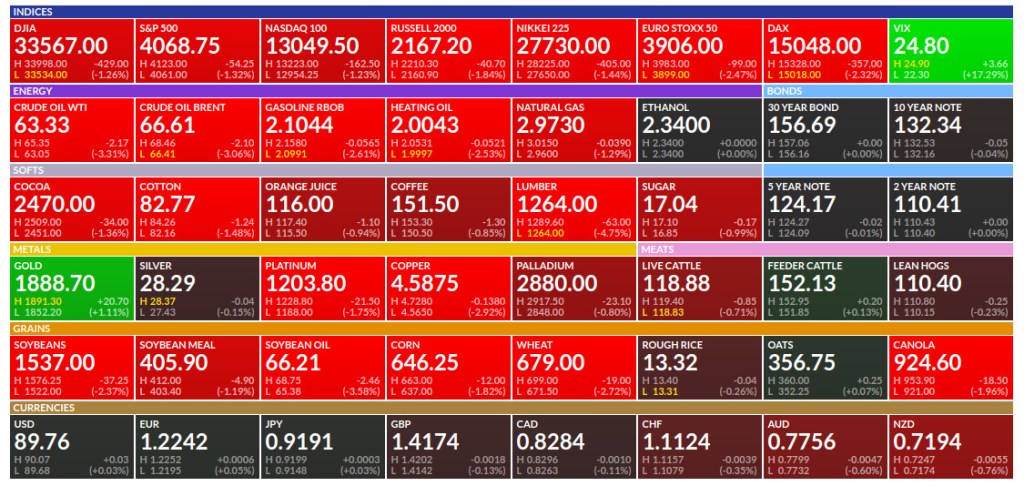
Here is a picture of the (futures) markets as of this writing:

Futures markets, courtesy of Finviz.

I took a look, and the first word that comes to mind was “angry”. Angry. The futures markets look angry.

Crypto

Unless you’ve been hiding under a rock (and maybe even if you have), you’ll know that cryptocurrencies and the US stock markets have been on fire. Cryptocurrencies gained around 3x (as measured by Bitcoin) from the start of 2021 to around mid April. Then, a series of unfortunate events (which mainly rhymes with Melon Tusk) occurred and everything started going down in fits and starts.

Today, or rather the past 24 hours, Bitcoin went down roughly 18% (as of this writing), though at the peak it was closer to a 30% drop. While Bitcoin has recovered from the lows, the current price action seems to suggest more downside in the near future.

Will it go down more? Or will it rebound? Who knows? A 30% drop in Bitcoin is basically par for the course. It’s something that happens so frequently that you can probably set your clocks to it. And at least all the previous drops have seen Bitcoin recover, and then some. Though in some cases, it took years before it eclipsed the prior highs.

Stocks, again

To round back on the main topic of the day. I had a not so immodest thought, that maybe the speculative fervor in stocks and crypto are linked. Maybe, it’s just an expression of excessive money sloshing around the system, and mostly in the hands of people who are ill-prepared to deploy them wisely, leading to excessive speculation and, in many cases, outright gambling.

So, if the underlying causes are the same, and the folks frolicking in these playgrounds are the same, then maybe, just maybe, when one goes down, the other goes down with it?

In some sense, this is an extension of what I’ve wrote before (see quick note on April 20) — those things which were going up a lot, seems to be hit the hardest, and crypto, with its absolutely mind-blowing out-performance year to date, seems to be first in line to take it on the chin.

To be fair, almost everything is going down today. So it could also just be a garden variety “batten down the hatches and sell everything” panic.

Or it could all recover tomorrow, as if nothing had happened. Yes, I’ve had a lot of practice saying a lot of words, and yet saying nothing.

May 17, 2021: Flipping the COIN

Foreword

This is a quick note, which tends to be just off the cuff thoughts/ideas that look at current market situations, and to try to encourage some discussions.

As usual, a reminder that I am not a financial professional by training — I am a software engineer by training, and by trade. The following is based on my personal understanding, which is gained through self-study and working in finance for a few years.

If you find anything that you feel is incorrect, please feel free to leave a comment, and discuss your thoughts.

Or COIN flipping you?

Coinbase just announced a $1.25b convertible bonds issue. These bonds mature in 2026 (5 years), and are convertible to class A stock (that’s the regular COIN that is being traded).

This is… weird?

Usually, when a company goes public, it is so that they can sell shares to the public and raise money. In that moment (traditionally an IPO, but Coinbase used a “DPO”, direct public offering, where it sells directly in the market instead of to market makers), the startup-soon-to-be-public-company is supposed to sell as many shares as it needs, so that it can fund itself until it becomes profitable, after which, it can fund itself perpetually.

Usually, a company does not need to raise debt, nor sell more shares for a while after it goes public, because, well, they generally have a good idea of how much cash they need, and with a marvelous invention called a calculator, they can generally figure out how much shares they need to sell in the IPO pretty accurately. To have to sell bonds so soon (Coinbase went public only about 1 month ago) is highly unusual.

Even more surprising, Coinbase’s DPO sold pretty well! Coinbase had expected to sell shares at around $250 a piece, but instead, it sold them at a high of $400 a piece (2). That’s a 60% upside! And since it’s a DPO instead of an IPO, Coinbase should have been able to keep that additional upside.

Even more even more surprisingly, the convertible bonds are being sold with basically no coupon — 0% – 0.5%. While the market will likely price it at some yield (by paying less than par for the bonds), generally the coupon is in the ballpark of the initial yield the issuer expects the bonds to sell at. Now, what are convertible bonds with basically no yield? Aren’t those just… options (1)?

So, again, why is a company, barely 1 month old in the public markets, selling options to the public?

Footnotes

  1. Technically, warrants.
  2. I found out after this post went out that Coinbase didn’t sell any shares in the DPO, only the insiders did. This is even more bizarre. A company of Coinbase’s size and operations, should be able to predict cash needs at least 2-6months in advance. So if they are raising cash because of a liquidity issue, then they should have known this months before the DPO. Why not just sell some shares in the DPO alongside the insiders? Or do the bond offering before the DPO (or bring on additional investors while it was still private)?
    1. It’s not a good look when insiders get to sell to the public at ~$400 a share, and then the public gets diluted almost immediately by the bond/option offering… after the stock already fell 30+% to ~$250.

May 8, 2021: Across the pond

Foreword

This is a quick note, which tends to be just off the cuff thoughts/ideas that look at current market situations, and to try to encourage some discussions.

While I try to stay away from politics, sometimes politics is just being a jerk and does things that affect our pretty, pristine (ahem) financial markets. This time we look across the pond, at the UK, specifically the Scottish elections.

As usual, a reminder that I am not a financial professional by training — I am a software engineer by training, and by trade. The following is based on my personal understanding, which is gained through self-study and working in finance for a few years.

If you find anything that you feel is incorrect, please feel free to leave a comment, and discuss your thoughts.

Scottish elections 2021

The Scottish elections for 2021 has just ended, with all results having come in. The Scottish National Party (SNP) won 64 seats, 1 more than the previous 2016 elections, and just 1 seat short of an outright majority. More importantly, the Scottish Greens won 8 seats, up from 6 in 2016. Together, that’s 72 seats, an outright majority.

Why does that matter? Well, it turns out that both parties were heavily pro-independence (from the UK) in the last Scottish independence referendum in 2014. That time around, the vote was 55% against independence and 45% in favor.

With the improvements of fortunes by the SNP, Nicola Sturgeon, the leader of the SNP and the First Minister of Scotland, is making the case that another referendum is in order. And she sort of has a point — it does seem like the voters are leaning more towards independence, especially after the fiasco of Covid-19, and various other recent scandals plaguing the ruling Tories in London.

Bill Blain (another blogger I follow) has a take on this here. In that blog post, Blain lays out the point that this referendum matters, perhaps more than the Brexit one. In some sense I agree with him — if Scotland does indeed votes for independence, it’s going to make things interesting in the UK, if nothing else.

And now, here comes completely baseless speculation. As someone with a very obviously broken crystal ball, I cannot tell you what will happen. I can only guess, and I guess we’ll see what happens. A reminder that the following is based on the premise that Scotland does indeed hold a referendum, and the results are a strong yes mandate to independence — neither of these are guaranteed, but…

  • Currently, the general view is that Scotland cannot stand on its own.
  • However, crazier things have happened. Before their independence, many, too, thought that Singapore, Ireland, and a whole host of other nations could not stand on their own. These countries are still independent as far as I can tell.
  • But more importantly, Scotland was strongly pro European Union, so there’s a good chance that an independent Scotland would seek to rejoin the EU.
  • Which will make the whole issue of Brexit that much more contentious (yes, it’s “settled”, but they are still arguing about it).
  • Right after Brexit the markets the world over took a huge dump.
  • Most markets quickly rebounded, but GBPUSD remained heavily depressed.
    • Other than a brief period around early 2018, GBPUSD hasn’t seen its pre-Brexit-vote highs until very recently.
  • The UK stock markets were also severely affected, trading mostly sideways since the vote till today, in part due to the uncertainty.
    • With many, many roller coaster moments every time there’s another news cycle about the latest UK/EU talks.

So, given what we have observed so far, it seems like if the Scots voted for a strong independence mandate, then,

  • The Scottish land border with the UK will likely become an issue if Scotland also votes (and is accepted) to rejoin the EU.
  • There will likely be another period of uncertainty in the UK stock markets, likely lasting for years (again).
  • There’s a good chance that GBPUSD will take another huge dump, and then go into roller coaster mode for years (again).
  • These are especially if the Remainers take up their cause again, and try to somehow undermine and/or force a renegotiation of the current Brexit deal between the UK and EU (which they’ll likely have to renegotiate anyway, due to Scotland’s land border).
  • All of which suggests that maybe global stock markets will take another bath.
  • Whether they’ll recover as quickly and as strongly as after the 2016 Brexit vote is unclear — stock markets the world around are a lot more fragile currently than in 2016.

What should I do!?

I don’t know. I’m a software engineer, remember? Also, all the above are hypotheticals. They may not happen.

But it’s just another “something interesting” to think about and watch out for.

May 4, 2021: Jumping ship

Foreword

This is a quick note, which tends to be just off the cuff thoughts/ideas that look at current market situations, and to try to encourage some discussions.

As usual, a reminder that I am not a financial professional by training — I am a software engineer by training, and by trade. The following is based on my personal understanding, which is gained through self-study and working in finance for a few years.

If you find anything that you feel is incorrect, please feel free to leave a comment, and discuss your thoughts.

Jumping ship

I have read from numerous sources over the past 2-3 weeks that large institutions (e.g: hedge funds) have been steadily selling out of their long positions. Today, Bloomberg joined in the party with this article: Nasdaq 100’s Worst Day Since March Sparked by Inflation Fears.

As noted in the prior quick note, this seems to be all related to how the market is gaming out expected higher inflation in the near future. My understanding is that the thought process goes along the lines of:

  • Supply chain disruptions during Covid-19 resulted in reduced capacity.
  • Fiscal policies are essentially massive transfer payments, which are affecting some workers’ need and/or willingness to go to work.
  • A lot of lower paying and/or less desirable jobs are having trouble filling vacancies.
  • All these results in reduced supply of goods.
  • At the same time, reopening of the US markets is causing a spike in demand.
  • The fact that consumers have been mostly huddled up at home for the past few months, and thus not spending money, means that they also now have more disposable income (on top of the transfer payments).
  • All these result in increased demand of goods.
  • Demand up, supply down, classic economics predicts increase in prices, i.e: inflation.
  • The Fed is, nominally, supposed to react to increasing inflation via raising rates.
  • At the same time, because the economy is improving, there is increased probability of a reduction in QE, which is, de jure, a form of monetary support for an economy in trouble.
  • Since a large part of the stock market’s unrelenting rise over the past ~decade is based on both QE and lower-rates-forever, there are some who predict lower stock prices, at least in the near/medium term.

At the same time, there are technical issues at play — lower interest rates mean that the cost of carry (alternatively the “price” of money) is lower, and this generally encourages risk taking.

However, since the real economy is generally in the dumps (for many sectors/industries, in most of 2020), there is less incentive to invest in actual productive capacity, and so this excess risk taking tends to manifest in financial markets.

If interest rates does increase substantially, the cost of carry goes up, and these hot money flows may quickly dissipate.

Note that as of right now, this is mostly just conjecture. Interest rates have moved up slightly from the pits of 2020, but are still, objectively, pretty low compared to even the past 2-4 years.

Note also that at least for a large part of 2020, institutional players have severely underestimated the market’s resilience, especially in the face of retail traders who were willing to buy the dip, and thus dramatically outperformed the professionals. Will this be 2020 redux?