The RSU Sleight of Hand

Foreword

Nowadays, many tech companies compensate their employees with restricted stock units (RSUs), effectively stock grants that vest over time. In most discussions with recruiters I’ve had, wonky maths was used to describe the actual compensation that is actually being offered, making comparisons between RSU-based and non-RSU based compensation packages difficult.

As usual, a reminder that I am not a financial professional by training — I am a software engineer by training, and by trade. The following is based on my personal understanding, which is gained through self-study and working in finance for a few years.

If you find anything that you feel is incorrect, please feel free to leave a comment, and discuss your thoughts.

Restricted Stock Units

The typical RSU award works like this:

Let’s say your employer wants to pay you $100k over 4 years in RSUs. They will figure out a reference price of the stock at the time of the grant (i.e. when they decided to give you the award). Usually this is the price of the stock at market close on some particular day, or the average of the market closing price of some number of days.

Let’s say for our example the reference price is $100. In this case, you would be awarded with 1000 RSUs. The grant itself typically does not actually result in you getting shares. Instead, the grant is the promise of future shares. You only get the shares at set dates in the future, called vesting dates. For example, let’s say the shares vest once per quarter for the next 4 years. So each quarter, for the next 16 quarters, you’ll get 1000/16 = 62.5 shares each.

Vesting dates typically come with the stipulation that you remain employed with the employer — that is, if you quit (or are fired) before the full 16 quarters are up, you’ll forfeit any unvested shares of the grant.

To further complicate things, it’s common that a (large) part of your total compensation will come in the form of refresh grants, which are annual grants of new RSU awards, each of which are tied to a different reference price as well as award value (i.e. how much money your employer wants to actually give you). The employer may or may not disclose the reference price and/or award value, and may instead just choose to give you the total number of shares for each grant.

So, what you end up with, is a vesting schedule that looks something like this (assuming 1000 shares per grant, and consolidating all grants in the same year to shorten the table):

YearGrant 1Grant 2Grant 3Grant 4Total
1250250
2250250500
3250250250750
42502502502501000

After the 16th quarter, the first grant will be fully vested and you’ll stop getting shares from it. But the 5th grant will kick in, so you’ll continue getting 250 shares per quarter.

Note that typically the first grant is much larger than the refresher grants — this is because it is actually 2 grants in 1 — the first is the typical annual grant like a refresher grant, and the second is actually you sign on bonus. For simplicity, I’m ignoring the sign on bonus component for now, so all grants are more similar in size.

Presentation

When the RSUs award schedule is presented, recruiter will usually present the actual dollar amount of the shares you’ll get. Assuming that the shares start at $100 and increase by 10% per year, then the dollar amount of the vesting schedule looks like:

YearTotal shares vestedDollar amount
1250$25,000
2500$55,000
3750$90,750
41000$133,100

And from then on, the total value will increase by 10% a year (same number of shares, but share price increases 10% per year).

Now, if you want to estimate the value of your total RSU compensation in year 3, it is natural to think that it is $90,750. Did you notice the sleight of hand?

Sleight of Hand

There are 2 main issues with computing your actual RSU compensation:

  • The increase in the share price confuses the matter
  • You forfeit whatever shares are not vested in all grants if you leave the company

Now, given that, what do you think is the RSU based compensation for the 3rd year? Is it

  • $90,750 — the actual value of RSUs received in year 3

OR

  • $121,000 — the actual value of RSUs granted in year 3

?

The answer is… neither. It is actually $82,750, which is $25,000 (the value from the first grant) + $27,500 (the value from the second grant) + $30,250 (the value from the third grant).

Think of it this way — because you forfeit any shares not vested if you leave the company, at the time of the grant, you haven’t actually earned the award yet, so $121,000 is wrong.

At the same time, the first grant is worth only $25,000, despite you getting $30,250 from the 250 shares because that’s what the company intended to pay you when it made the grant — 250 shares at $100 each. The fact that the shares have gone up in value over the next 2 years is irrelevant — the additional 30,250 – 25,000 = $5,250 is the compensation you get for taking the risk of the stock exposure! Remember that instead of going up 10% a year, the stock price could just as easily have gone down instead.

Another way of thinking of it is this — if instead of giving you a 4 year deferred grant 1, the company had just given you the $100,000 flat out. In this case, you would have the choice of whether to buy the company’s stock or not. If you did, then you’d have bought 1000 shares (at a price of $100 per share). After the 4th year, your shares would then be worth $133,100. Would you now say that the first grant was $133,100 instead of $100,000? Obviously not!

If you had valued grant 1’s shares at the vesting price instead of the reference price, then you would value grant 1’s RSUs at a total of $25,000 + $27,500 + $30,250 + $33,275 = $116,025 over the 4 years, and that just doesn’t make sense — receiving the $100,000 upfront in year 1 is clearly better, since you get the money earlier, and you have the optionality of what to do with the money, so how can it be worth less than being forced to effectively buy your employer’s stock and to hold the stock for 4 years, while risk forfeiting part of the grant if you leave the employer early?

Taxes

One argument that some make for the RSUs instead of cash upfront, is that by deferring the payment, you are also deferring taxes, and since you are getting stock, you are benefiting from the deferred payment being invested, effectively compounding the part of the upfront payment that would have been paid in taxes.

Let’s model this out. Let’s say you pay long term capital gains taxes of 20% (highest) and marginal income taxes of 25% (somewhere in the middle).

In the RSU case, you would then receive:

YearVesting sharesReceived sharesTotal sharesShares value (pretax)Shares value (post tax)
1250187.5187.5$18,750$18,750
2500375562.5$61,875$61,500
3750562.51125$136,125$134,512.50
410007501875$249,562.5$245,227.50

If instead you had been paid cash upfront, paid your taxes, and then bought the shares:

YearPost tax grantTotal sharesShares value (pretax)Shares value (post tax)
1$75,000750$75,000$75,000
2$82,5001500$165,000$150,000
3$90,7502250$272,250$267,450
4$99,8253000$399,300$389,055

I think it should be clear in terms of cash flow, getting the cash upfront is better. However, if we just look at the first grant mathematically, in year 4, it will be worth:

  • If received in RSUs, with 187.5 vested at 100, 187.5 vested at 110, 187.5 vested at 121, 187.5 vested at 133.10, for a total of 750 shares worth $99,825 pretax, or $97,263.75 post tax.
  • If received in upfront cash, you’ll still end up with 750 shares, but worth $94,860 post tax, due to the lower cost basis of 100 for all shares.

So the main benefit of the deferral is that you have a higher cost basis for the shares received later, which does translate to a higher after tax dollar value if sold.

Whether this benefit is enough compensation for losing control/optionality of the grant for 4 years, and having to forfeit the unvested shares if you leave the employer early, is up to you.

Comparison shopping

When comparing compensation packages between an employer that pays with RSUs, vs another one that pays with cash, it is important to remember the RSU sleight of hand, and properly value what your compensation package will actually be.

The 3 key points to watch out for are:

  • If you leave the employer, will the deferred part of the compensation still be paid?1
  • Properly value the dollar value of each grant by adjusting for the risk you are taking by being forced to effectively buy your employer’s stock.2
  • The tax benefits of a higher cost basis for those shares that vest at a higher stock price than the reference price.

Footnotes

  1. Some employers may have wording in the contract to the effect of “if you do something we do not like, and you get terminated for it, then the deferred part is forfeit”. In these cases, you’ll have to estimate for yourself how likely it is that you fall afoul of those rules. In many cases, the rules are actually pretty generous and you only forfeit the deferred payments if you break a law or otherwise get involved in some serious shenanigans.

    If you are confident the deferred payments will actually be made, then you should consider the payments to be made at time of grant (because that’s also when they vest). ↩︎
  2. If the deferred portion is paid in cash, then you may need to discount the value of that cash to the time of vesting. ↩︎
December 27th, 2024: Weekend Video Binge

Foreword

This is a quick note, which tends to be just off the cuff thoughts/ideas that look at current market situations, and to try to encourage some discussions.

Adam Taggart is out with a fantastic interview with Graham Weaver — professional PE fund manager, Stanford professor and blogger/youtuber.

As usual, a reminder that I am not a financial professional by training — I am a software engineer by training, and by trade. The following is based on my personal understanding, which is gained through self-study and working in finance for a few years.

If you find anything that you feel is incorrect, please feel free to leave a comment, and discuss your thoughts.

Graham Weaver

Graham Weaver is a more traditional private equity fund manager, along the styles of Warren
Buffett — someone who invests in boring, predictable, but highly cash flow generative businesses, and holds them for the long term.

In this interview, he discusses the philosophy behind his investing style, and what contributes to his success. Well worth a watch.

Alpha

Foreword

Everyone in finance seems to be chasing alpha, but very few people seem to really understand what it is. What is alpha, and why does it matter?

As usual, a reminder that I am not a financial professional by training — I am a software engineer by training, and by trade. The following is based on my personal understanding, which is gained through self-study and working in finance for a few years.

If you find anything that you feel is incorrect, please feel free to leave a comment, and discuss your thoughts.

Simply alpha

Alpha, in finance, specifically quantitative finance, is defined as the excess returns of a strategy above and beyond market returns. In other words, alpha measures the outperformance of a strategy — the higher the alpha, the better the strategy1.

And because everything in finance is about *ahem* number measuring exercises, everyone in finance seems to be striving for higher alpha.

Unfortunately, many people, including those working in finance, don’t really understand what alpha is, and often conflate increased risk (which you do not want) with increased alpha (which you do want).

Maths

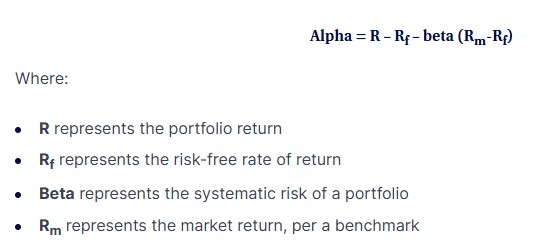
According to https://corporatefinanceinstitute.com/resources/career-map/sell-side/capital-markets/alpha/, the mathematical formula for alpha is:

Alpha definition, https://corporatefinanceinstitute.com/resources/career-map/sell-side/capital-markets/alpha/

If you look at the equation more carefully, you’ll realize that:

  • Alpha is net of the risk free rate.
  • Alpha is independent of market return.

Which is to say, if all the return of a strategy can be expressed as a function of market return, then that strategy, by definition, has zero alpha.

To “simplify” things a bit, to compute the alpha of a strategy, run a correlation test of that strategy’s returns against SPX minus the risk-free rate (assuming you are using SPX as a benchmark), and the correlation, with magnitude, is your beta. (edit: clarified that beta is correlation + magnitude)

The part of the strategy’s return beyond that which can be explained by market returns (i.e. beta(Rm – Rf)) would be alpha + Rf, so you can compute alpha by just taking away from that remainder the risk-free rate.

Some examples

Now, let’s consider some examples:

  • A fund that simply buys SPY, returning 33% in 2021, -14% in 2022 and 19% in 2023, with a cumulative total return over the 3 years of 34%.
  • A fund that simply buys UPRO (3x SPY), returning 106% in 2021, -49% in 2022 and 43% in 2023, with a cumulative total return over the 3 years of 50%.
  • A fund that returned 6% in 2021, 8% in 2022 and 9% in 2023, with a cumulative total return over the 3 years of 25%.

Clearly, the second fund has the highest cumulative total return, but which strategy has higher alpha?

Well, SPY is basically just the ETF expression of SPX, and UPRO is just 3x SPY, so the correlation of both funds would be very close to 1 (with SPY having a beta of around 1, and UPRO having a beta of around 3, edit: clarified that beta is correlation + magnitude), which implies both funds have zero alpha. However, the 3rd fund clearly does not move with the market — it goes up every year even when the SPX went down in 2022, and if you do the maths, it is returning about 5% above the risk-free rate every year. So the alpha of the 3rd fund is actually 5%.

Cue surprise

The above result often surprises many who don’t really understand what alpha means — how can a fund that returns less than SPY be considered to have alpha, while a fund that returned almost double of SPY has 0 alpha?

Recall that alpha is the part of the return that is above and beyond what can be explained by market returns. Both SPY and UPRO explicitly try to mimic market returns, with the exception that UPRO does it with 3x leverage. So neither have an excess return above that which can be explained by market returns, and the additional return UPRO provides over SPY is really just the result of UPRO taking more risk, in the form of using leverage.

Recall when we said people often confuse more risk (bad!) with more alpha (good!)? There you go.

The 3rd fund, on the other hand, has 0 beta2, so all its returns are just alpha + Rf, and if you subtract the risk-free rate (generally assumed to be 10Y US Treasury yield), you get about 5% alpha per year.

But the returns suck!

Yes. Compared to both the first 2 funds, the return of the 3rd fund is indeed subpar. This is a common theme of true alpha funds — their returns tend to be around the 5-10% mark annually (edit: This is net of risk-free rate, i.e. alpha). Yes, there are some funds that have much higher alpha (e.g. the Medallion fund from Renaissance), but those tend to be closed off to outside investors.

The reason alpha funds tend to have lower returns, is because they are hard, and more often than not, they are rare. Alpha is hard because it is genuinely hard to find a strategy which will do well regardless of what the market does — most strategies have some non-trivial amount of beta associated with it just because they need to operate in the market. They are also rare, because most alpha strategies tend to have low capacity, meaning you can only put so much money into the strategy, before your positions affect the markets, and you distort the market enough that the returns dissipate.

Constructing an alpha only fund

To get some insights into a true alpha fund, consider a fund which returns 5% of alpha, and 80% of beta, i.e. the fund returns 80% of whatever SPX returns in any single year, and on top of that, returns 5% additionally (+ risk-free rate).

Well, we can convert such a fund into a true alpha fund by simply bundling this fund with a short up to 80% of your portfolio value of SPY. The total return of this bundle will now be: 5% + 80%SPY – 80%SPY = 5%, the alpha.

Not so fast though — shorting is not free. You typically pay a fee (short borrow fee, maybe margin costs, etc.) to short. To keep the maths simple, let’s say that the total fee for this shorting is 1% of total returns.

Which means, your true alpha fund, the bundle, will only return 4% alpha.

In general, a true alpha fund tends to involve a lot of trades to hedge out market exposure, which in turn will reduce the actual return (and thus alpha) of the fund.

Why bother?

So to recap, a true alpha fund first needs to find a good strategy, then pay fees to trade that strategy, and pay more fees to hedge out market exposure, just to get a net return of around 5-10% of alpha. While market return, at least in the past few years, has dramatically outperformed that with much less hassle.

So… why bother? Are Wall Streeters just stupid? Or maybe they just like Rube Goldberg-esque exercises in futility?

Let’s consider our 3rd fund again, which returned 5% alpha, i.e. 5% return net of risk-free rate.

Large institutional traders (and even savvy individual traders), can often get financing (i.e. loans) at, or close to, the risk-free rate.

If you are in such a position, then you can borrow, say $1m, at risk-free rate (Rf), then put that $1m into the fund to deliver a total return of alpha + Rf, which means effectively you get a return of alpha “for free”. Since this is a positive value arbitrage, you can simply re-lever your positions to get another loan at risk-free rate, put that new money into the fund to increase your returns. This process can be repeated forever — an infinite money glitch.

The ability to re-lever into positive alpha strategies, is also why these strategies tend to be rare — any existing alpha found will likely be pushed to its limits, until little, if any, alpha is left.

You can also lever into beta funds (i.e. buy UPRO), but that has limits — because market return can be negative, you cannot re-lever into the fund infinitely; There is a chance that a large enough negative year will wipe you out, so your lenders will likely place very strict and very conservative limits to how much leverage you can apply. After all, even if your strategy blows up, they still want to be paid!

Quickly identifying alpha

To conclude, if you are looking at a strategy, and you’re trying to figure out if the strategy has alpha, a simple way to quickly estimate this is just to look at the strategy’s total return over a period which includes a number of high return years and negative return years.

If any of these are true, then there’s a good chance that the strategy has positive alpha:

  • The strategy manages to return more than the market in all of those years.
  • The strategy has a fairly stable, positive return in all of those years.

But if the strategy simply returns more in good years, but also loses more in bad years, then even if the strategy’s total return over all the years is greater than the market, the fund may not have alpha, or may even have negative alpha.

Footnotes

  1. A better and more complete definition can be found at https://corporatefinanceinstitute.com/resources/career-map/sell-side/capital-markets/alpha/. ↩︎
  2. You can’t compute this based on the data provided, but let’s go with it. ↩︎

November 22nd, 2024: Weekend Video Binge

Foreword

This is a quick note, which tends to be just off the cuff thoughts/ideas that look at current market situations, and to try to encourage some discussions.

Adam Taggart is out with a fantastic interview with Grant Williams.

As usual, a reminder that I am not a financial professional by training — I am a software engineer by training, and by trade. The following is based on my personal understanding, which is gained through self-study and working in finance for a few years.

If you find anything that you feel is incorrect, please feel free to leave a comment, and discuss your thoughts.

Grant Williams

Grant Williams is the author of “Things That Make You Go Hmmm…”, which discusses interesting phenomena in finance over time.

In this interview, Grant talks about what he expects in the near-term future, the phenomenon such as the meme stock craze, crypto, etc.

In particular, at the 58m 52s mark, he talks about something dear and close to my heart — the differences between investing and speculating. Something which, it seems, many younger “investors” should really understand.

Politinomics

Foreword

The country has decided — Trump is the next president of the United States of America. What does that mean economically and financially?

As usual, a reminder that I am not a financial professional by training — I am a software engineer by training, and by trade. The following is based on my personal understanding, which is gained through self-study and working in finance for a few years.

If you find anything that you feel is incorrect, please feel free to leave a comment, and discuss your thoughts.

Politics

To be absolutely clear — I am a registered Democrat and I voted for Harris. She lost, Trump won. I’m not happy about it, but the country voted, and a democracy, a strong democracy, is one where the will of the people is respected. If you do not like the result, you certainly have the right to be upset and protest. But that right only extends to doing so peacefully and respectfully.

Other than the little paragraph on top, this post is about finance and economics, specifically what I think the results of Trump’s stated preferences, as well as his actions in office the first time around, have on the country.

Explicitly, this post is not about the differences in policies between Trump and Harris, nor why I (or anyone) prefer one candidate over the other, nor why one candidate’s policies are better or worse than the other.

Tariffs

Trump has made no secret of his love for tariffs, and how he intends to raise the tariffs of all imported goods by astronomical amounts once in office. As far as I can tell (and I am NOT a lawyer nor am I in any way qualified to say so authoritatively), I believe this is something that the president can do, almost unilaterally.

First off, and let’s get it out of the way — despite what the Republicans say, tariffs are inflationary. Yes, I understand that Trump may just be using the tariffs as a negotiating tool to get companies to reshore their factories. That’s irrelevant — tariffs are inflationary. To put it simply, consider this — why do you think companies offshore much of their manufacturing processes? If you say because it is cheaper, then give yourself a pat on the back. For better or worse, many workers in less developed countries are willing to work in manufacturing jobs for a lot less than what the typical American worker is willing to accept.

So, if the tariffs don’t work to push companies to reshore, then the cost of the tariffs will mostly be passed on to consumers via higher prices. But even if they do work, and companies reshore their factories, that just means that companies pay higher prices for the labor in their factories. Again, the cost of this will be passed on to the consumer in the form of higher prices. Either way, prices of goods and services that are hit by tariffs will likely go up. The only question is, by how much and when.

That said, tariffs aren’t all bad. If the gambit to reshore jobs work, there is a good chance that it’ll reinvigorate the flailing manufacturing sectors in many parts of America, and that can be a very good thing — providing dignified, good paying jobs to many despondent Americans, while increasing the income tax base significantly.

However, the inflation hit will be immediate and certain — companies can pass on higher costs (tariffs in the short run, higher wage costs in the long run) very easily, while factories and supply lines take years to build so any potential benefits may not even be materialized until Trump is out of office. On the bright side, if the introduction and management of the tariffs are managed well, the inflationary hit may be dispersed over time, so that it is less onerous.

In summary, this is a gamble, and a pretty high stakes one. But one where the reward could be potentially game changing for many, many American families. In that regard, and while I don’t particularly like the man, I certainly hope he succeeds in this goal.

Foreign workers

This is a thorny subject, and to be clear, I am biased — I’ve worked my entire life in tech, and foreign workers are a fact of life in tech — there simply aren’t enough Americans with the right qualifications to satisfy the needs of all our tech companies, and so a large part of the tech workforce are foreigners.

There are, in my opinion, 3 types of foreign workers:

  • High skilled, consisting mostly of college graduates in STEM fields.
  • Low skilled, consisting mostly of agricultural workers, temporary workers and family members of other foreign workers who don’t have the necessary qualifications for higher paying jobs.
  • Illegal/undocumented/unauthorized workers. Regardless of their qualifications, these are generally low skilled workers, since they don’t have the legal right to work.

Trump is on the record for saying that he’s pro high skilled immigrants, going as far as to say that anyone who graduates from an American college with the right qualifications should be given a green card (permanent residency). I don’t know if the president has the ability to do so unilaterally, though I don’t believe so.

As for low skilled foreign workers, Trump hasn’t really made his stance clear as far as I know.

Lastly, for illegal workers, his stance is, frankly, abhorrent — often labeling and maligning them as criminals, especially violent ones.

To be clear, data has shown, consistently, that while undocumented workers do sometimes resort to crimes, the rates at which these workers commit crimes is much lower than American citizens. This makes sense — if you are in the country illegally, the last thing you’ll want to do is to draw attention to yourself. Keeping your head down, doing your job and getting paid while remaining outside of the radar of law enforcement seems paramount. Which is to say, the vast majority of undocumented workers really only want to do their jobs, to provide a better life for their families and to live their lives in peace.

Finally, the data has, consistently, shown that illegal workers are doing jobs that most American citizens don’t actually want to do — those low paid jobs that are less glamourous like agricultural work, janitorial work, construction, hospitality, etc.

For a more nuanced look at illegal immigration, I recommend reviewing these videos which at least try to be informative and neutral, rather than pure scaremongering:

This is not to say that undocumented workers are a boon for the US — they do have a negative downside for Americans, particularly those who are less educated via the crowding out effect, and as such, contribute to (though not the only nor even the main reason for) the economic malaise of those same Americans.

If the flow of unauthorized workers was to suddenly stop, then certain industries will be affected negatively — they would be forced to offer higher wages to American workers, and at the same time, be forced to deal with a labor force that is less motivated to work. These naturally translate into higher costs, which will then be mostly passed on to the consumer, resulting in inflationary pressures.

On the other hand, assuming an equilibrium can be reached such that these less glamourous jobs can be filled, at a labor cost that is not prohibitive, then an argument can be made that this will revitalize many segments of American society, which can have a positive multiplicative effect on the economy. As with the tariffs issue, though, the benefits are likely to take much longer to materialize than the downsides.

In the end, the issue of foreign workers in general and illegal workers in particular is nuanced and complex. There are pros and cons to whatever policies are implemented, whether welcoming them or not, and certainly broad brushes to try and get a quick fix are unlikely to work.

Global order

Anyone who has been paying attention for the past 50-60 years, will know that to a first approximation, the USA has been the underwriter of global security to a very large extent. By this, I mean that the USA has been active in many regions of the world, forming alliances, providing security guarantees, and maintaining military bases pretty much throughout the world.

There are complex geopolitical issues involved in this, and certainly not everyone is happy about the arrangement. To avoid the more thorny issues, I’m focusing mainly on the security of trade routes against illegal non-state actors (i.e. pirates, bandits, etc.), and ignoring the political issues.

While not always successful (see the attacks on ships around the Red Sea), the presence of a well armed and coordinated military has been made a real difference against less organized attackers such as around the Cape of Good Hope, South East Asia, etc.

This has resulted in reduced insurance (and thus carrier) costs for shippers and more shipping routes opening up, which then translates into deflationary forces for imported goods, which is a huge boon for both American consumers and many export-oriented economies, as the USA is the single largest importer in the world.

If the USA was to shift its focus dramatically inwards, as Trump’s (nuanced) isolationist tendencies have hinted at, this could spell trouble for the current system of global trade routes. Whether Trump will do that, though, is not certain — as noted, while he displays isolationist tendencies, it is more nuanced than that, and an outright withdrawal from the world seems unlikely.

Another thing to remember, is that the USA is uniquely positioned in the world — she has abundant natural resources, and is self-sufficient in most critical sectors (or can be with enough effort). So a truly isolated USA may not be economically bad… for the USA.

For the rest of the world, though, it is likely to be an extremely painful adjustment. The bulk of the world’s trades are conducted in dollars, and a large fraction of international debt is denominated in dollars. To simplify things massively, the world (minus the USA) is dramatically short the US dollar. If the US was to draw inwards, the flow of US dollars out of the USA to pay for her imports will slow dramatically, which will likely result in a massive shortage of US dollars around the world. This is likely to result in financial ruptures in hard to predict regions of the world, and can be extremely disruptive.

Summary

Trump’s policies, as he has opined on them publicly, are a fairly dramatic departure from the policies of both Republican and Democrat presidents in the recent past. Many of them have the potential to result in dramatic upsides for the USA in the long run, though come at a fairly high short term cost. Also, remember that we are now discussing the policies in a vacuum — the world is unlikely to sit still and do nothing, and the world’s reactions to Trump’s policies are likely to affect the outcomes as well.

In short, the only thing that seems certain right now, is that the economic and financial landscapes are likely to be volatile for the next 4’ish years. The question is, will this be the kind of volatility that ultimately results in good outcomes? Or not?

War

Foreword

The world is in a bad place today — war rages on continental Europe, a phenomenon that hasn’t occurred for almost 80 years. The middle east is bathed in conflict, with Israel locked in fierce combat with its neighbors and Iran, while multiple less publicized conflicts wage across many parts of Africa. In total there are well over 100 armed conflicts currently in the world.

As usual, a reminder that I am not a financial professional by training — I am a software engineer by training, and by trade. The following is based on my personal understanding, which is gained through self-study and working in finance for a few years.

If you find anything that you feel is incorrect, please feel free to leave a comment, and discuss your thoughts.

Distasteful

Before we begin, I must admit that I find war distasteful. It is a depressing state of affairs, when one group of human beings thinks that the best, or only, way to resolve their grievances, is by the wanton destruction of properties, and the violent taking of lives of other human beings. It should not have to be this way!

But it is. Unfortunately, I do not have the power to unilaterally fix things and avoid war, so there is only the next best thing to do — plan and prepare for how it may affect me.

This is, primarily, a finance blog, and so we will focus on the finance and economics of war. Parts of this post may be distressing to some, and distasteful to many, but this post is only about the finance and economics of the situation. My apologies in advance.

USA

I also want to note that I am American, and so this piece is USA-centric. The USA enjoys many advantages that other countries simply do not — having control of the global reserve currency, having a large land mass relative to population, having a relatively large population, a vibrant economy, (relatively) stable politics, abundant natural resources, etc.

Some of the arguments below may not apply to other countries which do not enjoy these same benefits.

Recession

There has been a steady drumbeat of people calling for recession, and some of them point out to the various large scale conflicts in the world today, and how some of them are likely to drag (or have already dragged) the USA into them, and how these conflicts will drain the resources of the USA and lead to a recession.

The situation, I think, is far more complicated than that. (Un)fortunately, war is not always bad for the economy.

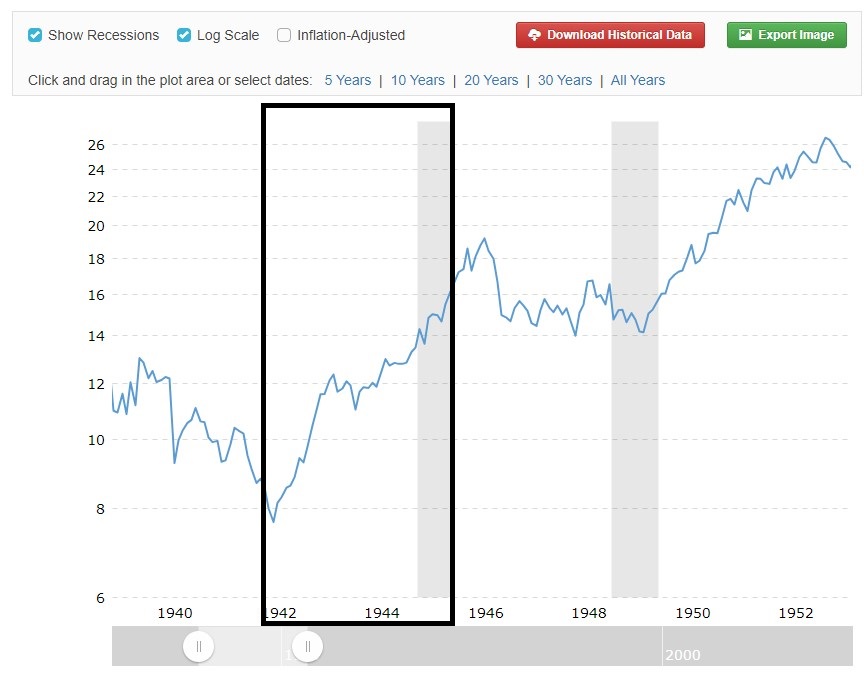
Take for instance War World 2. The USA officially entered the war in December 1941, and the war ended officially in September 1945. These are the graphs of the S&P500 and DJIA, with that time period highlighted (not exact, eyeball estimate), courtesy of Macrotrends:

S&P500 performance around the period of World War 2, source: https://www.macrotrends.net/2324/sp-500-historical-chart-data
DJIA performance around the period of World War 2, source: https://www.macrotrends.net/1319/dow-jones-100-year-historical-chart

As you can see, despite the rhetoric, the stock markets actually went up, and significantly during the period of time.

What gives?

As we’ve discussed early, war is terrible. It leads to the wasteful and mindless destruction of properties and lives. However, things need to be put in perspective.

During World War 2, the battles were almost entirely fought outside of American soil. As a result, other than Pearl Harbor and various military installations/equipment around the world, the USA actually did not suffer much property losses. Those countries that did suffer such losses, such as much of continental Europe, many parts of Asia, and parts of Northern Africa, did indeed see dramatic economic and financial suffering — their means of productions (power plants, factories, industrial vehicles, offices, etc.) were damaged or destroyed, and that naturally has a huge and negative impact on productivity. But the USA mostly escaped that fate.

Separately, the war effort needs to be financed. Soldiers need to be trained, equipped and paid, military hardware needs to be procured. All of these result in a transfer of wealth from the government to the private sector, in the form of payments for services or products, salaries to the soldiers, etc.

The fact of the matter is, a recession is, first and foremost, an unwillingness of participants in the economy to spend, leading to a dramatic drop in the velocity of money (i.e. how fast money gets spent, earned and then re-spent). If there is a large entity with effectively unlimited wealth, such as the US government, willing to spend huge sums of money, then how can a recession happen?

Another important thing to note is that after the war, the USA was the largest unscathed country. It thus naturally enjoyed the benefits of, almost literally, being the only country still able to produce in bulk many of the products needed to rebuild the rest of the world. Many academics have argued that in addition to the new factories largely financed by the US government during the war, this resulted in the beginning of the USA’s global financial and economic dominance.

To put it crudely, World War 2, despite its many human tragedies, was an economic and financial boon to the USA, pretty much from 1941 till today.

National debt

To be clear, the US government took on a lot of debt to finance its war efforts, and after the war, there was a period of adjustment during the late 1940’s to pay down that debt. Eventually, pain needs to be suffered if one incurs debt — either the debt is paid down slowly via small deductions over time, or all at once via severe austerity, or via default (which wipes the debt, but imposes many other penalties). Though as we have seen in more recent times, “eventually” can be very, very far off in the future.

While much of that money is wasted on destructive efforts, a lot of it was also spent on productive efforts, like the aforementioned new factories subsidized by government spending.

Germany and Japan

There are some who claim that war is profitable for the winners, and detrimental for the losers. That is also not something I agree with.

Two of the largest losers of World War 2 were Germany and Japan — Both were part of the Axis powers which lost the war. However, Germany is, and has been, the strongest economy in the European Union for many years now, and Japan was, briefly, a contender for the largest and strongest economy in the world in the late 80s, a mere 40 odd years after the war.

The key, I think, is again due to the destruction, or lack thereof — while the Axis powers inflicted much damage to the countries they invaded, they themselves suffered relatively mild property (and more importantly, productive assets) damages, as the end of the war was relatively swift compared to the length of it.

Not all fun and games

To be clear — I am definitely NOT advocating for war. It is, again, a senseless and horrific waste of resources, lives and treasures. However, I do not agree with many of the sentiments flying around that war is strictly bad economically or financially for the USA. As we can see from the largest war mankind has known to date, whether war is good or bad financially and economically, depends a lot on the circumstances.

Inflations

Foreword

For as long as I can remember, inflation measures have been criticized as being inaccurate, biased towards the current political ruling elite. The complaints generally assert that inflation was under reported to serve some nefarious political means, usually related to re-elections or other political goals. At the same time, numerous alternative inflation measures were introduced, almost all with much higher numbers than the official inflation figure, some even consistently in the double digits.

What gives?

As usual, a reminder that I am not a financial professional by training — I am a software engineer by training, and by trade. The following is based on my personal understanding, which is gained through self-study and working in finance for a few years.

If you find anything that you feel is incorrect, please feel free to leave a comment, and discuss your thoughts.

Looking outside the window

As I type this, I look outside the window at what looks to be a dreary day — overcast skies and just generally gloomy. At the same time, Google is reporting that the temperature is 82 degrees Fahrenheit (28 degrees Celsius), a warm, bright sunny day.

As I shake my head at the obvious lies the government is feeding us, trying to convince us of global warming to justify the nonsense Green Transition, I changed the Google query from “weather tokyo” to “weather toronto”. Now it says 58 degrees Fahrenheit (14 degrees Celsius), with a heavy downpour. Well, which is it?! Is it hot and sunny or chilly and raining?!

Looking outside the window that is cloudy but clearly not raining, much less a downpour, I can only sigh. What is the world coming to, when even Google’s weather reports are so influenced by the government that you cannot trust it to tell you the weather, here, in New Jersey?

Headline inflation

As we all know, the preferred inflation measure of the US government is CPI inflation, sometimes called headline inflation. More accurately, this is the Consumer Price Index for All Urban Consumers (CPI-U) inflation. This inflation measure is the rate of change of the CPI-U index, itself a composite measure of what the average urban consumer pays for their goods and services in the measurement period.

To simplify it a lot, the CPI-U index is the “composite price” of a basket of goods over time, and CPI inflation is just the rate of change of that composite price. You can find the basket of goods, their relative weights, and the prices of those goods in data from the Bureau of Labor Statistics (BLS), for example, here.

To recap – CPI inflation is based on a known methodology (rate of change) of the CPI-U index. The CPI-U index is a composite index with publicly released methodology on how it decides what is or is not included, with details on the underlying components, their weights and prices, all freely available.

Conspiracy 1

One of the most common conspiracies about the inflation measure is that it is opaque, and legislators/regulators change it at a whim to sugar coat bad economic numbers or to somehow achieve some political gains.

As we can see from above, that is.. quite a far from the truth. The methodologies and details are all public information, and freely available. Yes, they are provided more than a month after the fact, and the data is often revised. But if you think about the scope of the project, the amount of data that needs to be collected, the number of people that need to be sampled and interviewed to determine the basket, it should be obvious that it’s hard to get everything in place in real time, and often initial estimates will be slightly wrong as more data comes in.

Conspiracy 2

The CPI-U methodology (not the data) is changed intentionally over time to make things look better.

Yes, the CPI-U methodology has changed over time. As research into consumer behaviors increase, and as we understand more about economics and finance, it often becomes clear that previous models are less accurate, and new models are made.

This is a common practice in the hard sciences, for example, we used to believe in Newtonian physics, but Einstein introduced Relativity and Einsteinian physics which are believed to be more accurate on a galactic scale. Despite this, Newtonian physics is still taught in schools, because it is pretty accurate when dealing with terrestrial matters and it is much easier to grasp. I don’t hear anyone screaming that the government is up to some nefarious purpose with regards to these 2 physics, do you?

The fact is that economics is not a hard science — there is generally no real way to conduct experiments to verify hypotheses. As a result, there are a lot of assumptions and unknowns in economics which, over time, get refined. Inflation is an area of economics that is most in debate, because of its significance and because so little is understood about it.

And to make it clear that there doesn’t seem to be some higher conspiracy at work, the BLS typically publish the CPI-U for historical dates using the new methodology when it does change, for example here.

So yes, maybe inflation is slightly better now with the new methodology, but it is also probably better for previous periods, which gives us a frame of reference.

Conspiracy 3

My favorite (not) conspiracy is that the government is intentionally lying to us by publishing only one inflation measure and claiming it is the unblemished truth.

If you pay attention to the news, you’ll see that the news outlets typically equivocate “inflation” to “CPI inflation” as we’ve discussed above. The claim by the conspiracy theorists is that this is intentional! That this one number, that clearly does not reflect anybody’s, certainly not their own, experiences is forced upon us for some ulterior motive.

First of all, this is utter bovine feces. There are many measures of inflation, and anybody bothering to spend 5s on Google can find that the government even explains why there are so many, why it’s so hard, and why certain measures are used, for example, here.

For government purposes, there are 2 main variants of inflation measures — the CPI series and the PCE series. There are various differences between how CPI and PCE collects data which I will not go into, and more importantly, each of these 2 series also have different methodologies applied to them to arrive at different inflation numbers.

For example, if you have paid attention in the past ~4 years, you’ll probably have heard of “trimmed mean” inflation, “sticky” inflation, “median” inflation, etc. These are different methodologies applied on the same underlying data (either CPI or PCE) to arrive at different numbers.

Of these, the trimmed mean inflation has a bad rep because it was accused of being conjured out of thin air to present a better picture during the Covid inflation scare of 2021/2022. The truth is that this measure was first proposed in the early 90’s, and has been published for a long time, with historical data points backfilled using the same methodology.

Trimmed mean inflation is just inflation calculated excluding the outliers. There are various ways to determine which outliers are, and different measures may use slightly different methodologies here, but the basic idea is one rooted in statistics. In statistics, an outlier is a data point more than 2 standard deviation away from the mean. The idea is that by removing these outliers, which are likely due to measurement errors or noise, we can arrive at a cleaner signal. Similarly, the trimmed mean inflation measure is intended to provide a cleaner read of inflation trends, by removing what may be erroneous data points.

So, to recap, there are many, many inflation numbers, for example, the regular CPI inflation, PCE inflation, trimmed mean CPI inflation, trimmed mean PCE inflation, median CPI inflation, median PCE inflation, etc., etc. And the government also publishes other measures of inflation outside of the CPI/PCE series.

And if you don’t like any of these, the good news is that the underlying data is all freely available, so you are free to pick your own basket of goods, their weights, and the methodology to determine your own inflation rate.

Conspiracy 4

There are many inflation measures and the government chooses the one that it likes the most for propaganda purposes!

Believe it or not, this argument was made to me by the same person who made conspiracy theory 3. Yes, go figure.

As mentioned above, to make policy decisions, the government (or its various agencies) needs to pick one inflation measure to use. They may look at all of the inflation measures, but there will always be one that is preferred, due to their particular purposes.

For example, for cost of living adjustments to social security payouts, it makes sense to look at the CPI series of data, because that series reflects prices that consumers pay. Of the CPI series of data, CPI-W (Consumer Price Index for Urban Wage Earners and Clerical Workers) was determined to be most representative of Americans on average, so that’s the one used.

Notice the bolded terms, on average. A single number must be used to adjust for whatever policy is at hand, and clearly the one representing the average American is the one most representatives of all Americans in this case. That doesn’t mean that all Americans will see the same inflation! For obvious reasons, everyone spends their money differently, and so will experience different levels of inflation. But for policy purposes, across all Americans, we can’t just pick the inflation that ConspiracyTheoristA faces and apply that to everyone else, can we?

So yes, the inflation measures that each government agency chooses may not represent you, but that’s more of a feasibility limitation than a conspiratorial one.

Other government agencies prefer other inflation measures because it makes more sense for them. For example, the Federal Reserve prefers “core” inflation measures using the PCE series for policy decisions. Core inflation measures strip out items that are generally not affected by interest rates, which generally means core inflation measures do not include food and energy items.

Yes, it is ironic that the Federal Reserve ignores food and energy, 2 of the largest components of inflation experienced by most everyday Americans, but there is a good reason. The Federal Reserve mainly has control over short term interest rates. However, food prices are mainly tied to weather (and thus how crops perform) and energy prices are heavily tied to geopolitical developments (e.g. instability in the Middle East). As such, it doesn’t make sense for the Federal Reserve to make short term interest rates policies based on food/energy prices, because those things are not very affected by short term interest rates in the first place!

Imperfect

The above argues that inflation measures are probably not nefarious in design, but that doesn’t mean they are perfect. And if your argument is that inflation measures are generally flawed, then I will agree completely with you!

Inflation is a subject that is emotional and very poorly understood. So any model of inflation, and any measure of it, is almost by definition wrong. That said, it should be noted that, all models are wrong, but some models are selectively useful.

The topic of what’s wrong with inflation measures is long, and best left for another day. The point I want to make in this post is that in most cases, it seems like the government is making the best of a bad situation, and adjusting their methods as more is learned through research. Maybe on the margins there are some shenanigans going on, but it doesn’t appear, to me, that there is institutional bad faith in policy decisions.

Average, imperfect world

You probably think I’m an idiot, complaining that the weather report for Tokyo and Toronto does not reflect what I’m personally experiencing here in New Jersey. And you’d be right.

Similarly, it doesn’t make sense to complain that any particular inflation measure doesn’t reflect your personal experience — they aren’t meant to. There are many different measures of inflation, for different purposes. Some are tailored to particular segments of the economy, or to particular regions of the country. Depending on how you spend your money, one or more, or none, of these inflation measures may apply to you.

It is, ultimately, up to you to figure out which inflation measure best reflects your personal situation, just like it is up to me, to figure out which weather measure best reflects my experiences.

Just understand that for policy purposes, one single measure needs to be chosen as representative for inflation. It doesn’t mean that some shady government officials shrouded in shadows are decreeing that measure is what everyone must be experiencing! It’s just that for whatever reasons, that measure is deemed to be most appropriate for the situation.

Personal finance

Quick note: It should be obvious from the above, that using CPI inflation for your personal financial planning is probably not the best idea.

Yes, it may represent the average American pretty well for certain purposes, but it probably doesn’t reflect you.

If you are so inclined, you can use the raw data published by the BLS, and your actual spending, to determine a better inflation measure for yourself.

But this is tedious and hard and easy to get wrong — there are legitimate one time expenses (e.g. roof repairs) that will skew the numbers and make things seem better or worse than they really are. Trying to properly adjust/account for these is a science unto itself, which I will not go into.

Personally, being the lazy slob that I am, I typically just take CPI inflation and add 1% to it. Which is to say, for most intents and purposes, for long term planning, I assume a personal inflation rate of 3% (2% Federal Reserve target +1% headroom).

Green Transition

Foreword

The Green Transition is the new name given to the idea that human activities are affecting the natural environment negatively, and that effort should be made to transition the economy to a more sustainable and Earth-friendly path.

Over time, it has garnered much discussion both for and against the idea, and right now, is a politically charged topic, when it really shouldn’t be.

As usual, a reminder that I am not a financial professional by training — I am a software engineer by training, and by trade. The following is based on my personal understanding, which is gained through self-study and working in finance for a few years.

If you find anything that you feel is incorrect, please feel free to leave a comment, and discuss your thoughts.

Background

It is hard to deny that global temperatures have been rising steadily, on the average, across time. Most of the debate in recent times have centered around whether this is a temporary cyclic phenomenon which will revert by itself, and whether this phenomenon is due to human activities, and thus whether human efforts can pause, halt or even reverse the change.

As with most charged debates where both sides are firmly entrenched, politics have gotten involved, and that has dragged in more polarization based upon one’s political affiliations.

Not helping is the apocalyptic language used by some proponents, especially earlier in the discussion (around the 80’s), in some cases suggesting the Earth may be inhabitable by around this time. Ooops. To make matters worse, it has come to light recently that some of the climate studies supporting the narrative have been doctored, fueling conspiracy theorists on the other side. Of course, that big moneyed interests are involved on both sides (building new green infrastructures vs existing fossil fuel based infrastructures) just makes this into an all out dog-fight.

My personal opinion

Before we go on, just as a disclaimer of sorts, here’s my personal take. I have not personally gone over the climate change data in detail — I am not a researcher in the area so the data will just go over my head anyway. I have, however, read quite a bit on the summaries of studies, as well as various layman oriented articles published by both news and scientific outlets.

While I am not 100% convinced, I lean heavily towards the belief that human activities are affecting global climate, and that the current means by which humans extract energy is unsustainable. I have no idea if changes in human behavior will pause/halt/reverse the effects, but I figure it can’t hurt, and more importantly, we need to find more sustainable sources of energy anyway — at some point we’ll run out of dead dinosaurs.

To the tree huggers

A message to the those who are for the climate change narrative — calm down. Yes, I think the scientific evidence leans heavily towards supporting your views, and some hypotheses floating around suggest that not doing anything, or even doing too little, could be disastrous. But crying your eyes out, screaming at the Earth murderers is not conducive to rational debate, and certainly does nothing more than alienate your audience.

Instead, think of it rationally — there is no point crying over spilled milk. The world and reality is what they are now, and we must make do with what is available to us, instead of crying over what it should have been.

First of all, it is impossible that all fossil fuel programs will stop right now, no matter how much you wish it. For all the advancement in sustainable energy sources, there are severe downsides:

  • Solar energy is terrible for base load power supply — there is too much of it during the summer, and way too little during the winter. While batteries can bridge the gap between day and night, even across multiple days to account for rain vs shine, there currently exists no battery technology that can store power across months at a large scale. Do not fret though, this is a well recognized problem, and there is a lot of scientific research into this area (more later!).
  • Wind energy works across the seasons and times of day, but is unpredictable because the wind itself is unpredictable. Also, during periods of strong gusts, wind turbines actually have to be shutdown to prevent damage to the turbines, an irony not lost to the other side. Wind turbines are also loud which means they need to be situated further from their use, and the nature of them requires much larger land acreage to deploy. Finally, like solar, wind energy isn’t very reliable in winter as extreme cold can sometimes require the turbines to be shutdown. So while less dependent on battery technology, wind energy still requires battery backup.
  • Tidal and hydropower sources tend to involve installing largish installations over rivers/beaches. Tidal energy is not deployed right now due to various issues, mostly to do with concerns about their effects on marine life, the sediment process (i.e. how beaches are formed), and that the turbines tend to need a lot more maintenance/replacement than other forms of green energy. Hydropower similarly affects the natural landscape and thus the wildlife and population centers that depend on it, and while much more durable, breaks in the dams built for hydropower can have devastating consequences for the people that live downstream.

At the same time, the transition is going to cost vast sums of capital, capital which the vast majority of the world simply does not have. Yes, over long periods of time, sustainable energy sources generally pencil out to be more cost effective, but that’s not the problem — the problem is the start up costs. Most countries simply do not have the resources to embark on such large scale transition, especially when there are attendant problems with the technologies (which, again, hopefully will be resolved with time). While it is easy for us in our air conditioned offices to type out articles about how the world should behave, it is important to understand that reality is very much different in other parts of the world. Current fossil fuel energy sources remain the most abundant and easily accessible energy sources for the less affluent countries. Yes, over time, investments in sustainable energy sources are very likely to pay off, but that does not address the very real need these countries need, to survive, now — it is hard to think of a better future when current reality simply demands all your focus.

Finally, and most importantly, it simply doesn’t work to shut off all fossil fuels immediately, not in a “we can’t afford it” way, but in a “it hurts the green transition” way. For the green transition to proceed, there things that we simply cannot do without — steel, fiber glass, copper wiring, etc.

As an extreme example, currently, steel cannot be made without coal — each ton of steel requires about 750kg of metallurgical coal, so if we shut down all coal mines, we’ll also be shutting down all steel production. No steel, no wind turbines, no solar panels (admittedly not a lot of steel is needed in solar panels), etc.

And more importantly, until the transition is over, we actually do need fossil energy to, well, power the transition! How else are we going to transport those gigantic wind turbines to remote parts of the country? How are we going to power the factories that manufacturer the solar panels?

A pet peeve of mine, and to illustrate the counter-productiveness of indiscriminate green protests, is the demand for shutting down of coal mines in some industrial countries. Shutting down a coal mine does not eliminate the fact that some industries (steelmaking!) and power plants need coal still to operate — they can’t simply shutdown overnight and leave entire towns without power. So what happens is that the same amount of coal is mined elsewhere, and then shipped to the original country. Think about it, instead of mining the coal nearby and then using it, we now:

  • Mine the coal elsewhere, often in a less regulated part of the world, thereby increasing the amount of environmental disruption (though admittedly out of sight),
  • Expend more energy, often in the form of burning fossil fuels, to ship the coal to where it is still needed.

How dumb is that?

To the climate deniers

Hey, I understand — those holier-than-thou, green woke hippies can be annoying. Like, really annoying. But let’s ignore their juvenile tactics for now and think rationally for a bit.

What if, just what if, they are right? Even if it’s a 1% of 1% chance, you have to admit, if they are right, the amount of gloating you’ll have to suffer through will be intolerable. But more than that, the Earth itself may be uninhabitable. Kinda makes the whole point of that Hummer pointless, no?

Now, I get it — you love your gas engines — they’re reliable, refuel in a minute and sound awesome. But the price of gas has been on a tear lately, and that is a bummer right? What if I told you, that there is a way for you to secure more gas for yourself, a way that’ll outright prevent some other folks from buying gas? Less demand, lower prices, I mean, you gotta love that right?

Which is why, I think you should support EVs. Yes, they are terrible — they take forever to charge, they don’t work right when it’s cold, and they simply have no soul. But you don’t have to drive one! Just encourage everyone else around you to buy one. Once they buy an EV, they will stop going to the gas station, and there’ll be less competition for gas, which should, all else equal, reduce the price of gas that you have to pay. Imagine paying for a tank of gas with a $50, and getting change!

Similarly for electricity. The more those climate idiots spend of their money developing new energy sources, the more supply of electricity there will be. And Economics 101 tells us that with increased supply, prices should go down. In parts of Europe, power generation during the daytime is so high due to solar power that energy prices went negative. Negative! Imagine being paid by the power company to blast the A/C at max?

So, don’t do it for them. They are wrong. But do it for your wallet. Smile politely and nod as they make their nonsensical case, and tell them to go about their plans, because it is good for you. It’ll lower the price of a tank of gas, it’ll reduce your monthly electricity bills, and more importantly, you get to gloat about how those idiots are paying you to live your life. What’s not to like?

Supporting the green transition

Now, whether you believe in climate change or not, I hope I have made the point that investment (by others, not necessarily you!) into new green technologies is beneficial.

And here comes the controversial part — buying the shares of “green” companies does almost nothing. Yes, maybe it makes you feel better to own shares of “Green Company XYZ”, but you have to understand that when you buy shares on the stock market, you are buying them off someone else, someone who is not “Green Company XYZ”. The company itself sees none of the money that transacted. While there is a case of be made that a higher stock price makes it easier to hold secondary funding rounds, the reality is that most public companies never, ever hold secondary funding rounds — it is generally seen as a sign of weakness, and the stock price tends to get demolished because of it. Also, a high share price does not make it easier for the company to hire better people. Stock/option grants are based on the current price of the share, so for those employees to benefit, the share price doesn’t have to be high, it has to be rising, and it is generally easier for shares with lower prices to rise than for shares with higher prices.

Instead, if you are willing and able to invest to support the green transition, I would recommend that you invest in the debt of green companies, or even better, to invest in green startups. Unlike stock, companies issue debt all the time, and tend to do so on a recurring basis. So the price of their debt is actually important to them, and affects their ability to continue operating. By buying their debt, you are providing another source of demand for that debt, and with higher demand comes higher prices, which directly helps the company during their next debt funding round.

Finally, startups are almost always in need of equity funding. Unlike buying shares from the stock market, investing directly in a startup means the money goes directly into that startup’s treasury, meaning the money is directly available to them to pursue their business needs.

Right now, the areas which I believe are most in need of research are:

  • Battery technologies, specifically long term energy storage with minimal leakage. Battery energy density research are good too, as they can help make EVs more palatable by having longer ranges.
  • Solar energy efficiencies. Solar power panels typically have an efficiency of under 20%, which is pretty abysmal — 80% of the energy that falls on the solar panel are simply not captured. Increasing that to just a barely passing 60% will decrease the surface area of panels needed to supply the same amount of energy by 67%! Imagine if a solar panels of roughly the size of a dinner table being able to supply all the power needs of a home!
  • More efficient/synergistic technologies. Right now, a lot of electricity is wasted simply because existing technologies are terrible at reusing heat. Think about it — we use electricity to remove heat from our fridges, which then dumps that heat in our homes. We then use electricity to turn on the A/C to move that heat outdoors, while at the same time using more electricity to heat up the pool/hot tub (for those who are lucky enough to have one). What if we could just remove the heat from inside the fridge, bypass the rest of the house and dump that heat directly into the pool/hot tub? While we’ll still need A/C to cool down the house during a hot day, the need will be reduced, and even better, that heat can also be pumped into the pool/hot tub! This basic idea of reusing heat can be applied to other areas too — heat generated from cooling of EV batteries can be used to warm up the interior of the car during winter, heat removed from giant datacenters can be used to heat homes, etc.
  • Cleaner fossil fuels. Refinement techniques to reduce emissions when burning fuels, while not a long term solution, can buy humanity more time for the green transition. At source carbon capture and sequestration techniques can be developed to reduce and safely store emissions from polluting industries, etc.

Closing

Whether you believe in climate change or not, the fact remains that all of us are stuck on this little rock floating around in space. So maybe let’s stop arguing and let’s start finding commonalities, and where particular efforts can be win-win.

June 15th, 2024: Weekend Video Binge

Foreword

This is a quick note, which tends to be just off the cuff thoughts/ideas that look at current market situations, and to try to encourage some discussions.

Patrick Boyle is out with another great video looking at what the modern financial system has become.

As usual, a reminder that I am not a financial professional by training — I am a software engineer by training, and by trade. The following is based on my personal understanding, which is gained through self-study and working in finance for a few years.

If you find anything that you feel is incorrect, please feel free to leave a comment, and discuss your thoughts.

Financial Nihilism

December 13th, 2023: Dove

Foreword

This is a quick note, which tends to be just off the cuff thoughts/ideas that look at current market situations, and to try to encourage some discussions.

PPI came in slightly below expectations, and the Fed goes full dove.

As usual, a reminder that I am not a financial professional by training — I am a software engineer by training, and by trade. The following is based on my personal understanding, which is gained through self-study and working in finance for a few years.

If you find anything that you feel is incorrect, please feel free to leave a comment, and discuss your thoughts.

Coo.. cooo..

PPI came in cooler than expected by a smidge, and while stocks went up early in the day, they quickly reversed and was almost flat at around 1pm.

For someone with QQQ calls expiring today, that was painful to watch. Good thing I was busy at work and wasn’t really watching.

By the time I could spare a moment, the FOMC announcement was out (at 2pm) and stocks went up in a straight line — instead of the 2 expected cuts, the Fed’s dot plots shows 3 cuts in 2024, and to top off the dove parade, Chairman Powell was (in my opinion) extremely dovish in his press conference at 2.30pm. See for yourself:

Long and longer

Which is why, if you follow me on StockClubs (1), you’ll notice that I took profits on the QQQ calls spread opened yesterday with a healthy profit, and almost immediately put most of that money into another call spread expiring today at a higher strike (i.e. more leverage).

It was a good trade, and I guess my kids get to eat dinner tonight.

Santa v2?

As of now (after the close) the only short term bet I have left is the CAVA short (via bearish put spread), which isn’t doing too hot.

But given how the market has reacted to events the past few days, and how dovish the Fed suddenly turned, I’m inclined to think that the Santa rally is back on, at least until the end of the year.

This Friday (12/15) is opex, which tends to be volatile and tricky to trade, so I’ll probably sit pat until Monday — if nothing changes my mind by then, I’ll probably play for a Santa rally into year end.

Footnotes

  1. Disclaimer: I am an investor in StockClubs and I’m only showing 1 (out of 10+) of my brokerage accounts in the app.