July 9, 2022: Weekend video binge – Wealthion & Lance Roberts

Foreword

This is a quick note, which tends to be just off the cuff thoughts/ideas that look at current market situations, and to try to encourage some discussions.

Wealthion just released a great interview this weekend, that I feel is well worth watching.

As usual, a reminder that I am not a financial professional by training — I am a software engineer by training, and by trade. The following is based on my personal understanding, which is gained through self-study and working in finance for a few years.

If you find anything that you feel is incorrect, please feel free to leave a comment, and discuss your thoughts.

Lance Roberts

Wealthion interviewed Lance Roberts this weekend (this is a weekly thing — Lance and Adam are friends), which I feel should be mandatory watching for anyone managing their own money.

In this, Adam and Lance talk about recent macro economic issues, possible resolutions, and general positioning strategies with such high uncertainty in the markets. For those who haven’t read it before, I wrote on something similar to one of the topics discussed a long time ago — Death of price discovery?

Even if you don’t have the time to sit through the whole 1hour+ (protip: Watch at 1.5x speed), you should at least listen to the ~10minutes from the 56m to around the 1h 5m mark, where Adam and Lance talk about the idea of permabears. This is something particularly close to my heart, because that’s a label some people who don’t seem to be very in tuned with macro economics like to hurl around.

July 6, 2022: Voyage to bankruptcy

Foreword

This is a quick note, which tends to be just off the cuff thoughts/ideas that look at current market situations, and to try to encourage some discussions.

Voyager Digital just filed for bankruptcy. What happens next is going to be interesting.

As usual, a reminder that I am not a financial professional by training — I am a software engineer by training, and by trade. The following is based on my personal understanding, which is gained through self-study and working in finance for a few years.

If you find anything that you feel is incorrect, please feel free to leave a comment, and discuss your thoughts.

Sailing to bankruptcy

According to Bloomberg, Voyager Digital, the crypto broker, just filed for chapter 11 bankruptcy.

In the regular world …

Now, if this was a regular broker, the process is fairly well established and straightforward. Generally speaking:

  1. The regulators and SIPC will try and find a buyer for the assets of the broker.
  2. If a buyer is found, that buyer will provide customers with new login details (or in some cases, use the bankrupt broker’s existing website/apps).
    1. Most customers will basically see no real down time, except for maybe creating a new account on the new broker’s website.
    2. SIPC will work in the background with the new broker to recover assets.
  3. If a buyer is not found, then a trustee of some form is created to find assets and distribute them.
    1. Customers with accounts below the SIPC insurance limits (currently $500k, at most $250k of which can be cash) will get instructions on how to move their assets to a broker of their choice. This probably takes a few days to a few weeks.
    2. Customers with accounts above SIPC insurance limits will get assets up to the insurance limit, and anything else will be considered unsecured debt against the trust.

For the majority of customers, it should mostly just be an inconvenience.

… and then there’s crypto

Since there are no regulators in crypto, and no insurance scheme, points 1, 2.2 and 3.1 don’t apply. Basically, if a buyer is found, the buyer assumes all liabilities (i.e. customer assets), and if a buyer is not found, then all customers become unsecured creditors to the trust.

But how would it actually work?

In regular finance, the assets are typically kept at third party custodians, so the process is relatively easy — the custodian freezes the account until SIPC/regulator/trustee signs off on release of assets. But in crypto, there are rarely third party custodians — Voyager itself likely holds the keys to its crypto assets, and in many cases, the assets are backed by the broker itself, such as Voyager Tokens.

If the accounts are at a third party, a court order will force the custodian to freeze the accounts, and any missing assets from that point on must be repaid by the custodian. But if Voyager (and presumably its executives) holds the keys to the assets, how do you freeze the assets?

What’s preventing some Voyager executive from mysteriously dying after all the assets disappear?

What would Voyager Tokens be worth after chapter 11?

Are the courts able to even wrap their heads around all of these to make a reasonable ruling?

Will the entire process take so long that the price of the assets shift dramatically? And if so, are customers owed the assets, or the value at time of bankruptcy, or the value at time of distribution? This is particularly interesting because Voyager loaned out much of the assets, and with the broker now defunct, how is it going to continue servicing the loans (issuing margin calls, collecting collaterals, etc.)?

So many questions! This event has the possibility of bringing a lot of clarity to the murky world of crypto. Stay tuned!

The Great Resignation

Foreword

Beginning as early as Q1 2021, there was a lot of consternation from employers about an unusually large number of employees resigning. Coupled with a seemingly general lack of available candidates to fill in those empty roles, it seemed for the past year or so that a large number of workers just simply decided to stop working altogether.

As usual, a reminder that I am not a financial professional by training — I am a software engineer by training, and by trade. The following is based on my personal understanding, which is gained through self-study and working in finance for a few years.

If you find anything that you feel is incorrect, please feel free to leave a comment, and discuss your thoughts.

I quit!

The Great Resignation seems to have started around Q1 2021, though it really picked up steam around mid 2021 through the end of 2021 and into early 2022. A lot of ink has been spilled about potential causes, amongst which include job dissatisfaction, fear of Covid, as well as being unable to work due to Covid.

Left unsaid was how those folks were going to support themselves, especially since a large number of those who quit were relatively young, and thus not eligible for various retirement/social security schemes.

Anecdotally speaking…

From my personal experience, it seems like the enabling factor for many of these folks to essentially retire early, was a booming, speculative market, especially in crypto. Talking to various people in different forums, the common theme I’ve found, was that those who have decided to retire early all fell into one (or more) of the following categories:

  • Got into crypto early, and at least at the end of 2021, had a large crypto portfolio.
  • Began day trading stocks and/or crypto, especially since early 2021, and made semi-stable income from the trading.
  • Made a lot of money speculating on options, especially during the Gamestop craze of Q1 2021.

Employment effects

The effects of the Great Resignation was easily predictable — as most of these folks seem to skew towards people in tech related companies, there was an acute shortage of tech employees, especially around Q3/Q4 2021. Many tech companies were offering double digit percentage increases in sign on bonuses as well as annual compensation — I’ve personally had multiple recruiters approach me with 7-figures annual compensation packages.

… and it’s gone

However, something broke in late 2021. When the Fed started talking about raising interest rates in Q4 2021, stocks and crypto started stalling. It was no longer possible to make ridiculous daily returns just by buying random short term calls.

At the start of 2022, this accelerated with dramatic (for that time) drawdowns in all 3 major US indices, cumulating today, with the NASDAQ composite down about 30%, and S&P 500 down about 20% year to date. Crypto fell anywhere between 70% to 100%.

And suddenly, instead of hearing friends and colleagues talking about early retirement, I start hearing about folks who had retired earlier starting to look for jobs.

Triple whammy

While some folks are starting to look for jobs again, the crypto market devastation resulted in multiple brokerages, funds and “banks” running into serious financial trouble. Three Arrow Capital was forced to liquidate, and rumor was it that their inability to settle their margin debts resulted in the insolvency of Celsius, BlockFi, Voyager, amongst others. Even Coinbase, previously seen as a bastion of stability in the US crypto market was not spared.

The stocks market drawdown(1) also has the market spooked, with many openly talking about impending recession, resulting in many companies, even large blue chip stocks, freezing hiring or even laying off employees.

These actions seem to be resulting in a surplus, at least temporarily, of tech workers, resulting in a triple whammy for those looking for jobs:

  • Portfolio losses
  • Increased competition from retrenched workers
  • Reduced job openings due to companies tightening

Short term

In the short term, it seems like there’s going to be pain all around in the form of higher prices, higher unemployment, lower wages(2), lower consumer demand, lousier economy.

On a lark, I’ve initiated some small sized, short term, short positions(3) — you can follow the trades (made on 6/29) by following me on StockClubs(4). Let’s see how that goes!

Footnotes

  1. Note that I’m only calling it a “drawdown”, as opposed to “meltdown” or other more bombastic terms as others have used. Because, honestly, 20-30% isn’t that big a deal. If this gets really bad, then we ain’t seen nothing yet.
  2. To be clear, it seems like wages are still going up, though slower than inflation. Also, I was referring specifically to tech workers.
  3. As always, this is not financial advice. I’m playing with a very, very small portion of my portfolio here, and it’s more gambling than anything else.
  4. Full disclosure — StockClubs is an app founded by a friend, and I have made a small investment in that company. I am definitely conflicted with regards to the success of the app.

4D chess

Foreword

Sometimes, someone makes an argument so profound, so beyond my understanding, I just have to concede that they are playing 4D chess.

As usual, a reminder that I am not a financial professional by training — I am a software engineer by training, and by trade. The following is based on my personal understanding, which is gained through self-study and working in finance for a few years.

If you find anything that you feel is incorrect, please feel free to leave a comment, and discuss your thoughts.

Matt Levine

Matt Levine wrote an interesting paragraph in his regular column “Money Stuff” on Bloomberg on Monday, June 13th, 2022:

See, I genuinely think that there are some people who would sneer at a bank saying “we have a fortress balance sheet and exceed out regulatory requirements for capital and liquidity, as you can tell from our quarterly financial statements”: “Sure,” these people would scoff, “we’ve heard that before.” And then they’ll read a Medium post from a crypto project that claims to have, but does not describe, a “comprehensive liquidity risk management framework” and put all their money in it.

Matt Levine, Bloomberg, https://www.bloomberg.com/opinion/articles/2022-06-13/merger-buyer-s-remorse-sometimes-works

It’s interesting, because I seem to be getting a lot of arguments in a similar vein, especially in the past few weeks.

Crypto

One of the arguments for crypto is that they are “not controlled by any central government”, and thus cannot be “printed”. This is weird of course — most major central banks understand very well the lessons learned over the course of millenniums, and so don’t actually print money, at least not in the way envisioned. But if you consider crypto, and how staking or mining works, you’ll be hard pressed to call it anything but “printing”.

More to the point, “printing” is apparently bad, because it causes inflation, which leads to the second argument — that crypto is an inflation hedge. Which was a great argument to make… all the way up to November 2021. When inflation actually started really going wild. Yes, our inflation hedge went down in value, as inflation went up.

To correct my clearly flawed understanding, someone recently noted that I misunderstood. It’s not that crypto is an inflation hedge, but it is a hedge against fiat debasement. Which, to me, is weird. Because that’s the same argument as before, just with different words — “printing” is “fiat debasement”, which leads to “inflation”, and as described before, things like QE isn’t really fiat debasement, and well, until 2021, there was no real inflation since crypto’s invention, and of course when inflation hit its stride in November 2021, crypto went down.

All very profound arguments that I’m still trying to understand.

Crème de la Crème

But the pièce de résistance, the crème de la crème of arguments, is this gem:

Crypto is a long term hedge for fiat debasement / inflation (1). Daily, weekly, monthly, quarterly, even yearly fluctuations are just noise.

Various

So let me get this straight:

Fed swapped Treasuries for Federal Reserve Notes with muted inflation consequences for a decade and a half.”

Response: “OMG! Fiat debasement!”

“Government issues massive fiscal stimulus to help those in need during a once in a century pandemic, resulting in US dollars losing 8.6% value in a year due to inflation.”

Response: “OMG! Hyperinflation!”

“Crypto drops around 70%, on top of the same 8.6% due to inflation, with some coins essentially becoming worthless in 7 months.”

Response: “Meh, just noise.”

Yeah, that’s some real 4D chess argument right there.

Be consistent

All jokes aside, it is important to recognize that a lot of the financial-sounding arguments put forth by many crypto advocates simply do not make sense.

There are reasonable, interesting properties of crypto that we may want to explore. But attributing mythical, but contradictory and illogical prowess is basically turning crypto into a cult.

Cults are (debatably) a “solution” if you are feeling spiritually lost. Not so great when you are financially lost.

Footnotes

  1. I’m still not sure which one they’ve settled on.

Something for nothing

Foreword

It seems nowadays, just about everybody is complaining about the Federal Reserve’s “money printing” via Quantitative Easing (QE).

As usual, a reminder that I am not a financial professional by training — I am a software engineer by training, and by trade. The following is based on my personal understanding, which is gained through self-study and working in finance for a few years.

If you find anything that you feel is incorrect, please feel free to leave a comment, and discuss your thoughts.

Thought experiment 1

Let’s say you give me a $1 note. In return, I give you another $1 note.

Thought experiment 2

Let’s say you give me a $1 note. In return, I give you 4 quarters.

Thought experiment 3

Let’s say you give me a $1 note. In return, I write you an IOU saying that I owe you $1.

Additionally, I create a reasonably widely used infrastructure that accepts that IOU as payment for services and goods.

Finally, I subject myself to annual third party audits, which verify that as long as that IOU is outstanding, I indeed hold that $1, at all times.

Consider

I think in the first 2 cases, everyone would agree that whatever I gave you, is worth exactly $1, which is also exactly what you gave me.

In the 3rd case, it becomes a bit more iffy. Some people would say that the IOU I handed you is fiat, and in a sense they’d be correct.

But assuming that everybody is acting in good faith, i.e. the $1 backing that IOU exists, I think it’s fair to say that the IOU is indeed worth $1.

Banks

Banks generally work on the basis of Thought experiment 3 — a depositor gives the bank cash, which the bank keeps on its balance sheet. In exchange, the bank creates an account for the depositor indicating the bank owes the depositor $1, the IOU in question.

There are multiple money transfer networks (ACH, debit cards, FedWire, etc.) which allow the depositor to spend that $1 the bank owes them, and at least within the USA, these networks are widely accepted.

At the same time, the bank is subject to frequent third party audits, as well as various strict regulations to ensure that the $1 it claims it holds on its balance sheet actually exists in some form (1).

In short, most people would probably treat bank account balances as “money good” — as long as the bank remains solvent.

Money market funds

Money market funds generally work by taking money (cash) from investors, and then investing that cash in short term bonds, either corporate or government. In exchange for the cash, money market funds similarly create accounts for the investors, indicating that the funds owe the investors the amount invested.

Because bonds are fixed income assets with a predetermined maturity date and fixed coupon payments, the present value of the bond fluctuates over time — if interest rates go up, the current value of a bond will drop.

This presents a problem for money market funds — they are supposed to have $1 on their balance sheet for each $1 invested, so if the value of their holdings can fall arbitrarily, it seems like they are breaking the rules?

In general, this works out via 2 means:

  1. Not every investor will want their money back at the same time. So the fund generally only needs a relatively small portion of its assets in actual cash to meet redemptions.
  2. Since the bonds are short term, they’ll generally expire in the near future. While the present value of a bond can fluctuate based on interest rate, the terminal value of a bond (i.e. par payment + all coupons) is nominally fixed in value. That is, if the fund simply waits until all its bonds matures, it’ll have more than enough cash to meet the redemption of every investor (2).

Together, these allow for money market funds to be extremely stable in value, despite their underlying being subject to market pricing forces.

Like banks, money market funds are subject to frequent third party audits. Many brokerages and banks allow the use of money market funds in lieu of the customer keeping a cash balance to pay for their purchases, which effectively means that these money market funds are widely accepted for payments of goods and services.

In short, most people would probably treat money market fund balances as “money good”.

Stablecoins

There are 2 main types of stablecoins — algorithmic stablecoins which try to control the value of the coin via some sort of balancing algorithm and backed stablecoins, which keeps assets to offset the coins issued.

Algorithmic stablecoins have a terrible reputation, with multiple such coins “breaking the buck” and going to $0 (or close enough) within just the past few years. For our discussions, I am not talking about these.

Backed stablecoins, on the other hand, are supposed to hold assets that fully back their outstanding issued coins — for every $1 the stablecoin takes in, it issues $1 worth of stablecoin, while holding that original $1 taken in in some account.

Now, to be clear, there are a lot of problems with stablecoins:

  • As far as I know, none of them are audited by well regarded, third party, large auditing firms.
  • A lot of them are technically securities under the laws of the USA, which means that they either need to be registered with the SEC, or can only be sold to accredited investors. As far as I know, none of them are registered, yet all of them are sold to anyone who cares to buy them.
  • A lot of them run on relatively immature infrastructure, which can have unforeseen problems (such as temporarily breaking the buck) during periods of high volume or stress.

But at least at a high level, stablecoins basically look like money market funds.

Generalization

In all the above, the process is similar:

  • Entity takes Value from Customer.
  • Entity holds Value on its balance sheet.
  • Entity issues IOU to Customer.

Whether Entity is a bank, a money market fund or a stablecoin, whether Customer is a depositor, an investor or a speculator, whether Value is actual dollars or some other representation of value, and whether IOU is a bank statement, a money market fund statement or a stablecoin, the results are essentially the same — Value is transferred from Customer to Entity, and Entity issues an IOU, which Customer than can use to represent the Value given up.

Federal Reserve

And finally, we get to the big one. The one that everybody is arguing about.

Officially, the US dollar is a liability of the Federal Reserve, which is why the official name of the US dollar is “Federal Reserve Note” — “note” is a financial term meaning “short term debt”. Each US dollar is actually an IOU from the Fed, indicating it owes you $1 in value.

When the Fed conducts Quantitative Easing, what it is doing is buying Treasuries and other types of assets on the open market, in exchange for US dollars it essentially conjures up. The steps are:

  • Fed takes Value from bank (the Fed only trades against banks).
  • Fed holds Value on its balance sheet.
  • Fed issues US dollar to bank.

Again, “US dollar” is, literally, an IOU issued by the Fed. Does the above process sound familiar?

In this case, Value generally takes the form of US Treasuries (3). In more recent cases, the Fed bought mortgage backed securities (MBS) and corporate bonds.

Most people would probably be fine with US Treasuries — if the US Treasuries default, we’ll have bigger problems to worry about, so most people treat US Treasuries as essentially “money good” (4). But MBS and corporate bonds are another matter — these can default, and they default quite often. What then?

Well, the Fed doesn’t actually just buy MBS nor corporate bonds. Instead, the Fed is actually buying the MBS/corporate bonds, as well as a put, an insurance, from the US Treasury. Effectively, if the MBS/corporate bonds default, the US Treasury has to reimburse the Fed any losses.

Effectively, balance sheet of the Fed is entirely backed by the US Treasury.

Just to clarify

So, just to clarify:

  • In the case of banks, money market funds, stablecoins and the Fed’s QE, effectively some entity is taking value in exchange for an IOU indicating the same value.
  • In all cases, the value is kept on the entity’s balance sheet, via an asset ultimately backed by the US Treasury.
  • In all cases, the IOU issued is essentially conjured out of thin air.

As far as I can tell, very few people are really concerned about banks and money market funds. Some people are concerned about stablecoins, yet others are not. And funnily enough, the people not concerned about stablecoins, tend to be the ones most concerned about the Fed’s QE.

Huh.

Money printing

Many people call QE “money printing”. Technically, it is accurate — money, in the form of US dollars, is indeed conjured out of thin air.

But the term “money printing” hails from another time, when monetary and fiscal policies were both controlled by the same government entity, and the conjured up money was not used to buy up assets kept on balance sheets (effectively backing the conjured money), but instead spent.

Yes, in its original form, “money printing” is highly inflationary, but the modern day QE form of “money printing” isn’t quite the same, and as explained above, and in the prior “Inflation Model“, isn’t really inflationary, at least not without a fiscal component.

Fiat/currency debasement

Another common complaint is that QE is fiat/currency debasement. It is not.

Debasement is defined as the lowering of the value of the currency. Originally, this hails from government entities literally reducing the percentage of precious metals used in minting coins. In the modern day, it refers to the printing of money without a corresponding increase in output.

However, an exchange of value, as I’ve explained above, doesn’t really debase the currency. Just like nobody will say that Thought experiments 1 and 2 debases the $1 or 4 quarters I give you, most people should intuitively understand that the IOU given in Thought experiment 3 or the bank account statement or the money market fund statement, or the US dollar, isn’t really debased in the transactions noted above.

Liquidity

The problem, it seems to me, that most people have trouble wrapping their heads around, is the issue of “money supply”. They will point at M1/M2 during periods of QE, and correctly note that money supply goes up. But that’s mostly an illusion — as noted above, Value can take many forms. The main difference between a US dollar, and IOU issued by a bank backed by a US dollar, is that the US dollar is more widely accepted and thus counted as part of M1/M2, while the IOU is not (it is part of M3).

The issue isn’t that “value is created out of thin air”, it’s just that value has shifted in liquidity — QE shifts assets, such as Treasuries, MBS, corporate bonds from less liquid forms of money supply to more liquid forms of money supply.

In other words, QE shifts assets in M3 and above, to MB, which is part of M1 and M2 (see https://en.wikipedia.org/wiki/Money_supply for definitions). That’s why QE is said to be “providing liquidity” to the system — it is, literally, converting less liquid assets into more liquid ones via the Fed’s balance sheet.

This isn’t to say that QE is “good” or even “neutral”. There are issues with increasing (or decreasing) liquidity in the system via shifting the liquidity of assets. There are issues with an entity with essentially unlimited money putting out price insensitive bids on assets. But that’s not quite the same as “fiat/currency debasement” or “money printing” (the original, bad kind).

Footnotes

  1. Technically, banks don’t hold actual cash on their balance sheets against deposits. Instead, the money is invested, similar to money market funds. However, the regulations are different because banks can invest in more risky assets, which subject them to a lot more rules to prevent bank failures.
  2. I’m intentionally skipping the potential for bonds to default. In practice, market market funds buy very high quality bonds (government bonds, etc.) or buy insurance for any risky bonds for the bulk of their holdings. So while the possibility of a fund “breaking the buck” is not 0, it is extremely small. In reality, since such funds were introduced in the 70s, only 2 have ever “broken the buck” (fell below $1 per $1 invested). In both cases, the losses were relatively small (under 10%) and regulations were introduced to prevent similar issues from happening.
  3. The confusion many people have, is that Treasuries are issued by the Fed, which seems to make the whole thing circular. But that’s not true — Treasuries are issued by the US Treasury (hence the name “Treasuries”), which is part of the government. The Fed is technically a private bank owned by other private banks (US banks are its main shareholders). Also, even if Treasuries are issued by the Fed, we just go back to Thought experiment 1 and 2 — while silly, the argument still stands.
  4. Large institutions actually frequently conduct trades by paying with US Treasuries instead of actual cash.

June 11, 2022: Do you feel lucky, punk?

Foreword

This is a quick note, which tends to be just off the cuff thoughts/ideas that look at current market situations, and to try to encourage some discussions.

Yesterday, CPI reported consumer inflation at the highest level in about 40 years — since 1981. Instead of the expected flattish reading of 8.3%, inflation was reported at 8.6%, a level that must certainly be ringing some alarm bells at the Fed.

As usual, a reminder that I am not a financial professional by training — I am a software engineer by training, and by trade. The following is based on my personal understanding, which is gained through self-study and working in finance for a few years.

If you find anything that you feel is incorrect, please feel free to leave a comment, and discuss your thoughts.

Expectations

Prior to the release of CPI numbers, economists were predicting that inflation was turning, that May’s CPI print would confirm a slowdown, which could signal the start of disinflation.

Listening and reading to various financial analysts over the past month or so, almost everyone has been positioning for a gradual end to inflation. The thinking is that the Fed will eventually raise rates to around 2-2.5% (from 1% now) sometime near the end of the year or early 2023, realize that they’ve overdone it, and start the next round of QE + rate cuts.

To that end, a lot of fund managers initiated positions in TLT (long duration Treasuries ETF), thinking that with the Fed tapering the rate hikes, TLT will bottom out soon.

Instead, we had a scorcher of a print, at a level way higher than anything seen so far in this inflation cycle.

Fed

I had previously expected the Fed to start the rate hike cycle much earlier, obviously that was wrong. The thinking was that the Fed needed to shock the market into reducing liquidity conditions, so as to reduce the velocity of money and thus inflation. The sooner they did so, the less they’d need to do in actual hikes, as market expectations will do most of the work for them.

However, the Fed has, thus far, taken relatively mild steps with regards to hikes, often telegraphing their intentions well ahead of time, effectively losing the shock and awe factor which I feel is needed for the Fed to regain the narrative over inflation.

Prior to the CPI print, the Fed hinted strongly at another 50bps hike this coming FOMC meeting (next week, June 14th and 15th). With the print, the media is speculating that the Fed may have to do 75bps.

Which is to say, a hike of 50bps next week could potentially be seen as dovish, and a 75bps hike may be seen as “expected”.

If the Fed wants to shock the market, then the next alternative is a 1% hike.

For those speculating on the markets, what do you think the Fed will do? Do you feel lucky, punk?

Arbitrage

Foreword

Arbitrage is the bedrock of almost all modern financial transactions. Arbitrage is what keeps ETFs and their underlying trading somewhat in sync, it is what prevents futures from drifting from their underlying, and it is what options pricing (Black Scholes model and its modern derivatives) is ultimately based on.

As usual, a reminder that I am not a financial professional by training — I am a software engineer by training, and by trade. The following is based on my personal understanding, which is gained through self-study and working in finance for a few years.

If you find anything that you feel is incorrect, please feel free to leave a comment, and discuss your thoughts.

Volatile volatility

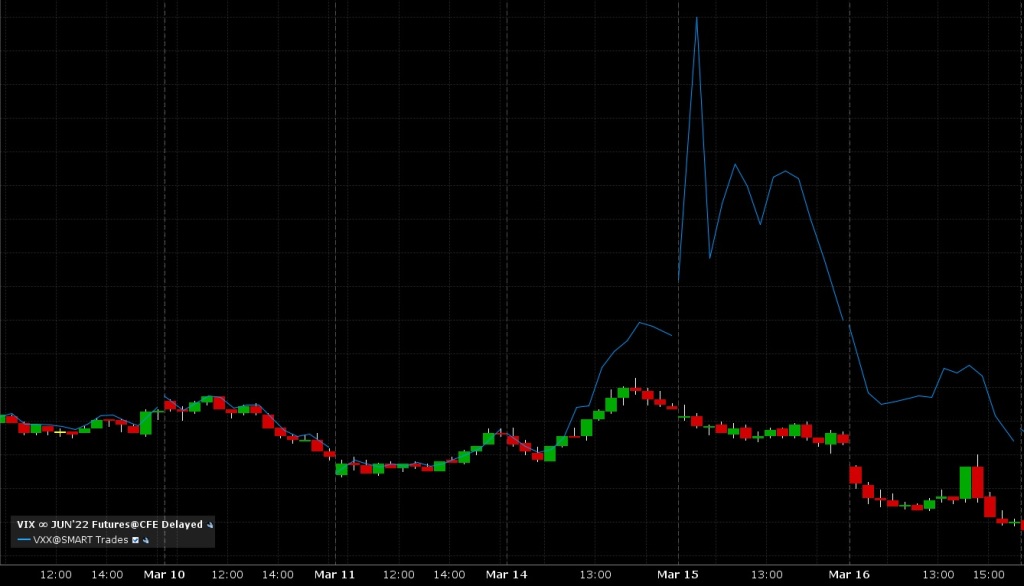
For those who are not aware, VXX is a ETN which is benchmarked against the VIX. There is a formula which ties the price of the VXX to the underlying VIX futures. The fund is backed by a well funded provider, so in theory, VXX should trade fairly closely to the VIX during regular trading hours.

If you look at the graph below, charting VIX (the candlesticks) vs VXX (the blue line), from March 9, 2022 to March 16, 2022, you’ll see that VXX and VIX move more or less in sync… until March 14. On March 15, VXX just went berserk.

VIX vs VXX, March 9, 2022 to March 16, 2022. Source: Trader WorkStation, Interactive Brokers.

What happened?!

ETNs, like ETFs, are kept in sync with their benchmarks mostly by market makers (more accurately, a subset of market makers called authorized participants). The details of how this works doesn’t matter, except that it relies on arbitrage:

If the ETN is trading higher than its benchmark, the authorized participants (APs) can short the ETN on the open market, and then buy newly created shares from the ETN provider at the price indicated by the benchmark to cover their short. Because the APs are selling (shorting) at a higher price than what they are paying the provider to create new shares to cover their short, the APs make an arbitrage profit — a “riskless” profit (1). Since it’s “riskless” profit and thus “free” (1) money, the APs will happily do this all day as long as the ETN is trading above the benchmark. The act of the APs constantly shorting the ETN will eventually cause the price of the ETNs to drop, so that it matches the benchmark.

If the ETN is trading below its benchmark, then the opposite happens. The APs will buy the ETN on the open market, and sell them to the provider at the higher price indicated by the benchmark. Again, the APs are making a “riskless” profit by buying low and selling high, so they’ll happily do this until their buying pressure forces the price of the ETN to match the benchmark.

So why didn’t the APs do anything on March 14 onwards?

On March 14, Barclays, the owner of the iPath funds (i.e. the provider) issued this press release: https://ipathetn.barclays/cms/static/files/ipath/press/Press%20Release_03_14.pdf

Essentially, Barclays is suspending the creation/redemption process mentioned above, where APs can buy/sell shares from it at the benchmark price. Effectively immediately, APs can still buy/sell on the open market, but they can no longer close their position via the 2nd leg of the trade, by selling/buying from the provider. This breaks the arbitrage chain, and there is no longer an arbitrage. No arbitrage, no “riskless” profit, and thus the APs stop their activities and the price of VXX goes haywire.

Arbitrage

The official definition of an arbitrage is a trade with 2 or more leg which:

  • Results in the final positions being exactly the same as before all the trades.
  • Results in a profit, despite the positions being exactly the same.

When all legs of the trade can be done simultaneously, then the arbitrage is said to be riskless. In the case of the VIX/VXX trade above, the legs cannot be done simultaneously since they are with different participants, so there is a small, but very real, time lag between each leg. Therefore, while it’s generally very safe, it’s not entirely riskless.

Notice the first crucial criteria — after all legs are completed, your positions must be exactly the same as before the first leg was made. This implies convertibility — at some stage, you must be able to convert whatever you have to something else to close a prior short or long. In the case of the VIX/VXX trade, the APs were able to convert cash from shorting VXX into new VXX shares by buying from the provider, or they could convert VXX shares into cash by selling to the provider.

But once convertibility is removed, there is no longer an arbitrage to be made.

As shown by the VIX/VXX trade, and GOOG/GOOGL in Q2 2021, whenever there is no arbitrage, there are zero guarantees that theoretical models of how things should trade would actually be realized.

There is no arbitrage without convertibility. (2)

Futures

Futures are essentially contracts signed between the buyer and seller (3) where they agree to trade some asset at some specified future time at some currently determined price. Details here.

Let’s say we enter into a futures contract, where I’ll sell you 1 barrel of crude oil 1 month from now. If the price of a barrel of crude oil on the spot market is currently $100, and the cost to store that barrel for 1 month is $2, then I’ll happily sell you that barrel in 1 month for any price $102 or more. I have an arbitrage — the futures contract provides the convertibility that closes the gap between “having a barrel of crude oil now” + “storing a barrel of crude oil for 1 month” and “selling a barrel of crude oil in 1 month”.

Similarly, for you, if you have a barrel of crude oil now, you can sell it for $100, and buy it back in 1 month for $102, while saving $2 of storage costs. Effectively, you have an arbitrage too, and so you’ll happily do this trade for anything $102 or less.

So the price to trade at is >= $102 (for me) and <= $102 (for you), and the intersection of those 2 inequalities is… $102. Because of the arbitrages on both sides, the futures contract will state that we will trade at $102 in 1 month.

In practice, of course, the math is a lot more complicated. The example above ignores the cost of money (i.e. interest rates), transport fees, etc. These fees (including storage costs) tend to be asymmetric so the trading price will be a range instead of a single point.

At the same time, if there is heavy speculation on one side or the other (maybe some really rich entity decides they really like a million barrels of oil in 1 month, regardless of the price), or other technical issues (all storage depots are completely full), then the futures price can temporarily be dislodged from the arbitraged range.

Very often (4), though, the futures markets are not predictive. In many cases (4), futures are arbitraged by producers and consumers of the underlying asset, so the stated trade price on the contract does not reflect any predictions on future spot prices.

Footnotes

  1. “Riskless” and “free” are in quotes because it’s technically not completely riskless — there are risks with regards to implementation (may be the authorized participant made a math mistake!), risks with regards to random events (maybe the market shuts down just after they short, but before they cover), etc. But with regards to the financial models of the assets, there are theoretically no risks.
  2. Implicit here, and shown by GOOG/GOOGL in Q2 2021, is that arbitrage is a critical component of the Efficient Market Hypothesis. Therefore, if there is no convertibility, EMH tends to break down too.
  3. Technically, for stability reasons, both buyer and seller simultaneously sign contracts with the futures exchange. This way, the futures exchange is “hedged” (also a form of arbitrage!), but if either buyer or seller is unable to fulfil their requirements, the futures exchange will step in and prevent the contract from defaulting.
  4. I have been reliably informed that crude oil tends to be backwardation rather often, roughly half the time. During these times, futures prices are somewhat predictive of future spot prices. For more nuance, see the St Louis Fed’s take.

June 3, 2022: Bubble bursting?

Foreword

This is a quick note, which tends to be just off the cuff thoughts/ideas that look at current market situations, and to try to encourage some discussions.

Recently, there has been a lot of talk about bubbles, and bubbles bursting. This is despite the fact that we are about 15% below all time highs for the SPX, and 6% above recent lows. It is getting scary out there…

As usual, a reminder that I am not a financial professional by training — I am a software engineer by training, and by trade. The following is based on my personal understanding, which is gained through self-study and working in finance for a few years.

If you find anything that you feel is incorrect, please feel free to leave a comment, and discuss your thoughts.

Sequoia

In 2008, Sequoia made the, then controversial move of publishing a slide deck titled “RIP Good Times”. Despite the events of late 2007, no major financial entity was publicly talking about dramatic economic hardships at the time, and the Fed then was still publicly optimistic.

As we now know, those slides turned out to be prescient, almost perfectly marking when the Great Financial Crisis really started in earnest, eventually resulting in the SPX dropping around 50% peak to trough.

Recently, Sequoia is out with another note, this time in a medium more fitting of the times, “Adapting To Endure”. While the title is less punchy and doomy than the deck in 2008, the contents aren’t exactly encouraging.

Wealthion

A relatively recent entrant to the financial news scene, Wealthion has grown fairly rapidly, with insightful interviews of various prominent financial scholars.

Wealthion recently published a 2-part interview with Peter Atwater, who is a fairly noted and celebrated financial observer, titled “Everything That Can Go Wrong, Will – As This Confidence Cycle Ends” and “As Bursting Asset Bubbles Vaporize Wealth, Social Blowback Will Be Inevitable”,

Clearly, the titles are less than optimistic, and the content matches the mood set.

Well then…

I would strongly encourage everyone to read Sequoia’s latest note. If nothing else, it gives some ideas for how one would prepare for potential future financial hardships.

The videos from Wealthion are also worth the time. They give a brief history of how we got to where we are, and highlights something I’ve been talking about on and off — price discovery doesn’t seem to be working well, especially since the Great Financial Crisis; With the dramatic rise in stock valuations in the past ~20 years, and despite the recent drop in stock prices and the dramatic earnings improvements of the past ~10 years, the P/E ratio of the S&P 500 is still about 30% higher than the average pre-dotcom.

Nobody really knows what the future will bring, so take the above with a pinch of a salt. They aren’t meant to be predictive, nor prescriptive. Instead, they suggest that at least in some parts of the economy, some people are starting to take note and they seem worried.

Marathon

Foreword

Unless you are extremely lucky, building wealth will likely be a long term process, something you work towards over long periods of time, possibly your whole career.

Once you’ve built your wealth, retaining it will require just as much, if not more effort. Without the discipline to control your budget, invest wisely and manage your risks, whatever wealth you may have built, can easily be squandered away.

As usual, a reminder that I am not a financial professional by training — I am a software engineer by training, and by trade. The following is based on my personal understanding, which is gained through self-study and working in finance for a few years.

If you find anything that you feel is incorrect, please feel free to leave a comment, and discuss your thoughts.

Expected returns

Let’s say there is a game, where you have to bet your entire liquid net worth every turn, but the expected return to whatever you bet is 10% (i.e. the expected value of a $1 bet is $1.10). Would you play this game? And if you would, how many rounds would you play?

Given the positive expected returns, I’m guessing a large number of people will play at least one game, and a good number of people will play until they are rich enough to retire.

What if I say that every turn, you have a 99% chance of winning 11.11% of your bet, and a 1% chance of losing everything (expected return is still 10% per turn)?

I’m guessing that most of those who would play at least once, will still play at least once, but most people will only play a relatively small number of games, somewhere in the 1-50 games range, certainly not enough to let most people retire.

What if every turn, you have a 1% chance of winning 110x of your bet and 99% chance of losing everything (expected return is still 10% per turn)?

I’m guessing close to nobody would play the game now.

The key to remember here is that positive expected return is not nearly enough information to determine if something is a good bet. Volatility of returns is important too!

The longest race

From the day you start accumulating wealth, to the day you pass from the world, the need for financial discipline is constant — it is the race that never ends, until you literally do.

If you become fabulously wealthy, then yes, you can probably be more reckless and still get away with it. But not too reckless! History is replete with famous rich people who manage to gamble away unimaginably large fortunes.

But no matter if you have $500k saved for retirement or $5b, the fact remains that you need to maintain some financial discipline. Simply betting your entire liquid net worth on a lark is probably not a winning strategy!

If you are making a one time risky bet, you may certainly get lucky — even better if the odds are in your favor. But no matter how small the chance of ruin, if you keep making that same bet, and if every single bet is an independent event and thus has the same odds, then that small chance of ruin will eventually catch up with you — the law of large numbers practically guarantees it.

It is with this in mind, that I view with horror at how some people are betting large portions of their net worth on options. Yes, in the short run, you can quickly grow your money by a few multiples, maybe even a few orders of magnitude — as long as you remain lucky. But once your luck runs out, one bad bet can easily ruin you. To make matters worse, buying options generally has negative expected returns — options are generally priced such that options sellers have positive expected returns, while buyers have negative expected returns.

Viable strategies

That’s not to say that risky bets are totally off the table. The crux of the matter is that the event of ruin, no matter how unlikely, will eventually occur if we tempt fate enough times. So, naturally, the strategies to counter involve trying to reduce or completely remove the chance of ruin.

For example:

  • Diversification
    • By spreading out your bets, the probability of all of them going sour at the same time is reduced, hence reducing your chance of ruin.
  • Taking profits
    • For speculative bets, including investments that have gone beyond rational exuberance, taking some profits off the table gives you cash to redeploy as and when the markets regain some sanity.
  • Buying insurance
    • Insurance in the financial markets tend to be expensive, but if you have a position that has a large chance of ruin, it may make sense to buy some insurance against that event. For example, if your portfolio is heavily concentrated in technology stocks, it may make sense to hedge that exposure by buying puts against QQQ.
  • Rebalancing, position sizing
    • A combination of taking profits and diversification, regularly rebalancing your portfolio and making sure the value in each position is a limited part of your entire portfolio will ensure that no single blow up will wipe you out.

Marathon

At the end of the day, it is important to recognize that getting “there” and staying “there” are two sides of the same coin. It is a journey from the first dollar you make, to when you are laid to rest. It is a marathon, and you need to treat it as such — making rational, long term decisions, instead of trying to bet the farm on random whims.

May 12, 2022: Markets be angry

Foreword

This is a quick note, which tends to be just off the cuff thoughts/ideas that look at current market situations, and to try to encourage some discussions.

A long time ago, before the creation of this blog, I used to write semi frequent, though not really regular, short notes about what I think about the markets in the near term. That was the model for the “quicknotes” posts in this blog.

A couple of people reached out and mentioned that they missed the discussions around those posts, and were also curious about my take on the market’s behavior so far this year. And so, here we are…

As usual, a reminder that I am not a financial professional by training — I am a software engineer by training, and by trade. The following is based on my personal understanding, which is gained through self-study and working in finance for a few years.

If you find anything that you feel is incorrect, please feel free to leave a comment, and discuss your thoughts.

Powell

Before we discuss more, we need to talk about my mental model of Powell. Personally, based on his words and actions I think that Powell leans towards the hawkish side of the Fed (I can’t substantiate these, as I’m lazy, deal with it):

  • He was on the record in favor of hikes when Yellen was chair.
  • He hiked in 2018, despite the markets going down.
  • He mentioned Volcker a lot in his speeches. Less so Greenspan.

Now, some people are very quick to point out that Powell blinked and reversed course in 2018, stopping the hikes after the markets turned down. That’s partially correct — he did do that, but I don’t believe he did it willingly.

If you’d recall, (then president) Trump was very upset about Powell hiking, and repeatedly bashed Powell in public, press conferences, Twitter, etc. He also repeatedly threatened (and was rumored to be exploring options) to fire Powell before Powell’s term was up. It was only after a long time of this abuse did Powell relent.

Imagine if your boss, and the president of the United States wanted you to do something, but you did something else instead. And only after being threatened did you relent. Would you be stopping willingly, or not?

From all these, it seems to me that Powell is a pragmatist, a technocrat. He recognizes that low interest rates forever is not a good thing as it distorts markets (1), and he’s willing to let the market take a hit to restore balance.

Federal Reserve

The Federal Reserve (Fed) as an institution has only 2 official mandates — price stability and full employment.

We are currently very near full employment (some may argue too high, given the labor shortages). But we have very high inflation, i.e. no price stability.

When I wrote my first inflation note, I had already seen early signs of inflation for a few months, which was why I was fairly confident that the Fed would have seen it too and would act soon. I mean, if a code monkey like me can see it, anyone who wasn’t blind could… right?

I figured that since it was early, if the Fed stepped in quickly, they could probably get away with just jawboning and maybe 1 or 2 symbolic hikes.

By September 2021, when the Fed still hadn’t acted, despite inflation being super obvious and already reflected in CPI numbers, I decided to flatten my portfolio (2). My thinking then was, the stock markets already seemed to be starting to price in some action from the Fed, despite nothing from them, so everyone must be seeing it. The fact that the Fed aren’t acting yet means that the problem is more likely to get out of hand, which then makes it that much harder to control — recall in my first inflation note that beyond some point, inflation becomes really hard to control without draconian measures (hence the Volcker policies of the 70s). I didn’t like the odds for the market, and so I tamped down my exposure.

At this point, inflation is so high that the Fed cannot simply jawbone it down, neither can they (I believe) just get it down with a few symbolic hikes. At the same time, inflation is so high that they cannot claim “mission accomplished” just by changing the trajectory of inflation (i.e. disinflation) — no, it’s too late for that now — to restore public confidence, it seems like they’ll need to get the absolute level of inflation down to some reasonable level, say 2-3%.

Biden

Finally, the last piece of the puzzle. Recall that in 2018, when Powell wanted to hike, Trump stopped him so as to bolster the stock markets. Well, will Biden do the same if stocks go down?

First of all, Trump was an unconventional president. Biden is quite a bit more conventional. And conventionally, presidents tend to avoid overtly influencing the Fed.

Secondly, Biden is on the record as saying that he believes inflation is too high. Indeed, inflation is currently seen as the most important topic for the midterm elections later this year.

Finally, Biden has expressed that he believes the Fed will tame inflation. I’m not much of a politician-speech expert, but I think that means “Powell, you’re it! Please get inflation down, kthxbai.”

Which is to say, Biden seems like he’s more concerned about controlling inflation, than about stock markets taking a beating or two.

Now what?

Currently, it seems like the 3 entities most able to control the inflation vs stock markets balance are all leaning towards “taming inflation”. Maybe they’ll be able to find a soft landing, maybe not. I don’t know.

Either way, it does suggests that volatility is here to stay for a while.

For reference, historically, the trough of the S&P500 tends to occur when its P/E ratio is from 5-15, or 18 (for the Dotcom bubble):  https://www.multpl.com/s-p-500-pe-ratio (3)

A P/E ratio of 5 for the S&P500 implies SPX at around 989. 15 implies 2968 and 18 implies 3561.

I’m guessing the truth is somewhere in there.

Footnotes

  1. Since it’s mid May 2022, I’m guessing most people have gotten this memo by now.
  2. “Flatten” here meaning reduce risk, not “sell everything”.
  3. I’m excluding the post GFC period. Guess why.