April 30, 2022: Inflation update 2

Foreword

This is a quick note, which tends to be just off the cuff thoughts/ideas that look at current market situations, and to try to encourage some discussions.

As usual, a reminder that I am not a financial professional by training — I am a software engineer by training, and by trade. The following is based on my personal understanding, which is gained through self-study and working in finance for a few years.

If you find anything that you feel is incorrect, please feel free to leave a comment, and discuss your thoughts.

Almost anniversary

Almost a year ago, on June 6th, 2021, I made a post about inflation. In it, I talked a bit about my thoughts on inflation, where I think it was heading, and some potential sectors to invest in if you believed inflation was going to be a problem. I made a follow up on August 30, 2021, clarifying some misunderstandings I hear from talking to people.

Unless you’ve been hiding in the middle of the forest and living off the land, you’ll probably have noticed that inflation has not been kind in the past “almost a year”:

Annual inflation rate in the US, as measured by CPI.
Source: https://tradingeconomics.com/united-states/inflation-cpi

And this is how the sectors I’ve talked about have performed:

Sector performance vs SPY. Source: Interactive Brokers Trader Workstation

Notes:

  • The candlesticks are for SPY, the colored lines are each for a sector ETF.
  • I’m cheating a little by using XLU. I wasn’t talking about the utilities sector in my prior posts, but “utilities-like” stocks (see the posts for clarifications). But there’s no real “utilities-like” stocks ETF, so I’m using XLU to represent.
  • Some people were confused when I say “housing”, thinking I meant “homebuilders”. No, I meant “housing”. Homebuilders didn’t do too well was what I gathered.
  • ARKK isn’t really a sector, but a bunch of people have been crowing about how “innovative, disruptive tech” is the best inflation hedge. Yeah…., no.

April 5, 2022: Brainard fixed the curve inversion

Foreword

This is a quick note, which tends to be just off the cuff thoughts/ideas that look at current market situations, and to try to encourage some discussions.

As usual, a reminder that I am not a financial professional by training — I am a software engineer by training, and by trade. The following is based on my personal understanding, which is gained through self-study and working in finance for a few years.

If you find anything that you feel is incorrect, please feel free to leave a comment, and discuss your thoughts.

Curve inverted

Historically, when the US Treasuries yield curve inverts, such that 2 year Treasuries have a higher yield than the 10 year Treasuries, recession very often follow within about 18 months. Therefore, you can imagine the concern in various financial forums when the 2/10s inverted late last week, and the inversion got even worse (2 year Treasuries yield – 10 year Treasuries yield became bigger) this week.

Separately, the thinking is that the Federal Reserve generally has greater control over the short end of the curve (i.e. the Fed can influence 2 year yields more than they can influence 10 year yields). Hence the inversion suggests that the Fed may have to stop their rate hiking cycle before it really got out the door, for fear of making the inversion even worse.

Brainard to the rescue

Today, Lael Brainard, Biden’s proposed vice chairperson of the Federal Reserve, also historically one of the biggest doves (in favor of lower rates) in the Fed, made a speech. In that speech, she shed her dovish skin, and made the case not just for greater rate hikes, but also for faster Quantitative Tightening (QT), possibly as soon as early May.

Conventional wisdom (as covered above) would suggest that such hawkishness from one of the traditionally more dovish members of the Fed, and also someone with considerable influence due to her pending appointment to vice chair, would cause rates to rise, and the inversion to get worse.

Conventional wisdom was half right. Yields across the curve jumped around 10bps (0.1%), but the curve un-inverted. 2 year Treasuries are now yielding less than 10 year Treasuries, albeit by a tiny amount (about 2 bps) — 10 year yields jumped more than 2 year yields due to Brainard’s speech.

What would the Fed make of this, I wonder? And how would they react? Would they be encouraged to hike even faster?

The Half-Off Dollar Company

Foreword

Let me introduce you to the latest, and greatest new investment opportunity! It is a disruptor in the space of retail and ecommerce, growing its business at the unprecedented rate of 50% per month! Sales grow entirely linearly with investment into the business — this is basically an infinitely scaling sales machine!

As usual, a reminder that I am not a financial professional by training — I am a software engineer by training, and by trade. The following is based on my personal understanding, which is gained through self-study and working in finance for a few years.

If you find anything that you feel is incorrect, please feel free to leave a comment, and discuss your thoughts.

Sales metrics

Before I tell you more about this incredible business, let me first throw out some numbers:

Age of company2 years
TTM annualized revenue$1 billion
MoM sales growth50%
YoY sales growth110x (that’s 11,000%!)
Total investment raised$500 million
Valuation assuming 2x FTM P/S$220 billion
Unrealized gain for existing investors440x (that’s 44,000%!)

Sounds wonderful doesn’t it! 440x returns! In 2 years!

Imagine if we scale the business for 2-3 more years, before tamping down on customer acquisition spend to ramp up profits!

Would you invest in our business?

Problematic numbers

If you looked at the numbers, and immediately noted that:

  • The valuation is based on FTM P/S (forward twelve months price/sales ratio),
  • The valuation assumes that the business will grow at the same incredible rate of 110x in the next year,
  • That rate seems unsustainable,

then give yourself a pat no the back! Yes, those numbers do seem incredible, and in a regular business, would almost definitely be unsustainable — any $1B business that grows at 110x a year would be doing more business than the world’s combined GDP in the span of about 3 years, and clearly that has not happened.

But what if I told you that I can guarantee the business will grow by 110x or more, as long as we continue investing in it? Would you buy into the business now?

Doing business

Hopefully you said no — because up till now, you still have no idea what the business actually does!

To be honest, the business is a very simple direct to consumer sales, with some very large B2B customers. We sell $1 US dollar notes, for 50c. That’s it. We’re, literally, a half-off dollar company.

Now that I’ve revealed the secret, can you see why I say the business metrics are real? And that we can definitely grow 110x or more per year, as long as we keep investing in the business?

But would you invest in this business?

Terrible business

There are no lack of businesses nowadays whose sole focus is to grow revenue at all costs. Many of them sustain massive losses while they “scale the business”, with the hope that at some point, they’ll be able to reduce the cash burn somehow, and thereby turning profitable.

To be fair to these companies, there are some truths to the basic idea. When a company is first starting up, it will not have a lot of economies of scale, so it tends to need to spend more to manufacture its products. At the same time, the company needs to spend on advertising and have other customer acquisition costs (such as retention, etc.). These costs tend to level out once a company has reached sufficient scale,.

However, some companies take the basic idea and push it to extremes which no longer make sense. For example, our half-off dollar company has basically no hope of ever turning profitable — any attempt to sell that dollar for more than $1 will immediately lead to complete customer base loss.

In other cases, the scale required by the business to be profitable would require the business to have more customers than there are people on Earth. Perhaps they have some insights into alien civilizations that I am not privy to, but this business model also seems suspect.

And in yet other cases, the business is in a commodity space (here “commodity” meaning “easily copyable” as opposed to actually trading physical commodities), and the moment the business stops spending on customer acquisition and retention, their customers will quickly be stolen by any competitors that are still spending on customer acquisition. Businesses like these are basically just racing each other to the bottom. Yes, maybe one of them will eventually crowd out the competition and win the race, but by then, the business would likely have burned so much cash that it may never return a sufficient return to investors. Even more condemning, the eventual winner may not be the one you actually bet on!

Before making an investment in a (currently) money losing business, it is imperative to figure out if there is actually a plan to profitability, and to then vet that plan for feasibility. Otherwise, you aren’t investing, you are making charitable donations for the benefits of the company’s employees.

Numbers game

When vetting such companies, you need to be careful, and think critically of the numbers presented. At a minimum, the gross profit (revenue – costs of goods sold) should be positive, or at least becoming less negative over time. This would indicate that the business is not simply selling products for below costs to attract customers — businesses selling products at below costs, like our half-off dollar company, often find that when they try to raise prices to become profitable, customers tend to leave.

Next, you need to verify that both operating and non-operating expenses are not growing faster than revenue. These are supposed to be “fixed” costs, and if they are moving linearly (or worse, super-linearly) to revenue, then something is very wrong indeed! Either maliciously or not, there is a chance that the business is classifying some costs of goods sold as operating/non-operating expenses. You need to figure out what’s going on here, before investing, and as before, understand the plan, and the feasibility of that plan, for reducing expenses in the future.

Finally, you need to then figure out if the company’s projections for when it’ll be profitable is reasonable. If the business needs to have 10billion active customers to be profitable, then run away as fast as you can! Or somehow figure out how to create 2billion humans out of thin air(1).

Total addressable market

One sneaky trick that needs special mention, which many companies like to pull, is to talk about TAM, or total addressable market. This is the amount of total potential sales that the company estimates is in its industry, and is often thrown around, conflated with “potential future sales of the company”.

The 2 main issues with TAM are:

  1. It is an estimate. There are no guarantees that it’s anything near to reality. Especially for new (disruptive!) industries, the number is often just a random pie-in-the-sky figure the company’s management dreamt up.
    • It is imperative that TAM claims are thoroughly researched by the investor to make sure they actually make sense. Or just ignore them completely.
  2. TAM is the total potential sales of the industry. What makes management think they’ll be the sole company in the industry? Or that they’ll even be in the top few by sales?
    • The TAM of the global cooked food industry is huge, and my random estimate puts it in the $1 trillion range per year. But that number is for the entire industry worldwide, and since different regions of the world have different preferences for food, it is unlikely that any single company will ever gather more than a small fraction of that TAM.
    • So, if a brand new fast food startup comes to you, and starts throwing the TAM of global cooked food industry around, trying to implicitly hint that they’ll grow to that size, your only reaction should be to laugh, politely excuse yourself, and find something else to occupy your afternoon.

In short, any company that brings TAM into the conversation should also provide:

  • Verifiable research into how they come up with that number.
  • How much of that TAM they actually believe they can address (in general any number more than 50% is highly suspect).
  • What plans they have for achieving that portion of the TAM.

Footnotes

  1. Current population of Earth is about 8billion.

Sentimentality and Profits

Foreword

You’ll be excused for thinking the stock market is schizophrenic the past few weeks — one moment it is down, the next it is up, and often on the same day!

In an environment like that, how should the rational investor price stocks?

As usual, a reminder that I am not a financial professional by training — I am a software engineer by training, and by trade. The following is based on my personal understanding, which is gained through self-study and working in finance for a few years.

If you find anything that you feel is incorrect, please feel free to leave a comment, and discuss your thoughts.

Magical pot of cash

Let’s say you have a magical pot of cash, where every 3 months, an additional $2.50 appears in that pot of cash, and you know this, because the pot is transparent and you can see the money actually in it, and count it.

However, the pot is completely sealed, and there is no way to get at the cash unless you break the pot. Unfortunately, breaking that pot will mean that it no longer generates that additional $2.50 every quarter.

If the pot currently contains $100. How much do you think you can sell this pot of cash for?

Well, if the buyer is rational, they’ll pay at least $99 for it — if nothing else, they can buy the pot for $99, break it and immediately make a $1 profit.

But what if the buyer only has $50? Clearly they won’t be able to pay more than $50 for the pot. And so that’ll be the maximum they’ll be able to bid. Remember, a transaction can only happen when the buyer is willing and able to afford the trade.

Secondly, let’s say the buyer has $150, but anticipates needing that $150 in 2 years. Well, the maximum they would be willing to pay for the pot is $120 — if they pay $120 for the pot, in 2 years, it’ll grow to $120, and they’ll be able to break it to take that $120 out, combined with the $30 in cash they’ll have remaining, they’ll be able to just meet their $150 obligation. Obviously if they want to make a profit, they’ll likely want to spend less than $120 for the pot, but $120 remains the upper bound.

Next, let’s say the buyer, for whatever reasons, feels that starting next quarter, the pot will grow by $5 a quarter instead of the current $2.50. Well, in this case, even if they still only have that $150 and still need that $150 in 2 years, they may be willing to pay up to $140 for the pot — they believe the pot will grow $40 in 2 years, and with the $10 in cash left, they’ll be able to meet their obligations. The buyer may be right, or they may be wrong — maybe they know how the pot actually works, maybe they consulted an Ouija board, or maybe they simply read some anonymous stranger make the claim on Reddit. Either way, that’s their belief, and they are willing to act on it.

Finally, let’s say the buyer has infinite money. In this case, they clearly aren’t worried about liquidity issues, and they may be willing to pay absurd amounts of money for the pot! Even if they pay, say, $1,000 for the pot, they’ll break even in 90 years and anything beyond is pure profit. And they’ll be willing to wait 90 years, because they have no immediate need for the money anyway.

Sentiments

To put it in more general terms, the amount that the buyer is willing to buy your pot for, is based on their personal situation and what they feel the future portends. In a single word, it depends on their sentiments — how and what they feel is going to happen in the future. The fact that the pot generates a stable flow of additional cash is relevant, but orthogonal to how much they are willing and able to pay for the pot.

Stocks

Now, to bring the discussion home — a share is basically just a representation of fractional ownership of a company. If we assume that the company is run by competent managers who are honest (i.e. no fraud), then the company’s business will generate profits over time. The company may or may not pay dividends, and for the sake of simplicity, we’ll assume it does not, in which case, the profits simply accrue on the books of the company forever, either as cash, product inventory, equipment or other assets.

Given that the company does not issue dividends, the average investor has no way to readily access those profits. Like our magic pot, the investor can only watch the profits accrue on the books of the company. However, our investor does have the option of selling their shares.

At the same time, a wealthy enough entity can also buy out the entire company, at which point that entity can then sell the company for its parts and get at the accrued profits, essentially “breaking the pot”.

Profit accrual

The fact that profits accrue on the books of our company is crucial — the company is a productive asset, and so buying and selling shares of that company is not a zero sum game; This is a positive sum game, because the accrued profits are an external injection of “value” into our system.

However, as we’ve discussed before, just because a company is profitable and well run, does not mean that buyers are willing and able to pay up for it. In different periods of time, people may value the same dollar of profit differently.

This may be due to demographics — an economy of retirees may have a shorter time horizon and thus less willing to pay for future profits, while an economy of twenty-year-olds may be more willing to pay more for future profits.

It may be due to political factors — in times of war, physical assets may get destroyed, which may cause losses to the company.

It may be due to irrational reasons — a group of investors who are collectively financially significant may decide to buy up shares of a company for no real reasons other than because “they like the stock”, etc.

In short, the price for each dollar of profit that a buyer is willing to pay (e.g. P/E ratio) changes based on sentiments, mostly orthogonally with the actual performance of the company.

Investing for profit

To profit as an investor, it is thus important to understand that the price paid for each dollar of profit is not a constant, and the market can and do over or under value that dollar of profit at different times. The intelligent investor should understand this, and treat the market as the proverbial irrational neighbor, who comes every day with a different price they are willing to buy or sell the shares our investor is interested in.

As long as the company remains profitable and well run, then the most profits can be made by buying when the market is irrationally valuing its shares at a low price. Similarly, our investor condemns themself to poor future investment returns if they buy the company’s shares at irrationally high prices — the accrual of profits by the company is generally independent on how high the shares for that company trade for.

That’s not to say that you should never buy shares of a company that are clearly overvalued. Just because you cannot make a decent investment return, does not mean that you cannot make a great speculative return! After all, just because you are a fool, does not mean that someone else won’t be a Greater Fool.

Price vs Value

Foreword

Stocks are on sale, with almost all stocks down at least 5-8% from all time highs, with some tech stocks down as much as 80-90%. Is now a good time to buy?

As usual, a reminder that I am not a financial professional by training — I am a software engineer by training, and by trade. The following is based on my personal understanding, which is gained through self-study and working in finance for a few years.

If you find anything that you feel is incorrect, please feel free to leave a comment, and discuss your thoughts.

Stock for sale

Let’s say you are looking at a stock to buy. A month and change ago, it was selling for $100 per share, and today, it’s selling for right around $50 a share — a 50% discount in just over a month. Would you buy it? Is it a great deal?

If the stock just gets back to where it was, you’ll double your money!

Bread for sale

Let’s say a bakery opens for business, and starts selling loaves of bread at $1.50 per loaf (1). One day, out of the blue, it starts offering to sell the exact same loaves of bread for $0.75 per loaf. Would you buy it? Is it a great deal?

Competition

Now, let’s say the first bakery returns its pricing to $1.50 per loaf. And another bakery opens offering to sell the exact same loaves of bread for $100 a loaf. It gets little business, and so decides to pull the same trick, offering the same loaves of bread for $50 a loaf. Would you buy it? Is it a great deal?

Monopoly

And finally, in our last scenario, let’s say the first bakery moves out of town, and the only bakery left is the one selling loaves of bread for $50 a loaf. Would you buy it? Is it a great deal?

Price vs Value

Price is what you pay for something. Value is what you get out of buying that something. These 2 measures are related, but separate. You can easily pay way too much (price) for way too little (value)!

So, considering our bakery scenarios –

Buying a loaf of bread at $0.75 per loaf? Yes, I believe that’s a great deal.

Buying a loaf of bread at $50 per loaf when the next door bakery is selling it for $1.50? No, that’s a terrible deal, even if it was discounted 50% from the original $100.

Finally, buying a loaf of bread at $50 when its the only bakery in town? Maybe! If there is no other food around, and I desperately need to eat, I’d certainly pay $50 (if I had it!) for a loaf of bread. But if there were other food in town, I’d probably eat something else.

In all 3 scenarios, the prices I pay for the same loaf of bread changes, but the value I get — a full tummy, remains the same. Whether the value justifies the price depends entirely on my circumstance. For example, even in the first scenario, where loaves were selling for $0.75, while I would probably buy the first and maybe second loaves of bread, I probably wouldn’t buy more than that — bread is a perishable product, and once my tummy is full, there’s not much value in more bread, to me.

Stock? For sale?

So what about the stock going for 50% less per share? Is it a great deal? Well, it depends!

If you believe in the efficient market hypothesis, then one way of thinking about it is: the stock was fairly priced at $100 a share. So, $50 a share should be a great bargain. Right?

If that’s the gist of your reasoning, then consider this — if the market was indeed efficient a month ago, what makes you think the market isn’t efficient now? Why couldn’t stocks be fairly priced at $100 a share a month ago, yet still be fairly priced at $50 a share today? Maybe something has changed to justify the stock being 50% lower!

If you don’t believe in the efficient market hypothesis, then why do you think a 50% discount, from some arbitrary value to another arbitrary value, means that stocks are a bargain now? Maybe like the $50 loaves of bread, stocks are still overpriced?

Value of a stock

There are two main ways to make a profit from stocks — investing vs speculating. When you invest, you are looking to make a return based on the productive capacity of the stock. So whether the stock is cheap or expensive depends on 3 things only:

  • How much return you expect to get from the stock for each dollar invested.
  • How much this return increases with time.
  • How much return you would like to make, for each dollar invested.

The first is generally measured by metrics like the P/E ratio, P/S ratio, etc. The second depends on your projections and expectations for the business represented by the stock. The third, and arguably the most important, is entirely a personal preference — some people expect to earn at least 8% per annum from their investments, while others may demand as high as 20%, or higher!

For example, if you’d like to make at least a 20% annual profit per dollar invested, and you don’t expect the business to improve, then investing at any P/E more than 5 simply does not make sense.

Separately, when you are speculating, you are looking to buy an asset at a price that is lower than what you’d expect someone else is willing to pay for the same asset, perhaps at a later time. In this case, the only 2 things that matter are:

  • Your projection of what that someone else would be willing to pay in the future.
  • How much return you would like to make for each dollar invested from now until then.

For example, if you expect someone is willing to pay $100 a share in a month, and you’d like to make a 100% return in one month, then yes, buying at $50 today may make sense.

You can always sit on your hands

The basic fundamental truth is that it doesn’t make sense to buy any asset at a price which you do not like. If you think an asset is too richly priced, even after a 50% or even 90% drop, and you don’t feel that you can make a sufficient return to justify your time and resources, then you can simply sit on your hands and do nothing.

Of course, this assumes that you have other uses for your resources, such as other investment/speculation avenues, or perhaps you think prices will get even better in the near future.

If you have no other avenues to deploy your resources, and you do not feel that prices will get better in the near future, then perhaps your expectations for returns are simply too high.

Footnotes

  1. $1.50 is roughly the average cost of a loaf of bread in 2021, in the USA.

Capital Stack

Foreword

How do business ventures get funded? Who’s paying for the overhead when the company is first starting out and has no revenue? And what do they get out of this?

As usual, a reminder that I am not a financial professional by training — I am a software engineer by training, and by trade. The following is based on my personal understanding, which is gained through self-study and working in finance for a few years.

If you find anything that you feel is incorrect, please feel free to leave a comment, and discuss your thoughts.

Decent proposal

Let’s say you have a fantastic new business idea, but to get the business started will require $50,000 right now, which you do not have. How could you fund your new venture?

Traditionally, there are 2 main avenues:

  1. Take a loan from a bank
  2. Take on some partners who have deeper pockets (i.e.: sell a portion of your new company)

The former is also known as debt financing, and the latter is equity financing.

When you take on debt, you agree to pay the lender some amounts of money on some fixed timeline. For example, 1% of the loan amount every month (interest payment), and then 100% of the loan amount at the end of 10 years (principal payment).

When you take on partners, they share in the profits (or losses!) of the entire enterprise. So, if after paying off all your bills (which may include debt payments), you are left with $1,000 to distribute between the partners, then you and your partner can(1) get up to $1,000 in total. Who gets how much depends on your partnership agreement, as well as how much of the company each of you own.

First come, maybe not first served

Who gets how much money, and when, is one of the 2 central differences between debt vs equity financing.

Debts must always be paid back, on the timeline agreed upon when the loan is taken out. If you fail to make even a single payment on the debt, it is technically in default, and may officially be in default after some grace period. At that point, the lender generally has some set of rights they can exercise, up to and including forcing you to give up ownership of your company to them.

Equity partners, on the other hand, generally have no fixed payments due. A company can very well never return a single cent to the equity partners! The main considerations are the partnership agreement(2), which will detail how any payments, if made, will be distributed amongst the partners, and fairness — in general, in the absence of any details about how profits are shared, then all dividends will be made pro rata, i.e.: if each of the partners own 50% of the company, then every dollar distributed will see 50c go to each partner.

One way of thinking about this, is that debt investors have the first dibs on revenue generated by the business. Once all debt payments are made, and all other costs are paid, whatever is left over (which may be nothing, or even negative — a loss) can be distributed to the equity partners. In exchange for this “seniority” in terms of payment, debt investors typically settle for a smaller and shorter-term profit — interest rates are generally much lower than what the business can be expected to return over the long term.

Control your enthusiasm

The other central difference between debt and equity financing is that of control, or rather rights — who has rights to do what with the company?

Debt investors generally have no rights on the company other than their regular payments (sometimes known as coupons). If, however, a payment was missed for long enough that the company is in default of the loan agreement, then debt investors generally have additional rights to recover their investment, such as forcing the equity partners to give up ownership of the company, or forcing a sale of the business to 3rd parties to repay the loan.

Equity investors are generally split into 2 groups — the general partners(3) who oversee the actual running of the company, and may even be personally responsible if the company goes bankrupt, and the limited partners, who generally provide the funding for the business, but otherwise have no say in the day to day running of the company.

Mix ‘n match

When you think carefully about it, debt investors and equity investors are very similar at a very high level. Each of them:

  • Provide capital for a company …
  • … and, in return, receives some promise of cash flow at a future time, …
  • … along with some rights with regards to the company.

And at this abstract level, it shouldn’t be surprising, then, to learn that the tradition little boxes that debt and equity investors fit in, are not nearly that clean cut in practice.

In practice, an investor in a company is labeled debt or equity based mostly on their rights to call an event of default on the company. If an investor can call an event of default on the company when their promised distribution is not received, then they are typically labeled debt investors. Otherwise, they are an equity investor.

Some examples, in order of decreasing priority when profits are being distributed (i.e.: an investor at a lower row is not paid, until all investors in higher rows are paid according to the agreement):

Senior debtTypically the highest priority of debt investor. All coupons of senior debt must generally be paid, before anyone else sees a single cent.

Due to this priority, senior debt is typically much safer than all other tiers of investors, and in many cases, senior debt investors may even have collateral — assets owned by the company which the investor can seize if the loan is in default.

In exchange for these protections, senior debt tends to have the lowest interest rates (i.e.: the lowest returns).
Mezzanine debtNot often seen, except in very large projects with huge capital requirements.

Mezzanine debt are paid after senior debt, but before all else. In most cases, mezzanine debt either are exactly the same as senior or junior debt, except that they are paid in between the two.

The additional carveout is almost always entirely just to provide the payment priority protection, and thus a higher interest rate than senior debt, but a lowest interest rate than junior debt.
Junior debtWhen there are 2 (or more) classes of debt investors, the lowest tier is called junior debt.

Junior debt typically are more risky, as they are paid only after senior/mezzanine debts are paid. Also, junior debt typically don’t have collateral.

In exchange for the increased risk, junior debt tends to command the highest interest rates of all debt tiers.
Preferred equityPreferred equity can really be anything at all — anything that you can describe in a legal contract (the partnership agreement) is probably fair game.

In some cases, preferred equity share the same uncertain returns as equity, but are paid first in cases of bankruptcies (i.e.: their entire investment is returned to them, and whatever is left is distributed to the equity tier).

Most commonly, however, preferred equity are very similar to debt — they get a fixed coupon that is generally at a higher rate than junior debt, and they may get a little bit extra if the business does exceptionally well.

In exchange for this higher rate of interest, preferred equity gives up the right to call an event of default on the company if their coupons are not made on time.
EquityThe equity tier is typically the lowest priority in terms of distribution of profits. This means that if there isn’t enough money to satisfy the claims of all higher priority tiers, the equity tier may not get any profits at all. However, if the business does exceptionally well, then the equity tier may get a return much higher than all other tiers combined.

The equity tier is also commonly known as “share holders” (or “stock holders”). When you buy and sell a stock, say GOOG, on the public markets, you are essentially trading ownership interests of the equity tier of that company.

A table where a company lists all its debt and equity investors, according to their priority in terms of payment and their contributions to the venture, is called a “capitalization table” (or “cap table” for short). A table or description detailing how the profits are actually distributed (assuming there are any profits to distribute) is called the “waterfall”.

In general, as you go down a cap table, risk increases, but potential return also increases.

To each their own

Which tier you want to invest in, is entirely up to you and your personal situation.

If you are a retiree, and you need stability of income, you may opt to give up some upside, but get more protection by going up the capital stack (i.e.: going up the rows in the cap table).

But if you are investing for the long term, and you are diversified such that your investment in a single company is a relatively small part of your entire portfolio, then it may make sense to take on the additional risks involved in the lower tiers, for a chance at a higher return — even if this particular company goes bankrupt and you lose all your money in it, hopefully, enough other companies that you’ve also invested in will succeed, such that you still make a greater return than investing at a higher tier.

In the end, where each investor ends up on the capital stack depends on their expectations of how the company will perform, as well as their personal financial situation (generally, their ability to withstand uncertain cash flow and/or losses).

Footnotes

  1. “Can”, not “will”, because in most cases, distributions (or dividends) are not paid on new companies. New companies tend to be very cash hungry, as they need cash to spin up their factories, advertising, research, etc., and more cash is almost always better. As such, equity partners generally don’t tend to see a single cent of profits until years 2-3 or beyond. The exact timeline depends on the nature of the business — some cash intensive businesses may not see a dividend for decades!
  2. Technically, a “partnership agreement” is only used in a partnership (this is a legal term). LLC’s (limited liability company) and corporations use “operating agreements” instead. However, for purely financing purposes, the basic principles remain the same — a group of people got together to fund the equity tier of a company, and there’s a document that describes what they can expect to get out of that venture. I’ll use partnerships for simplicity going forward. Understand that the issues discussed affects LLC’s and corporations as well, though perhaps with minor differences.
  3. As with “partnership agreement”, “general partner” and “limited partner” are terms used in partnerships (the legal entity). LLC’s and corporations have different names for these roles (board of directors, executive team vs shareholders, etc.). Despite the naming differences, the roles are mostly the same and for simplicity, I’ll stick with the nomenclature for partnerships.

Diversification

Foreword

Real estate vs stocks, the perennial debate. Which one should you invest in?

As usual, a reminder that I am not a financial professional by training — I am a software engineer by training, and by trade. The following is based on my personal understanding, which is gained through self-study and working in finance for a few years.

If you find anything that you feel is incorrect, please feel free to leave a comment, and discuss your thoughts.

Caveats

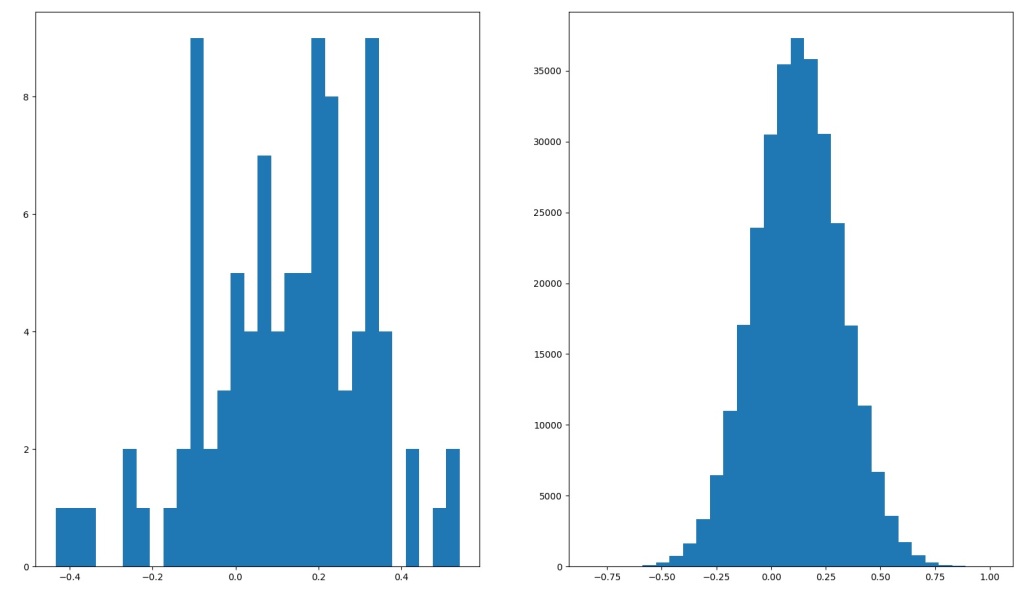
Before we go deeper into the discussion, I’d like to address some criticisms of “Monte Carlo“. To be absolutely clear, in “Monte Carlo” and in this post, I use simplified models to represent returns from various assets. In particular, stock returns have been modeled as normal distributions, which isn’t quite correct:

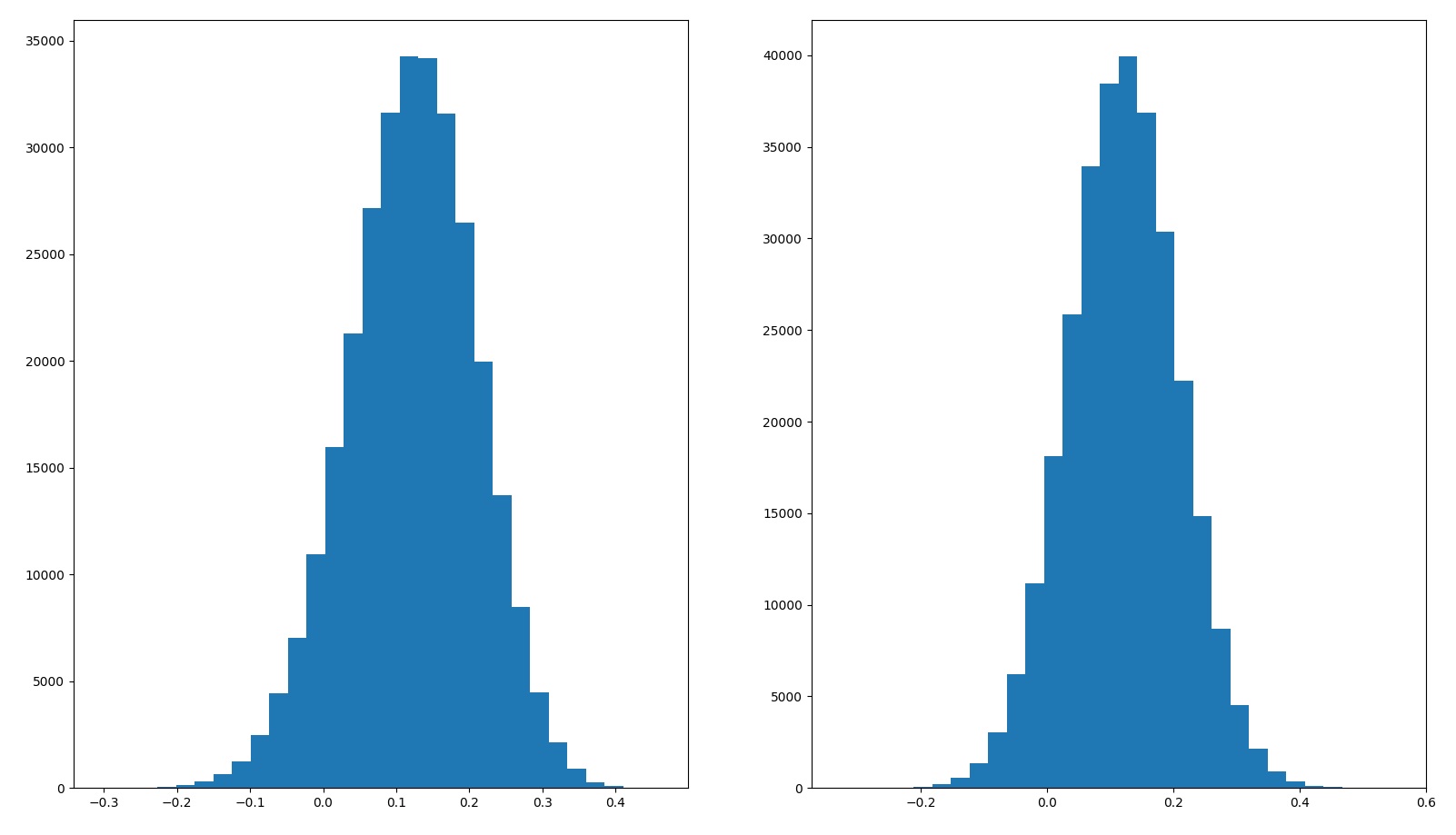
Left: Historical total returns of S&P500 from 1926 to 2020, inclusive.
Right: Normal distribution with 12.2% mean returns and 19.7% standard deviation.

As you can see from the histograms, actual stock markets total returns (left) is quite different from the stylized normal distribution with similar mean and standard deviation.

Separately, assumptions that stocks and bonds (and in this post, real estate) returns are completely uncorrelated are clearly too permissive. In reality, stocks, bonds and real estate are somewhat (negatively) correlated over short periods of time, as all of them are generally affected by politics, inflation and interest rates, amongst other things.

That said, the point of “Monte Carlo” and this post isn’t to build a perfect model for anyone’s financial planning purposes. Instead, these 2 posts are meant to explore various aspects of portfolio construction — how you should think about expected returns, CAGR, SWR, and how volatility affects these metrics. With this rather more modest goal, I believe the simplified models used are more than adequate.

My my, what low returns you have!

In “My Personal Portfolio“, I mentioned that I invest heavily in real estate, generally via private real estate syndications.

In some private discussions about real estate syndications, others have noted that the pro forma returns presented by some real estate syndications that I invest with (generally in the 10-15% range) are lower than what the stock markets have returned in the past 20 years or so.

If you pick up a calculator, you’ll find that from 2009 – 2020 stocks have returned about 15.5% on average every year, with a CAGR of about 15%. Compared to the 10-15% pro forma returns, it seems silly to even consider real estate.

Therefore, we should just invest 100% in stocks… right?

Expected returns

The first problem with the 100% stocks assertion, is that expected returns are misleading — expected returns are merely “expected” as opposed to “realized”. The future is always uncertain, and it is entirely possible that the next N years see returns dramatically below expected returns based on the past N years.

That is why in “Monte Carlo“, each test is done 10,000 times and the metrics reported are the averages of the 10,000 simulations. However, since the average person cannot live 10,000 lives and pick the best/median/average lives (1), these numbers should be taken with a pinch of salt — they are expected values, not realized nor even predicted values. In the context of a single lifetime, the law of large numbers simply does not hold.

Looking further

The next problem with the 100% stocks assertion is that only looking at the expected returns of the past ~11 years is misleading. Typically, expected returns are the arithmetic means of historical returns. In effect, they tell you “given a random year, what is the expected returns of that year”. Stock markets, however, do not always go up uninterrupted — periods of growth are punctuated with periods of declines.

In the context of historical stock markets performance, the past ~11 years have been unusually kind to stock investors, and it is currently not clear if future years will be as kind.

Since returns are multiplicative, a few years of subpar returns in the future will reduce lifetime CAGR significantly. In “Monte Carlo“, I presented historical total returns of the S&P 500, which suggests that long term CAGR is closer to 10%, with mean annual total returns of around 12.2%. Suddenly real estate is looking much better(2)!

Volatility

As we’ve discussed above and in “Monte Carlo“, volatility in the portfolio, as represented by standard deviation of annual total returns, can dramatically curtail the safe withdrawal rate from that portfolio. To illustrate this point, let’s look at some example scenarios.

In each of these, stocks are represented by both their sampled historical returns as well as their normally distributed returns (mean 12.1%, standard deviation 19.7%). The 2 alternate universes is a hypothetical scenario, where we invest 50% of our portfolio each in 2 completely independent stock markets (i.e.: each stock market in its own alternate universe). 5 alternate universes is where we invest 20% of our portfolio each in 5 completely independent stock markets. Real estate is represented by a normally distributed model with mean of 9% and standard deviation of 10% (3).

In each case, the portfolio is rebalanced annually so that the portfolio is distributed across the assets according to the description.

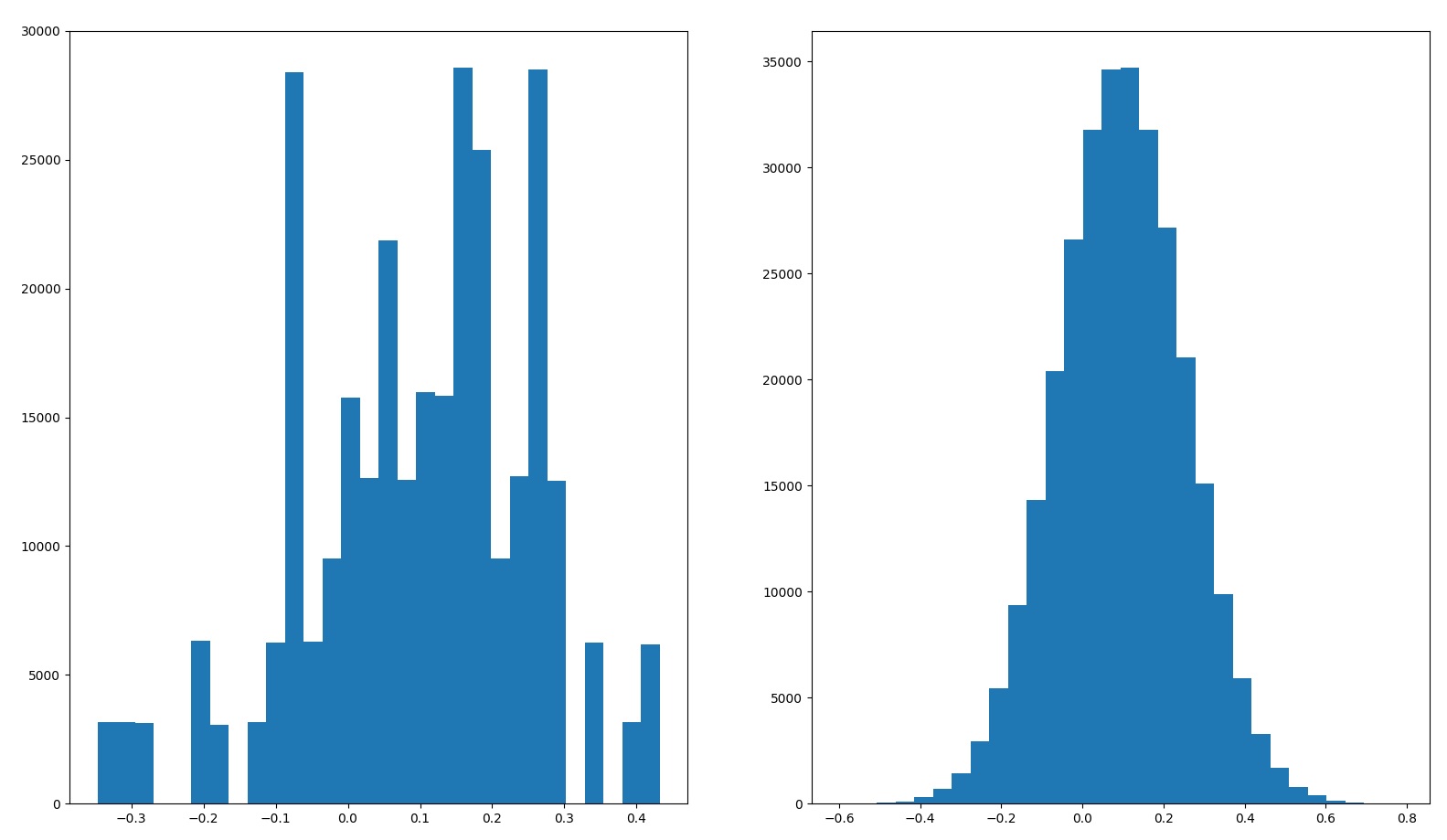
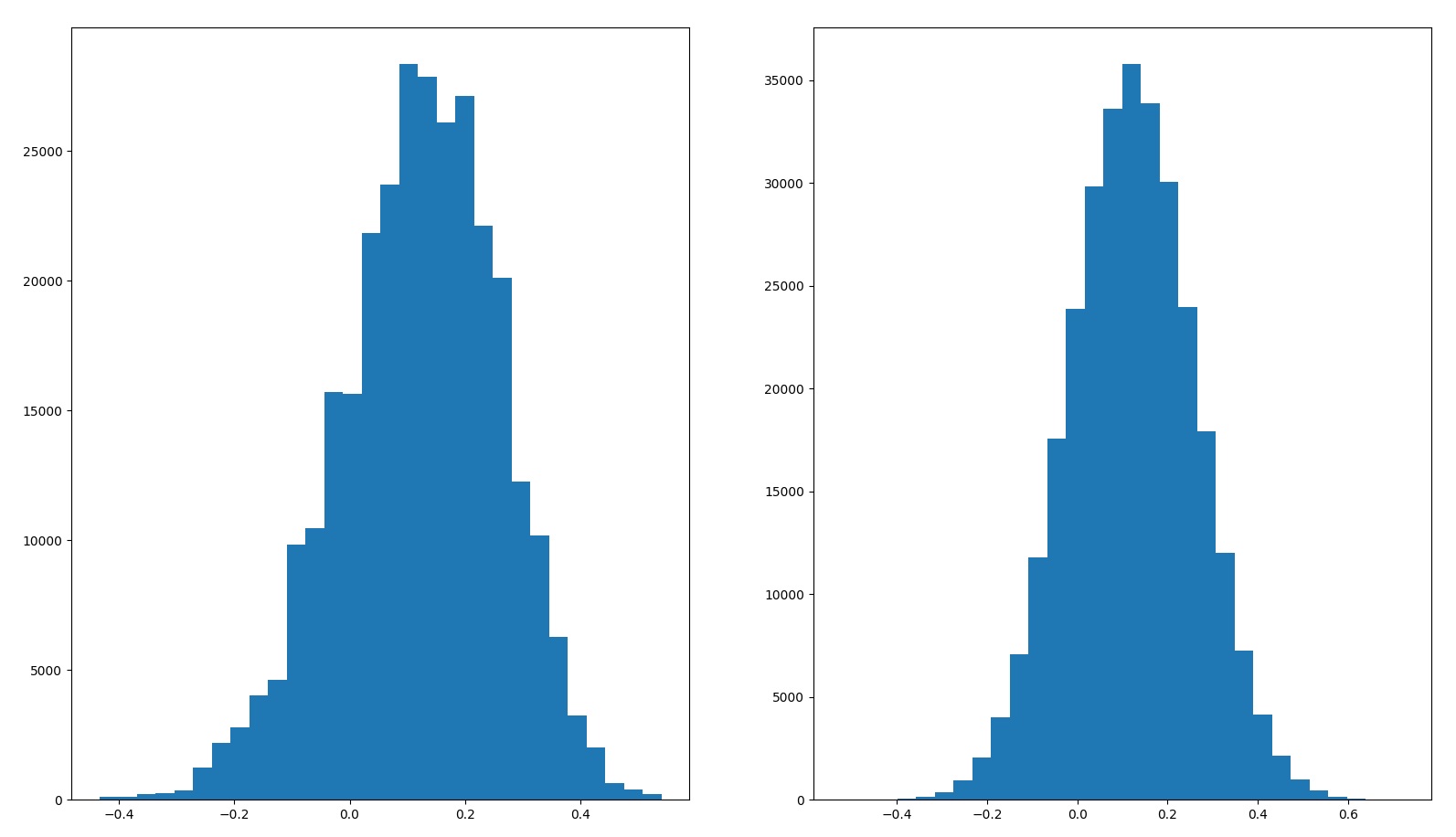
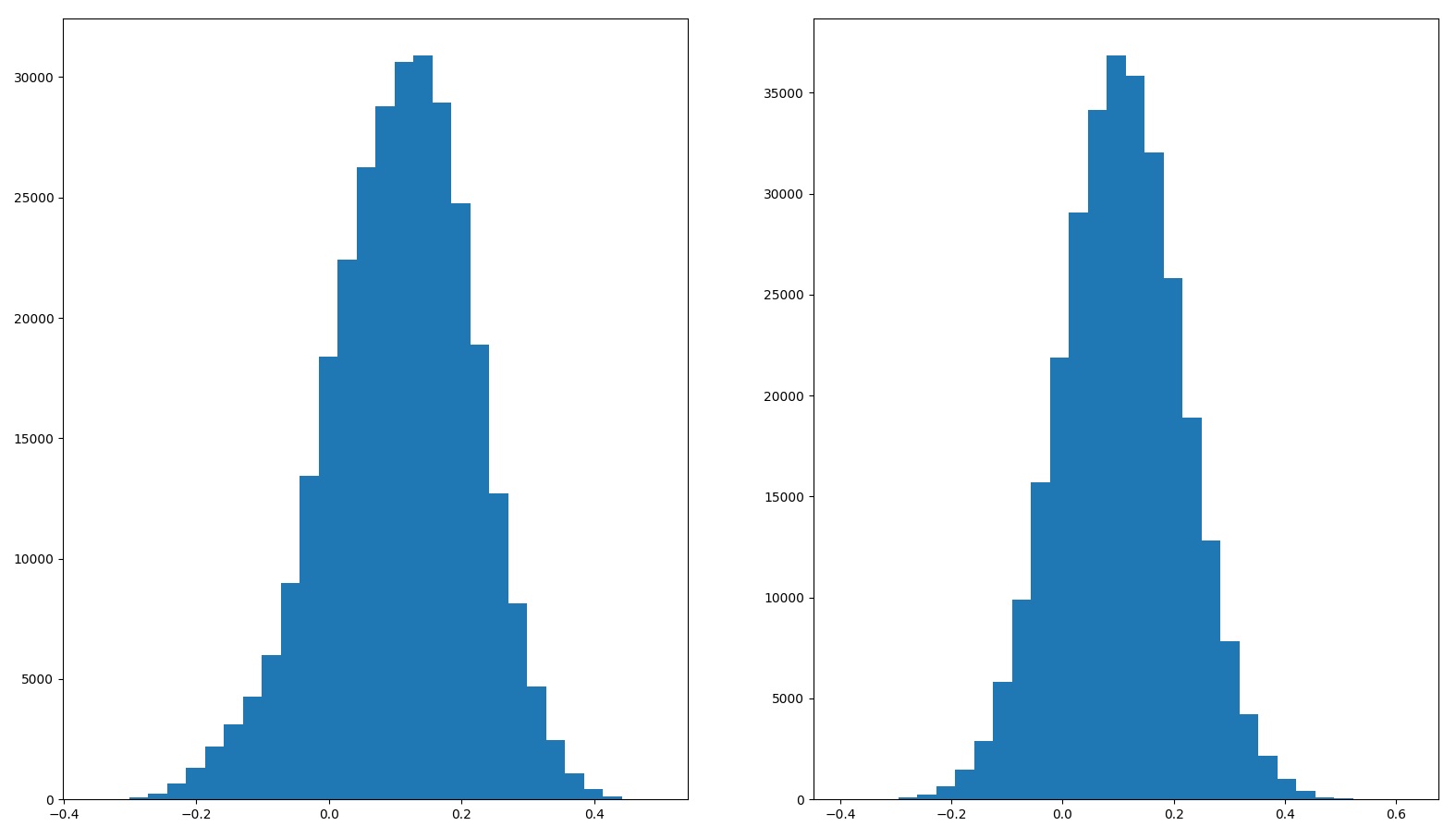
The histogram on the left is when we use sampled historical stock returns for the simulation, and the histogram on the right is when we use normalized stock returns.

PortfolioAverage returnsStandard deviation of returnsHistogram of returns
100% stocksSampled – 12.1%
Normalized – 12.1%
Sampled – 19.7%
Normalized – 19.7%
80% stocks 20% cashSampled – 9.7%
Normalized – 9.7%
Sampled – 15.6%
Normalized – 15.7%
2 alternate universesSampled – 12.2%
Normalized – 12.2%
Sampled – 13.8%
Normalized – 13.9%
5 alternate universesSampled – 12.1%
Normalized – 12.2%
Sampled – 8.75%
Normalized – 8.79%
50% stocks 50% real estateSampled – 10.6%
Normalized – 10.6%
Sampled – 11.00%
Normalized – 11.00%

And for the same 5 portfolios, we compute the CAGR and SWR over 30 years (see “Monte Carlo” for a full description of the methodology details).

PortfolioAverage returnMedian returnCAGRSWR 90%SWR 95%SWR 99%
100% stocksSampled – 12.1%
Normalized – 12.1%
Sampled – 13.9%
Normalized – 12.1%
Sampled – 10.3%
Normalized – 10.4%
Sampled – 3.78%
Normalized – 3.95%
Sampled – 3.00%
Normalized – 3.25%
Sampled – 1.87%
Normalized – 2.08%
80% stocks 20% cashSampled – 9.7%
Normalized – 9.7%
Sampled – 11.1%
Normalized – 9.8%
Sampled – 8.5%
Normalized – 8.6%
Sampled – 3.65%
Normalized – 3.78%
Sampled – 3.05%
Normalized – 3.22%
Sampled – 2.11%
Normalized – 2.32%
2 alternate universesSampled – 12.2%
Normalized – 12.2%
Sampled – 12.9%
Normalized – 12.2%
Sampled – 11.3%
Normalized – 11.3%
Sampled – 5.42%
Normalized – 5.46%
Sampled – 4.76%
Normalized – 4.82%
Sampled – 3.60%
Normalized – 3.74%
5 alternate universesSampled – 12.1%
Normalized – 12.2%
Sampled – 12.4%
Normalized – 12.1%
Sampled – 11.8%
Normalized – 11.8%
Sampled – 6.74%
Normalized – 6.78%
Sampled – 6.26%
Normalized – 6.34%
Sampled – 5.39%
Normalized – 5.46%
50% stocks 50% real estateSampled – 10.6%
Normalized – 10.6%
Sampled – 11.2%
Normalized – 10.6%
Sampled – 10.1%
Normalized – 10.0%
Sampled – 5.27%
Normalized – 5.29%
Sampled – 4.70%
Normalized – 4.81%
Sampled – 3.80%
Normalized – 3.93%

Some interesting results:

  • If we invest in 2 or more independent assets, then the sampled returns approximate the normally distributed model.
    • This is why the differences between using sampled stock returns and normally distributed model is generally small, especially when we consider a diversified portfolio.
  • If you just put 20% of your assets in cash, and 80% in stocks, your expected returns will suffer. However, somewhere in the 95-99%-ile range, your SWR will actually go up.
  • If you can invest in stock markets in 2 alternate universes, then your expected annual returns will remain roughly the same. But your CAGR and SWR will increase dramatically.
  • This is even more pronounced if you can invest in 5 alternate universes.
  • Since I am a mere mortal, the best I can do is invest 50% in stocks and 50% in real estate, which definitely helps SWR, and maybe helps with CAGR as well(3).

Diversification

The basic idea behind the magical increase in CAGR and SWR beyond 100% stocks, is simply “diversification”. When you diversify, and you rebalance your portfolio periodically (4), what you are doing is essentially selling high (the asset which outperformed) and buying low (the asset which underperformed). Buying low and selling high is, historically, the winning strategy for investing (and speculating), and will likely remaining a winning strategy in the future (5).

So, the last problem with the 100% stocks strategy, is that even if real estate has a lower expected annual returns and lower expected CAGR than stocks (3), the very fact that they are not very correlated to stocks means that an allocation to real estate can help increase your portfolio’s CAGR and SWR.

This is the same principle in use when financial advisors recommend investing in index funds (as opposed to single name stocks) — diversification helps to reduce overall volatility and regular rebalancing forces you to buy low and sell high.

Side note: taking profits

A corollary that is not immediately obvious from the above, is the act of “taking profits”. Historically, when people have asked me for advice on what to do after some speculative asset they’ve bought appreciated by a huge amount (more than 100% increase in price), my general advice is something along the lines of “sell enough so that you take a decent profit, and won’t be sad if everything else drops back to your cost basis.”

The psychological effect of doing so is that you’ve now already realized a decent profit, and everything left in that asset is essentially “house money”. While a mathematical fallacy, I have found that this has made holding on to a speculative asset that much easier.

The financial/mathematical effect of doing so, is essentially the same as diversification. Assuming the money you take out is put into another (not very correlated) asset, then you have essentially achieved the “2 alternate universes” scenario.

Code

What kind of a nerd would I be, if I didn’t also present the code for the simulations mentioned above? Note that this builds upon the code in “Monte Carlo” — you’ll need to copy the code there and save it in a file titled “montecarlo.py” for the code below to work.

#!/usr/bin/python3.8

import matplotlib.pyplot as plt
import montecarlo
import numpy


HISTORICAL_RETURNS = montecarlo.HISTORICAL_RETURNS

NormalDistribution = montecarlo.NormalDistribution
UniformSampling = montecarlo.UniformSampling
Cash = montecarlo.Cash
Composite = montecarlo.Composite

GenerateReturns = montecarlo.GenerateReturns
MonteCarlo = montecarlo.MonteCarlo


def PlotHistogram(data):
  _, axs = plt.subplots(1, len(data))
  if len(data) == 1:
    axs.hist(data, bins=30)
  else:
    for i in range(len(data)):
      axs[i].hist(data[i], bins=30)
  plt.show()


def PrintStats(label, data):
  print("{}  Mean:{:.3g}%  StdDev:{:.3g}%".format(
    label,
    numpy.mean(data) * 100,
    numpy.std(data, ddof=1) * 100))


class NormalizedDistribution(NormalDistribution):
  def __init__(self, label, data):
    NormalDistribution.__init__(self, label, numpy.mean(data), numpy.std(data, ddof=1))


def Main():
  cash = Cash("Cash")

  sampled_stocks = UniformSampling("SampledStocks", HISTORICAL_RETURNS)
  normal_stocks = NormalizedDistribution("NormalizedStocks", HISTORICAL_RETURNS)
  normal_re = NormalDistribution("NormalizedRE", 0.09, 0.1)

  data = GenerateReturns(normal_stocks).flatten()
  PrintStats("Historical S&P 500", HISTORICAL_RETURNS)
  PrintStats("Normalized S&P 500", data)
  MonteCarlo(sampled_stocks)
  MonteCarlo(normal_stocks)
  PlotHistogram([HISTORICAL_RETURNS, data])

  sampled_stocks_80 = Composite("80% sampled", (sampled_stocks, 0.8), (cash, 0.2))
  normal_stocks_80 = Composite("80% normalized", (normal_stocks, 0.8), (cash, 0.2))
  s_data = GenerateReturns(sampled_stocks_80).flatten()
  n_data = GenerateReturns(normal_stocks_80).flatten()
  PrintStats("80% sampled stocks, 20% cash", s_data)
  PrintStats("80% normalized stocks, 20% cash", n_data)
  MonteCarlo(sampled_stocks_80)
  MonteCarlo(normal_stocks_80)
  PlotHistogram([s_data, n_data])

  sampled_stocks_alt2 = Composite("Alt2 sampled", (sampled_stocks, 0.5), (sampled_stocks, 0.5))
  normal_stocks_alt2 = Composite("Alt2 normalized", (normal_stocks, 0.5), (normal_stocks, 0.5))
  s_data = GenerateReturns(sampled_stocks_alt2).flatten()
  n_data = GenerateReturns(normal_stocks_alt2).flatten()
  PrintStats("2 alternate universes, sampled stocks", s_data)
  PrintStats("2 alternate universes, normalized stocks", n_data)
  MonteCarlo(sampled_stocks_alt2)
  MonteCarlo(normal_stocks_alt2)
  PlotHistogram([s_data, n_data])

  sampled_stocks_alt5 = Composite("Alt5 sampled",
                                  (sampled_stocks, 0.2), (sampled_stocks, 0.2), (sampled_stocks, 0.2),
                                  (sampled_stocks, 0.2), (sampled_stocks, 0.2))
  normal_stocks_alt5 = Composite("Alt5 normalized",
                                 (normal_stocks, 0.2), (normal_stocks, 0.2), (normal_stocks, 0.2),
                                 (normal_stocks, 0.2), (normal_stocks, 0.2))
  s_data = GenerateReturns(sampled_stocks_alt5).flatten()
  n_data = GenerateReturns(normal_stocks_alt5).flatten()
  PrintStats("5 alternate universes, sampled stocks", s_data)
  PrintStats("5 alternate universes, normalized stocks", n_data)
  MonteCarlo(sampled_stocks_alt5)
  MonteCarlo(normal_stocks_alt5)
  PlotHistogram([s_data, n_data])

  sampled_stocks_re = Composite("Stocks+RE sampled", (sampled_stocks, 0.5), (normal_re, 0.5))
  normal_stocks_re = Composite("Stocks+RE normalized", (normal_stocks, 0.5), (normal_re, 0.5))
  s_data = GenerateReturns(sampled_stocks_re).flatten()
  n_data = GenerateReturns(normal_stocks_re).flatten()
  PrintStats("Sampled stocks + normalized real estate", s_data)
  PrintStats("Normalized stocks + normalized real estate", n_data)
  MonteCarlo(sampled_stocks_re)
  MonteCarlo(normal_stocks_re)
  PlotHistogram([s_data, n_data])


if __name__ == "__main__":
  Main()

Footnotes

  1. Not religious advice!
  2. This is an imperfect comparison. The pro forma returns from syndications are estimates and may be wrong (though in my, very limited, experience good sponsors tend to underestimate returns). Also, the pro forma returns of syndications today have very little bearings on historical total returns of real estate over long periods of time. Certainly, the Great Financial Crisis of 2008 taught us that real estate prices can go down too!
  3. Real estate returns are hard to measure, because real estate tends to illiquid and non-fungible, and the way depreciation affects accounting just confounds that matter even more. The 9% mean, 10% standard deviation modeled here is mostly out of thin air — I picked 9%/10% because it is a lower return with lower volatility than stocks. Some (unverified) data I’ve found suggests this is too pessimistic — historical real estate returns seems to be better than this.
  4. Rebalancing periodically is key here! If you do not rebalance, then most, if not all, the benefits of diversification goes away. Every time I hear someone boast about how they are both “diversified” and “passive” (so passive that they do not rebalance), I die a little bit inside. I am already old, stop trying to help me along.
  5. If you’ve managed to lose money by buying low and selling high, please let me know!

My Personal Portfolio

Foreword

This is a discussion of how I think about my personal portfolio, and what I do with it.

I want to be absolutely clear here — this post is about me, myself and I, and nobody else. What I do for my portfolio may or may not be suitable for anyone else, especially you. I am not a trained financial analyst, financial planner nor financial anything — please consult a professional if you need help with your own financial planning and/or portfolio management.

If you find anything that you feel is incorrect, please feel free to leave a comment, and discuss your thoughts.

Conservative overall portfolio

Firstly, let’s get this out of the way — I am a scaredy cat. I am not trying to become a billionaire — my financial plan resolves entirely around early retirement, paying for my children’s college degrees and leaving them enough assets to bootstrap their adult lives. So, my investment choices generally tend towards more conservative assets, which as we’ve discussed before, are expected to provide more stable cash flows and allow for a higher safe withdrawal rate.

Ballast portfolio

I’m not sure where I first heard the term “ballast”, but it refers to the part of the portfolio that forms the “foundation” or “fallback” — if everything else goes to smelly, this is the part that will likely remain, relatively unscathed. A long time ago (does anyone still remember pre-QE days?), this part of my portfolio was just US Treasury bonds and municipal bonds. They provide a very safe, but lower, yield, which I can generally depend upon.

However, with the advent of QE, these bonds yield too little to be meaningful, yet are priced so richly that even a relatively small increase in interest rates(1) will cause their current mark-to-market values to plummet. As such, they went from “safe, but lower yield” to “risky, and essentially no yield”. Not really what I would call ballast-material!

In place of government bonds, I have been trying various other assets to form the ballast of my portfolio. For now(2), I have settled on these:

  1. Private real estate equity funds
  2. Various short term bonds (of both government and corporate varieties)
  3. Short term private notes

The main goal of the ballast portfolio is to provide a source of stable cash flow, from which to fund all other endeavors.

Stocks portfolio

Other than the ballast side of my portfolio, everything else is invested in stocks. In my stocks portfolio, I further divide into 3 accounts:

  1. Ballast-lite
  2. Main
  3. Gamble

Ballast-lite account

The ballast-lite account of my stocks portfolio is, as its name implies, allocated in safer, more conservative stocks and strategies. For example,

  1. Stable, conservative dividend stocks
  2. Index funds with the wheel strategy(3)

Like the ballast portfolio, the goal is for stable growth, with relatively controlled downside.

Main account

The main account of my stocks portfolio is where I do what most people do (or should do) in the bulk of their portfolios — buy index funds and mostly forget about it. In this account, I also buy some blue chip stocks that I’ve done research on, and are willing to hold for the long term.

Generally, I buy the stocks outright, though for the single name stocks, I may use the wheel strategy to tamp down on volatility and/or squeeze out some additional yield.

Gamble account

The gamble account of my stocks portfolio is where I do crazy things. This is a relatively small account, where I try out experimental strategies, or just bet on silly things (I’ve bought and sold puts and calls on GME during the Jan-Mar 2021 madness).

This is also the account I generally use when I’m uncomfortable about the market, and just want to hedge some of the exposure in the other accounts — in that case, I’ll buy some puts or even outright short in this account to counterbalance the stock exposures in the other accounts.

Target proportions

Ultimately, the goal is for the ballast portfolio to yield enough cash flow to support my lifestyle (with inflation adjusted), while remaining under 50% of my investable assets. When that happens, I’ll know that I can comfortably and safely retire.

The ballast-lite account is meant to provide additional spending money as a buffer, as well as for splurges — maybe I fancy a new flashy car, or to go on an exotic vacation, etc. The main and the gamble accounts are meant to provide for growth in the overall portfolio, as well as assets to leave to my children.

In my stocks portfolio, I generally keep around 30-45% in the ballast-lite account, 30-45% in the main account, and everything else in the gamble account. The exact ratio depends on their recent performances and how I feel about the market — sometimes I forget to rebalance for months on end.

Final word

As noted before, this is a rather conservative portfolio — most people in their prime working years should probably have less than ~60-70% of their portfolio in “ballast”-like investments(4).

However, I’ve found that this suits me fine — I have a day job that pays reasonably well, and so, for my investments, I prefer surety to higher expected, but much more volatile, returns. If nothing else, it helps me sleep at night.

This, again, may or may not be suitable for you. Please consult a professional advisor if you need help with financial planning.

Footnotes

  1. Recall that the Federal Reserve can, almost unilaterally, increase short term interest rates at will.
  2. As the market environment changes, I may tweak or even completely revamp the assets I hold as ballast. And I almost certainly will not be giving anyone a heads up before I do. Therefore, recall the disclaimer — please consult a professional advisor if you need help with financial planning.
  3. The wheel strategy is where you start by having cash, and writing cash secured puts on the asset. If you don’t get assigned, then you just roll the puts over to the next period. If you get assigned, then you switch to writing stock secured calls. Essentially, this caps your upside, but provides a buffer on the downside before you suffer losses.
  4. In my defense, I’ve found that I’ve consistently managed to squeeze out fairly reasonable returns from the “ballast”-like assets, generally to the tune of around 10%, which as we’ve discussed before, is what stocks generally yield over long periods of time anyway.

Inflation model

Foreword

QE, money printing, fiscal stimulus… inflation?! What is inflation? What determines how high inflation gets?

This is a discussion of my personal model of inflation and how it occurs.

I want to be absolutely clear here — this is based entirely on personal study and understanding — I am not a trained economist. All I have, is a high school diploma(1) in Economics, from over 2 decades ago — no doubt there are gaps and/or flaws in my understanding.

If you find anything that you feel is incorrect, please feel free to leave a comment, and discuss your thoughts.

What is inflation?

First off, let’s define inflation. The official economics definition of inflation has undergone some changes throughout history. In this post, I’ll be using the more common, modern day textbook definition which is roughly: Inflation is the general increase in prices of goods and services, and thus a general decrease in the purchasing value of money.

In the quantity theory of money, the equation of exchange gives us(2):

MV = PT

(Simplified) Equation of exchange, https://en.wikipedia.org/wiki/Equation_of_exchange

where

  • M – The total nominal money supply
  • V – The velocity of money
  • P – Price level
  • T – The number of financial transactions

So, assuming the number of financial transactions is the same, then an increase in P (inflation) is simply an increase in MV.

i.e.: Inflation is a product of increasing total money supply times the velocity of money.

Of particular note, and this is something that a lot of people get wrong — inflation is the increase in general price levels:

  • Inflation is not the increase in price(s) of one or even a handful of products.
    • It needs to be an increase in prices of all or almost all products.
  • Inflation is not high prices.
    • Inflation is the increase in prices.
    • Even if prices are still low after the increase, it is still inflation.
    • Conversely, if prices are high, but didn’t increase, then it is not inflation.
  • If after a round of high inflation (large increases in prices), prices remain stable at very high levels, then inflation did not persist.
    • Just because the effects of inflation are permanent, need not mean that inflation itself is permanent.
    • For prices to go back to “normal” levels, would require negative inflation (decrease in prices), also known as deflation.

Hyperinflation

In today’s financial environment, whenever inflation is brought up, people immediately jump to hyperinflation, conjuring up images in their minds of stacks of useless cash pushed around in wheelbarrows.

To be clear, the official definition of hyperinflation is 50% month over month increases in prices, which translates to around 129x (12974.63%) annually. Compared to that, the current 5-6% annual inflation rate is pretty tame.

That said, what causes hyperinflation? Well, happily(3), history provides a lot of examples of where hyperinflation struck. In the popular retellings of these events, the story generally goes along the lines of, “the government/central bank printed more and more bank notes, resulting in an excessive supply of these notes, which then resulted in their devaluation and thus inflation”.

In my opinion, that is a very misleading description of what transpired. As a thought experiment, imagine if the governments of the hyperinflationary events were to print the bank notes, and then burn them up in a giant bonfire. Do you think there would have been hyperinflation, or even high inflation then? It seems to me, that the excessive printing of money was a necessary, but not sufficient step towards hyperinflation. It was the left out bit, the part where “the government then spent the newly printed money with abandon”, which resulted in hyperinflation. In effect — simply printing the bank notes did nothing. But distributing them via government spending (i.e.: fiscal policy), resulted in the increase of money supply(4) (increase in M), and the excessive spending by the government resulted in more money being spent and circulated (increases in V). And that excessive spending is the actual trigger of hyperinflation.

In simple terms, it is not “printing money” that is the problem, but the attempt at creating “value” out of thin air — by printing bank notes not backed or offset by anything, and then spending them as if they were valuable.

Monetary vs fiscal policy

Just a quick note here, because we are going to talk about monetary and fiscal policies a lot.

Monetary policies are generally policies with regards to the money supply .

Fiscal policies are generally policies with regards to taxation and government spending.

In modern society/finance, you can think of monetary polices loosely as “what central banks decide to do”, and you can think of fiscal policies loosely as “what governments decide to tax and spend on”.

Quantitative easing

Since 2009 when quantitative easing (QE) started in the USA (and most of the world), there have been many analysts going on about how QE is printing money, and that it would result in hyperinflation. These doomsayers make very compelling arguments by equating QE to money printing, conjuring up images of massive industrial printers working overtime. However, it has been over 12 years, and only fairly recently did inflation even get comfortably past the 2% that central banks generally target. What happened?

Facts

Before we discuss what happened with QE, let’s talk about some facts:

  • In the USA, QE started in 2009, and was increase multiple times since then, with the latest increase in around March 2020 due to the Covid-19 pandemic.
  • In the USA, inflation from 2009 to March 2020 has generally been low to very low, generally in the 0-2% range.
  • Most other developed nations saw similar trajectories with regards to QE and inflation as the USA, though numbers and dates may be slightly different.
  • Japan started aggressive monetary policies in the early 90’s, culminating in QE around 2001 — 8 years before most of the other developed nations.
  • Japan’s annual inflation rate up to March 2020 has generally been extremely low, with bouts of deflation (negative inflation).
  • In March 2020, in addition to aggressive monetary policies by central banks around the world, fiscal policies around the world also stepped up, culminating in a series of transfer payments(5) around late 2020 into early 2021.
  • In March 2021, we finally saw inflation pick up in the USA.
  • Again, most of the world mirrored the USA’s experience since 2020.

Printing money

The first thing to note when discussing QE, is that it isn’t really “printing money”. In the popular nomenclature, “printing money” generally implies a(n) (attempted) creation of additional “value” out of thin air. However, that is simply not what QE does.

Imagine if you are a bank and I am a client. I choose to deposit $1000 cash with you. In exchange for my cash, you give me a little deposit slip saying I now have $1000 with you. Now, I can write a check against my $1000 with you, and most places would accept my check as payment for services. In effect, that check is “money”(6), and I have, almost literally, “printed money” (with a pen!). I’m sure we can all agree, that lil’ ol’ me isn’t going to cause inflation, much less hyperinflation.

In technical terms, when I deposit $1000 with you, you created 2 entries in your ledger — one under “assets”, which is the actual $1000 cash I deposited with you. The other entry is under “liabilities”, which is the $1000 you now owe me. The total amount of “value” in the system is the same — the $1000 under your assets cancels out the -$1000 under your liabilities.

In a similar fashion, central banks are the banks of normal banks — normal banks can deposit their money with central banks. Generally, (normal) banks need to put up a certain amount of money with their central banks known as reserves. There are complicated rules around the minimum level of reserves a bank needs, and we won’t go into that here, but basically, for a bank to operate, it needs a certain amount of money in the central bank. Any money the bank has in excess of that reserve requirement, is called “excess reserves”(7).

During the Great Financial Crisis of 2008, a lot of assets held on banks’ balance sheets were deemed “risky”. To avoid bank failures, regulators demand that banks increase their amount of reserves. However, there was a general liquidity crunch at the time, so banks couldn’t really do that. At the time, central banks stepped in, and essentially bought up a lot of these assets on the banks’ balance sheets (generally government debt, and government guaranteed mortgage debts). In some sense, this is the same as me depositing my $1000 with you — the banks give the Federal Reserve assets worth $X(8), and the Federal Reserve give the banks a little deposit slip saying “I now owe you $X” (9). On the Federal Reserve’s books, under “assets”, we have these newly bought assets, and under “liabilities”, we have $X owed to the banks.

As you can see, there isn’t really any attempt to create “value” out of thin air. Yes, in a very literal sense, “money is printed” (via increase in reserves on the banks’ books). But that “money” is really just a matched asset/liability pair on the Federal Reserve’s books, and the net “value” in the system is the same — just as me depositing $1000 with you, and then spending that $1000 via a check doesn’t really create “value”.

Liquidity

After the Great Financial Crisis, central banks continued QE, essentially buying up assets from banks, and increasing banks’ excess reserves account (after the immediate crisis, banks already meet your reserve requirements, so any excess sales of assets to central banks really only increase excess reserves).

A further charge of the doomsayers, is that these excess reserves is money, and thus this “money printing” causes inflation.

As we’ve discussed above, while this is “money printing” in the literal sense, there is no attempt at creating “value” out of thin air unlike hyperinflationary episodes from history, because while the central banks issue (excess) reserves, they also take away “value” by taking away equivalent value in assets.

However, there are some effects of this QE! By buying up assets in a price insensitive manner, the central banks effectively put a floor on the value of some assets (generally safe assets like government bonds and government backed debts). This has 2 effects:

  1. These assets that the central banks target effectively have a higher clearing price (i.e.: become more expensive than they would be without QE).
  2. The money that was previously invested in these assets now need to be invested elsewhere.

Together, this resulted in what is colloquially known as “yield tourism” — investors forced out of safe Treasuries and government backed debts, now have to “reach for yield” by buying more risky assets, such as corporate debt, municipal bonds, equities, etc.

In effect, this increased the liquidity in the system, by both reducing the amount of assets that money can buy, and increasing the amount of money in the system. However, this effect is generally confined to financial markets — the Federal Reserve really isn’t in the market to buy baby diapers or new cars. The money displaced by the Federal Reserve’s buying will generally go into buying other financial assets instead of being spent on consumer goods.

In simple terms, if you’ve $1000 to invest, just because the Federal Reserve prevents you from buying some financial assets, doesn’t mean that you’ll just spend that $1000 on chocolate bars! You will likely just invest in something else — that $1000 doesn’t really make it into the consumer goods market.

Putting it all together

In summary, I believe that QE does not result in inflation. Instead, it results in “financial assets inflation”, which is colloquially used to mean increase in financial asset prices only. This is also why, I believe, the prices of stocks, bonds and various other liquid financial assets have been going up non-stop since 2009.

How then, do we explain the high inflation that started around March 2021? Well, recall under “Facts” above, that QE wasn’t the only thing that happened in 2020. Something else happened. Something new. Something changed in mid/late 2020 — governments started massive fiscal policy programs.

Recall from our short note in “Hyperinflation”(10) how inflation doesn’t really begin until that newly created money is spent. Well, that newly created money started being distributed for spending around mid/late 2020 into early 2021. And then we saw inflation take off in early 2021.

In technical terms, before 2020, while M (the money supply) was rapidly increasing, V (the velocity of money) was rapidly decreasing. As a result, the product MV was actually increasing at a rather slow rate, thus low inflation. After late 2020, the rate at which V decreased slowed down dramatically (it is now almost flat), but M increased dramatically. As a result, MV started increasing at a higher rate, i.e.: higher inflation.

Crimping inflation

Recall that in my August inflation update I noted that I believe the Federal Reserve has all the tools it needs to combat inflation. How would that work if I’m now saying fiscal policy is the cause of inflation?

Well, one way of analogizing about this is that loose monetary policy is fuel, and loose fiscal policy is heat. You cannot start a fire with only fuel, and you cannot start a fire with only heat. You need to combine both(11) to start a fire.

Which is to say, I believe that the Federal Reserve can clamp down on inflation by simply tightening monetary policies — inflation can be reduced by simply reducing money supply faster than the velocity of money. And since the velocity of money isn’t really going up — it’s just “mostly flat” (compared to rapidly decreasing in the past ~2 decades) — the Federal Reserve can simply cool down inflation by stopping QE and increasing interest rates back to “normal”. If need be, they can even increase interest rates to high levels, like what Volcker did in the 70’s (12).

Footnotes

  1. Technically, A-levels Economics, which is roughly the equivalent of a high school diploma / AP examinations.
  2. Note that this is a simplification. The complete equation is much more complicated. If interested, please refer to the Wikipedia page.
  3. From a purely academic perspective. Obviously, if hyperinflation strikes a country, the country’s people wouldn’t be happy about it.
  4. To be clear, “total money supply” is short for “total circulating money supply”. Simply printing bank notes and storing them in a vault does not increase the “total money supply” — you have to circulate the newly printed notes first.
  5. Transfer payments in the form of deferred rent, loan payments, government subsidies, etc.
  6. This is actually a pretty accurate description of how the central banks work. For example, each $1 US dollar bill is actually just a “standardized check” — it is a debt instrument issued by the Federal Reserve indicating that someone had previously deposit $1 with the Federal Reserve, and that $1 US dollar bill is the “check” which represents that $1 now on the Federal Reserve’s books.
  7. Yes, bankers are not very original with their naming.
  8. There are some quibbles with regards to pricing. The gist is that these assets are under duress and should not be valued at such high levels. The reality is more complicated, since the Federal Reserve, unlike regular banks, don’t have reserve requirements and can hold on till maturity — in some sense, the same assets are “safer” on the Federal Reserve’s books. In practice, I believe the Federal Reserve actually made money on these assets, which suggests some truth to that idea.
  9. No, they don’t literally give out deposit slips. C’mon, we live in the digital age.
  10. To be absolutely clear, I’m using the hyperinflationary episodes as a way to illustrate the relationships between monetary and fiscal policies. I am not saying that there will be hyperinflation in the USA, or any other developed nation in the near/medium term.
  11. And technically oxygen as well. But this is not a physics lesson.
  12. I say it rather dispassionately here, but there is a very good chance that a rapid tightening cycle as described will be extremely painful financially for a lot of people.

Financial planning, portfolio management and wealth management

Foreword

Financial planning, portfolio management and wealth management are often used interchangeably, but they are actually different disciplines in finance.

In this post, we look at the differences between the three, and how they should be employed.

As usual, a reminder that I am not a financial professional by training — I am a software engineer by training, and by trade. The following is based on my personal understanding, which is gained through self-study and working in finance for a few years.

If you find anything that you feel is incorrect, please feel free to leave a comment, and discuss your thoughts.

Financial planning

Financial planning, as the name implies, is a process where you plan out your finances. First, you come up with financial goals that you want to achieve, for example:

  • Save for a house down payment by age 30
  • Pay for children’s college
  • Financial independence by 45
  • Retire by 55
  • etc.

These goals should have a dollar amount attached, estimated to the best of your abilities. They should also have a deadline. In effect, all of these goals can be translated into a statement of the form:

I want to have $D by year Y.

Once you have your list of goals, you’ll effectively have a list of net worth dollar amounts that you’ll need, by certain years.

The next step is to take stock of what your assets are, right now. You should be able to then assess the viability of your financial plan, by just applying aggressive assumptions for your assets, for example, 15% annual growth year over year, every year. You should also factor in your expected annual income from a job, trust, allowance, etc., as well as your annual expenditures, again, use aggressive assumptions — your income will grow 2-4% a year, your expenditures will only grow 1.5-3% a year, etc.

If your financial plan fails even with the aggressive assumptions, i.e.: you miss one or more goals even with such aggressive assumptions, then your goals are likely unreasonable, and you should re-evaluate the goals and try and make them more reasonable. For example, maybe delaying retirement by a few years?

Finally, you need to figure out how much risk you need to take on, and how much you need to increase your income by, and how much you need to limit your expenditures by, in order to give your financial plan the highest probability of success. This is important! You are not trying to maximize the return of your assets/investments, but rather, under the set of goals, you are trying to figure out what is the least risky way for you to achieve it.

This last step is where you start making more conservative assumptions. Is 15% annual growth in investments reasonable? There certainly are stocks that grow 15% or more a year for long periods of time. But how likely are you to identify them ahead of time? Also, these stocks tend to be more risky — either small/mid caps, highly levered, etc. Also, how likely are you to get a 2-4% raise every year? How much harder will you have to work to achieve that? Are you willing to work that much harder? And how much will you have to sacrifice in terms of living standards to keep your expenditures low? Are you sure you can maintain such low expenditures for long periods of time?

These are all questions you need to ask yourself honestly, and answer honestly. Make the necessary adjustments to what kind of risks you are willing to take with your investments, how much you are willing to put into your job to try and achieve the raises you target, and how much you are willing to forsake in current standards of living in order to meet your goals.

Remember always, that you are trying to maximize the probability that your plan works! Yes, if you work 20hours a day, you may get a 6% raise every year. But is that reasonable? What are the chances that you work yourself into serious health issues, and then have to take months or even years off of work to recover? Think about all these issues, then ask yourself, is it reasonable to expect yourself to work 20hours a day for 2 years? 5 years? 10 years? Probably not!

As you are probably thinking now, this is an iterative process. As you figure out the kind of sacrifices, risks and adjustments you’ll have to make, you’ll find that perhaps you are willing to trade off some goals to reduce the amount of sacrifices, risks and adjustments you’ll need to make, which in turn will likely increase the probability of success.

After a few rounds of adjusting goals, making more conservative assumptions, you’ll have a better picture of the tradeoffs that you need to make — either reducing your goals, or increasing your risk, sacrifices and adjustments.

And once you are done, once you are happy with the final result, you’ll have a financial plan.

That’s not the end, though! Life is unpredictable and things often change without warning. After you have a financial plan, you need to re-evaluate your plan periodically — I like to do it once a year or when I have to make major financial decisions. Figure out if you are on track for your plan, and if not, go through the iterative process again, and figure out what you need to do to get yourself back on track.

Portfolio management

Portfolio management is the curation of your investment assets. For example, let’s say you have a financial plan in place, and you have devoted $100,000 to investing. What assets should you buy? In what ratio? Should you have excess cash lying around to opportunistically time market downturns? Or will you stay 100% invested at all times? Or will you even lever your position to be more than 100% invested?

These are all questions that you’ll answer when you are managing your portfolio.

In order to answer these questions, though, you’ll need to have an idea of the different asset classes. Largely they are:

  • Cash
  • Equity (stocks, or ownership of private businesses)
  • Bonds (or other types of debt(-like) instruments such as loan, preferred equity, etc.)
  • Real estate
  • Commodities (such as precious metals, agricultural products, energy commodities, or more likely derivatives of these)
  • More exotic forms such as fine wine, rare art, etc.

Each of these behave differently in different environments. For example, in inflationary environments, commodities and real estate tends to do well, equity decently, but bonds and cash tend to suffer. In reducing interest rate environments, bonds and equity tend to do well, real estate decently, commodities and cash maybe not so much, etc.

Figuring out what to invest in, and in what ratio, is non-trivial! Happily, for most people, the answer need not be very nuanced. A 60/40 portfolio of 60% equities and 40% bonds (1), with maybe a few percentage taken out of each to invest in real estate will generally be a fairly good trade off between risk undertaken and potential reward. However, if you are willing to spend more time on the topic, you may be able to eek out more return without increasing risk or reduce your risk without reducing your return. Unless you have a substantial amount of assets under you care, however, you may find that the results are simply not worth the effort.

Remember that when you are planning your portfolio, you are effectively aiming for some goal from your financial plan — say you need to get 10% returns every year. This goal may severely hamper the choice of assets that you can invest in! If you aim for 10% returns every year, for example, leaving your portfolio entirely in cash is unlikely to work.

Finally, unlikely financial planning, where the focus is mainly on trying to maximize the probability of success (i.e.: reducing risk), portfolio management takes a more balanced approach and looks more at expected returns of assets, before figuring out how to reconcile that with expected risk (i.e.: trading off risk vs return).

Wealth management

Wealth management is generally spoken of as a service provided by a professional, a wealth manager. It’s not really something someone does for themselves.

In effect, wealth management is a service which combines aspects of financial planning and portfolio management. The wealth manager will work with you to figure out what you are comfortable doing for yourself, and what you would prefer professional help with, and then work through the financial planning and portfolio management process with you. At the extreme, you may simply give the manager power of attorney over your assets, and they will then manage everything towards the goals you’ve discussed, and perhaps send you a regular stipend for living expenses.

In practice, wealth management services tend to be very expensive, as they involve a lot of risk for the manager (legal and liability risks mostly), which need to be defrayed with increased fees. Also, ongoing portfolio management and financial planning services tend to be labor intensive, while also requiring fairly specialized skills, again pointing to high fees. So, in general, wealth management services are typically only offered to those who are wealthy, and for most managers, the minimum assets a client must have is generally in the $2-10m range.

How they intertwine

Financial planning can be thought of as your “life’s goals”, finance-wise. It is the targets that you’d like to hit, if you think of your financial life as a business. Portfolio management is, then, the actual steps you’d take to achieve those targets (though focusing only on investments, while a financial plan often involves incomes and expenditures as well).

Wealth management, in our little analogy, will then be the hiring of external consultants or vendors to advice on or run part of your business for you.

Do I need a financial plan?

Probably yes! Everyone has goals they’d want to meet in the future, and unless you are so incredibly wealthy that almost any goal you can think of can be trivially met financially, you’ll probably want to develop a financial plan to figure out where you stand, and what you need to work on.

Do I need to manage my portfolio?

Probably yes, but this may not be that hard. Unlike financial planning which often involves taking stock of your current situation and trying to figure out what goals are feasible and how much effort/risk you need to take on, portfolio management can be fairly straightforward.

For most people, a passive (or mostly passive) investment portfolio may be appropriate — unless you have specialized knowledge about the financial markets, or you are personally interested in finance, or if you have a large amount of assets already where even a marginal increase in returns is a meaningful absolute number, you may find that effort spent on managing your portfolio to optimize it more, may be wasted. Instead, for most people, it may be more bang-for-the-buck if you spend more of your efforts on trying to increase your income, for example, taking on more at work to aim for a promotion, or taking on a side gig, etc., or by spending time going through your expenses to try and reduce your expenditures.

A passive investment portfolio may be as simple as figuring a ratio between stocks/bonds that you’d like to hold, and then buying the respective indices in the decided ratio. (2)

Do I need a wealth manager?

Probably not. The pre-requisite net worth for a wealth manager to be even willing to work with you is often a bar most people do not meet. And honestly, unless you are incredibly wealthy and have a very complicated financial situation, it probably isn’t worth the money hiring a wealth manager in the first place.

However, if you do happen to have the requisite $2-10m lying around (check your couch!), and you don’t happen to be interested in finance and just want to enjoy what life has to offer, then a wealth manager may indeed be just what you need.

Footnotes

  1. For those who are younger, you may want to take on more equity risk, say, 70/30, or even up to 90/10, depending on your risk tolerance. For those who are closer to retirement, you may want to reduce equity risk, say, 50/50, etc.
  2. It irks a lot of people, but I generally will not provide financial advice except to people I am close to. This is for conscience reasons (I may be wrong), legal reasons (I am not licensed to provide financial advice) and for liability reasons (you may sue me if I’m wrong). Therefore, this is about as specific as I will go.